
When I started at 375lbs, running was not an option. My knees ached walking to the car. The idea of high-intensity exercise felt as distant as running a marathon. What I needed — and what millions of people in the UK need — was exercise that actually worked at my starting point, not exercise designed for people who were already reasonably fit.
Low impact exercise is not the consolation prize for people who cannot do “real” exercise. For heavier people, people with joint problems, people post-surgery, people over 50, and people who are simply starting from a low fitness base, it is the most intelligent starting point available. This guide covers what it actually is, which options burn the most calories, and how to build a routine that produces real results without breaking you in the process.
📋 On this page
- What is low impact exercise?
- Why low impact works for weight loss
- Calorie burn comparison — all main options
- Walking
- Swimming
- Cycling
- Walking pad
- Rowing machine
- Elliptical trainer
- Aqua aerobics
- Yoga and Pilates
- Resistance training
- Best options for bad knees
- Best options for heavier people
- Post-surgery and recovery
- Low impact exercise on GLP-1 medication
- Building a low impact routine
- Nutritional support
- FAQs
What is low impact exercise?
Low impact exercise is physical activity where at least one foot or body part remains in contact with a surface at all times, or where body weight is fully or partially supported by water or equipment. This reduces the impact forces transmitted to joints — particularly the knees, hips, and ankles — compared to high-impact activities like running, jumping, or plyometrics.
The distinction matters because impact force is the primary cause of exercise-related joint pain and injury in overweight, older, and deconditioned people. When you run, each footstrike transmits a force of 2–3× your body weight through your joints. At 20 stone (127kg), that is 254–381kg of force with every step. Walking transmits approximately 1–1.5× body weight — significantly less, and tolerable even at high starting weights.
| Exercise | Impact level | Joint force per stride | Weight bearing? |
|---|---|---|---|
| Running | High | 2–3× body weight | Full |
| Walking | Low | 1–1.5× body weight | Full |
| Cycling (stationary) | Very low | Minimal — seat-supported | Partial |
| Swimming | None | Effectively zero | None (buoyancy) |
| Elliptical | Very low | Less than walking | Full but cushioned |
| Rowing machine | Low | Minimal if technique correct | Seated |
| Aqua aerobics | None | Effectively zero | None (buoyancy) |
| Yoga / Pilates | Very low | Body weight distributed | Partial, controlled |
Why low impact exercise works for weight loss
A common misconception is that low impact means low effectiveness. The research does not support this. What matters for weight loss from exercise is total calorie burn over time — which is a function of intensity, duration, and above all consistency.
Low impact exercise often outperforms high-impact exercise for weight loss over 12+ weeks precisely because it is sustainable. A person who walks or swims every day for three months produces better outcomes than someone who runs hard for three weeks and then stops because of knee pain, fatigue, or injury.
For heavier people specifically, low impact exercise has an additional advantage: each movement burns more calories per unit of effort because more mass is being moved. A 25-stone person walking at 3mph burns approximately 500 calories per hour. A 12-stone person at the same speed burns approximately 250. Low impact exercise at high starting weights is not a compromise — it is genuinely effective.
Calorie burn comparison — all main low impact options
| Exercise | Calories/hr (80kg) | Calories/hr (110kg) | Calories/hr (140kg) | Joint impact | Equipment needed |
|---|---|---|---|---|---|
| Walking (4 km/h) | ~280 | ~385 | ~490 | Low | None |
| Walking brisk (6 km/h) | ~380 | ~525 | ~665 | Low-moderate | None |
| Swimming (moderate) | ~430 | ~590 | ~750 | None | Pool access |
| Cycling (moderate, stationary) | ~420 | ~580 | ~735 | Very low | Bike or gym |
| Walking pad (2 km/h) | ~165 | ~230 | ~290 | Low | Walking pad |
| Elliptical (moderate) | ~400 | ~550 | ~700 | Very low | Elliptical machine |
| Rowing machine (moderate) | ~440 | ~605 | ~770 | Low (knees bent) | Rowing machine |
| Aqua aerobics | ~300 | ~415 | ~525 | None | Pool access |
| Yoga (hatha) | ~180 | ~250 | ~315 | Very low | Mat |
| Pilates (mat) | ~175 | ~240 | ~305 | Very low | Mat |
Estimates are approximate. Actual burn varies with individual fitness level, exercise intensity, and technique.
Walking — the foundation of everything
Walking is the most accessible, most sustainable, most evidence-backed low impact exercise available. It requires no equipment, no gym membership, no special clothing, and no fitness base to start. It can be done at any weight, any age, and any fitness level.
For weight loss specifically, walking’s primary advantage is not the calorie burn per session — it is the cumulative effect of daily consistency. Walking 10,000 steps every day for a year burns significantly more total calories than running hard twice a week with six sedentary days in between.
Walking for weight loss — practical targets
- Starting from very low activity: 3,000 steps per day consistently for two weeks, then increase by 1,000 every two weeks
- First meaningful target: 5,000 steps per day — this is the level at which walking begins producing measurable metabolic benefits
- Weight loss sweet spot: 7,000–10,000 steps per day — at this level walking makes a significant contribution to a calorie deficit
- Acceleration: incline walking (even a gentle 5% gradient) increases calorie burn by 20–30% for the same pace and step count
For the complete step-building programme: How Many Steps a Day to Lose Weight UK.
Swimming — the highest calorie burn with zero joint impact
Swimming is the closest thing to a perfect low impact exercise. Water supports approximately 90% of body weight, removing virtually all compressive load from joints while allowing full-body movement at a cardiovascular intensity that produces significant calorie burn. For anyone with knee, hip, or back problems, swimming is the exercise where those problems effectively disappear.
Why swimming is particularly valuable for heavier people
- Buoyancy scales with body size — heavier people float more easily, making swimming actually easier to sustain than for lighter people
- Water resistance increases with effort — working harder burns significantly more calories without additional joint load
- The cooling effect of water prevents the overheating that makes other exercise harder to sustain at higher weights
- Swimming uses muscles that most other low impact exercises do not reach — particularly the upper body, which walking and cycling neglect
Getting started with swimming for weight loss
- Start with 20 minutes of continuous swimming regardless of stroke — any stroke at any speed burns significant calories
- Front crawl burns the most calories per minute of any swimming stroke — but breaststroke is easier to sustain for longer sessions
- Aim for three 30–45 minute sessions per week as a target once initial fitness is established
- Many UK leisure centres offer adult swimming lessons for those not confident in the water — worth the investment if this is a barrier
- Aqua aerobics classes provide structured pool exercise without requiring swimming ability — excellent for complete beginners
🌿 Lily & Loaf Electrolytes — hydration during swimming
Swimming in a heated pool is more dehydrating than it feels — the water temperature suppresses thirst while sweat is continuously diluted and washed away. Many swimmers finish sessions mildly dehydrated without realising it. Electrolyte loss during swimming is also significant. The Lily & Loaf Electrolyte formula delivers sodium, potassium, magnesium, B vitamins, zinc and vitamin C to support hydration and energy metabolism. One teaspoon in water before or after a swim session supports recovery and prevents the post-swimming fatigue that discourages consistent attendance.
Cycling — high calorie burn, minimal joint load
Cycling — whether stationary or outdoor — provides cardiovascular and calorie burn approaching swimming, with minimal knee and hip impact when the bike is correctly set up. The seated position takes weight off the joints, and the smooth rotational movement avoids the impact forces of walking on hard surfaces.
Stationary vs outdoor cycling for weight loss
| Stationary bike | Outdoor cycling | |
|---|---|---|
| Calorie burn | Similar per hour | Similar per hour (higher with hills) |
| Joint impact | Very low — stable platform | Low — some vibration from terrain |
| Weather dependence | None | Significant in UK |
| Convenience | Very high — home use | Requires bike, route, weather |
| Intensity control | Precise — resistance settings | Variable — terrain dependent |
| Equipment cost | £150–£800 for home bike | £200–£1,000+ for quality bike |
| Mental engagement | Lower — can be boring | Higher — changing scenery |
For home use, a basic stationary bike or spin bike is one of the most calorie-effective pieces of home exercise equipment available for low impact training. For outdoor use, even moderate cycling on UK cycle paths produces a significant weekly calorie burn without requiring high fitness.
Bike setup for joint health
Incorrect bike setup is the most common cause of knee pain during cycling. The key adjustments:
- Saddle height: when the pedal is at its lowest point, your knee should have a slight bend (approximately 25–30 degrees) — not fully extended and not bent more than 90 degrees
- Saddle position: when the pedal is at the 3 o’clock position, your knee should be directly above the pedal spindle
- Handlebar height: higher handlebars reduce back strain — particularly relevant for those with lower back issues

Walking pad — the most practical home option
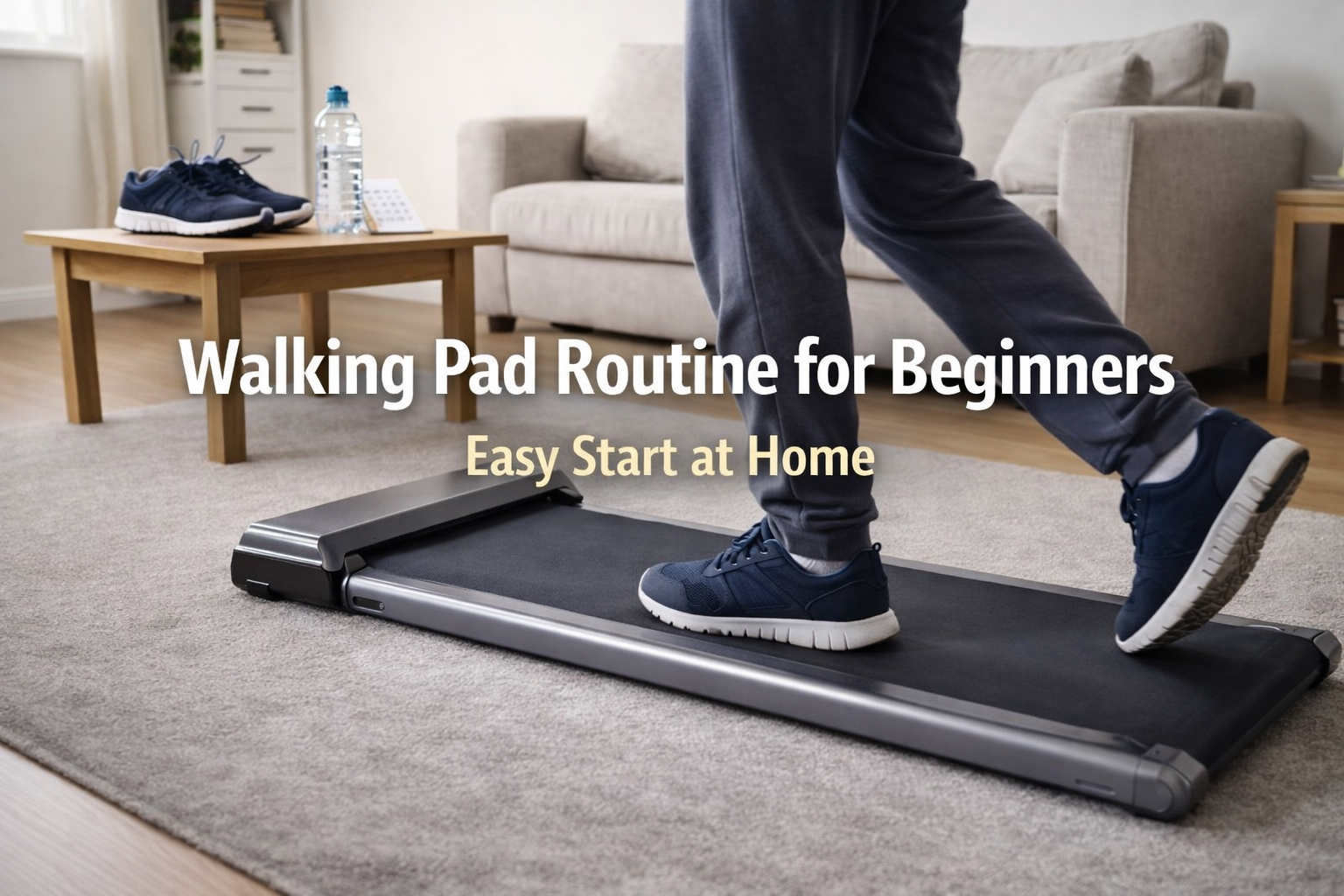
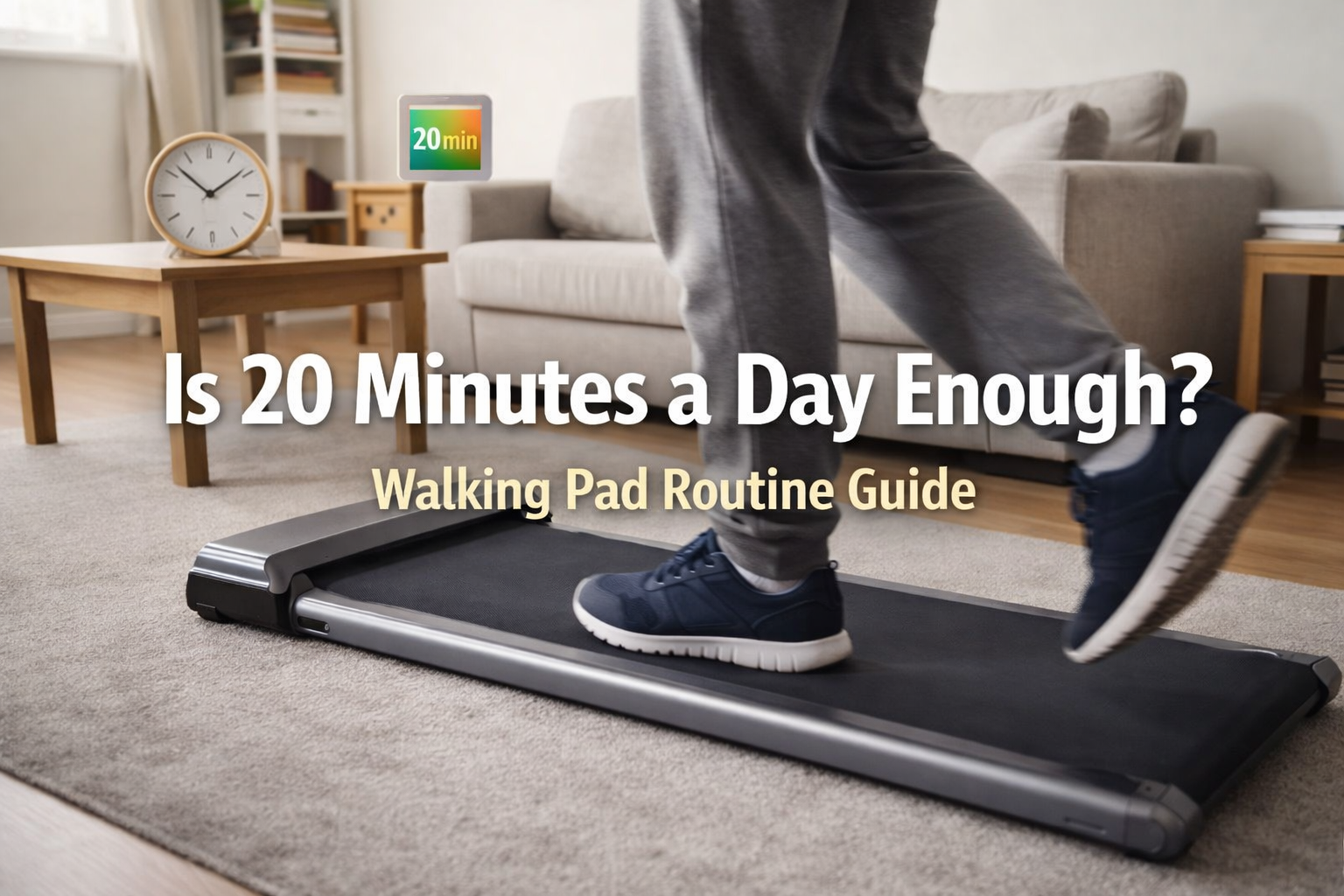
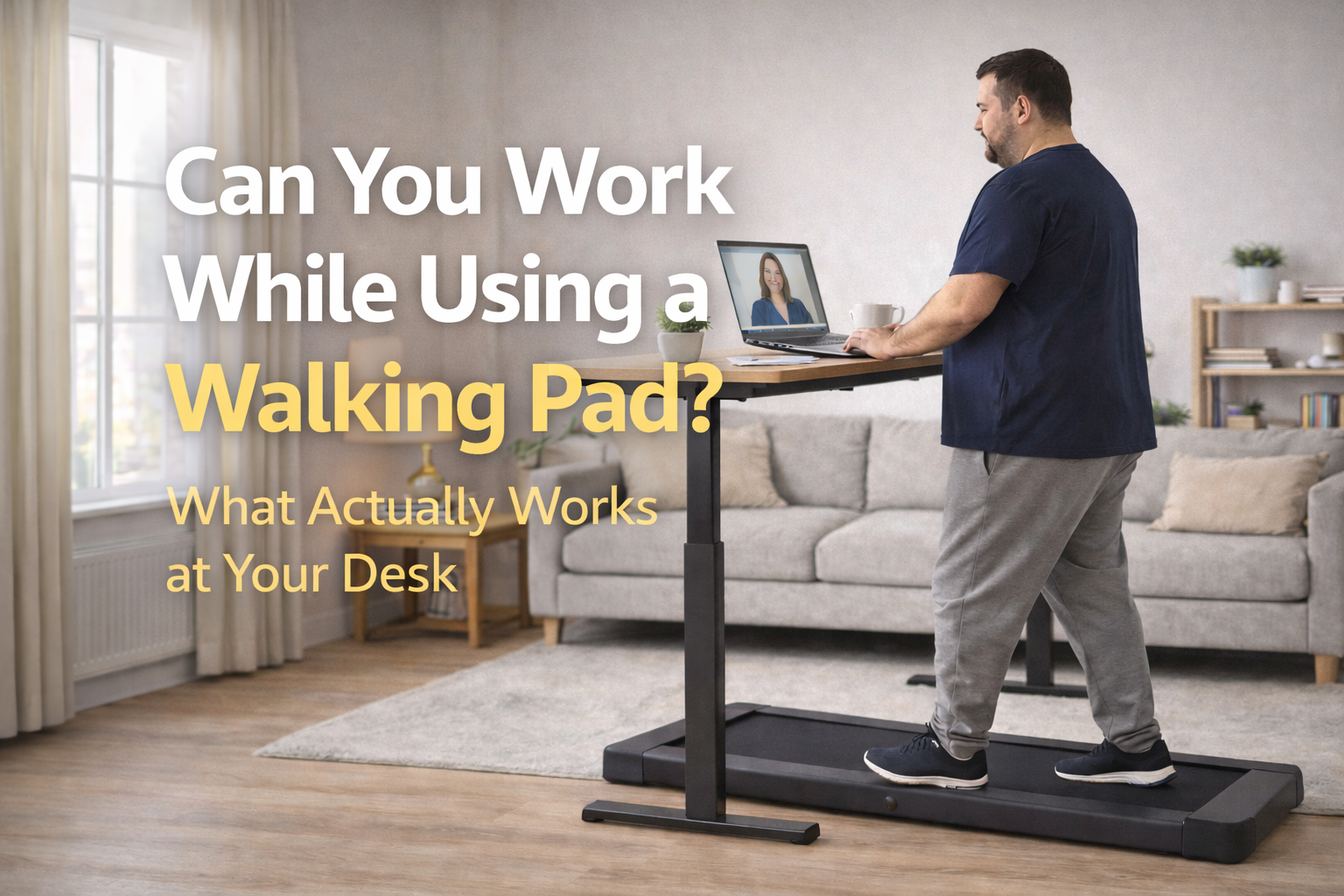
A walking pad at low speed (1.5–2 km/h) is the most practical low impact exercise tool for UK adults who work from home, have limited outdoor access, or want to accumulate steps without dedicated workout sessions. It is not a replacement for higher-intensity options in terms of calorie burn per hour — but it is unique in its ability to generate 3,000–5,000 steps during activities that would otherwise be completely sedentary (calls, television, reading).
For heavier people specifically, a walking pad removes the psychological barrier of being slow or visibly unfit in a public space. Progress can be built privately, at any pace, without judgment.
For the complete comparison of walking pad models: Best Walking Pads UK 2026. For heavier users specifically: Best Walking Pads for Heavy People UK.
Rowing machine — the full-body low impact option
The rowing machine is one of the most complete low impact exercise tools available — engaging approximately 86% of the body’s muscle groups in a single, fluid movement that places minimal compressive load on the knees and hips when technique is correct.
Why rowing is underused for weight loss
- Most people use incorrect technique — hunching forward from the back rather than driving with the legs — which makes rowing uncomfortable and ineffective
- Correct technique is simple once learned: legs drive first (80% of the power), then lean back slightly, then pull the handle to the lower chest. Legs back, lean forward, arms out — repeat
- With correct technique, rowing is genuinely comfortable for most people regardless of fitness level
- Rowing at moderate intensity (20–24 strokes per minute) for 45 minutes burns approximately 400–600 calories — comparable to swimming
Rowing and knee concerns
Rowing involves knee flexion but not knee impact. People with osteoarthritis or mild knee problems often row comfortably while finding walking painful. The key is not forcing full knee bend — stopping at 90 degrees of flexion rather than fully compressed is appropriate for knee concerns.
Elliptical trainer — running motion without running impact
An elliptical trainer (cross-trainer) replicates the movement pattern of running while eliminating foot strike impact entirely. The feet move in a smooth elliptical path, keeping them in continuous contact with the pedals and removing the impact forces that make running problematic for heavier or joint-compromised people.
Calorie burn on an elliptical at moderate intensity is comparable to running at the same effort level — approximately 400–600 calories per hour at 80kg — making it one of the most calorie-efficient low impact options available. The addition of moving handles engages the upper body and increases total calorie burn by 20–30% compared to lower-body-only movement.
The primary disadvantage is that ellipticals are gym or home equipment — they are not as accessible as walking and require either a gym membership or a significant home purchase (£400–£1,500 for a decent home model).
Aqua aerobics — pool exercise without swimming
Aqua aerobics provides structured cardiovascular exercise in a pool environment without requiring swimming ability. The water provides resistance in all directions (making movements more effortful than in air) while buoyancy removes joint impact entirely.
For people who are significantly overweight, post-surgery, or have significant joint problems, aqua aerobics is often the only form of cardiovascular exercise that is immediately accessible without pain. UK leisure centres run aqua aerobics classes widely — typically 45–60 minutes at various intensity levels.
Calorie burn is lower than swimming (approximately 300–500 calories per hour) but the class format provides structure, social accountability, and instruction — factors that significantly improve consistency for many people.
Yoga and Pilates — the overlooked weight loss tools
Yoga and Pilates are not primarily calorie-burning exercises — a 60-minute hatha yoga session burns approximately 180–250 calories depending on weight and style. Their value for weight loss is indirect but real:
- Stress reduction: yoga consistently reduces cortisol — directly relevant to weight loss given cortisol’s role in abdominal fat storage and appetite
- Sleep improvement: regular yoga practice improves sleep quality, and better sleep directly improves hunger hormone regulation and fat loss efficiency
- Core and flexibility: Pilates specifically builds the core strength and flexibility that makes other exercise more comfortable and reduces injury risk
- Muscle activation: regular Pilates addresses the postural muscle deactivation that prolonged sitting and excess weight cause — improving movement quality for all other exercise
Neither yoga nor Pilates should be the primary calorie-burning exercise in a weight loss programme. But adding one session per week alongside walking, swimming, or cycling produces compounding benefits beyond what the calorie number alone suggests.
Resistance training — the most important addition
Resistance training is not traditionally classified as “low impact” but it is — when performed correctly, bodyweight and free weight training places minimal compressive load on joints while producing the single most important exercise outcome for sustained weight loss: muscle preservation.
During a calorie deficit, the body breaks down muscle alongside fat for energy. Resistance training prevents this. Each kilogram of muscle preserved during dieting maintains approximately 13 calories per day of additional resting metabolic rate — permanently. Losing 5kg of muscle through restriction without resistance training reduces BMR by 65 calories per day. Over a year, that is 23,725 extra calories the body would need to overcome to maintain the same deficit.
Bodyweight exercises suitable for all fitness levels
- Wall push-ups: upper body strength without floor-level difficulty — suitable at any starting weight
- Seated leg raises: core and quad work from a chair — no floor required
- Glute bridges: lie on your back, feet flat, push hips toward ceiling — activates glutes deactivated by sitting, requires minimal joint load
- Chair squats: stand up from a chair and sit back down — basic squat pattern with the safety of the chair as a stopping point
- Bird dogs: on all fours, extend opposite arm and leg — core stability without spinal compression
- Resistance band rows: anchor a band at waist height, pull toward you — upper back and posture correction
Two sessions per week of 20–30 minutes of bodyweight exercises is sufficient to meaningfully preserve muscle during a weight loss programme.
🌿 Lily & Loaf Triple Magnesium — muscle recovery and joint support
Magnesium supports normal muscle function, contributes to reduction of tiredness and fatigue, and supports normal psychological function — all relevant when starting a new exercise programme. Muscle soreness and fatigue in the first two to three weeks of increased activity are the most common reasons people stop. Triple Magnesium taken in the evening supports muscle recovery overnight, reduces cramping, and improves the sleep quality that determines how energetic you feel for the next session.
Browse Lily & Loaf Triple Magnesium →

Best low impact exercise for bad knees
Knee pain is one of the most common barriers to exercise in the UK — and one of the most self-defeating, since the right exercise is one of the most effective treatments for knee pain. The key is choosing activities that load the joint without compressing or twisting it.
| Exercise | Knee friendliness | Notes |
|---|---|---|
| Swimming | ⭐⭐⭐⭐⭐ Excellent | Virtually zero knee load; best option for severe knee pain |
| Aqua aerobics | ⭐⭐⭐⭐⭐ Excellent | Same as swimming; no swimming ability required |
| Stationary cycling | ⭐⭐⭐⭐ Very good | Good if seat correctly positioned; avoid if knee bends past 90 degrees cause pain |
| Rowing machine | ⭐⭐⭐ Good | Good if stopping before full knee compression; bend to ~90 degrees only |
| Elliptical | ⭐⭐⭐⭐ Very good | Smooth motion; less knee load than walking |
| Walking (flat, slow) | ⭐⭐⭐ Good | Manageable at low speed on flat soft surface; avoid hills and tarmac initially |
| Walking pad (slow) | ⭐⭐⭐ Good | Flat surface, controlled speed, consistent surface — better than outdoor walking for knees |
| Yoga / Pilates | ⭐⭐⭐ Good | Avoid poses that require deep knee bend; modify as needed |
Best low impact exercise for heavier people
If you are significantly overweight — over 18–20 stone — standard exercise advice often does not account for your specific starting point. Here is what actually works:
- Start with water: swimming or aqua aerobics removes joint load entirely. At high body weights, the buoyancy advantage is greatest — you will find water exercise significantly more comfortable than land-based exercise at equivalent effort
- Walking pad before outdoor walking: a walking pad removes the psychological barriers of public exercise — being seen as slow, worrying about fitting on equipment, the heat and discomfort of outdoor exercise at high weight — while building the fitness base that makes outdoor walking comfortable
- Check weight limits: always check equipment maximum user weight — walking pads, stationary bikes, and ellipticals vary significantly. See the best walking pads for heavy people UK guide
- Seated exercise first: stationary cycling and rowing are weight-supported — the equipment bears much of your weight, making these more accessible at higher starting weights than standing exercise
- Footwear matters more: at higher body weights, the mechanical load on feet and ankles is greater. Wide-fit trainers with substantial cushioning reduce pain and increase the amount of exercise you can sustain
Post-surgery and recovery exercise
Exercise after surgery — including gallbladder removal, bariatric surgery, joint replacement, or any abdominal procedure — requires careful progression. The general principles are:
- Always follow your surgeon’s specific guidance on return to activity — the following is general education, not medical advice for your individual situation
- Weeks 1–2: short, slow indoor walking only — 5–10 minutes, two to three times per day. A walking pad at 0.5–1 km/h is ideal. No swimming, cycling, or resistance training
- Weeks 3–4: gradually increase walking duration to 15–20 minutes. Still avoid uneven terrain, hills, or carrying loads
- Weeks 5–8: normal walking distances typically resume for keyhole procedures. Stationary cycling and gentle swimming can often be introduced with surgeon approval
- Weeks 8+: gradual return to full activity with bodyweight resistance training introducible for most standard procedures
For post-gallbladder removal specifically, see the complete gallbladder removal guide.
Low impact exercise on GLP-1 medication
People using GLP-1 medication (Mounjaro, Wegovy, Ozempic) alongside exercise face specific considerations:
- Lower available energy: significantly reduced calorie intake means less fuel available for exercise. Starting walks shorter and slower than you think you need to is sensible, not weak. Build gradually as appetite and energy stabilise
- Muscle loss risk is higher: the combination of calorie restriction from GLP-1 and increased exercise creates good conditions for fat loss but also some muscle loss risk. Resistance training becomes more important, not less — even two short bodyweight sessions per week makes a meaningful difference
- Hydration is more critical: GLP-1 appetite suppression often reduces thirst alongside hunger. Exercise increases fluid and electrolyte loss. Drinking to a schedule rather than to thirst is essential
- Low impact is the right starting point: for people beginning GLP-1 treatment who are also starting to exercise, low impact exercise is the appropriate entry point — it builds the habit and the fitness base without the injury risk that aggressive exercise on reduced calories would create
Related reading: Why am I so tired on GLP-1? | How to reduce muscle loss on GLP-1 | Electrolytes for GLP-1 users
Building a low impact routine that produces results
The best routine is the one you will actually do consistently. Here are three sample weekly schedules at different starting points.
Beginner — starting from very low activity
| Day | Activity | Duration |
|---|---|---|
| Monday | Walking (flat, gentle pace) | 15 min |
| Tuesday | Rest or gentle stretching | — |
| Wednesday | Walking or walking pad | 20 min |
| Thursday | Rest | — |
| Friday | Walking | 20 min |
| Weekend | One longer walk if energy allows | 25–30 min |
Intermediate — building fitness
| Day | Activity | Duration |
|---|---|---|
| Monday | Walking or walking pad (daily steps target) | 30 min + background steps |
| Tuesday | Bodyweight resistance training | 25 min |
| Wednesday | Swimming or cycling | 30–40 min |
| Thursday | Walking + movement breaks | Steps target |
| Friday | Bodyweight resistance training | 25 min |
| Saturday | Longer walk, swim, or cycle | 45–60 min |
| Sunday | Rest or yoga/stretching | 20–30 min |
Established — consistent low impact athlete
| Day | Activity | Duration |
|---|---|---|
| Monday | Walking pad + resistance training | Steps + 30 min weights |
| Tuesday | Swimming or cycling (moderate intensity) | 45 min |
| Wednesday | Walking pad + steps target | Active day |
| Thursday | Resistance training + walking | 30 min weights + 30 min walk |
| Friday | Aqua aerobics or elliptical | 45 min |
| Saturday | Longer outdoor walk or cycle | 60–90 min |
| Sunday | Yoga or rest | 30 min or full rest |
🌿 Lily & Loaf Daily Essentials Bundle — complete nutritional support for active weight loss
When increasing exercise alongside a calorie deficit, the body’s demand for protein, key micronutrients, and gut-supporting nutrition all increase. The Daily Essentials Bundle covers three critical bases: Daily Fuel (21g protein, 15 vitamins and minerals, 5g fibre — closes the protein gap that resistance training requires), Daily Balance (Omega 3-6-9 — supports joint health, inflammation reduction, and cardiovascular function), and Daily Flora (probiotics and B vitamins for gut health and energy metabolism). A practical all-in-one daily routine for anyone combining low impact exercise with weight loss.
🌿 Lily & Loaf Vitamin D3+K2 — essential for UK exercisers
Vitamin D supports normal muscle function, bone health, and immune function — all directly relevant to people increasing their exercise load. In the UK, most adults are deficient for at least 6 months of the year due to limited sun exposure, and deficiency is more pronounced in people who are significantly overweight (body fat stores vitamin D rather than releasing it). D3+K2 provides high-strength vitamin D3 with K2 to direct calcium to bones and support the musculoskeletal health that makes consistent exercise sustainable.
Related reading on this site
- How Many Steps a Day to Lose Weight UK
- Best Walking Pads UK Guide 2026
- Best Walking Pads for Heavy People UK
- How to Lose Weight with a Desk Job UK
- How to Reduce Muscle Loss During Weight Loss
- How Long to Lose a Stone UK
- Why Am I Not Losing Weight Even Though I’m Eating Less?
- GLP-1, Gallstones and Gallbladder Removal UK

Frequently asked questions
What is the best low impact exercise for weight loss UK?
Walking is the most accessible and sustainable. Swimming produces the highest calorie burn with zero joint impact. Cycling offers high calorie burn with minimal joint load. For home use, a walking pad is the most practical option. The best choice is always the one you will do consistently — and for most people starting from a low base, that means walking first and adding other activities as fitness builds.
Can you lose weight with low impact exercise?
Yes. Low impact exercise produces effective weight loss when done consistently alongside a calorie-aware diet. Walking 10,000 steps daily burns 300–800 calories depending on weight. Swimming for 45 minutes burns 400–700 calories. None of this requires running or high-impact movement.
What exercise is best for weight loss with bad knees?
Swimming and aqua aerobics are the best options — water removes virtually all compressive load from the knee joint. Stationary cycling is excellent if the seat is correctly positioned. Walking at low speed on flat soft surfaces is manageable. Avoid high-impact activities, deep lunges, and any movement that produces sharp joint pain.
Is walking enough exercise to lose weight?
Walking alone can produce meaningful weight loss when done consistently at sufficient volume — 7,000–10,000 steps per day — combined with dietary awareness. For heavier people, walking burns significantly more calories per step. Combined with a modest calorie deficit, consistent walking produces 0.5–1lb per week of fat loss without any high-impact exercise.
What low impact exercise burns the most calories?
Swimming and rowing burn the most calories per hour of any low impact exercise — approximately 400–700 calories per hour at moderate intensity for an 80kg person, scaling higher with body weight. Cycling and elliptical training produce comparable calorie burn. Walking burns fewer calories per hour but wins on daily consistency and cumulative total.
What is low impact exercise?
Low impact exercise is physical activity where at least one foot or body part remains in contact with a surface at all times, or where body weight is supported by water or equipment. This reduces impact forces on joints compared to high-impact activities like running or jumping. Examples include walking, swimming, cycling, rowing, and elliptical training.
Discover more from Healthy Weight Loss GLP1
Subscribe to get the latest posts sent to your email.