
I spent years working at a desk wondering why my weight kept climbing despite not eating dramatically differently to people I knew who stayed lean. The answer — which took me an embarrassingly long time to understand — was not the food. It was the sitting.
A desk job is not just a neutral starting point for weight loss. It is an active barrier to it. The human body was not designed to be stationary for 8–10 hours a day, and the metabolic consequences of prolonged sitting are real, measurable, and significant. But they are not insurmountable. Understanding exactly what is happening in your body during a desk job — and what to do about it practically — is what this guide covers.
📋 On this page
- The numbers — why desk jobs create a calorie gap
- NEAT — the calorie burn you are missing
- What prolonged sitting does to your body
- Movement breaks
- Getting to 10,000 steps from a desk
- Walking pads for desk workers
- Standing desks
- Exercise strategy for desk workers
- Back pain and exercise
- Eating at a desk job
- Working from home
- Traditional office
- Hybrid working
- Desk job stress and weight gain
- A sample active desk week
- Daily plan
- Nutritional support
- FAQs
The numbers — why desk jobs create a calorie gap
The difference in daily calorie burn between a desk job and a physically active job is larger than most people appreciate — and it compounds in ways that explain a great deal of gradual weight gain over a career.
| Job type | Daily NEAT estimate | Total daily burn (80kg adult) | Weekly gap vs desk job | Annual gap vs desk job |
|---|---|---|---|---|
| Desk job (sedentary) | 200–400 kcal | 1,900–2,100 kcal | — | — |
| Light active (teacher, retail) | 600–900 kcal | 2,300–2,600 kcal | 2,800–3,500 kcal | ~145,000–182,000 kcal |
| Moderate active (nurse, tradesperson) | 1,000–1,400 kcal | 2,700–3,100 kcal | 5,600–7,000 kcal | ~290,000–364,000 kcal |
| Heavy physical labour | 1,500–2,500 kcal | 3,200–4,200 kcal | 9,100–14,700 kcal | ~470,000–764,000 kcal |
The annual calorie gap between a desk job and a moderately active job — before accounting for formal exercise — is approximately 290,000–364,000 calories. Expressed in weight terms, that gap represents roughly 80–100lbs of fat, spread across a working career. This is not the cause of all weight gain in desk workers, but it illustrates the scale of the structural disadvantage that sitting all day creates.
NEAT — the hidden calorie burn you are not getting
Non-Exercise Activity Thermogenesis (NEAT) is the energy burned through all movement that is not formal exercise: walking to meetings, pacing during calls, taking stairs, carrying things, standing, fidgeting. For physically active people, NEAT accounts for 30–50% of total daily energy expenditure. For desk workers, it can be as low as 10–15%.
The critical insight about NEAT is that it is not one behaviour to be “done” and ticked off. It is hundreds of small movements distributed across the day, each burning 5–30 calories, accumulating to a total that dwarfs what a single gym session produces.
| Activity | Calories per hour (80kg adult) | Practical equivalent in a working day |
|---|---|---|
| Sitting at desk | ~85 kcal | 8 hrs = 680 kcal |
| Standing at desk | ~140 kcal | +55 kcal per hour vs sitting |
| Walking slowly (1.5 km/h — walking pad) | ~165 kcal | 2 hrs on pad = 330 kcal |
| Walking briskly (4 km/h — lunchtime) | ~280 kcal | 20 min walk = ~93 kcal |
| Pacing during calls | ~220 kcal | 1 hr of calls pacing = 220 kcal |
| Stair climbing | ~450 kcal | 5 min of stairs = ~37 kcal |
How to maximise NEAT without disrupting your working day
- Walk every call: pace during phone calls and video calls where you do not need to be seen on camera. 80–100 steps per minute on a 30-minute call adds 2,400–3,000 steps
- Take every stairs opportunity: two flights of stairs five times per day adds approximately 200 calories of NEAT burn over a week
- Stand during reading and email: not all desk work requires sitting. Switching to standing for reading, reviewing documents, or less demanding email keeps NEAT higher than continuous sitting
- Walk to colleagues: in an office, walking to a desk rather than emailing adds 100–300 steps per visit
- Park further or get off one stop early: adds 500–1,500 steps per day with no conscious effort once the habit is established
- Drink more water: deliberately drinking more water creates natural movement breaks through bathroom trips — the hydration benefit is real and the step count benefit is a bonus
What prolonged sitting does to your body — and why it matters for weight loss
Beyond calorie burn, prolonged uninterrupted sitting produces physiological changes that directly impair weight loss. Understanding these makes the movement break recommendations feel less arbitrary.
Lipoprotein lipase shutdown
After approximately 60–90 minutes of sitting, lipoprotein lipase — the enzyme responsible for breaking down fat in the bloodstream and moving it into muscle cells for use as fuel — drops by up to 90%. This means prolonged sitting actively impairs your body’s ability to use fat as an energy source, regardless of whether you exercised earlier in the day.
This is the mechanism behind “active couch potato” syndrome: people who exercise for an hour but then sit for 8 hours show similar metabolic markers to completely sedentary people. The exercise does not fully compensate for the continuous sitting.
Insulin sensitivity reduction
Extended sitting reduces insulin sensitivity in leg muscles — one of the body’s largest glucose-clearing tissues. After a full day of sitting, the body’s ability to regulate blood sugar is measurably impaired. This promotes fat storage (particularly visceral abdominal fat) and creates the blood sugar fluctuations that drive afternoon hunger and cravings.
Postural muscle deactivation
Prolonged sitting deactivates the glutes, hip flexors, and core stabilising muscles through reciprocal inhibition. Over months and years, this produces muscle imbalances that affect posture, increase injury risk during exercise, and reduce the calorie efficiency of walking — each step burns slightly fewer calories with poorly activated posterior chain muscles.
Elevated cortisol from cognitive stress
Knowledge work produces sustained low-level psychological stress — complex decisions, interpersonal demands, always-on communication — that elevates cortisol throughout the day. Elevated cortisol promotes abdominal fat storage, impairs fat breakdown, and drives cravings for high-calorie comfort foods. The desk job itself is a cortisol-generating environment independent of whether you are under unusual pressure.
Movement breaks — the simplest evidence-based fix
A movement break is any interruption to continuous sitting — standing up, walking to the kitchen, climbing a flight of stairs, pacing for two minutes. The metabolic benefit comes from the interruption of the lipoprotein lipase shutdown, not from the intensity of the movement.
| Break frequency | Duration | What to do | Steps added per break | Daily total (8-hour day) |
|---|---|---|---|---|
| Every 30 min | 2 min | Stand, walk to kitchen, refill water | ~200 | ~3,200 |
| Every 60 min | 5 min | Walk to another room, flight of stairs, short loop | ~500 | ~4,000 |
| Every 2 hrs | 10 min | Outdoor walk or longer building loop | ~1,000 | ~4,000 |
| Lunch | 15–20 min | Dedicated walk, eaten first away from desk | ~1,500–2,000 | ~1,500–2,000 |
On a typical 8-hour working day with the every-60-minute and lunch break pattern, this adds approximately 5,500–6,000 steps — enough to take most desk workers from 2,000 daily steps to 7,000–8,000 without any before or after work exercise.
How to actually remember breaks
- Set a recurring 60-minute timer on your phone, computer, or smartwatch
- Use a fitness tracker that vibrates after a set period of inactivity — most Fitbit, Garmin, and Apple Watch devices have this
- Make a rule: every time you finish a task, stand up before starting the next one
- Use time-blocking software that enforces brief pauses between work sessions (Pomodoro technique)
- Drink a full glass of water at each break — the hydration is genuinely useful and the bathroom visit creates the next break automatically
Getting to 10,000 steps from a desk job — how it actually adds up
Getting from 3,000 to 10,000 steps while working 8 hours at a desk feels impossible until you see how it distributes across the day. Here is a realistic breakdown:
| Activity | Steps added | Extra time required |
|---|---|---|
| Morning routine — getting ready, moving around house | 400–600 | Already happening |
| Commute or pre-work walk (15 min) | 1,200–1,500 | 15 min if not commuting |
| Movement breaks every 60 min (7 breaks at 5 min each) | 3,500 | 35 min distributed through day |
| Lunchtime walk (20 min) | 1,800–2,000 | 20 min at lunch |
| Walking pad during 90 min of desk work | 3,000–4,500 | 0 extra — during work time |
| Evening — general activity around house | 600–1,000 | Already happening |
| Post-dinner walk (10 min) | 800–1,000 | 10 min |
| Total | 11,300–14,100 | ~80 min deliberate (or ~45 min with walking pad) |
For the full progressive step-building programme from any starting point, see: How Many Steps a Day to Lose Weight UK.
Walking pads for desk workers — the honest assessment
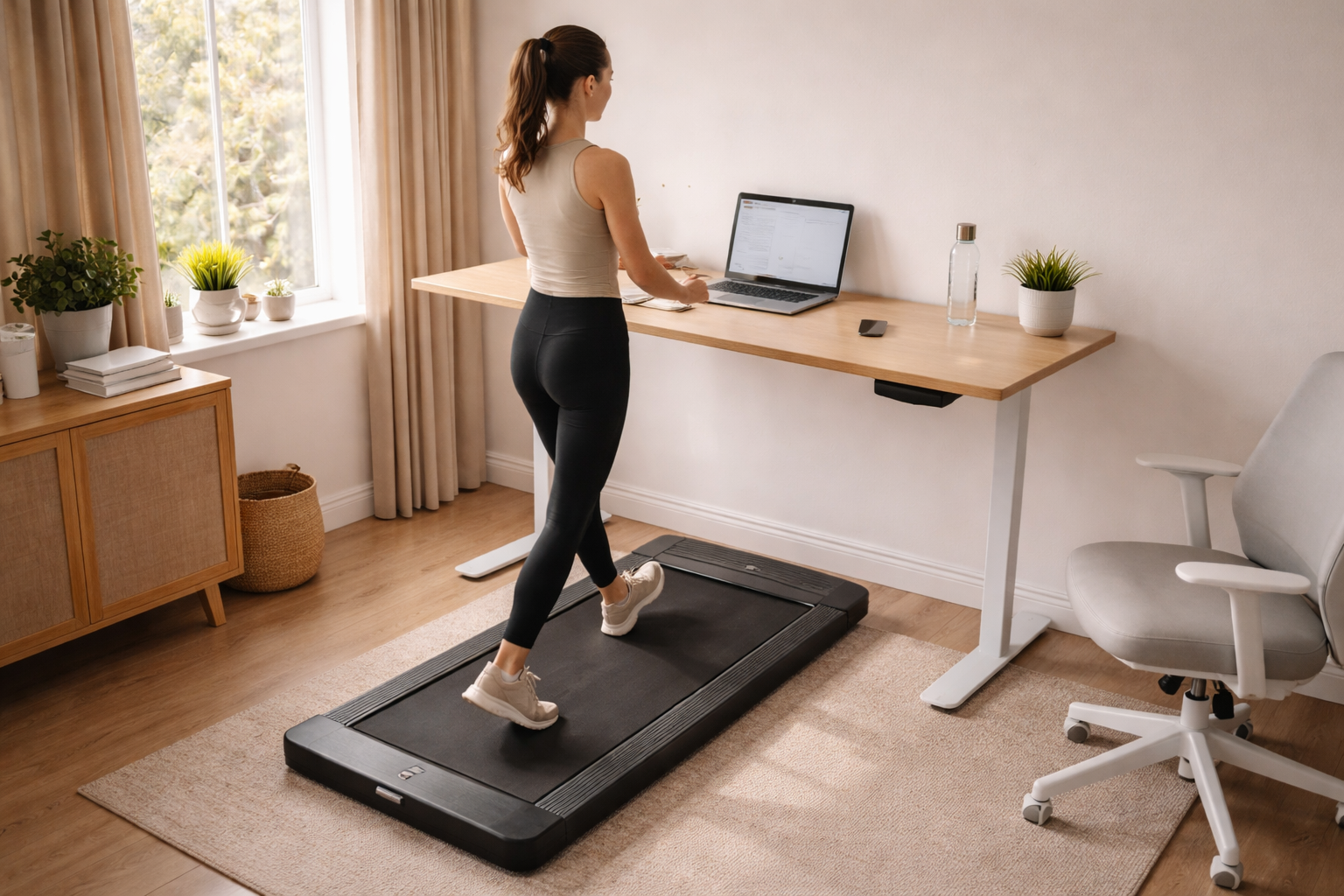
A walking pad under a standing desk is the single most impactful purchase a desk worker can make for weight loss — not because of intensity, but because of effortlessness. At 1.5–2 km/h, a walking pad requires no conscious effort, produces no sweat, does not affect cognitive performance for most work tasks, and adds 3,000–5,000 steps to the working day without requiring any additional time.
What you can do on a walking pad at low speed
- Video calls where your movement is not visible
- Phone calls of any kind
- Reading documents, reports, and longer emails
- Listening to meetings or webinars
- Data entry and routine administrative tasks
- Reviewing work created by others
- Watching training videos or online courses
What is harder on a walking pad
- Complex writing or deep analytical thinking
- Intricate spreadsheet work
- Creative work requiring sustained focus
- Anything requiring very precise mouse control
The practical approach: use the walking pad for the lower-concentration portions of your working day and sit for high-concentration work. Even 90 minutes of low-speed walking across an 8-hour day adds 3,500–4,500 steps — a meaningful contribution to a calorie deficit without a single minute of additional time.
Can you work on calls while using a walking pad?
Yes — and this is one of the most compelling use cases. At 1.5 km/h, walking is stable and quiet enough that movement is undetectable on video calls at normal camera angles. I use a walking pad daily during calls and have never had anyone notice or comment. See the full guide: Can You Work While Using a Walking Pad?
Choosing a walking pad for desk use
- Weight capacity: always check the maximum user weight — see the best walking pads for heavier users
- Noise level: critical if you are on calls or have people nearby — quiet models are worth the premium
- Low speed stability: for desk walking you need consistent performance at 0.5–2 km/h — not all models do this well
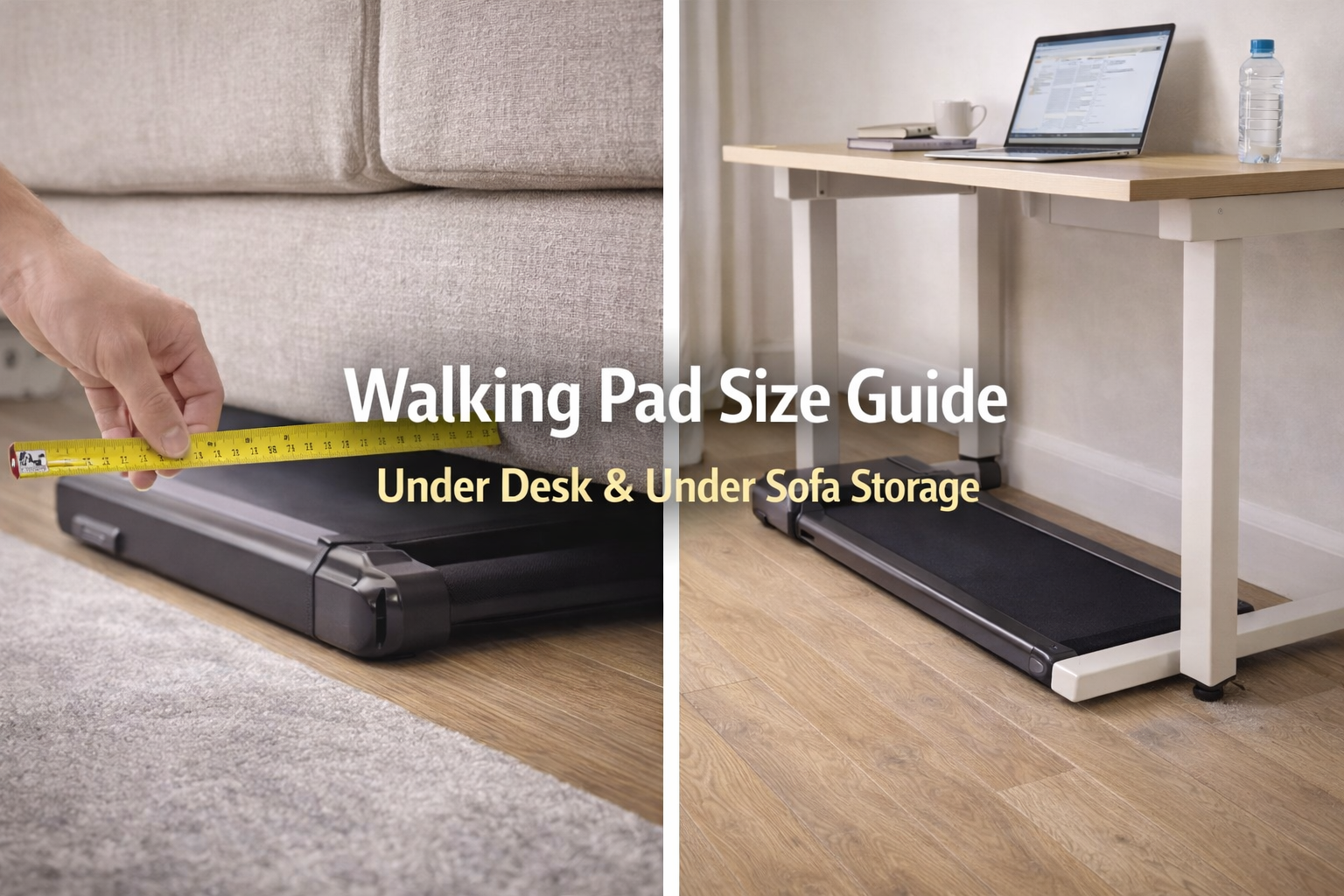
- Dimensions: measure your under-desk space carefully — see the walking pad size guide
Full comparison of all models: Best Walking Pads UK Guide 2026 and Best Under-Desk Treadmills UK.
Standing desks — what they actually do for weight loss
Standing desks are widely marketed as a health and weight loss tool. The reality is more nuanced than the marketing suggests.
What standing desks genuinely do
- Burn approximately 50 extra calories per hour compared to sitting — approximately 200–300 additional calories on a standing day
- Reduce the lipoprotein lipase shutdown associated with prolonged sitting
- Create the physical platform for walking pad use — the primary weight loss benefit
- Encourage more spontaneous movement breaks — people at standing desks tend to walk more between tasks
- Reduce lower back pain for many people, removing a common barrier to exercise
What standing desks do not do
- Produce meaningful weight loss on their own — 200 extra calories per standing day is useful but not transformative without dietary support
- Replace actual movement — standing still for 8 hours is not significantly better than sitting still metabolically or cardiovascularly
- Compensate for poor nutrition — a standing desk does not change the dietary adjustments required for weight loss
Exercise strategy for desk workers — what matters most
Desk workers face a specific exercise challenge: by the time the conventional after-work exercise window arrives, cognitive fatigue and depleted willpower make motivation genuinely harder to generate. Understanding this shapes which approaches work best.
The resistance training priority
For desk workers specifically, resistance training is the most important formal exercise — more important than additional cardio. The reasons:
- Desk jobs gradually deactivate the posterior chain (glutes, hamstrings, upper back) through prolonged sitting posture. Resistance training directly counteracts this
- Each kilogram of muscle burns approximately 13 calories per day at rest — adding muscle mass partially offsets the NEAT deficit of sedentary work
- Two 30–45 minute sessions per week is sufficient — lower time commitment than most cardio approaches
- The metabolic benefit (EPOC) continues for 24–48 hours after each session, unlike walking which produces only immediate calorie burn
- Resistance training improves posture and reduces the back pain that is both a product of desk work and a barrier to further exercise
When to exercise around desk work
| Time window | Pros | Cons | Best for |
|---|---|---|---|
| Before work (6–8am) | Willpower highest; done before day derails it; cortisol naturally elevated — useful for exercise | Requires earlier wake-up; winter darkness barrier; needs night-before preparation | People with unpredictable evenings; those who find consistency easiest in mornings |
| Lunchtime | Breaks up the day; improves afternoon energy and focus; no additional time cost to the day | Limited to 30–45 min; shower access needed; social lunch pressure | People near a gym; those with flexible lunch hours; low-impact training |
| After work (5–7pm) | More time available; body temperature higher; social exercise options easier | Willpower depleted; easy to cancel; late sessions can affect sleep | People with reliable evening routines; gym class formats that provide external accountability |
The minimum effective exercise programme for a desk worker
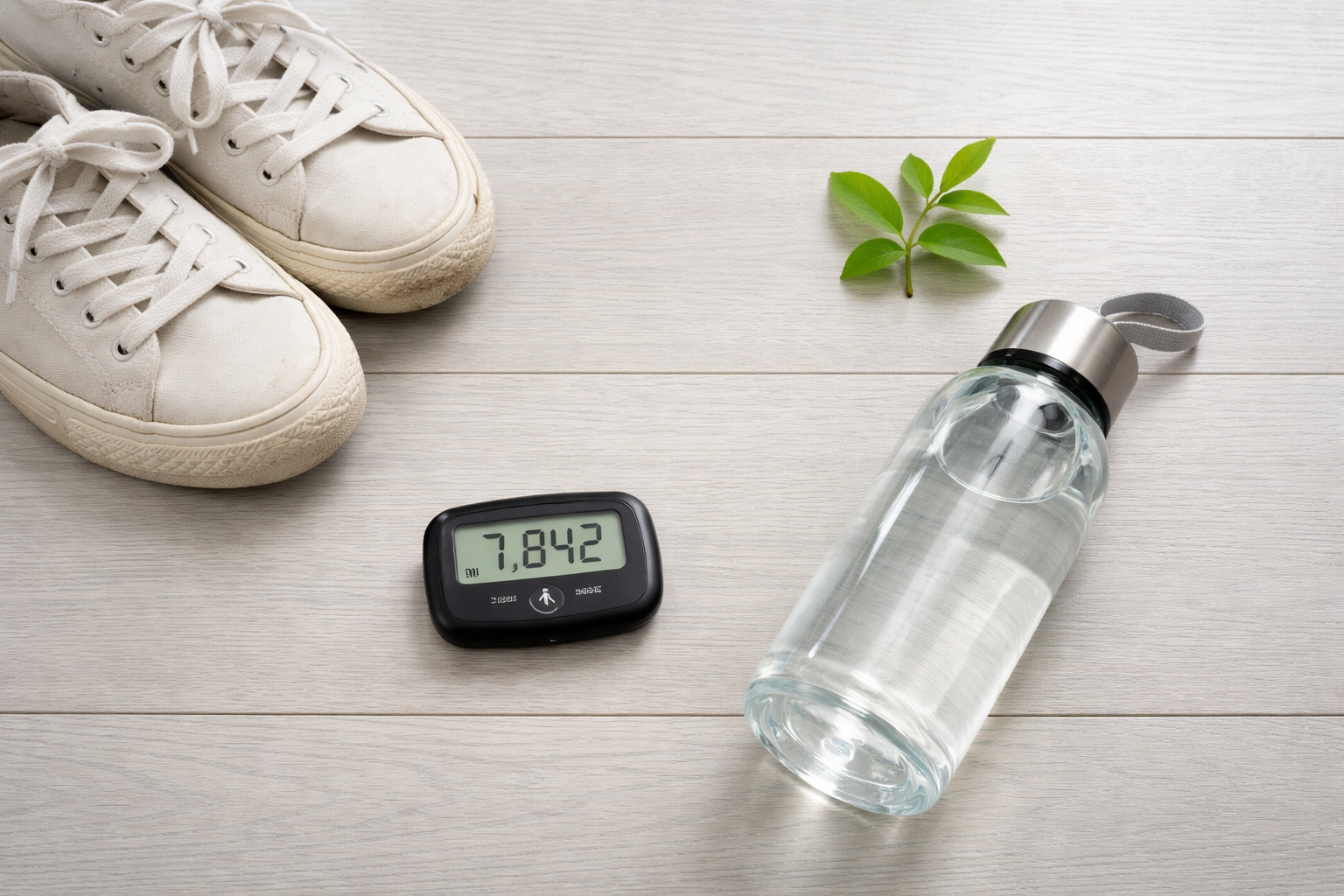
- 7,000–10,000 steps daily (via movement breaks, lunchtime walk, walking pad)
- 2 × 30–45 min resistance training sessions per week
- 1 × longer walk or swim at the weekend
This totals approximately 90 minutes of deliberate exercise per week beyond walking — entirely manageable around a full working schedule without heroic commitment.
Back pain and exercise — addressing the desk worker’s biggest barrier
Lower back pain affects approximately 28% of UK adults and is significantly more prevalent in desk workers than the general population. It is also one of the most common reasons desk workers give for not exercising — and one of the most self-defeating, since the right exercise is one of the most effective treatments for desk-related back pain.
Why desk work causes back pain
Prolonged sitting causes:
- Hip flexor shortening — pulling the pelvis forward and increasing lumbar spine load
- Glute inhibition — the primary stabilising muscles of the lower back become underactive
- Upper back and neck tightening — from forward head posture over screens
- Core deactivation — the deep stabilising muscles of the spine atrophy with disuse
Exercise that helps desk-related back pain
- Glute activation exercises: glute bridges, clamshells, and hip thrusts reactivate the muscles that sitting deactivates. These are the highest-priority exercises for desk workers
- Hip flexor stretching: kneeling hip flexor stretches held for 30–60 seconds, done daily, reduce the anterior pelvic tilt that compresses the lumbar spine
- Core strengthening: dead bugs, bird dogs, and planks build the deep stabilising capacity that supports the spine during prolonged sitting
- Walking: moderate walking is consistently one of the most effective and evidence-backed treatments for non-specific lower back pain — not rest, not avoidance
- Swimming: the decompressive effect of water combined with full-body movement makes swimming particularly beneficial for desk workers with back pain
Exercises to avoid with desk-related back pain
- Sit-ups and crunches — increase compressive load on already-compressed lumbar discs
- High-impact running if hip flexors are very tight — corrects to the gait until flexibility is restored
- Heavy deadlifts or squats without adequate posterior chain activation — risk of movement compensations that increase injury risk
Eating for weight loss at a desk job
Desk jobs create specific eating challenges: office food culture, decision fatigue by lunchtime, proximity to vending machines and communal snacks, and the psychological pull of food as a stress or boredom response during sedentary hours.
Calorie target adjustment for desk workers
Most TDEE calculators use activity multipliers that assume more movement than a typical sedentary desk job produces. The “sedentary” setting (1.2× BMR) is appropriate for desk workers who do not exercise at all. If you are adding regular walking and two resistance sessions, “lightly active” (1.375×) is more accurate.
If the calculation produces slower than expected weight loss, reducing the daily target by 100–200 calories is often the correct adjustment — many calculators slightly overestimate NEAT for desk workers.
The prepared lunch principle
Bringing a prepared lunch is the single most impactful food change for most desk workers. Restaurant and takeaway meals are typically 2–3× the calorie density of equivalent home-prepared meals, and the lunchtime decision — made while hungry, time-pressured, and socially influenced by what colleagues are ordering — consistently produces worse outcomes than a pre-committed choice.
Batch cooking five lunches on Sunday takes 30–45 minutes and removes five daily decisions that collectively represent 500–1,500 calories of weekly variance. See the meal prep approach in: High Protein Meals for Weight Loss UK.
Sponsored — Hello Fresh
Remove the Evening Meal Decision Entirely
After a full day of desk work decisions, the last thing you need is planning what to cook. Hello Fresh delivers pre-portioned, calorie-counted meals with simple instructions — high-protein options included. Decision fatigue is real at a desk job. Use code ALAN50 for 50% off your first box, then 20% off your next 4 boxes plus free treats for 3 months.
Watch Alan’s Hello Fresh unboxing and review:
Desk snack strategy
Hunger between meals at a desk is one of the most reliable pathways to poor choices — vending machine visits, communal biscuits, cake in the kitchen. The prevention is simple: keep better options at your desk so the hungry decision is already made.
| Snack | Protein | Calories | Prep needed | Cost approx |
|---|---|---|---|---|
| Cottage cheese pot (150g) | 17g | ~130 kcal | None | ~50p |
| 2 hard-boiled eggs | 12g | ~155 kcal | Batch cook Sunday | ~45p |
| Skyr pot (170g) | 17g | ~100 kcal | None | ~£1.00 |
| Tinned tuna + oatcakes (2) | 28g | ~200 kcal | 2 min | ~80p |
| Edamame (150g, microwaved) | 17g | ~185 kcal | 3 min | ~60p |
| 30g mixed nuts | 5g | ~185 kcal | None | ~40p |
| Protein shake (1 scoop + water) | 22g | ~110 kcal | 1 min | ~55p |
Managing office food culture
Birthday cakes, biscuit tins, communal snack tables, and team lunches are a fixture of UK office life. Navigating them without becoming the person who refuses everything — or the person who quietly eats three slices of cake — requires a practical approach:
- Distance from the biscuit tin: research shows people eat significantly less from communal food when it requires standing up to access. If possible, sit as far from communal food as the layout allows
- The one-choice rule at celebrations: have one item, enjoy it, do not compensate with restriction afterwards, move on. Perfection is not the goal — consistency is
- Eat before team lunches: arriving at a restaurant or group lunch moderately full produces significantly better choices than arriving hungry after a light morning
- Have a default order: at the regular lunch order, have a pre-decided choice that does not require in-the-moment decision making

Working from home — specific challenges and solutions
Working from home (WFH) creates a different set of weight loss challenges to a traditional office. In some ways it is easier; in others it is significantly harder.
WFH advantages for weight loss
- Full control over the kitchen environment — no communal biscuit tins, no birthday cakes you did not choose to buy
- Freedom to take movement breaks without social awkwardness
- Ability to use a walking pad without office politics
- No commute — time that can be redirected to morning or evening walks
- Ability to cook proper meals rather than relying on bought food
WFH challenges for weight loss
- Constant kitchen proximity: boredom, stress, and procrastination all pull towards the kitchen when it is 10 metres away. WFH workers eat more frequently throughout the day, often without hunger as the trigger
- Fewer incidental steps: no commute, no walking to meeting rooms, no walking to colleagues. WFH workers often average 1,000–2,000 fewer steps than office workers before any deliberate effort
- Blurred boundaries: working longer hours from home is common, which increases sedentary time and reduces the clear “work is done, exercise now” cue that an office departure provides
- Social isolation: loneliness is associated with increased comfort eating, particularly among those living alone or with limited social contact during the working day
WFH-specific solutions
- Scheduled eating windows: set specific times for breakfast, lunch, and a snack. The kitchen is not available outside those windows. This prevents the habitual grazing that WFH enables
- Walk your commute: replace the missing commute with a morning walk of similar duration. This maintains structure, adds steps, and provides a clear “start of day” signal
- End-of-day walk: a 15–20 minute walk at the end of the working day provides the “work is done” signal that a commute previously gave, reduces cortisol before the evening eating window, and adds the steps the missing commute took away
- Walking pad as the default tool: for WFH workers, the barriers to walking pad use (noise concerns, what colleagues think) are absent. Using it during calls and reading is entirely private and produces significant step accumulation without leaving the house
- Kitchen structure: keep the same snack strategy as an office worker — pre-portioned protein snacks ready to go, unhelpful foods not in the house rather than in it but resisted
Traditional office — specific challenges and solutions
The traditional 5-day office environment creates different challenges: more food culture and social eating pressure, commute energy cost, and environmental temptations that are outside your control.
The commute and energy management
UK commutes average approximately 59 minutes per day (ONS data). For many desk workers, the commute is the most physically and mentally draining part of the day — arriving at work already depleted, leaving work too exhausted to exercise. Managing the commute’s energy cost is a genuine weight loss consideration:
- Walking or cycling part of the commute converts dead time into active time — even one bus stop earlier adds 500–1,000 steps
- A slightly earlier start to avoid peak commute stress meaningfully reduces cortisol and preserves willpower for the day
- If the commute is unavoidably draining, morning exercise before the commute is more reliable than post-commute exercise — willpower is highest before the day depletes it
Office-specific movement strategies
- Use the furthest bathroom on your floor — adds 100–200 steps per visit
- Take stairs for any floor within 4 flights — the 20 seconds of inconvenience adds up meaningfully over a week
- Have in-person rather than digital conversations where possible — walking to a colleague’s desk is always better than an email
- Use a walking meeting for one-to-one conversations — walking meetings are increasingly normal and more productive than seated ones for many discussion types
Hybrid working — making the most of both patterns
Hybrid working (typically 2–3 days in the office, 2–3 days at home) is now the most common working pattern in UK knowledge work. It creates a unique situation for weight loss management because the challenges change day by day.
Using hybrid days strategically
- Office days: leverage the forced movement of office environments — commute steps, colleague walking, stairs. Use office days for the social eating management practice that improves your resilience throughout the week
- WFH days: prioritise walking pad use, scheduled eating windows, and the kitchen control that WFH allows. These are the days to hit high step counts and maintain dietary precision
- Consistency across both: maintain the same core habits regardless of location — protein-first eating, movement breaks, prepared food. The habits should not change; the environment changes around them
The consistency challenge in hybrid working
The biggest risk of hybrid working for weight loss is using the different environments as permission to behave differently. “It’s an office day so I’ll just eat whatever is available” followed by “it’s a WFH day so I’ll snack all morning” produces worse outcomes than either consistent approach alone. The environment changes; the approach does not.
Desk job stress and weight gain — the direct connection
Knowledge work is cognitively demanding in ways that physical work is not. The sustained mental effort of complex analysis, difficult decisions, interpersonal management, and the always-on nature of email and messaging produces chronic low-level stress with direct weight gain consequences.
How desk job stress drives weight gain
- Elevated cortisol from sustained cognitive stress promotes abdominal fat storage regardless of calorie intake
- Decision fatigue reduces food choice quality progressively through the working day — the worst food choices typically happen in the evening, after the most cognitively demanding work
- Stress eating is neurologically real — the brain seeks dopamine relief from food when under cognitive pressure, particularly from high-sugar, high-fat foods
- Poor work-life boundaries disrupt sleep, and poor sleep elevates hunger hormones the following day
- Caffeine overconsumption (a common desk worker pattern) elevates cortisol further and impairs sleep quality
Practical stress management for desk workers
- Protect lunch breaks: eating lunch at the desk while working is one of the most damaging habits for weight management — it removes the physical and cognitive break that reduces afternoon cortisol and snacking
- End-of-day decompression: a 10–15 minute walk after finishing work reduces cortisol before the evening eating window
- Reduce evening screen time: continued work emails or stressful news after work hours extends cortisol elevation into the period when food choices are already hardest to manage
- Manage caffeine timing: caffeine consumed after 2pm extends cortisol elevation and impairs sleep quality — both directly affecting weight loss motivation and hunger the following day
🌿 Lily & Loaf Triple Magnesium — cortisol, stress and sleep support for desk workers
Desk workers are among the groups most likely to be magnesium deficient — sustained cognitive stress depletes magnesium, and most UK adults are already at the lower end of adequate intake. Low magnesium amplifies the cortisol response to stress and disrupts sleep quality — both of which directly undermine weight loss progress. Triple Magnesium combines three bioavailable forms of magnesium for optimal absorption. Taken in the evening it supports sleep quality, nervous system regulation, and overnight cortisol management — the specific challenges of knowledge work.
A sample active desk week — what it actually looks like
This is not a perfect week. It is a realistic one — showing how the elements fit together across five different working days with varying schedules and energy levels.
| Day | Morning | Work hours | Lunch | Evening | Approx steps |
|---|---|---|---|---|---|
| Monday | 15-min walk before work (1,500 steps) | Walking pad 90 min during calls + hourly breaks | 20-min walk + prepared lunch at desk | Post-dinner 10-min walk | ~10,500 |
| Tuesday | 30-min resistance training at home | Hourly movement breaks only (no walking pad — intensive writing day) | 15-min walk + prepared lunch | Rest — no additional walk planned | ~7,000 |
| Wednesday | Normal routine, no extra steps | Walking pad 2 hrs during calls + review work + breaks | 20-min outdoor walk + prepared lunch | 20-min evening walk | ~11,000 |
| Thursday | 30-min resistance training | Office day — commute, stairs, colleague walking | Walk around block + office lunch (pre-planned choice) | Commute home steps | ~9,500 |
| Friday | 15-min walk | Walking pad 1 hr + breaks | Shorter walk (15 min) — end-of-week energy lower | Weekend preparation — active evening | ~8,500 |
| Week total | ~46,500 steps (~9,300/day average) |
This is not every day at 10,000. It is a realistic distribution where some days hit 11,000 and one hits 7,000 — but the weekly average lands squarely in the range that supports consistent weight loss. Perfect days are not the goal. Consistent weeks are.
A practical daily plan template
| Time | Action | Steps / benefit |
|---|---|---|
| 7:00am | High protein breakfast | Hunger control for the day |
| 7:30am | 15-min walk (pre-commute or replace commute) | ~1,500 steps, morning cortisol management |
| 9:00am | Work begins — walking pad on during first call or email block | ~1,000–1,500 steps/hr |
| 10:00am | Movement break — kitchen, water, stairs | ~300–500 steps |
| 11:00am | Movement break + protein snack | ~300 steps, prevents pre-lunch hunger |
| 12:30pm | Lunch away from desk + 20-min walk | ~2,000 steps, cognitive reset |
| 2:00pm | Movement break | ~300 steps, post-lunch glucose management |
| 3:00pm | Walking pad during afternoon calls or review work | ~1,500–2,500 steps |
| 4:30pm | Movement break + protein snack if needed | ~300 steps, prevents evening overeating |
| 5:30pm | Work ends — 15-min decompression walk | ~1,500 steps, cortisol reduction |
| 7:00pm | High protein dinner (prepared or Hello Fresh) | Muscle preservation, satiety |
| 8:00pm | 10-min post-dinner walk | ~900 steps, post-meal glucose management |
| Total | ~9,600–11,000 steps |
Nutritional support for desk workers
🌿 Lily & Loaf Daily Fuel — protein when desk lunches fall short
When a lunch meeting runs over, a deadline means eating at your desk, or the prepared meal did not get made, Daily Fuel provides 21g of complete protein with 15 vitamins and minerals and 5g of fibre in a quick shake. A reliable backup that keeps protein targets on track even on the most chaotic working days. Particularly useful as a desk snack on days when hunger arrives before the prepared lunch is ready.
🌿 Lily & Loaf Electrolytes — hydration during desk walking
Even at low speeds, walking for extended periods during a working day increases electrolyte loss — particularly in warm offices or summer months. Low electrolytes cause the fatigue, heavy legs, and afternoon headaches that make people stop using their walking pad. The Lily & Loaf Electrolyte formula delivers sodium, potassium, magnesium, B vitamins, zinc and vitamin C in a sugar-free format. One teaspoon in 300ml of water once daily maintains hydration and energy throughout the working day.
🌿 Lily & Loaf Vitamin D3+K2 — essential for UK desk workers
Desk workers in UK offices often spend entire working days without meaningful sun exposure — particularly through autumn and winter. Vitamin D deficiency is extremely common in the UK population and directly affects energy, mood, muscle function, and immune health. Deficiency is particularly prevalent in desk workers who rely on indoor activity like a walking pad. D3+K2 provides high-strength vitamin D3 with K2 to direct calcium to bones rather than soft tissues — important for the bone and joint health that makes consistent daily movement sustainable.
Related reading on this site
- How Many Steps a Day to Lose Weight UK
- Best Walking Pads UK Guide 2026
- Can You Work While Using a Walking Pad?
- Best Under-Desk Treadmill UK
- Beginner Walking Pad Routine
- Why Am I Not Losing Weight Even Though I’m Eating Less?
- High Protein Meals for Weight Loss UK
- How to Stay Motivated to Lose Weight UK

Frequently asked questions
Can you lose weight with a desk job?
Yes — but it requires more deliberate effort than an active job. A desk job means 6–10 hours of sitting per day, which significantly reduces total daily energy expenditure. The solution is structured movement breaks, a lunchtime walk, a walking pad if possible, two weekly resistance training sessions, and dietary awareness that accounts for lower calorie burn.
Why is it hard to lose weight with a desk job?
Desk jobs dramatically reduce NEAT — burning 300–500 fewer calories per day than physically active roles. Decision fatigue by evening reduces food choice quality. Cognitive stress elevates cortisol, promoting fat storage. Office food culture creates constant ambient temptation. All of these operate simultaneously and compound over time.
How many steps should a desk worker aim for?
Desk workers typically average 2,000–4,000 steps without deliberate effort. Aiming for 7,000–10,000 per day is achievable through structured breaks, lunchtime walking, and a walking pad. Distributing steps throughout the day rather than one session produces better metabolic outcomes.
Does a walking pad help with weight loss at a desk job?
Yes significantly. At 1.5–2 km/h, a walking pad adds 3,000–5,000 steps during the working day without disrupting most work tasks. Over a week this adds 15,000–25,000 steps that would otherwise not exist — a meaningful calorie deficit contribution without requiring additional time outside work hours.
What should I eat at a desk job to lose weight?
Bring a prepared high-protein lunch rather than buying food. Keep protein snacks at your desk. Distance yourself from communal office food. Account for lower daily calorie burn in your targets. The single most impactful change is a prepared lunch — removing five weekly decisions that collectively represent 500–1,500 calories of variance.
How do I exercise when I work long hours at a desk?
Stack activity into existing time: lunchtime walks, movement breaks, walking pad during calls and reading. Add two 30-minute resistance training sessions weekly. A consistent morning or evening walk rounds out the approach. The key is not adding entirely new sessions but making existing time active.
Is standing at a desk better than sitting for weight loss?
Standing burns approximately 50 extra calories per hour — about 200–300 additional calories on a full standing day. The primary weight loss benefit of a standing desk is as a platform for walking pad use. Combined with a walking pad, the setup burns 400–600 extra calories per day compared to sitting.
How is working from home different from an office for weight loss?
WFH removes communal office food but creates constant kitchen proximity, which drives habitual grazing. WFH workers typically take fewer incidental steps than office workers — no commute, no walking to meetings. The solutions are scheduled eating windows, a walking pad to replace commute activity, and a clear end-of-day walk to signal the work-to-home transition.
Discover more from Healthy Weight Loss GLP1
Subscribe to get the latest posts sent to your email.