

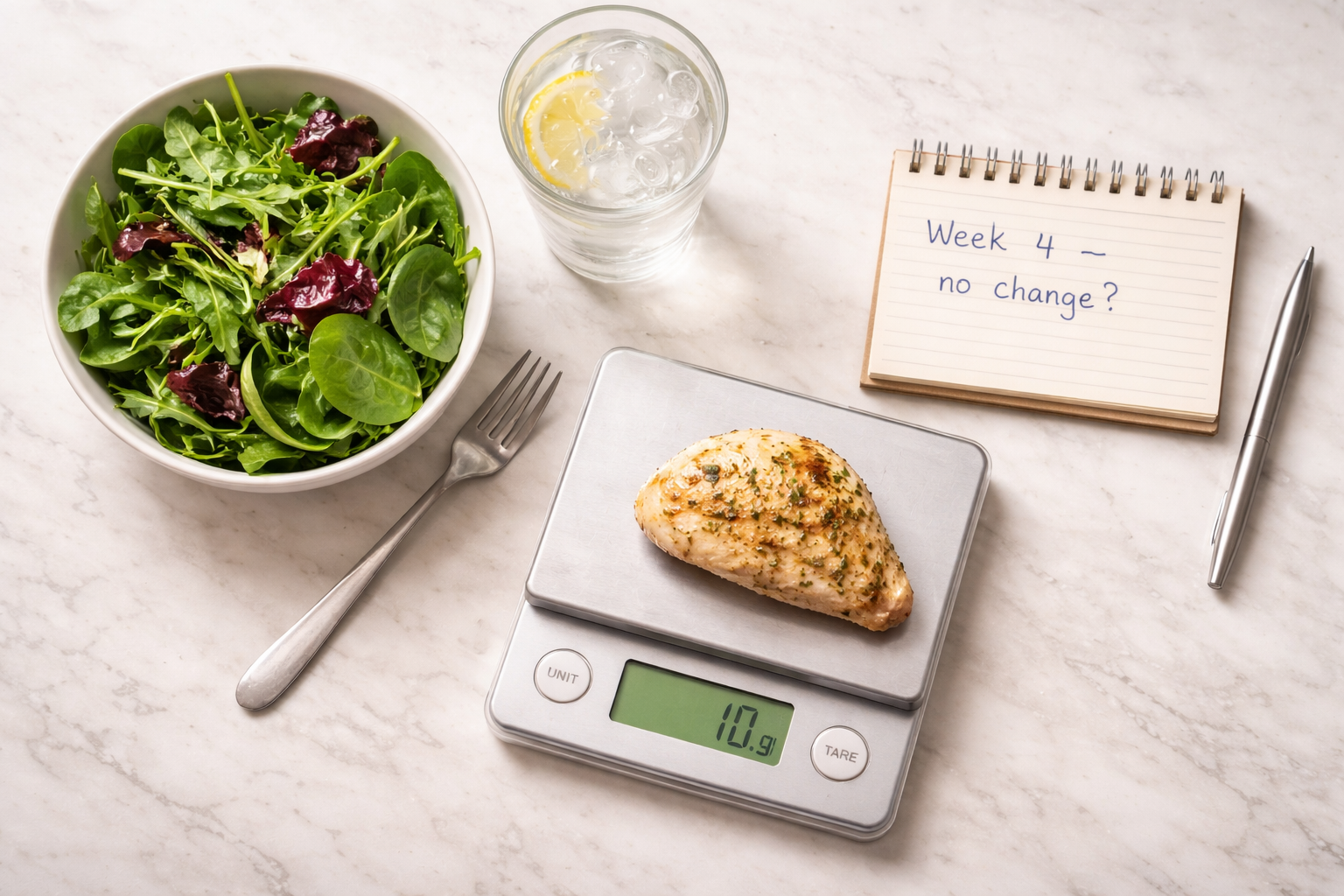
I spent months eating what I genuinely believed was very little and wondering why the scales were not moving. I had done the maths. I was eating less. The weight should have been coming off. It was not.
What I eventually learned — through trial, error, a lot of research, and ultimately a significant weight-loss journey of my own — is that “eating less” is not a simple equation. The body does not respond to a calorie deficit like a spreadsheet. It responds like a survival system that has spent millions of years evolving to resist starvation.
This guide covers every real reason eating less stops working, what is actually happening in your body, and — most importantly — what to do about each one. If you have been stuck for weeks or months despite genuinely reducing your food intake, something in here is almost certainly the explanation.
📋 On this page
- Why eating less stops working
- Reason 1: You are eating more than you think
- Reason 2: Metabolic adaptation
- Reason 3: You are not eating enough protein
- Reason 4: Leptin resistance and hunger hormones
- Reason 5: Cortisol and chronic stress
- Reason 6: Poor sleep
- Reason 7: Insulin resistance
- Reason 8: Muscle loss from under-eating
- Reason 9: Weekend and social eating
- Reason 10: Liquid calories and hidden intake
- Reason 11: Thyroid and medical causes
- Reason 12: You are losing fat but not seeing it on the scales
- What to actually do about it
- The case for a diet break
- Nutritional support for a stalled diet
- FAQs
Why eating less stops working — the honest explanation
The basic principle of weight loss is real: consume fewer calories than you burn and your body uses stored fat for energy. That is not wrong. But it is incomplete in ways that matter enormously in practice.
Here is what the simplified version misses:
- your body actively adjusts its calorie burn in response to eating less — sometimes dramatically
- hormones that regulate hunger, fullness, fat storage, and metabolism all shift in response to dieting
- the stress and sleep quality in your life directly affect whether your body releases fat or holds onto it
- what you eat matters as much as how much you eat — particularly protein
- most people significantly underestimate how much they are actually consuming
The result is that someone who starts a calorie-restricted diet and loses weight for the first few weeks often finds progress slowing, stopping, or even reversing — despite making no conscious change. This is not a failure of willpower. It is biology doing exactly what it was designed to do.
| What you think is happening | What is actually happening |
|---|---|
| Eating less → burning stored fat | Eating less → body lowers metabolic rate, increases hunger, reduces movement |
| Consistent deficit → consistent loss | Deficit shrinks as body adapts, loss slows even with same intake |
| Scales not moving → not losing fat | Scales not moving → possibly losing fat but gaining water or muscle |
| Eating less than ever → should be fastest loss | Severe restriction → muscle loss, hormonal disruption, metabolic slowdown |
Reason 1: You are eating more than you think
The most common reason — and the least comfortable one
Research consistently shows that people underestimate their calorie intake by an average of 20–40%. This is not dishonesty — it is a well-documented cognitive bias that affects everyone, including trained dietitians and nutrition researchers when they estimate their own intake without tracking.
The ways this happens are predictable and worth knowing:
Portion size underestimation
Most people pour significantly more than a stated serving size without realising it. Oil is the most dramatic example — a “splash” of olive oil is typically 100–150 calories, while a stated tablespoon serving is around 120 calories. Most people pour two to three tablespoons and count zero. Nuts, cheese, peanut butter, cereal, and pasta are other notorious underestimation foods.
Cooking and tasting calories
Tasting while cooking, finishing children’s food, and eating while preparing meals are all uncounted but real calories. Research estimates these add 200–400 calories to the average person’s daily intake without any conscious awareness.
Tracking only “meals” not everything
A coffee with full-fat milk and one sugar. A handful of crisps from a shared bag. One biscuit with tea, twice a day. A protein bar that is 250 calories. None of these feel like meals so many people do not log them. Cumulatively they can add 300–600 calories per day.
Weekend and special occasion drift
A solid deficit five days a week is entirely negated by two days of significantly higher intake. Many people eat very carefully Monday through Friday and then “relax” on the weekend in ways that cancel the week’s deficit entirely. See Reason 9 for more detail on this.
What to do
- Use a food scale for one to two weeks to recalibrate your portion intuition — you do not need to do it forever
- Log everything including cooking oils, drinks, condiments, and tastings
- Be consistent across all seven days, not just weekdays
- Use the “scan barcode” feature in tracking apps for packaged foods rather than estimating
Reason 2: Metabolic adaptation — your body has adjusted
The body’s most powerful defence against weight loss
When you consistently eat less, your body does not simply burn stored fat to make up the difference. It actively reduces the number of calories it burns through multiple mechanisms — some of which can persist for years after dieting ends.
Metabolic adaptation — sometimes called “adaptive thermogenesis” — involves several simultaneous processes:
Reduced basal metabolic rate (BMR)
Your BMR is the number of calories your body burns at complete rest to maintain basic functions. After sustained calorie restriction, BMR drops — not just because you have less body mass (which would be expected) but by an additional 10–15% beyond what body size alone would predict. This is the body actively conserving energy in response to perceived food scarcity.
Reduced NEAT (non-exercise activity thermogenesis)
As covered in Post 1, NEAT is background movement — fidgeting, posture shifts, casual walking, standing. When calorie intake drops, NEAT drops almost automatically and unconsciously. Studies have measured reductions of 300–400 calories per day in NEAT alone during calorie restriction, even without the person doing anything differently.
Improved digestive efficiency
The gut adapts to extract more calories from the same food during restriction. The same meal delivers slightly more energy when you have been dieting for months than when you first started. This effect is small but real.
Reduced body temperature
Core body temperature drops slightly during sustained restriction — an energy-saving measure. This is why people on long diets often feel cold even in warm environments.
What to do
- Avoid extreme calorie restriction — deficits of 500–750 calories per day produce better long-term results than 1,000+ deficits because they trigger less adaptation
- Incorporate diet breaks (see the dedicated section below) — periods of eating at maintenance reset some of the adaptive responses
- Increase protein to protect muscle mass during the deficit — muscle loss amplifies metabolic slowdown
- Prioritise resistance exercise alongside calorie reduction — maintaining muscle preserves metabolic rate better than cardio alone
- Increase NEAT deliberately — see the steps for weight loss guide for practical approaches

Reason 3: You are not eating enough protein
The single most impactful dietary change most people are not making
Protein is the macronutrient with the most direct impact on whether your weight loss comes from fat or muscle, how hungry you feel on a deficit, how much your metabolism slows during dieting, and how sustainable the whole process is.
Most UK adults eating a reduced-calorie diet consume 50–80g of protein per day. The amount needed to preserve muscle, support metabolism, and control appetite during weight loss is closer to 120–160g per day for the average adult — and higher for heavier people or those who are active.
Why protein matters so much for weight loss
Thermic effect: 25–30% of the calories in protein are burned during digestion. Eat 200 calories of protein and your body burns 50–60 calories just processing it. The equivalent figure for carbohydrates is 5–10% and for fat is 0–3%. Protein is the only macronutrient that meaningfully contributes to calorie burn through digestion.
Satiety: protein is the most filling macronutrient. It suppresses ghrelin (the hunger hormone) more effectively than carbohydrates or fat, and it sustains fullness for longer. People who eat a high-protein diet consistently report less hunger on the same or lower calorie intake.
Muscle preservation: during a calorie deficit, the body will break down muscle for energy if protein intake is inadequate. Muscle tissue is metabolically expensive — it burns calories just to maintain itself. Losing muscle during dieting reduces your BMR, meaning you need to eat even less to maintain the same deficit. This is a vicious cycle that high protein intake prevents.
Body composition: research consistently shows that people in a calorie deficit who eat high protein lose more fat and less muscle than those eating low protein at the same calorie intake. The number on the scales may be similar, but the body composition change is dramatically different.
High protein food sources
| Food | Protein per 100g | Calories per 100g | Protein per calorie (efficiency) |
|---|---|---|---|
| Chicken breast (cooked) | 31g | 165 kcal | Excellent |
| Tuna (tinned in water) | 26g | 116 kcal | Excellent |
| Egg whites | 11g | 52 kcal | Excellent |
| Cottage cheese | 11g | 98 kcal | Very good |
| Greek yoghurt (0%) | 10g | 57 kcal | Very good |
| Prawns (cooked) | 24g | 99 kcal | Very good |
| Salmon (cooked) | 25g | 208 kcal | Good |
| Lentils (cooked) | 9g | 116 kcal | Good |
| Tofu (firm) | 8g | 76 kcal | Good |
| Whole eggs | 13g | 155 kcal | Good |
🌿 Lily & Loaf Daily Fuel — protein shake with vitamins, minerals and fibre
When appetite is reduced — whether from eating less, GLP-1 medication, or post-surgery recovery — hitting 140–160g of protein per day through food alone becomes genuinely difficult. Daily Fuel provides 21g of complete protein per serving with all 8 essential amino acids, plus 15 vitamins and minerals including iron, B12 and magnesium, and 5g of fibre for satiety and digestion. A practical and efficient way to close the protein gap without adding significant calories.
Reason 4: Leptin resistance and hunger hormones
The hormone system that fights back against fat loss
Leptin is produced by fat cells and signals to the brain that energy stores are adequate — it is the fullness and satiety hormone at a systemic level. When you lose fat, leptin levels fall. When leptin falls, the brain responds by increasing hunger, reducing energy expenditure, and making food significantly more rewarding. This is the hormonal basis of why dieting gets harder over time, not easier.
How leptin affects weight loss
Leptin reduction during a calorie deficit triggers a coordinated hormonal response:
- Ghrelin rises — the primary hunger hormone increases, making food feel more urgently necessary
- Neuropeptide Y increases — a brain chemical that drives carbohydrate cravings specifically
- Thyroid hormones reduce — further slowing metabolic rate
- Dopamine response to food increases — food becomes more rewarding and harder to resist
This is not psychology — it is physiology. The person who “can’t stop thinking about food” while dieting is experiencing a genuine neurological response to falling leptin, not a character flaw.
Leptin resistance in obesity
People who have been significantly overweight for years often develop leptin resistance — a state where the brain stops responding normally to leptin signals even when fat stores (and therefore leptin levels) are high. This means the fullness signal is chronically impaired, hunger is chronically elevated, and the body acts as though it is starving even when it has substantial energy reserves.
Leptin resistance is one of the most significant reasons people with obesity find it genuinely harder to feel full and easier to overeat than people of normal weight — not because of lack of effort but because of a compromised hormonal signalling system.
What improves leptin sensitivity
- Adequate sleep — even one week of sleep restriction measurably reduces leptin and increases ghrelin
- Reducing highly processed food — ultra-processed food appears to interfere with leptin signalling particularly
- Regular physical activity — exercise improves leptin sensitivity independently of weight loss
- Diet breaks — returning to maintenance calories periodically allows leptin to recover
- Omega-3 fatty acids — have demonstrated leptin sensitivity improvements in research
🌿 Lily & Loaf Daily Balance — Omega 3-6-9
Omega-3 fatty acids support normal cardiovascular function, joint health, and brain health — and have been shown in research to improve inflammatory markers that are associated with leptin resistance. Daily Balance provides essential fatty acids from a balanced omega 3-6-9 formula to support heart, joint, skin, and brain health as part of a daily nutrition routine.
Browse Lily & Loaf Daily Balance →
Reason 5: Cortisol and chronic stress
The stress hormone that actively stores fat
Cortisol is your primary stress hormone — produced in response to physical, psychological, and emotional stress. In short bursts it is essential and beneficial. Chronically elevated, it directly undermines fat loss in ways that have nothing to do with how much you are eating.
How cortisol blocks fat loss
Promotes fat storage — particularly abdominal fat: cortisol directs the body to store fat preferentially in visceral (abdominal) adipose tissue. This is why people under chronic stress often gain or retain fat specifically around the middle, regardless of overall calorie intake.
Increases insulin release: cortisol raises blood glucose (a survival mechanism — your body wants fuel available if you need to run), which triggers insulin release. Elevated insulin promotes fat storage and inhibits fat breakdown. You can be in a calorie deficit while elevated cortisol and insulin actively oppose fat release from stores.
Drives cravings for high-calorie, high-palatability food: the dopamine system under chronic stress craves comfort foods — typically high in sugar, fat, or both. This is not weakness; it is the brain seeking the fastest neurochemical relief it knows. Research shows that people under chronic stress consume more calories, particularly from ultra-processed foods, even when they intend not to.
Disrupts sleep: cortisol and sleep are inversely linked. Elevated evening cortisol — common in chronically stressed people — delays sleep onset, reduces deep sleep quality, and creates a negative cycle (poor sleep → more cortisol → worse sleep).
Breaks down muscle tissue: cortisol is catabolic — it breaks down tissue for energy. Under chronic stress, muscle protein is converted to glucose through gluconeogenesis. This reduces muscle mass, lowers BMR, and further impairs the body’s capacity to burn fat efficiently.
Common sources of chronic stress that affect weight loss
- Work pressure and long hours
- Financial stress
- Relationship difficulties
- Undereating itself — a calorie deficit is a physical stressor that raises cortisol
- Over-exercising or training too hard without adequate recovery
- Chronic low-grade illness or inflammation
- Parenting demands and sleep deprivation
What lowers cortisol
- Adequate sleep — the most powerful cortisol-regulating intervention available
- Moderate (not excessive) exercise — a brisk walk lowers cortisol; a punishing two-hour gym session raises it
- Magnesium — research consistently links low magnesium to elevated cortisol, and supplementation has demonstrated cortisol-reducing effects
- Reducing ultra-processed food and caffeine excess
- Social connection — genuine social interaction lowers cortisol measurably
- Time outdoors in natural environments
🌿 Lily & Loaf Triple Magnesium — for stress, sleep and cortisol support
Magnesium is involved in over 300 enzymatic reactions in the body, including regulation of the HPA axis (the cortisol stress response system). Low magnesium amplifies the cortisol response to stress; adequate magnesium helps buffer it. Triple Magnesium combines three bioavailable forms of magnesium for optimal absorption, and is best taken in the evening when it also supports sleep quality and muscle recovery.
Browse Lily & Loaf Triple Magnesium →

Reason 6: Poor sleep
The most underestimated factor in weight loss
Sleep is not a passive state — it is when the body repairs tissue, regulates hormones, processes memory, and manages the hormonal signals that govern hunger and fat storage the next day. Consistently poor sleep does not just make weight loss harder; it makes the biology of fat loss work against you.
What poor sleep does to weight loss
Increases ghrelin, reduces leptin: a landmark University of Chicago study found that just two days of sleeping 4 hours instead of 8 increased ghrelin by 28% and reduced leptin by 18%. The result was a significant increase in appetite — specifically for high-calorie, carbohydrate-dense foods. The participants had not changed what they ate; sleep alone changed their hunger hormones dramatically.
Shifts fat loss to muscle loss: research published in the Annals of Internal Medicine found that dieters who slept 8.5 hours per night lost 55% of their weight loss from fat, while those sleeping 5.5 hours lost only 25% from fat — losing the remaining 75% from muscle. Both groups were in the same calorie deficit. Sleep quality determined whether the body burned fat or muscle.
Increases cortisol: sleep deprivation is one of the most reliably cortisol-elevating experiences known, with measurable increases in cortisol after even one night of poor sleep.
Impairs insulin sensitivity: even partial sleep deprivation measurably reduces insulin sensitivity, making blood sugar harder to regulate and promoting fat storage.
Reduces willpower and decision-making quality: the prefrontal cortex — the part of the brain responsible for impulse control and long-term thinking — is significantly impaired by sleep deprivation. Food choices worsen, portion control becomes harder, and the emotional pull of comfort food increases.
How much sleep is needed for weight loss
7–9 hours per night is the evidence-based range for adults. Below 7 hours, the hormonal effects described above become significant. Below 6 hours, they become severe. Sleep quality matters as much as duration — fragmented sleep that totals 8 hours produces different hormonal outcomes than 8 uninterrupted hours.
What actually improves sleep quality
- Consistent sleep and wake times — even on weekends
- Dark, cool bedroom — melatonin production is temperature and light sensitive
- No screens for 30–60 minutes before bed — blue light suppresses melatonin
- Avoiding alcohol — alcohol disrupts REM and deep sleep significantly despite promoting initial drowsiness
- Magnesium supplementation — particularly magnesium glycinate, which has the strongest sleep quality evidence
- Reducing caffeine after 2pm — caffeine has a 5–6 hour half life
- A consistent wind-down routine — the brain responds to cues that sleep is approaching
🌿 Lily & Loaf Double Magnesium — for sleep quality and recovery
Magnesium glycinate — one of the forms in Double Magnesium — is the most researched form for sleep quality improvement. Magnesium supports normal psychological function, nervous system regulation, and the reduction of tiredness and fatigue. Taking Double Magnesium in the evening as part of a consistent wind-down routine supports both sleep quality and overnight muscle recovery — both directly relevant to weight loss outcomes the next day.
Reason 7: Insulin resistance
When your body stops responding normally to blood sugar signals
Insulin is the hormone that unlocks cells to allow glucose from food to enter and be used for energy. In insulin-resistant people, cells do not respond normally to insulin signals — so the pancreas produces more and more insulin to achieve the same effect. Chronically elevated insulin is one of the most powerful fat-storage signals the body has.
How insulin resistance affects weight loss
- High insulin levels suppress fat breakdown (lipolysis) — the body cannot easily access stored fat for energy when insulin is elevated
- Excess glucose that cannot enter cells efficiently is converted to fat and stored — particularly as visceral (abdominal) fat
- Blood sugar fluctuations create intense hunger and cravings, particularly for carbohydrates — the body is trying to get more glucose in to compensate for poor uptake
- Energy levels become erratic — the “afternoon slump” and post-meal fatigue many people experience are often insulin-related
Signs that insulin resistance may be a factor
- Weight that concentrates particularly around the abdomen
- Strong cravings for carbohydrates and sugar
- Energy crashes 1–2 hours after meals
- Fatigue that is not explained by sleep
- A family history of type 2 diabetes
- Polycystic ovary syndrome (PCOS)
- History of gestational diabetes
What improves insulin sensitivity
- Regular physical activity — exercise is one of the most powerful insulin sensitisers available, independent of weight loss
- Reducing refined carbohydrates and sugar — the blood glucose response to food directly affects insulin demand
- Increasing fibre intake — slows glucose absorption and reduces post-meal insulin spikes
- Adequate sleep — as discussed above
- Reducing stress and cortisol
- Increasing protein and reducing refined carbohydrates
- Walking after meals — even a 10-minute walk after eating measurably reduces post-meal blood glucose
Reason 8: Muscle loss from under-eating
The paradox of eating too little
Very low calorie diets — typically defined as under 800 calories per day, but problematic effects can begin below 1,000–1,200 depending on the individual — cause the body to break down muscle tissue for energy. Losing muscle while dieting creates a cascading problem that makes weight loss progressively harder.
Why muscle loss matters so much
Muscle tissue is metabolically expensive to maintain. Each kilogram of muscle burns approximately 13 calories per day at rest, compared to approximately 4 calories per kilogram of fat. Losing 5kg of muscle through aggressive dieting reduces BMR by approximately 65 calories per day. Lose 10kg of muscle and that becomes 130 calories per day — a meaningful and permanent metabolic penalty unless muscle is rebuilt.
This is why yo-yo dieters — people who lose and regain weight repeatedly — often find each cycle harder than the last. Each period of aggressive restriction loses some muscle. Each regain period mostly adds fat back. Over several cycles, the ratio of muscle to fat worsens, BMR drops, and the same calorie intake produces more fat storage than it did before the cycling began.
Signs you may be losing muscle not fat
- Strength declining in everyday activities — stairs feel harder, carrying shopping is more difficult
- Feeling weak or shaky despite eating enough calories
- Scales going down but body composition looking softer or more “skinny fat”
- Fatigue disproportionate to calorie intake
How to preserve muscle while eating less
- Eat adequate protein — as detailed in Reason 3 above, 1.6–2.0g per kg of target body weight
- Include resistance exercise 2–3 times per week — even bodyweight exercises at home preserve muscle significantly better than cardio alone
- Do not cut below 1,200 calories (women) or 1,500 calories (men) without medical supervision
- Aim for a moderate deficit (500 calories per day) rather than an aggressive one
Reason 9: Weekend and social eating
The gap between what we plan and what we actually do
A common and rarely discussed pattern: eating well within a calorie deficit Monday through Friday, then eating significantly above maintenance on Saturday and Sunday. Over a full week, the net result is maintenance or even a surplus — despite genuinely eating carefully for five days.
The maths of weekend drift
Consider a person who creates a 500 calorie deficit on each weekday (2,500 calorie weekly deficit) but consumes 1,000 calories above maintenance on each weekend day (2,000 calorie weekly surplus). Their net weekly deficit is only 500 calories — equivalent to one tenth of a pound of fat loss per week. Most people in this situation feel like they are “being really good” because their weekday behaviour is genuinely disciplined.
Social eating patterns that derail deficits
- Restaurant meals — restaurant portions are typically 2–3x larger than home portions and contain significantly more oil, butter, and hidden calories than equivalent home-cooked meals
- Alcohol — a bottle of wine is approximately 600 calories; a pint of beer is 180–250 calories; cocktails frequently exceed 300 calories each. Alcohol also reduces inhibition around food choices and disrupts sleep quality.
- Takeaways — a typical UK takeaway meal (curry, Chinese, pizza) is often 1,000–1,500 calories, frequently more
- Social events — office celebrations, birthday parties, family gatherings all tend to involve high-calorie food that is hard to quantify and socially awkward to decline
How to manage without eliminating your social life
- Choose one day as a “higher intake” day and plan for it — eating slightly less on surrounding days to create weekly balance
- At restaurants, look up menus in advance and choose before arriving — this removes in-the-moment decision making
- Set a specific alcohol limit before a social event, not during it
- Eat a protein-rich snack before events where food will be freely available — arriving less hungry produces better choices
- Track weekly averages rather than daily — a flexible approach that accounts for variation is more sustainable than rigid daily targets
Reason 10: Liquid calories and hidden intake
The calories that do not register as food
Liquid calories are uniquely problematic for weight loss because they produce almost no satiety response — they do not suppress hunger the way solid food does — while contributing significantly to daily intake. Research consistently shows that people who consume calories in liquid form do not compensate by eating less solid food.
Common liquid calorie sources
| Drink | Typical calories | Notes |
|---|---|---|
| Latte (full fat, 12oz) | 190–220 kcal | Two per day = 400+ kcal before food |
| Oat milk flat white | 150–180 kcal | Often perceived as “healthy” |
| Orange juice (250ml) | 110–120 kcal | Same sugar as a can of cola |
| Smoothie (shop-bought) | 200–350 kcal | Often perceived as a light option |
| Protein shake (commercial) | 150–300 kcal | Varies hugely by brand |
| Pint of lager | 180–220 kcal | Three pints = 600+ kcal |
| Glass of wine (250ml) | 190–210 kcal | A bottle = ~600 kcal |
| Sports drink (500ml) | 130–150 kcal | Only useful during intense prolonged exercise |
| Hot chocolate (café) | 300–400 kcal | Often more than a meal |
Hidden calorie sources in otherwise healthy eating
- Cooking oils — 100–130 calories per tablespoon; most people use 2–4 tablespoons when sautéing
- Salad dressings — shop-bought Caesar or ranch dressings can add 200–300 calories to an otherwise low-calorie salad
- Sauces and condiments — ketchup, mayo, sweet chilli, and teriyaki sauces all add significant calories that rarely get counted
- Protein bars — marketed as healthy, many contain 250–350 calories and substantial sugar
- Dried fruit — very calorie-dense compared to fresh fruit; 50g of raisins is approximately 150 calories
- Nuts — extraordinarily healthy but calorie-dense; a small handful (30g) of mixed nuts is 170–200 calories
Reason 11: Thyroid and other medical causes
When the problem needs a GP, not a diet adjustment
Most cases of “eating less but not losing weight” are explained by the behavioural, hormonal, and metabolic factors already covered. But a minority have an underlying medical cause that a dietary approach alone cannot address.
Hypothyroidism (underactive thyroid)
The thyroid gland produces hormones that regulate metabolic rate. An underactive thyroid produces insufficient thyroid hormone, which can reduce BMR by 15–40% — a massive effect that makes weight loss extremely difficult regardless of calorie intake. Other symptoms include fatigue, feeling cold, constipation, hair loss, dry skin, and low mood. Hypothyroidism is significantly more common in women and increases in prevalence with age. A simple blood test (TSH) through your GP confirms or excludes it.
Polycystic ovary syndrome (PCOS)
PCOS involves insulin resistance, elevated androgens, and disrupted hormonal signalling that collectively make weight loss harder and fat storage (particularly abdominal) more pronounced. Women with PCOS often need to approach weight loss differently — with a stronger focus on carbohydrate quality, insulin management, and potentially medical support.
Medications
Several commonly prescribed medications cause weight gain or make weight loss significantly harder:
- Antidepressants — particularly SSRIs and tricyclics
- Antipsychotics
- Beta-blockers
- Insulin and some diabetes medications
- Corticosteroids
- Some antihistamines
- Hormonal contraceptives — for some people
If you are on any of these and have been unable to lose weight despite genuine dietary effort, discuss this with your GP. Do not stop medication without medical guidance, but the conversation is worth having.
Menopause and perimenopause
The hormonal changes of menopause — particularly declining oestrogen — shift fat distribution toward the abdomen, reduce BMR, disrupt sleep, and make weight loss objectively harder than it was before. This is not imagination; the biology genuinely changes. Women in perimenopause or menopause often need to adjust their approach, typically by increasing protein further, adding resistance training, and prioritising sleep even more carefully.
Reason 12: You are losing fat but the scales are not showing it
When the evidence is there — just not where you are looking
Body weight fluctuates by 1–3kg on any given day due to water retention, digestive contents, hormonal changes, and sodium intake. These fluctuations are real and measurable but have nothing to do with fat loss. A person can lose 200–300g of fat in a week while simultaneously retaining 1–2kg of water and show a net weight gain on the scales.
What causes weight fluctuations that mask fat loss
- Water retention from increased exercise: starting a new exercise programme causes muscles to retain water as they adapt and repair — scale weight rises while body fat falls
- High sodium intake: eating more salt than usual causes water retention; the effect can persist for 24–48 hours
- Hormonal fluctuations: water retention of 1–3kg in the days before menstruation is normal and real — scales during this window are unreliable indicators of fat loss
- Digestive contents: food and waste in the digestive system at any given time weighs 0.5–2kg and varies daily
- Glycogen storage: increasing carbohydrate intake causes water retention because glycogen stores approximately 3g of water per gram — adding or losing 200–400g of glycogen changes scale weight by 600–1,200g
Better ways to measure progress
- Weekly average weight (daily weigh-ins averaged over 7 days) rather than single daily readings
- Body measurements — waist, hips, chest — often change before the scales do
- How clothes fit — jeans that were tight becoming comfortable is fat loss, regardless of what the scales say
- Progress photos taken every 2–4 weeks — visual changes are often more encouraging and accurate than scales
- Body composition scans — DEXA scans or InBody measurements distinguish fat from muscle and water
What to actually do — a practical action plan
If you are eating less and not losing weight, work through these steps in order. Each step is a diagnostic and an action combined.
| Step | Action | What it addresses |
|---|---|---|
| 1 | Track everything for 7 days with a food scale | Reason 1: underestimation |
| 2 | Calculate your current protein intake and increase to 1.6g/kg if below | Reason 3: insufficient protein |
| 3 | Audit your sleep — are you consistently getting 7+ hours? | Reason 6: poor sleep |
| 4 | Assess stress levels honestly — work, relationship, financial | Reason 5: cortisol |
| 5 | Count your weekend calories for two weeks | Reason 9: weekend drift |
| 6 | Eliminate or account for all liquid calories | Reason 10: hidden intake |
| 7 | Add 2,000 steps to your daily average | Reason 2: metabolic adaptation via NEAT |
| 8 | Take body measurements weekly alongside scales | Reason 12: scale weight fluctuation |
| 9 | Consider a 2-week diet break at maintenance calories | Reasons 2, 4, 5: metabolic and hormonal reset |
| 10 | If none of the above produces change after 6 weeks, see your GP | Reason 11: medical causes |
The case for a diet break
A diet break is a planned period — typically 2–4 weeks — of eating at maintenance calories rather than a deficit. It sounds counterintuitive. It works.
What a diet break does
- Leptin levels recover — after a period at maintenance, leptin rises, hunger normalises, and the hormonal environment becomes more favourable for the next dieting phase
- Metabolic rate partially recovers — some of the adaptive metabolic slowdown reverses during a break
- Cortisol drops — the physical stress of sustained restriction eases
- Muscle glycogen refills — energy for exercise improves, training quality rises, and muscle preservation improves in the next phase
- Psychological sustainability improves — research shows that people who take planned diet breaks lose the same or more total weight over 6 months as those who diet continuously, with better adherence and less regain
How to do a diet break properly
- Calculate your maintenance calories (TDEE) — your current intake plus your deficit
- Eat at maintenance for 2–4 weeks — not above, not significantly below
- Continue the same exercise and food quality habits — the break is from the deficit, not from healthy eating
- Expect a small scale weight increase (typically 1–2kg of water and glycogen) — this is not fat gain
- Return to a moderate deficit after the break
Nutritional support for a stalled diet
When eating less for an extended period, micronutrient deficiencies become more likely — both because total food intake is lower and because restriction often narrows dietary variety. These deficiencies can directly affect energy, hormone function, and the body’s ability to lose fat efficiently.
🌿 Lily & Loaf Daily Essentials Bundle — the complete daily safety net
The Daily Essentials Bundle covers the three most important nutritional bases for anyone eating less and trying to lose weight: Daily Fuel (21g protein, 15 vitamins and minerals, 5g fibre — closes protein and micronutrient gaps), Daily Balance (Omega 3-6-9 — supports hormonal health, inflammation reduction, and leptin sensitivity), and Daily Flora (15 probiotic strains and prebiotics — supports gut health and the gut-brain axis that influences appetite and mood). A practical and efficient daily routine for people on a calorie deficit.
🌿 Lily & Loaf Vitamin D3+K2 — especially important during weight loss
Vitamin D is stored in body fat and released as fat is lost — but during active weight loss, many people experience a temporary functional deficiency as the released vitamin D is quickly used. Vitamin D supports normal muscle function, immune function, mood, and bone health. In the UK, deficiency is extremely common for much of the year. D3+K2 ensures K2 directs calcium to bones rather than soft tissues — important when eating less and potentially reducing dairy intake.
🌿 Lily & Loaf Multi-Vits & Minerals — broad spectrum micronutrient insurance
When eating 1,200–1,500 calories per day, getting every essential vitamin and mineral from food alone is genuinely difficult. The Lily & Loaf Multi-Vits & Minerals formula provides a broad-spectrum baseline — vitamin D, vitamin C, B-complex, zinc, iron, iodine, folate, and botanical extracts including turmeric and green tea — covering the most common gaps that appear during calorie restriction.
Related reading on this site
- How Many Steps a Day to Lose Weight UK
- Weight Loss Plateau: What Actually Helps
- How to Reduce Muscle Loss During Weight Loss
- Why Am I So Tired During Weight Loss?
- Can’t Sleep? What Actually Helps
- Electrolytes and Weight Loss
- Supplements for Weight Loss: UK Starter Stack
- Walking Routine for Beginners

Frequently asked questions
Why am I not losing weight even though I’m eating less?
The most common reasons are underestimating actual calorie intake, metabolic adaptation (your body burning fewer calories in response to restriction), insufficient protein, poor sleep, elevated cortisol from stress, hormonal changes including leptin resistance, and inconsistent intake over weekends. Most people experiencing this are dealing with several of these simultaneously.
Can eating too little actually stop weight loss?
Yes. Very low calorie intake triggers metabolic adaptation — the body reduces its metabolic rate, increases hunger hormones, reduces background movement, and breaks down muscle for energy. The result is a body that burns significantly fewer calories at rest, making the same intake produce less and less deficit over time.
How long does it take for eating less to show results?
Early weight changes (1–2 weeks) often reflect water and glycogen changes rather than fat loss. Meaningful fat loss on a consistent calorie deficit typically becomes visible after 4–8 weeks. If nothing has changed after 3–4 consistent weeks, something else is affecting the equation — work through the reasons in this guide.
Does stress stop you losing weight even if you eat less?
Yes. Chronic stress elevates cortisol, which promotes abdominal fat storage, increases appetite and cravings, disrupts sleep, and impairs insulin sensitivity. You can be in a calorie deficit while stress hormones actively counteract fat release from stores.
Can poor sleep stop weight loss?
Yes. Even one week of sleeping under 6 hours measurably increases ghrelin, reduces leptin, elevates cortisol, and shifts the body toward muscle loss rather than fat loss — even on the same calorie intake.
Why did I lose weight at first but now nothing is happening?
Early weight loss is partly water weight and glycogen depletion rather than purely fat. As the diet continues, metabolic adaptation reduces calorie burn, the original deficit shrinks, and hormonal changes increase hunger. A diet break at maintenance calories for 2–4 weeks can reset hormonal and metabolic responses before the next phase.
Does protein intake affect weight loss?
Significantly. Protein has the highest thermic effect of any macronutrient, is the most satiating, and preserves muscle mass during a deficit. People who eat adequate protein lose more fat and less muscle than those who do not — even on identical calorie intakes.
What should I do if I’ve been eating less for months but stopped losing weight?
First, audit your actual intake with a food scale for one week — most people find they are eating 300–500 more calories than they thought. Then assess sleep, stress, and protein intake. Consider a 2–4 week diet break at maintenance calories. If nothing changes after 6 weeks of genuine adjustments, speak to your GP about thyroid function and other medical causes.
Discover more from Healthy Weight Loss GLP1
Subscribe to get the latest posts sent to your email.