
An air fryer won’t make you lose weight on its own, but it’ll make you cook the foods that help you lose weight with less fat, less hassle, and less washing up than any other kitchen appliance I own. For a GLP-1 user in 2026, where nutrition-dense, protein-forward meals are doing the heavy lifting, an air fryer genuinely earns its counter space. This post walks through the four UK air fryers worth considering in 2026, what size to buy, what to actually cook, and the small things most reviews don’t tell you.
For the broader kitchen-gear picture see Kitchen Gear Worth Buying in the Complete Guide. For recipes that make the most of it, the High-Protein Dinner guide has several that air-fry brilliantly.
Why an air fryer, specifically, for GLP-1 users
Three practical reasons it fits the GLP-1 lifestyle better than a standard oven:
1. It cooks portions of one or two fast. Your appetite is suppressed. You’re rarely cooking a full family oven tray for yourself. An air fryer heats up in 2 minutes and cooks a single chicken breast in 12 — no waiting for a cold oven to reach 200°C just to cook one portion.
2. It lets you cook higher-protein foods that historically needed deep-frying. Chicken thighs, salmon fillets, prawns, halloumi, tofu. All of these crisp up beautifully in an air fryer without needing oil beyond a light spray. Same texture, fraction of the fat.
3. It rescues frozen protein. A freezer stocked with chicken breasts, salmon fillets, or lean meat portions becomes an actual useful resource when you have an appliance that can take them from frozen to cooked in 15–20 minutes. Frozen chicken breast in the oven takes 45 minutes; in an air fryer, 18–22.
It’s not magic — it’s a small convection oven with a fan. But the speed and the single-portion-friendliness changes cooking behaviour in a meaningful way.
What to look for when buying
The air fryer market has exploded since 2020 and the entry-level has gotten genuinely good. The premium has gotten better but not by proportionally as much. Five things that actually matter:
1. Size (litres). This is the single most important decision. Too small and you can’t cook a proper chicken breast without cutting it in half. Too big and it takes up the kitchen counter of three smaller appliances. For GLP-1 users specifically: a single-basket 4–6 litre is the sweet spot for solo cooking; a dual-basket 8–10 litre is the sweet spot for household cooking where you want to make a full meal for two or more.
2. Dual basket vs single basket. Dual-basket models let you cook protein and vegetables simultaneously at different temperatures and times. For meal prep this is a meaningful quality-of-life improvement. Single-basket models are cheaper, smaller, and fine if you don’t mind cooking in two batches.
3. Temperature range. Good models go 40–80°C low (for dehydrating or slow-cooking) up to 200–230°C high (for proper crisping). If an air fryer caps out at 180°C you won’t get good crispy chicken skin. Check this spec.
4. Dishwasher-safe basket and crisper plate. The difference between a kitchen tool you use every day and one that lives in a cupboard. Non-dishwasher baskets get grim fast with regular cooking.
5. Window or not. Being able to see what’s happening without opening the drawer and interrupting the cook matters more than you’d expect. Windowed air fryers cost £15–£30 more but are worth it.
Things that matter less than marketing suggests: app connectivity, voice control, 50+ “smart” presets, rotisserie function for most home cooks, “steam” combination features. Nice-to-haves, not decision-makers.
The 4 picks for 2026
Best overall household: Ninja Foodi Dual Zone AF400UK (9.5L)
Approximately £180–£220. Dual 4.75L baskets. 40–240°C temperature range. 6 cooking functions.
The reason Ninja dominates UK air fryer sales: the dual-basket format solves the real problem of cooking a full meal in one appliance. You can cook salmon in one basket at 180°C for 12 minutes and asparagus in the other at 200°C for 8 minutes, both finishing at the same moment thanks to the “sync” function that delays the faster one until the slower one is ready.
For a GLP-1 household, this is genuinely transformative for dinner prep. Protein in one basket, vegetables in the other, plate 15 minutes after starting. Baskets are dishwasher-safe. Crisper plates hold up well after a year of daily use. The only legitimate gripe is the unit’s size — it takes up about as much counter space as a standard microwave.
Buy from: Ninja Foodi Dual Zone AF400UK on Amazon UK.
Best solo / small kitchen: Tefal Easy Fry 4.2L
Approximately £70–£90. Single 4.2L basket. 80–200°C range. 8 cooking presets.
If you live alone, have a small kitchen, or just want an air fryer without spending £200+, the Tefal Easy Fry range is the standout in the sub-£100 bracket. 4.2L is enough for 1–2 portions of chicken, a full salmon fillet with sides, or a decent portion of roast vegetables. The footprint is modest (roughly 30 x 30 cm), it’s light, dishwasher-safe basket, and the preset buttons are genuinely useful rather than cluttered.
Cons: no window, so you have to pull the basket out to check food. No dual-basket option. Temperature caps at 200°C which is fine for most things but slightly limits crispiness on some meats.
Buy from: Tefal Easy Fry on Amazon UK.
Best large household: Ninja Foodi MAX Dual Zone AF451UK (11L)
Approximately £240–£280. Dual 5.5L baskets. Same temp range and functions as AF400.
The AF400’s bigger sibling for larger households. Each basket takes a full chicken or two salmon fillets side by side. If you’re cooking for 3–4 people regularly or doing serious batch prep on Sundays, the extra capacity is the difference between one air-fryer session and two.
Caveat: it’s large. Properly large. Measure your counter before ordering. In a kitchen with limited counter space the AF400 is the smarter buy even if you could technically fill the MAX.
Buy from: Ninja Foodi MAX on Amazon UK.
Best premium all-rounder: Instant Vortex Plus ClearCook 5.7L
Approximately £130–£160. Single 5.7L basket. 40–205°C range. Windowed.
The single-basket premium pick. What earns its spot: a clear window so you can actually see what’s cooking without opening the drawer, slightly better temperature control at the low end (dehydrating, slow-cooking), and Instant Brands’ generally solid build quality. The Vortex ClearCook has been on sale reliably since 2023 and the firmware/hardware has been refined meaningfully over successive versions.
Compared to the Ninja AF400: you lose dual baskets, you gain the window and a slightly smaller counter footprint. For solo users who want a premium-feeling appliance, this is the pick.
Buy from: Instant Vortex Plus ClearCook on Amazon UK.
What I actually cook in it
After a year of daily use, here’s my honest air-fryer rotation. These are the things it does better than any other method in my kitchen:
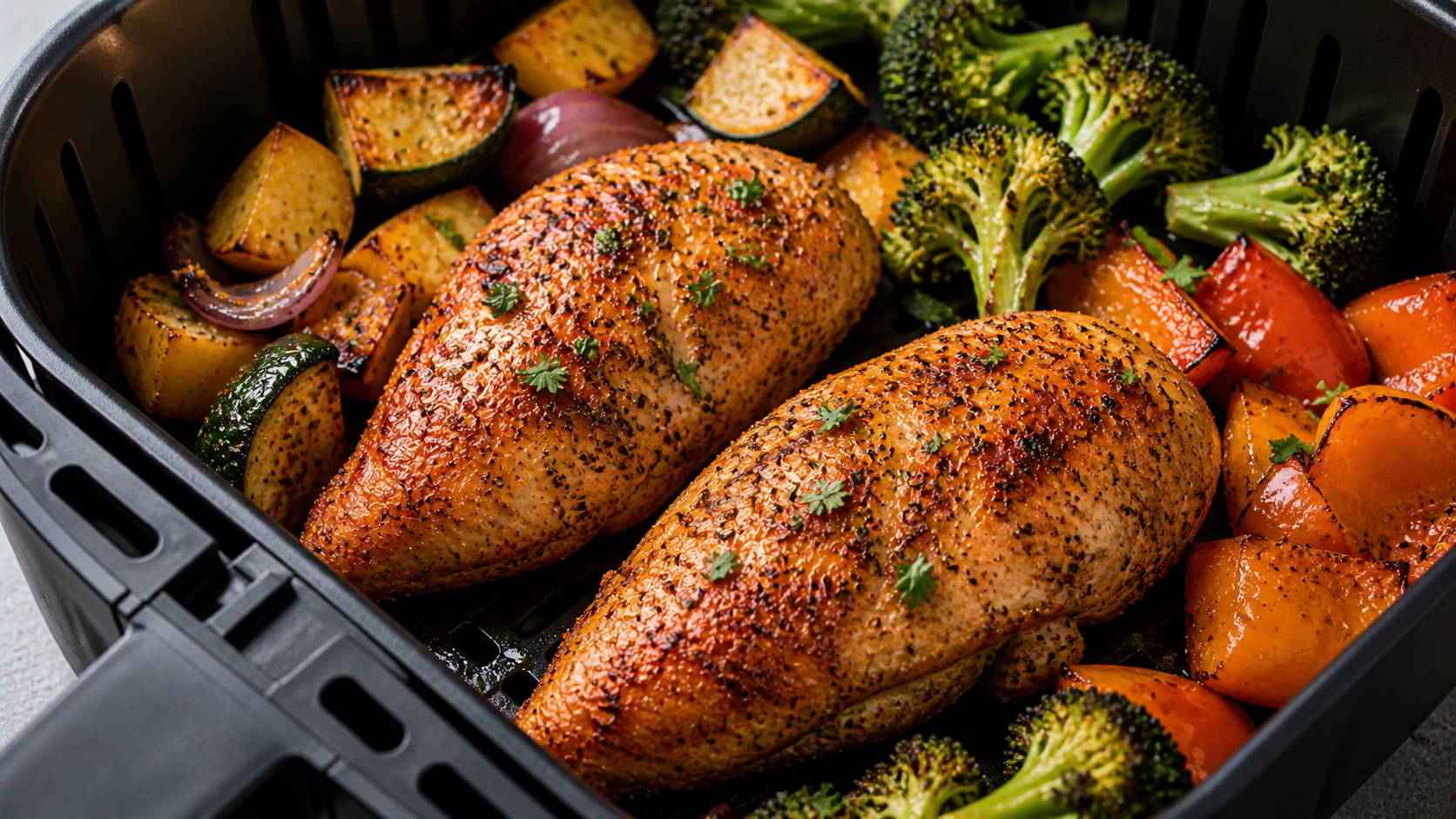
- Chicken breast — 180°C for 16–18 minutes, juicy and just-brown, perfect for meal prep bowls
- Chicken thighs (bone in, skin on) — 200°C for 22–25 minutes, skin crisp as deep-fried, meat tender as slow-cooked
- Salmon fillets — 180°C for 10–12 minutes, skin crisp, flesh flaky, no oil mess
- Prawns (large frozen) — 200°C for 6–8 minutes straight from frozen, perfect for Thai curries
- Halloumi (for salads) — 200°C for 6–8 minutes, less oily than pan-fried
- Roast vegetables (peppers, courgette, red onion, sweet potato cubes) — 200°C for 15 minutes, shake halfway
- Tofu cubes (pressed first) — 200°C for 15 minutes, genuinely crisp exterior, soft interior
- Bacon medallions — 180°C for 8 minutes, perfect weekend breakfast protein
- Frozen chicken breast — 180°C for 20 minutes straight from freezer, weeknight lifesaver
- Roasted cauliflower (for low-carb sides) — 200°C for 12–15 minutes with olive oil and spice
What I don’t do in it anymore because other methods are better:
- Steaks — a hot cast iron pan still wins for crust
- Eggs — too finicky vs the hob
- Pasta sauces or anything with liquid — wrong tool
- Full Sunday roast chicken — an oven does this better with less fuss
Specific GLP-1-friendly meals the air fryer makes easier
Chicken traybake (dual-basket style)
Basket 1: 2–3 chicken breasts at 180°C for 16 minutes. Basket 2: chopped peppers, red onion, courgette, sweet potato cubes at 200°C for 20 minutes, starting 4 minutes earlier. Dinner in 20 minutes, 40g+ protein, one-pan clean-up.
Salmon with asparagus
Basket 1: salmon fillets at 180°C for 11 minutes. Basket 2: asparagus with olive oil and salt at 200°C for 8 minutes. Plate with lemon and quinoa. The fastest restaurant-feeling meal in your kitchen.
Crispy tofu rice bowls
Press tofu, cube, toss with cornflour and a little soy sauce, air fry at 200°C for 15 minutes. Serves over rice with stir-fried vegetables and peanut sauce. The crispy tofu from an air fryer rivals restaurant results.
Breakfast protein (bacon medallions + eggs)
Bacon medallions in the air fryer (8 mins at 180°C). Eggs in a small heat-proof ramekin inside the basket for the last 5 minutes. Breakfast in 10 minutes, protein-forward, zero pan to wash.
Common air fryer mistakes to avoid
1. Overcrowding the basket. The fan needs to circulate hot air around the food. Piled-high means soggy, unevenly cooked, or undercooked. Cook in batches, or use a dual-basket if you’ve got a lot.
2. Not preheating. Most air fryers do best with a 2–3 minute preheat. Starts the Maillard reaction faster and gets better crisp results. Some models preheat automatically; most don’t.
3. Using too much oil. You don’t need a teaspoon of oil on a chicken breast — a light oil spray is ample. Too much oil smokes and messes up the basket.
4. Not shaking or turning. Small pieces (cubed tofu, chopped veg, prawns) benefit from a shake halfway through for even cooking.
5. Cleaning lazily. Protein residue burns on and becomes extremely hard to clean if left. Wipe the basket after each use while still warm; deep clean (dishwasher or hand-wash) weekly.
6. Using foil or baking paper that blocks air flow. If you line the basket, use the specific air fryer liners that have perforations. A solid sheet of foil blocks circulation and ruins results.
Air fryer accessories worth buying
Most air fryer accessory sets are over-engineered marketing noise. Three things actually earn their price:
- Silicone air fryer liners (reusable). Save you from burnt-on residue and reduce cleaning time. A 2-pack is £8–£12. Silicone air fryer liners on Amazon UK.
- Oil spray bottle (refillable, pump-action). Lets you control exactly how much oil goes on food. £8–£12. Better than aerosol spray cans which leave residue.
- A small heat-proof ramekin (Pyrex 150ml). Lets you cook eggs, mini egg-based dishes, or protein-rich baked oats in the air fryer. £3–£5 from any supermarket.
Things not to bother with: rotating baskets, multi-layer racks (reduce airflow), specialty cake tins designed for air fryers, subscription air fryer recipe boxes.
The honest cost–benefit
A good air fryer costs £80–£250 depending on which pick you go for. On a per-meal basis, if you use it 5–7 times a week over 3 years (realistic lifespan), that’s under 20p per meal for the appliance itself. The actual running cost is lower than a standard oven because it’s smaller and heats faster — roughly half the energy cost of an equivalent oven meal, per UK energy use estimates.
Against the cost you’re saving: takeaway habits that air fryers often displace, oil cost for deep or shallow frying, oven energy for small portions. In my first year I estimated I saved roughly £40–£60 per month on takeaways simply because air-fryer meals are fast enough and satisfying enough that “I’ll just grab something” became “I’ll just air-fry something.” Over a year that’s £500–£700 — covers a premium air fryer in 3–4 months.
The one thing I wish I’d known before buying
Buy once, buy right. I bought a cheap 3L single-basket air fryer first, used it twice a week, realised within a month I needed something bigger and dual-basket, then bought the Ninja AF400. The cheap one went to a family member. If you’re going to use it — and I strongly suspect you will — start with the format you actually want rather than the cheap one you’ll outgrow.
My recommendation in one line
For most UK GLP-1 users cooking for 1–3 people, the Ninja Foodi Dual Zone AF400UK is the buy. For single solo cooks or tight kitchens, the Tefal Easy Fry. Everything else is edge cases.
For what to cook once you have it: the high-protein meal guides (breakfast, lunch, dinner) all feature several air-fryer-friendly meals. For the broader kitchen setup: Kitchen Gear Worth Buying.
Disclosure: some links above are affiliate links. If you buy through them, this site earns a small commission at no extra cost to you. I only recommend products I use myself or would confidently give to friends and family.
Discover more from Healthy Weight Loss GLP1
Subscribe to get the latest posts sent to your email.