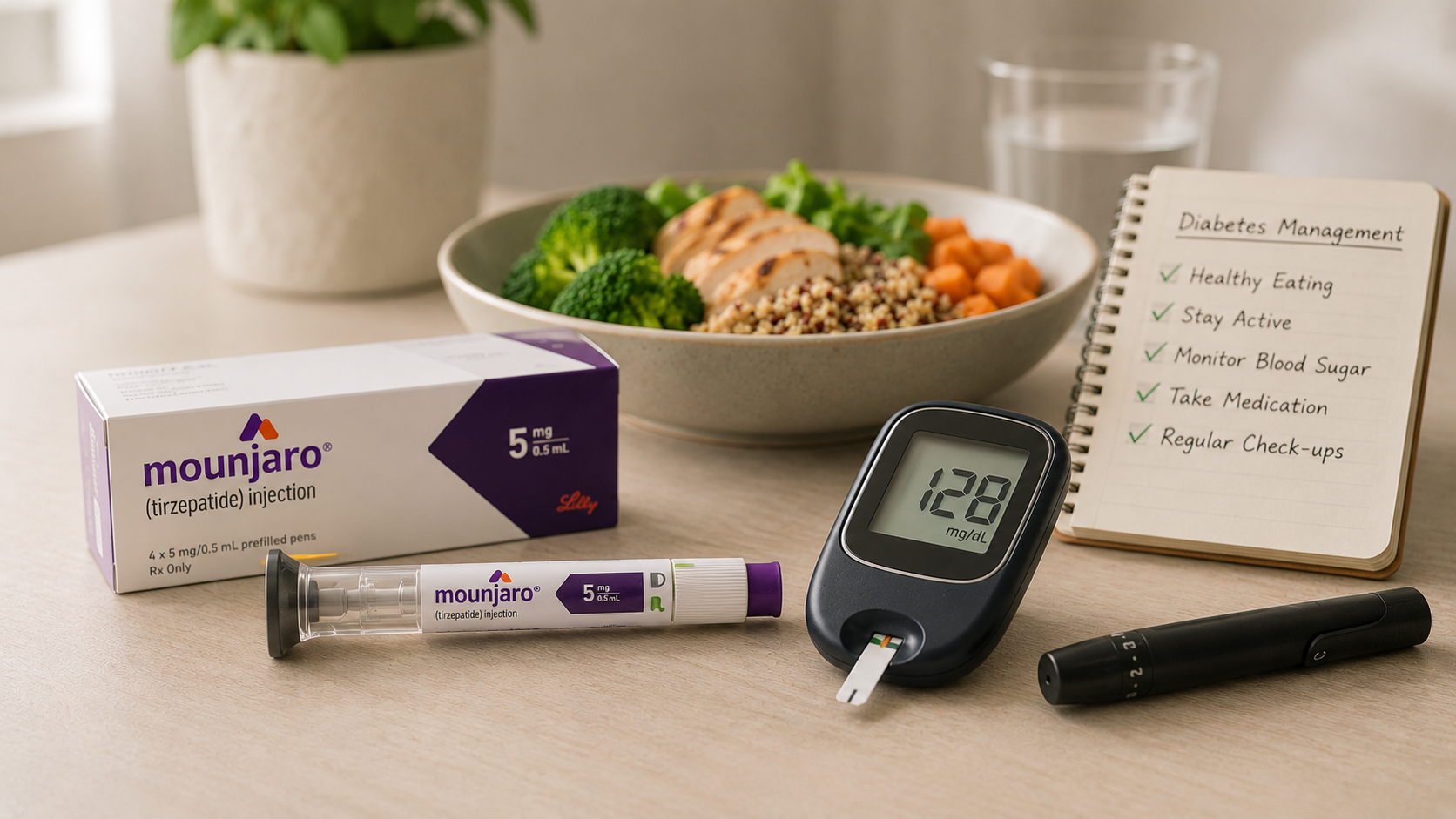

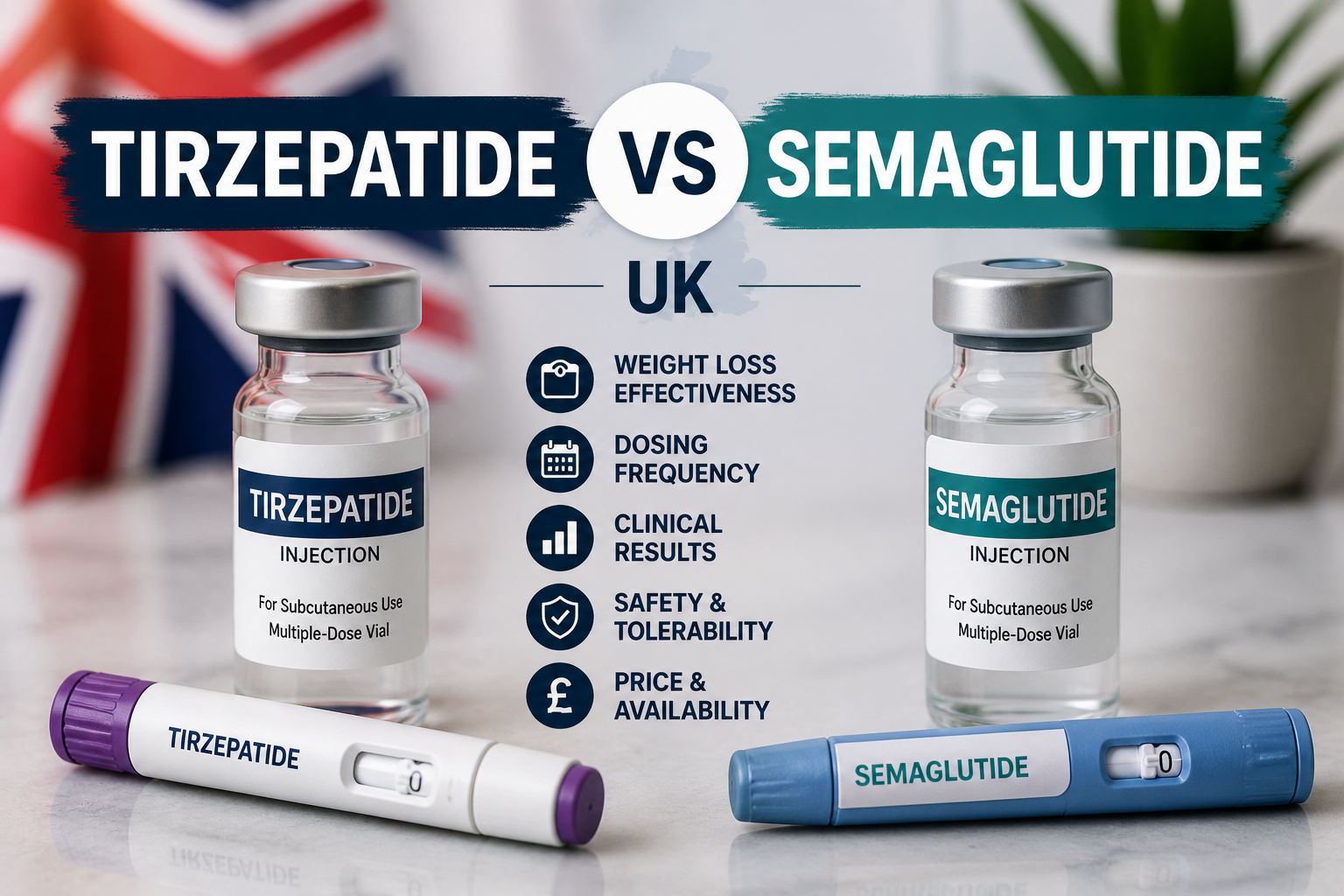
Tirzepatide (Mounjaro) and semaglutide (Wegovy) are the two headline weight-loss medications available in the UK in 2026. Tirzepatide typically delivers more weight loss. Semaglutide has more long-term data behind it. This is the honest comparison most marketing pages won’t give you: head-to-head mechanism, weight loss, side effects, cost, and which one is the right pick for which person.
For the broader mechanism overview see How GLP-1 Medications Work in the Complete Guide. This post is specifically the tirzepatide vs semaglutide head-to-head.
The one-paragraph summary
Tirzepatide is a dual GIP/GLP-1 receptor agonist; semaglutide is a single GLP-1 receptor agonist. On head-to-head comparison in the SURMOUNT-5 trial (published 2025), tirzepatide at maximum tolerated dose produced approximately 20.2% body weight reduction over 72 weeks versus semaglutide’s 13.7% — a meaningful difference. Side-effect profiles are broadly similar, with tirzepatide showing slightly higher rates of mild-to-moderate GI effects but a broadly comparable tolerability profile. Cost is similar in the UK private market in 2026. NHS eligibility criteria currently favour tirzepatide for Cohort 1 weight management. For most patients starting a weight-loss GLP-1 in the UK in 2026, tirzepatide is the more effective option; semaglutide remains appropriate for specific clinical scenarios.
Mechanism: what’s actually different in the drug itself
Both drugs work on the glucagon-like peptide-1 (GLP-1) receptor, which is central to appetite regulation and glucose control. GLP-1 receptor agonism produces slower gastric emptying, improved insulin and glucagon response, and central appetite suppression.
Tirzepatide does something semaglutide doesn’t: it also agonises the glucose-dependent insulinotropic polypeptide (GIP) receptor. GIP is the other major incretin hormone in the gut-brain axis. GIP’s exact contribution to weight loss is still being understood, but the current best theory is that GIP receptor activation enhances the metabolic effects of GLP-1 agonism, improves insulin sensitivity in fat tissue, and may contribute to the additional weight loss observed with tirzepatide over semaglutide.
Practically this means: tirzepatide is a dual-action molecule hitting two targets, while semaglutide is a single-action molecule hitting one. On average, dual-action produces more weight loss.
Weight loss: what the trials actually show
The headline trials to know:
STEP-1 (semaglutide): 2.4mg weekly semaglutide vs placebo in adults with obesity. 68 weeks. Mean weight loss in active arm: approximately 14.9% of body weight vs 2.4% placebo.
SURMOUNT-1 (tirzepatide): tirzepatide 5mg, 10mg, or 15mg weekly vs placebo in adults with obesity. 72 weeks. Mean weight loss at 15mg: approximately 20.9%. At 10mg: 19.5%. At 5mg: 15.0%.
SURMOUNT-5 (head-to-head): tirzepatide vs semaglutide in adults with obesity without diabetes. 72 weeks. Tirzepatide group: approximately 20.2% weight loss at maximum tolerated dose. Semaglutide group: approximately 13.7%. Both medications significantly more effective than placebo would be; tirzepatide more effective than semaglutide.
These are group averages. Individual results vary widely. Some people on semaglutide see 25%+ weight loss; some on tirzepatide see 8%. The average difference is real; the individual variation is bigger than the average difference between drugs.
Side effects: honestly compared
Both drugs share the GLP-1 family side-effect profile because both primarily act on GLP-1 receptors. The differences are subtle rather than dramatic.
Common side effects (both drugs):
- Nausea (most common in first 4–8 weeks)
- Diarrhoea or constipation
- Reduced appetite (the mechanism, not really a “side effect”)
- Fatigue in early weeks
- Reflux, sulphur burps, epigastric discomfort
- Headaches (usually dehydration-related)
- Gallstones and gallbladder issues during rapid weight loss (see Gallstones & Gallbladder Risk)
- Rare: pancreatitis, allergic reactions
- Rare (label warning): medullary thyroid carcinoma risk in people with familial risk
Differences worth knowing:
Tirzepatide showed slightly higher rates of nausea, vomiting, and diarrhoea in SURMOUNT trials than semaglutide showed in STEP trials, but the difference in side-effect-related discontinuation was small. In SURMOUNT-5, head-to-head, discontinuation rates were roughly similar between the two drugs.
Semaglutide has a longer real-world safety record (available for diabetes under the brand Ozempic since 2017, for weight loss as Wegovy in the UK since 2023), so extremely rare side effects are better characterised.
Tirzepatide is newer (approved 2022 for diabetes, 2023 for weight loss), so the very-long-term side-effect profile is still being established in real-world use.
Neither drug has emerged with any unexpected safety issues over their time in widespread use. Both are well-tolerated for the majority of users.
Dose and titration schedules
Tirzepatide (Mounjaro)
Seven weekly doses, titrated up every 4 weeks: 2.5mg, 5mg, 7.5mg, 10mg, 12.5mg, 15mg. The 2.5mg dose is a starter/titration dose; therapeutic doses are 5mg and up. Most users settle at 10mg or 15mg maintenance.
Semaglutide (Wegovy)
Five weekly doses, titrated up every 4 weeks: 0.25mg, 0.5mg, 1mg, 1.7mg, 2.4mg. The 2.4mg dose is the target maintenance dose. Most users aim to reach and maintain 2.4mg weekly.
Practical difference: tirzepatide’s titration schedule means a full 24 weeks to reach maximum dose, giving a slightly gentler run-up. Semaglutide reaches its target dose faster but at a lower absolute amount relative to its full effect.
Cost in the UK (April 2026)
NHS: Both drugs are available to eligible patients under NHS weight management pathways. Current Cohort 1 criteria favour tirzepatide for first-line prescribing in most ICBs. For eligible patients, cost is the NHS prescription charge (£9.90 per dispense in England; free in Scotland, Wales, Northern Ireland).
Private:
- Tirzepatide 2.5–5mg: £125–£200 per month
- Tirzepatide 7.5–10mg: £200–£275 per month
- Tirzepatide 12.5–15mg: £275–£375 per month
- Semaglutide 0.25–1mg: £150–£220 per month
- Semaglutide 1.7–2.4mg: £220–£320 per month
Roughly comparable costs with modest variation. Neither drug is meaningfully cheaper at equivalent efficacy. For comparison of specific providers see Cheapest Mounjaro Provider UK 2026.
Which one is right for which person
Tirzepatide is probably better for you if
- Your primary goal is maximum weight loss
- You’re in NHS Cohort 1 territory (BMI 40+ with 4+ qualifying comorbidities)
- You have type 2 diabetes (tirzepatide is particularly strong on HbA1c reduction)
- You’ve tried a single-target GLP-1 (semaglutide, liraglutide) and response was modest
- You tolerated that previous GLP-1 and side effects weren’t the blocking issue
Semaglutide is probably better for you if
- Your goal is moderate weight loss (10–15%) rather than maximum
- You specifically want the longer real-world track record
- You’ve had particularly strong GI side effects on tirzepatide in the past
- Cost differences in your specific region make it cheaper
- Your prescriber has more experience with semaglutide and feels more comfortable managing your case on it
- You need a medication with established cardiovascular outcome data (semaglutide has more extensive CV outcome trials)
Either is fine for you if
- You’re a first-time user without specific reason to prefer one over the other
- You’re picking primarily based on availability with your local prescriber
- You have no strong preference and trust your prescriber’s recommendation
Switching between them
Sometimes a user starts on one and wants to switch to the other. Common scenarios:
Starting on semaglutide, switching to tirzepatide because response is modest. This is straightforward with prescriber oversight: stop semaglutide, start tirzepatide at the 2.5mg starter dose after at least a week gap. Expect the standard 2.5mg adaptation period though it’s often milder because of carryover GLP-1 tolerance.
Starting on tirzepatide, switching to semaglutide because side effects are too strong. Same principle: stop tirzepatide, start semaglutide at 0.25mg starter dose after a week gap.
Don’t DIY switches without prescriber input. Gaps in titration, overlapping doses, and under-dosing all have their own issues to avoid.
What the trial comparison doesn’t capture
Three things that matter in real life but don’t show up in head-to-head trials:
1. The subjective experience of food-noise reduction. Some patients report dramatically different experiences on the two drugs. Some find tirzepatide more effective at quieting food noise. Others find semaglutide is the one that reaches the psychological part they needed. Research on this specific endpoint is limited; anecdotal variation is considerable.
2. Weight regain patterns after stopping. Both drugs show substantial weight regain after discontinuation. Patterns seem broadly similar between the two, though tirzepatide’s relatively shorter real-world use means long-term discontinuation data is still maturing.
3. Quality of life changes beyond weight. Energy, sleep, mood, libido, specific cravings, alcohol tolerance. Both drugs affect these in similar but not identical ways. User preference between the two for these qualities exists but isn’t well-studied yet.
Brand names in the UK (who makes what)
- Tirzepatide: branded as Mounjaro (weight management) or Mounjaro (T2 diabetes — same brand, same drug). Manufacturer: Eli Lilly.
- Semaglutide: branded as Wegovy (weight management) or Ozempic (T2 diabetes). Also oral Rybelsus. Manufacturer: Novo Nordisk.
Note that Wegovy and Ozempic are the same molecule (semaglutide) at different dose ranges. Ozempic maxes out at 2mg weekly for diabetes use; Wegovy goes to 2.4mg for weight management. The drug itself is identical. The “Ozempic for weight loss” discussion you’ve seen online is largely about off-label use of the diabetes brand for weight loss at its diabetes doses; for actual weight management, Wegovy is the on-label product.
For a deeper dive on Ozempic vs Wegovy specifically: Ozempic vs Wegovy UK (in prep).
What the 2026 landscape adds to this comparison
Two 2026 developments worth knowing:
1. NHS Cohort 2 expected rollout. Through 2026 and 2027, NHS weight management access is expected to expand. Current implementation favours tirzepatide; future rollout details may adjust.
2. Generic/follow-on competitors in earlier development. A pipeline of alternative GLP-1 and dual-action molecules is progressing through late-stage trials. Nothing immediately displaces tirzepatide or semaglutide in 2026 but the market may look meaningfully different by 2028–2029.
The single most important point
The difference between being on a GLP-1 medication and being on no GLP-1 medication is dramatically larger than the difference between tirzepatide and semaglutide. If you’re eligible and deciding whether to start, don’t let the tirzepatide-vs-semaglutide question stall you. Pick one your prescriber agrees is appropriate, tolerate the first-month adaptation, and progress.
If you’re a year in and not getting the response you hoped for on one, switching to the other (with prescriber oversight) is a reasonable next step. Many people find their best fit on the second drug rather than the first.
For the full mechanism and landscape: How GLP-1 Medications Work. For everything post-prescription: the Complete GLP-1 Weight Loss Guide.
Medical note: this is a general comparison based on published trial data. Individual clinical decisions should be made in consultation with a qualified prescriber who knows your full medical history.
Discover more from Healthy Weight Loss GLP1
Subscribe to get the latest posts sent to your email.