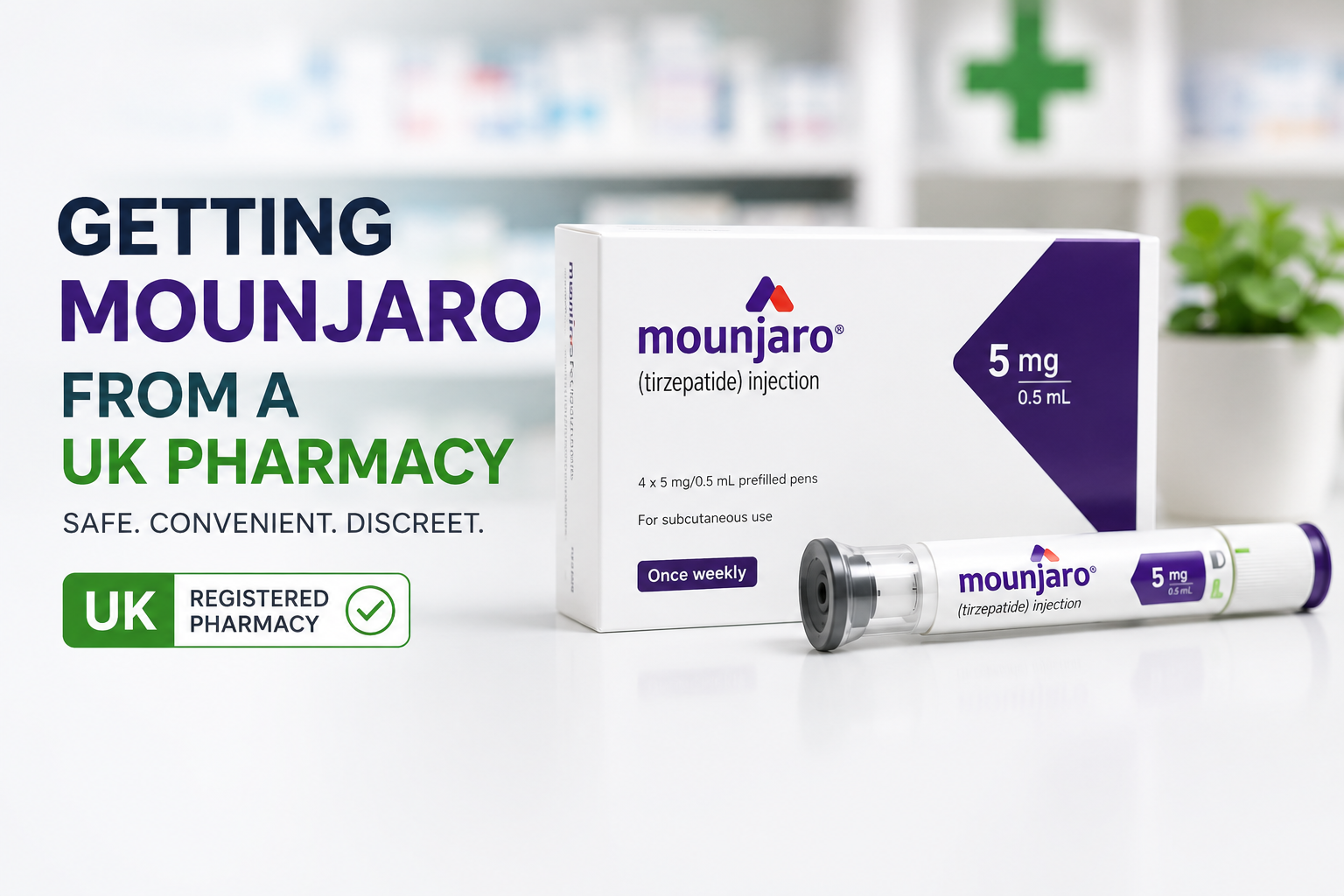

Private Mounjaro prices in the UK in 2026 range from about £125 to £375 per month for the same dose, depending on which provider you use. That’s a £3,000+ annual swing for a medication that’s clinically identical. This post looks at what actually separates the cheapest end of the market from the premium end, when the cheapest option is legitimately the right call, and when it’s costing you more than you think.
For the general sourcing picture, see How to Get Mounjaro in the UK. For the online-route-specific process, see Mounjaro Online Prescription UK. This post is specifically on the price question.
What determines the price of a Mounjaro prescription in the UK
Three costs stack up between Eli Lilly’s wholesale price and what you pay:
1. The wholesale price itself. Eli Lilly raised its UK wholesale prices for Mounjaro in September 2025. From that date, pharmacies pay more to stock the pens, and that cost flows through to you. The wholesale price is broadly the same across all UK providers — no provider is buying Mounjaro at a secret cheaper price. Anyone claiming they are should be treated with suspicion.
2. The pharmacy dispensing cost. The GPhC-registered pharmacy dispensing the pen has overheads: pharmacist time, packaging, cold-chain equipment, premises. This varies by provider but is typically £5–£25 per dispense.
3. The clinical service cost. Prescriber time for the initial consultation, titration reviews, aftercare messaging, customer support, platform technology. This is where the wide price variation comes from. Cheap providers run lean clinical teams with shorter reviews and lighter aftercare. Premium providers invest in longer consultations, named prescribers, video options, and responsive out-of-hours support.
The medication itself — the pen in the box — is identical across all providers. What differs is the care wrapped around it.
Cheapest end of the UK market (approx £125–£180 per month)
The budget end of the market in April 2026 typically offers:
- A short online consultation form (5–10 minutes)
- Automated eligibility screening with a prescriber review
- Auto-ship subscription with the next dose sent 28 days later
- Email-based customer support with 1–3 working day response times
- No scheduled titration reviews; the next dose just arrives
- No direct access to the prescriber outside of a new consultation
For a healthy, uncomplicated user who tolerates the medication well and has done their own homework, this can be genuinely adequate. If you don’t need much clinical hand-holding, you’re saving £100–£200 a month for a product that’s the same. At £150/month × 12 months, that’s £1,800 saved over a year vs a premium provider.
Mid-tier (£180–£260 per month)
Mid-tier providers typically add:
- Longer initial consultation (15–20 minutes of questions)
- Proactive titration review before each dose increase (form-based check-in)
- Faster customer support (same-day email, sometimes live chat)
- A named prescriber you can message for follow-up questions
- Some providers include a video consultation option at initial sign-up
- More thoughtful side-effect guidance and clinical aftercare resources
For most users this is the sensible sweet spot. The additional £30–£80 per month over the budget providers buys real clinical value — the things that matter if you hit a rough patch with side effects, hit a plateau, or need to pause titration for any reason.
Premium end (£260–£375+ per month)
Premium providers typically offer:
- Face-to-face or video-only consultations with named doctors (rather than pharmacist prescribers)
- Extensive bloodwork included (full lipid panel, HbA1c, kidney function, TFTs)
- Dietitian and nutritionist access included or low-cost add-on
- Integration with a private GP or specialist weight management service
- Premium aftercare (same-hour messaging response, 24/7 phone line, weekend cover)
- Personalised titration including ability to hold at sub-max doses with prescriber support
For most general users this level of service is over-engineered. It genuinely earns its price if you have complex medical history, are on multiple interacting medications, are managing menopause-related weight loss with HRT, have a history of eating disorders needing ongoing professional oversight, or simply value the premium experience and can afford it.
When cheap is genuinely fine
Budget providers are the right call if all of these apply to you:
- You’re in otherwise good health with no complex medication interactions
- Your BMI is comfortably in eligible range (not borderline)
- You have a regular NHS GP you’re happy to loop in for any clinical questions
- You’re comfortable doing your own research on side effects and titration
- You can tolerate a 1–3 day wait for non-urgent questions
- You have a UK-based friend, family member, or partner with medical knowledge you can check things with
If any of the above are not true, pay more for mid-tier at minimum.
When cheap is a false economy
Don’t go budget if any of these apply:
- You have multiple medications (particularly contraceptives, HRT, anti-depressants, cardiovascular medications, anti-diabetics)
- You have a history of disordered eating
- You’re approaching, in, or past menopause
- You’ve had previous adverse reactions to medications
- You’re managing another chronic condition (IBD, thyroid disease, diabetes)
- You’re nervous enough about starting that you’ll want responsive support in the first weeks
- You have a history of gallbladder issues or have had a cholecystectomy
In all of these cases, the mid-tier price premium is medically justifiable. The £50 extra per month buys you a prescriber who will actually read your concerns and respond same-day.
Red flags even at the cheap end
Some things are non-negotiable regardless of price:
- GPhC pharmacy registration. Check the dispensing pharmacy’s registration number on the GPhC public register. Legitimate UK pharmacies appear here. Any provider that can’t supply this is not legal to be prescribing in the UK.
- CQC or equivalent clinical registration. The prescribing service itself must be registered with the CQC (England), HIW (Wales), HIS (Scotland), or RQIA (Northern Ireland). Look for the registration number on the provider’s site; cross-check on the regulator’s register.
- A UK-registered prescriber. Named GMC doctor or GPhC pharmacist independent prescriber. If the provider hides prescriber identity, walk away.
- Clear side-effect reporting pathway. The provider should tell you how to report side effects to them and to the MHRA Yellow Card Scheme.
Any provider missing any of the above is operating either illegally or at the very edge of the rules, and you should not trust your health to them regardless of price. For my shortlist of providers that meet the basics: Best Online Mounjaro Providers UK.
Tricks to lower your cost legitimately
Assuming you’ve picked a legitimate provider, there are honest ways to reduce the cost further:
1. Subscription discounts. Most providers discount monthly rates by 5–15% if you commit to an auto-ship subscription. Worth it if you’ve tolerated the medication for a few months and know you’ll continue. Not worth it in month one when you’re still checking whether it works for you.
2. Bulk buying at specific dose steps. Some providers offer a 2- or 3-month multi-buy at a dose where you’re likely to hold steady for a while. If you’re settled at 10mg maintenance for 6 months, bulk buying can save meaningful amounts.
3. Sharing a household / couples discount. A few providers have started offering couples or household discounts for two people signing up together. Worth asking about if you and a partner are both considering starting.
4. NHS Cohort 2 eligibility becoming available. Cohort 2 is expected to expand NHS eligibility through 2026/2027 to BMIs down to 35 with fewer comorbidities. If you’re currently outside Cohort 1 but above BMI 35, keep checking the NHS England weight management injections page for rollout updates. Becoming NHS-eligible drops your monthly cost from £150+ to £9.90.
5. Combining with employer health benefits. A growing number of UK employers are starting to include weight management medication in their private medical insurance offerings or workplace wellness programmes. If your employer offers Bupa, AXA Health, Vitality, or similar, check whether Mounjaro is included.
Dishonest “cheap” options to avoid
Several routes that look cheap on the surface are actually cheap because they’re cutting corners that put your health at risk:
- Overseas online pharmacies. Turkey, Pakistan, India, Mexico-based sites advertising Mounjaro at £40–£80 a month. Counterfeiting risk is real and documented. Even if genuine, the products may not meet UK storage chain standards in transit. MHRA has issued formal warnings.
- Social media resellers. “Private seller” Instagram, Facebook, and TikTok accounts offering pens. Illegal, unregulated, frequently counterfeit.
- Compounded versions. Less common in the UK than the US, but some sites sell compounded semaglutide or tirzepatide at low prices. MHRA does not authorise compounded versions of these medications.
- “Mounjaro alternatives” that aren’t Mounjaro. Search engines return lots of results for “affordable GLP-1 alternatives” that are herbal preparations, berberine supplements, or unregulated peptides sold as if equivalent. They’re not.
If you spot a price that’s dramatically below the UK legitimate market (say under £100 a month), there’s almost certainly something wrong with it. The pharmaceutical wholesale cost alone means no legitimate UK prescriber can sell below roughly £110–£120 per month for the lower doses without absorbing a loss.
The actual annual maths
To give you the real comparison:
Cheapest legitimate provider, 12 months, titrating up to 10mg maintenance: approximately £1,850–£2,200.
Mid-tier provider, same scenario: approximately £2,400–£2,900.
Premium provider, same scenario: approximately £3,200–£4,200.
The difference between cheapest and mid-tier is around £500–£800 per year. The difference between mid-tier and premium is another £700–£1,500.
For my money, the cheapest-to-mid-tier jump is almost always worth it. The mid-tier-to-premium jump is only worth it if you specifically need what premium providers offer (complex medical history, dietitian support, face-to-face care, premium aftercare). For most users, mid-tier is the value sweet spot.
My recommendation
Most UK GLP-1 users should pick a mid-tier provider. Spend half an hour reading their clinical approach, message their customer support with a question before signing up to see how responsive they are, and commit. The few pounds a week you’d save going budget usually isn’t worth the clinical thinness you’d get in return.
Exceptions: very healthy, very self-sufficient users who’ve done the research, have an NHS GP on side, and just want the pen at the lowest possible legitimate cost — budget providers are fine for you.
For the complete picture on costs including supplements, gear, and hidden costs most don’t mention: Costs & Whether It’s Worth It (Complete Guide).
Medical note: Price isn’t a substitute for clinical judgement. The cheapest provider isn’t the right provider if they’re not appropriate for your clinical situation. When in doubt, pay for more oversight, not less.
Discover more from Healthy Weight Loss GLP1
Subscribe to get the latest posts sent to your email.