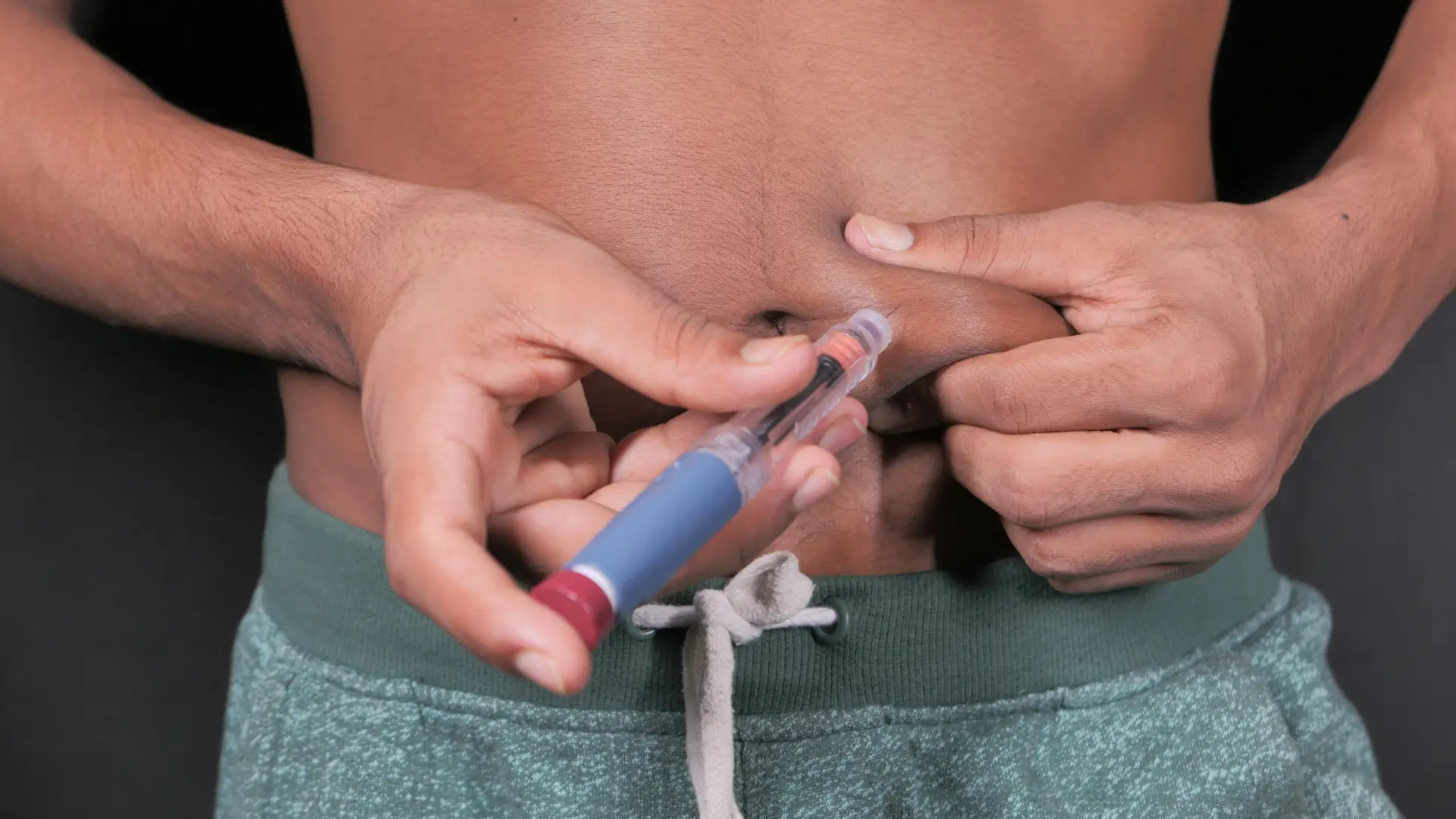

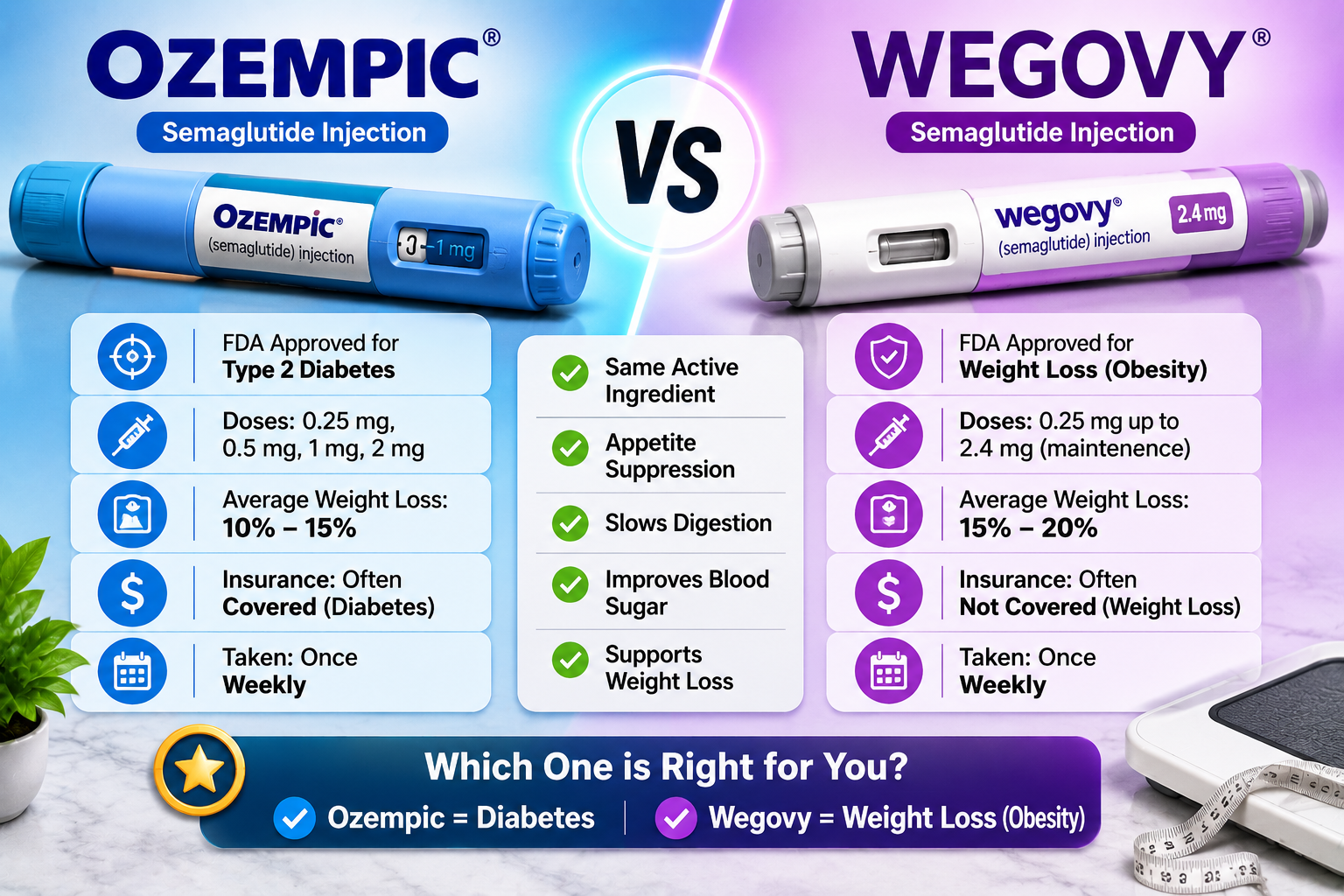
Ozempic and Wegovy are the same drug — semaglutide — sold by the same manufacturer (Novo Nordisk) at different dose ranges and for different licensed uses. Ozempic is for type 2 diabetes at 0.25–2mg weekly; Wegovy is for weight management at 0.25–2.4mg weekly. The “Ozempic vs Wegovy” question, which dominates UK discussion in 2025–2026, is more about licensing, dosing, and NHS pathways than about the drug itself. This post untangles the details honestly.
For the tirzepatide vs semaglutide picture see Tirzepatide vs Semaglutide UK. For the full GLP-1 mechanism context: How GLP-1 Medications Work in the Complete Guide.
The fundamental point: they’re the same molecule
Semaglutide is semaglutide, regardless of the brand on the pen. Both Ozempic and Wegovy contain identical active ingredient, manufactured at the same Novo Nordisk facilities. What differs is:
- Licensed indication (what the product is officially approved for)
- Dose range (what doses are available in each branded pen)
- Packaging and marketing
- Pricing (in some contexts)
The active ingredient itself is the same drug at the same potency per mg. This matters because it explains why off-label use of Ozempic for weight loss (common in 2022–2024 when Wegovy supply was limited) was pharmacologically reasonable even though it wasn’t regulatorily clean.
Ozempic: the diabetes product
Ozempic was the first semaglutide product on the UK market. Licensed indication: type 2 diabetes mellitus, as an adjunct to diet and exercise to improve glycaemic control, either as monotherapy when metformin is contraindicated, or in combination with other glucose-lowering medications.
Dose range: 0.25mg weekly (starter), 0.5mg, 1mg, 2mg. Titration: typically 4 weeks at each dose step, aiming for the dose that achieves glucose targets.
Available as: pre-filled multi-dose pen, refrigerated, 1–4 doses per pen depending on which pen strength.
On the NHS: prescribed by GPs and diabetes specialists for people with type 2 diabetes who meet clinical criteria (typically after metformin, in line with NICE guidance). Cost is the NHS prescription charge (£9.90 per dispense in England; free in the devolved nations).
Through 2022–2024 UK there was substantial Ozempic supply pressure because of off-label weight-loss prescribing alongside genuine diabetes demand. Supply has stabilised in 2025–2026 but remains tighter than Wegovy for most users.
Wegovy: the weight management product
Wegovy was launched in the UK in September 2023 (delayed by supply constraints globally). Licensed indication: weight management in adults with obesity or overweight with weight-related comorbidities, as an adjunct to reduced-calorie diet and increased physical activity.
Dose range: 0.25mg weekly (starter), 0.5mg, 1mg, 1.7mg, 2.4mg. Titration: typically 4 weeks at each dose step, aiming for 2.4mg maintenance dose for most users.
Available as: pre-filled, single-dose, disposable pens — one pen per weekly injection. Refrigerated shipping.
On the NHS: available through specialist weight management services under current eligibility criteria. Private prescribing available through CQC-registered online clinics and some high-street pharmacies.
The dose question: why is it different?
Why does Wegovy go up to 2.4mg while Ozempic maxes at 2mg? Two reasons:
1. Research justification. The STEP trials (semaglutide for weight management) specifically studied 2.4mg as the target dose, because it produced the largest weight-loss effect while remaining clinically tolerable. The SUSTAIN trials (semaglutide for diabetes) studied up to 2mg, which was sufficient for glucose control.
2. Licensing follows evidence. Regulators authorise doses supported by specific clinical evidence. Ozempic is authorised up to 2mg because that’s what the diabetes evidence base supports; Wegovy is authorised up to 2.4mg because that’s what the weight management evidence base supports.
Practically: the 0.4mg difference between Ozempic’s top dose (2mg) and Wegovy’s top dose (2.4mg) is modest. At equivalent doses (both at 2mg, for instance), the drug is doing the same thing.
The off-label question
Through 2022–2024, many people without diabetes received Ozempic prescriptions for weight loss via private clinics — a pattern of off-label use that attracted considerable media attention. Two things made this happen:
1. Wegovy was unavailable or supply-constrained. Wegovy launched globally in 2021 but had significant production issues; UK launch was delayed until late 2023, and even then supply was tight.
2. Ozempic was available and produced meaningful weight loss. Because it’s the same molecule, Ozempic at diabetes-maxed doses still produced meaningful weight loss (typically 8–12% body weight over 6–12 months) even though that wasn’t its licensed use.
In 2026, with Wegovy supply broadly stable, the off-label Ozempic-for-weight-loss scenario is less common but hasn’t disappeared. Some private providers still prescribe Ozempic for weight loss either because they haven’t updated their service offering or because certain patients prefer the Ozempic multi-dose pen format.
Regulatorily, prescribing Ozempic for non-diabetic weight loss in 2026 UK is at the edge of acceptable practice — not clearly illegal but not aligned with NICE guidance or Novo Nordisk’s licensing. Most reputable UK providers have moved to Wegovy as the weight-management product of choice.
The pen format difference matters in practice
Beyond dose and licensing, the pens themselves differ:
Ozempic pens
- Multi-dose (4 doses per pen for lower doses, 1 dose per pen for 2mg)
- Requires needle attachment (separate component, you attach before each injection)
- Dial-to-dose mechanism — you adjust the displayed dose on the pen
- Slightly fiddlier first-time use
- Refrigerate before first use; can be stored at room temperature once opened for up to 6 weeks
Wegovy pens
- Single-dose disposable pen — one pen per injection
- Pre-attached hidden needle (no separate needle handling)
- Auto-dosed by pen type (each pen is pre-set to its specific dose)
- Simpler first-time use
- Each pen typically used within 28 days of first exposure to room temperature
For first-time users, Wegovy’s single-dose pen format is generally easier. For more experienced users, Ozempic’s multi-dose pens can be slightly more cost-effective per dose and reduce packaging waste.
Efficacy: what the trials show
Head-to-head, at equivalent doses, the products are pharmacologically identical. At maximum licensed doses, Wegovy has a small edge purely because 2.4mg is a somewhat higher dose than Ozempic’s 2mg.
Ozempic for diabetes (SUSTAIN trials): HbA1c reductions of 1–2 percentage points, body weight reduction of 4–6kg at 1mg dose.
Wegovy for weight management (STEP trials): At 2.4mg, mean body weight reduction of approximately 14.9% over 68 weeks in STEP-1.
The Wegovy trials showed greater weight loss than the Ozempic trials — but this is largely a consequence of the higher dose and longer study durations, not a fundamental difference in the drug.
Practically: at 2mg weekly, Ozempic delivers similar weight loss to Wegovy at the same dose. At its maximum 2.4mg, Wegovy delivers somewhat more.
Side effects: same drug, same profile
Both products share the GLP-1 side-effect profile because they are the same molecule:
- Nausea (most common, particularly in early weeks)
- Diarrhoea or constipation
- Reduced appetite (the mechanism, not really a “side effect”)
- Fatigue in early weeks
- Reflux, sulphur burps, epigastric discomfort
- Gallstones and gallbladder issues during rapid weight loss
- Rare: pancreatitis, allergic reactions, injection-site reactions
- Label warning: medullary thyroid carcinoma risk in people with familial predisposition
At higher doses (2.4mg Wegovy) side effects tend to be slightly more frequent and intense than at lower diabetes doses, consistent with dose-related pharmacology.
Cost in the UK (April 2026)
Ozempic (NHS): NHS prescription charge (£9.90 in England; free elsewhere). Private: £130–£250 per month depending on dose and provider.
Wegovy (NHS): Available through Cohort 1 weight management pathways; NHS prescription charge. Private: £150–£320 per month depending on dose and provider.
At equivalent doses, Wegovy is typically £20–£50 per month more expensive privately than Ozempic. The difference reflects packaging costs (single-dose vs multi-dose pens), licensing positioning, and market segmentation rather than the drug itself.
Which should you pick?
Pick Wegovy if
- Your primary goal is weight management
- You don’t have type 2 diabetes
- You want a licensed product for your indication
- You prefer the simpler single-dose pen format
- You want access to the higher 2.4mg maintenance dose
- You’re going through the NHS weight management pathway
Pick Ozempic if
- You have type 2 diabetes (the licensed indication)
- You prefer the multi-dose pen format (fewer items in the fridge)
- Your prescriber specifically recommends it for your clinical situation
- You’re targeting glucose control as well as weight
Consider tirzepatide (Mounjaro) instead of either if
- You want maximum weight loss effect
- You’re eligible for NHS Cohort 1 (tirzepatide is the current NHS first-line choice)
- You’ve tried semaglutide and response was modest
- You have type 2 diabetes alongside weight management goals
See Tirzepatide vs Semaglutide UK for the deeper head-to-head.
Switching between Ozempic and Wegovy
Clinically straightforward: they’re the same drug. If you’re on Ozempic for weight loss (off-label) and want to switch to Wegovy (on-label), your prescriber can transition you at equivalent doses without a washout period.
Common scenarios:
- Ozempic 1mg → Wegovy 1mg: direct same-dose switch
- Ozempic 2mg → Wegovy 2.4mg: step up via a 4-week period at 2.4mg if previously tolerated at 2mg
- Wegovy to Ozempic: usually because of diabetes diagnosis; transition at same dose typically
The question most people are really asking
Reading between the lines, most “Ozempic vs Wegovy” queries are really asking one of these:
“Should I take Ozempic for weight loss?” In 2026, probably not — Wegovy is available, on-label, and at higher doses. The historical off-label Ozempic-for-weight-loss scenario is fading as Wegovy supply normalises.
“Is Ozempic cheaper than Wegovy?” Slightly, at equivalent doses. But the cost difference is usually not enough to justify the off-label positioning.
“What about Mounjaro?” Mounjaro (tirzepatide) is a different molecule with dual GIP/GLP-1 action. Typically produces more weight loss than either Ozempic or Wegovy. See Tirzepatide vs Semaglutide UK and the Complete GLP-1 Weight Loss Guide.
“Can I just take someone else’s Ozempic?” No. Shared prescription medications is illegal, unsafe, and doesn’t come with clinical oversight. Use the actual prescribed pathway for your situation.
What about Rybelsus?
Novo Nordisk also produces Rybelsus, which is oral semaglutide — the same molecule in tablet form rather than injection. Current licensing is for type 2 diabetes; dosing is different (3mg, 7mg, 14mg daily tablets) and absorption is lower than injected semaglutide.
At current doses Rybelsus produces more modest weight loss than Wegovy. It’s not currently licensed in the UK for weight management. Some off-label use exists but is less common than the Ozempic off-label scenario was.
Full deep-dive: Rybelsus (Oral Semaglutide) UK when published.
The summary
Ozempic and Wegovy are the same drug at different doses, licensed for different things. In 2026 UK, Wegovy is the correct product for weight management (on-label, higher maximum dose, simpler pen format); Ozempic remains the diabetes product. For weight management, the more interesting question isn’t Ozempic vs Wegovy — it’s semaglutide vs tirzepatide, which has a bigger clinical difference.
For the deeper comparison: Tirzepatide vs Semaglutide UK. For the broader mechanism: How GLP-1 Medications Work. For the full picture: Complete GLP-1 Weight Loss Guide.
Medical note: clinical decisions about which product is appropriate should be made with a qualified prescriber who knows your full medical history, not based on online comparisons.
Discover more from Healthy Weight Loss GLP1
Subscribe to get the latest posts sent to your email.