

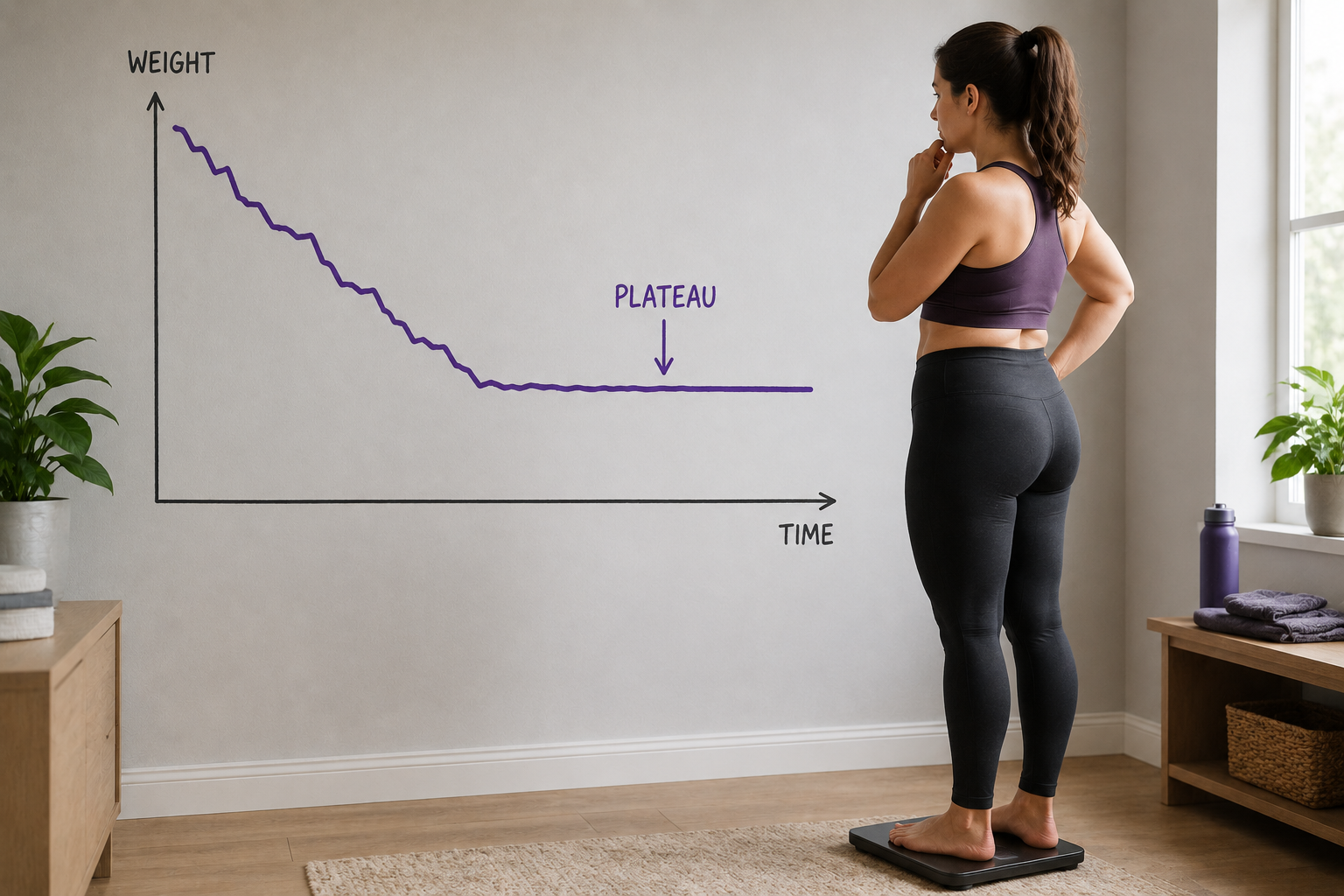
A Mounjaro plateau — when the scale stops moving for two weeks or more despite staying on the medication — is normal, common, and almost always fixable. The most common causes in UK users are protein intake that’s quietly dropped, calorie creep from portion sizes drifting back, metabolic adaptation, or simply a temporary hormonal stall that resolves on its own. This guide covers every cause in order of likelihood, and the specific fixes for each.
See also: Plateau on GLP-1: What Actually Helps UK and How to Break a Weight Loss Plateau UK.
First: what actually counts as a plateau
Weight fluctuates daily by 1–3kg based on hydration, salt intake, glycogen stores, and for women, cycle phase. A two-day stall is not a plateau. A one-week stall usually isn’t either.
A true plateau for GLP-1 users: no net downward movement on the scale across two to three full weeks, despite consistent medication adherence and no obvious lifestyle change. If you’re within this definition, read on. If not, wait another week before troubleshooting.
Cause 1: protein intake has dropped (most common)
As appetite reduces on Mounjaro, total food volume shrinks. If you’re not actively prioritising protein, your proportion of protein in your diet often shrinks fastest — it’s harder to eat chicken breast than it is to eat a biscuit when you’re not very hungry.
Below approximately 1g of protein per kg of body weight, your body preferentially burns muscle alongside fat during a calorie deficit. Less muscle means lower resting metabolic rate, which means a slower rate of fat loss even at the same calorie deficit.
The fix: log three days of eating honestly in Cronometer and check your protein average. Most users who have plateaued are hitting 60–80g daily when they need 100–140g+ (depending on body weight). Increase protein sources at every meal: Greek yoghurt at breakfast, a larger protein portion at lunch and dinner, a protein shake if appetite allows.
See How to Get Enough Protein on GLP-1 UK for practical strategies.
Cause 2: calorie creep
After months on Mounjaro, the strong appetite suppression of early treatment becomes the new normal. Portions that would have been tiny pre-medication start feeling appropriate again. This is natural adaptation — but it can mean a gradual drift in calorie intake that erodes the deficit.
The fix: a one-week food log. Not to restrict — to audit. Log everything for seven days, including drinks, cooking oils, sauces, and snacks. Most people find 150–400 extra daily calories that they weren’t accounting for. Awareness alone often resolves this.
Cause 3: metabolic adaptation
Your body is not a simple calorie calculator. As you lose weight, your metabolic rate adjusts downward because you’re physically smaller and your body makes minor hormonal adjustments to reduce energy expenditure. This is well-documented and normal — it’s not the medication failing.
This means the same calorie deficit that produced 2kg of loss per month at your starting weight may only produce 1kg of loss per month after significant weight loss. The rate slows; it doesn’t stop.
The fix: accept the slower pace as the new normal rather than trying to aggressively cut calories further. Adding resistance training increases resting metabolic rate over time — see Strength Training on GLP-1 UK.
Cause 4: insufficient activity
Mounjaro creates a calorie deficit through reduced intake. Physical activity creates an additional deficit and maintains metabolic rate. If your activity has been low throughout treatment, the medication is doing all the work. As metabolic adaptation sets in, this can tip into a stall.
The fix: adding 30 minutes of daily walking (target 8,000–10,000 steps) has a measurable impact on fat loss for most people. Adding two to three resistance sessions per week has a longer-term impact on metabolic rate. You don’t need to do both immediately — start with walking, which has the lowest barrier.
Cause 5: dose is no longer optimal
Some users plateau because they’re at a dose that no longer provides sufficient appetite suppression. The medication hasn’t stopped working — it’s providing less effect than a higher dose would.
The fix: if you’ve been at the same dose for more than 12 weeks and have plateaued, a conversation with your prescriber about stepping up is warranted. See Mounjaro Dose Guide UK for context on when dose steps are typically appropriate.
Cause 6: water retention masking fat loss
This one is underappreciated. You can be losing fat consistently but not see it on the scale because water retention is offsetting it. Common causes:
- Higher sodium intake than usual (takeaway, restaurant meal, salty snacks)
- Starting or increasing resistance training (muscles hold more water when adapting)
- Hormonal cycle phase (women can retain 1–3kg in the luteal phase)
- Stress and elevated cortisol
- Insufficient water intake paradoxically causes water retention
The fix: measure waist circumference alongside scale weight. If your waist is still shrinking during a scale plateau, fat loss is still happening. Increase water intake, reduce sodium, and be patient through the cycle phase if applicable.
Cause 7: poor sleep and high stress
Sleep deprivation and chronic stress both raise cortisol, which promotes fat retention (particularly abdominal) and increases appetite. On a GLP-1, the medication partially compensates — but high cortisol can still slow progress significantly.
The fix: improving sleep often breaks plateaus faster than dietary changes. Aim for 7–9 hours. See Sleep on GLP-1: What Actually Helps UK and How to Sleep Better for Weight Loss UK.
Cause 8: alcohol
Alcohol is calorie-dense (7 kcal per gram), often consumed in quantities that are easy to underestimate, and promotes fat storage by temporarily displacing fat metabolism while the liver processes the alcohol. On Mounjaro, alcohol tolerance often reduces — smaller amounts have larger effects, but the calories remain.
The fix: if you’re having more than 10–14 units per week, a two-week alcohol reduction is a reasonable plateau-breaking experiment. Even reducing by 50% often removes 500–1,000 weekly calories that weren’t being tracked.
What doesn’t cause a Mounjaro plateau
Things that are commonly blamed but usually aren’t the cause:
- Eating too little — rarely the issue on GLP-1s. Starvation mode is largely a myth at the calorie levels GLP-1 users eat.
- Too much fruit — fructose in normal fruit quantities is not causing your plateau
- Specific “bad” foods — single food items don’t cause plateaus; overall intake patterns do
- The medication having “stopped working” — tirzepatide doesn’t simply stop working; if you’re still taking it, it’s still active
A plateau-breaking checklist
Work through this in order before concluding there’s something more complicated going on:
- Log three days of food in Cronometer — check protein and calories
- Check waist measurement — is it still moving even if scale isn’t?
- Review alcohol intake for the past two weeks
- Check sleep — averaging under 6.5 hours?
- Assess stress levels — unusually high period at work or home?
- Review activity — steps and resistance training
- Check injection technique and storage — medication stored correctly? Rotating sites?
- If still stalled after 4+ weeks: contact prescriber to discuss dose review
Tracking as a plateau-breaking tool
The single most useful thing you can do when a plateau hits is spend one week logging everything you eat in Cronometer. Not to restrict — to audit. Cronometer’s verified food database removes the guesswork from portion estimates, and the micronutrient breakdown often reveals the protein gap that’s slowing progress before you’ve consciously noticed it.
Specific things to check during a plateau logging week:
- Protein average across seven days — is it consistently hitting 1.2g+ per kg of body weight? Single-day highs don’t compensate for a week of low days.
- Fibre intake — low fibre causes constipation on GLP-1s, which creates the illusion of a scale plateau (bloating, water retention in the gut). Target 25–35g daily.
- Sodium — high sodium days correlate with multi-day water retention. Tracking sodium often reveals takeaway or restaurant meals as the hidden culprit.
- Alcohol calories — often tracked separately or not at all. Log honestly.
Most users who plateau and log honestly find the cause within three days of logging. The food diary rarely lies.
How long does a Mounjaro plateau typically last?
Natural plateaus (water retention, hormonal) often resolve within 1–3 weeks without any change. Diet-related plateaus typically resolve within 1–2 weeks of addressing protein and calorie intake. Metabolic adaptation plateaus are longer-term and require activity changes rather than dietary restriction. Dose-related plateaus resolve after titration.
If you’ve worked through the checklist, made changes, and still haven’t seen movement in six weeks, a detailed review with your prescriber is warranted.
Frequently asked questions
Is it normal to plateau on Mounjaro?
Yes. Most users experience at least one significant plateau during treatment, typically around months four to six as the initial rapid loss phase ends and metabolic adaptation sets in. Plateaus are a normal part of the process, not a sign of failure.
Should I increase my Mounjaro dose to break a plateau?
Only after ruling out dietary and lifestyle causes first. A dose increase is appropriate when you’ve been at the same dose for 12+ weeks and the plateau persists after addressing protein, calories, activity, and sleep. Talk to your prescriber before adjusting dose.
Can eating too little cause a plateau on Mounjaro?
In theory, severe under-eating can slow metabolic rate. In practice, GLP-1 users rarely eat too little for this to be the cause — the medication’s appetite suppression typically keeps intake in a reasonable range. More often, the issue is protein quality rather than total calories.
Does drinking more water help break a plateau?
It helps with water-retention plateaus. Adequate hydration (2–2.5 litres daily) supports kidney function, reduces water retention, and marginally increases metabolic rate. It won’t overcome a dietary or dose-related plateau but is worth optimising regardless.
Medical disclaimer: if your weight loss has stalled significantly, discuss this with your prescriber. Do not self-adjust your dose. This guide is general information only.
Discover more from Healthy Weight Loss GLP1
Subscribe to get the latest posts sent to your email.