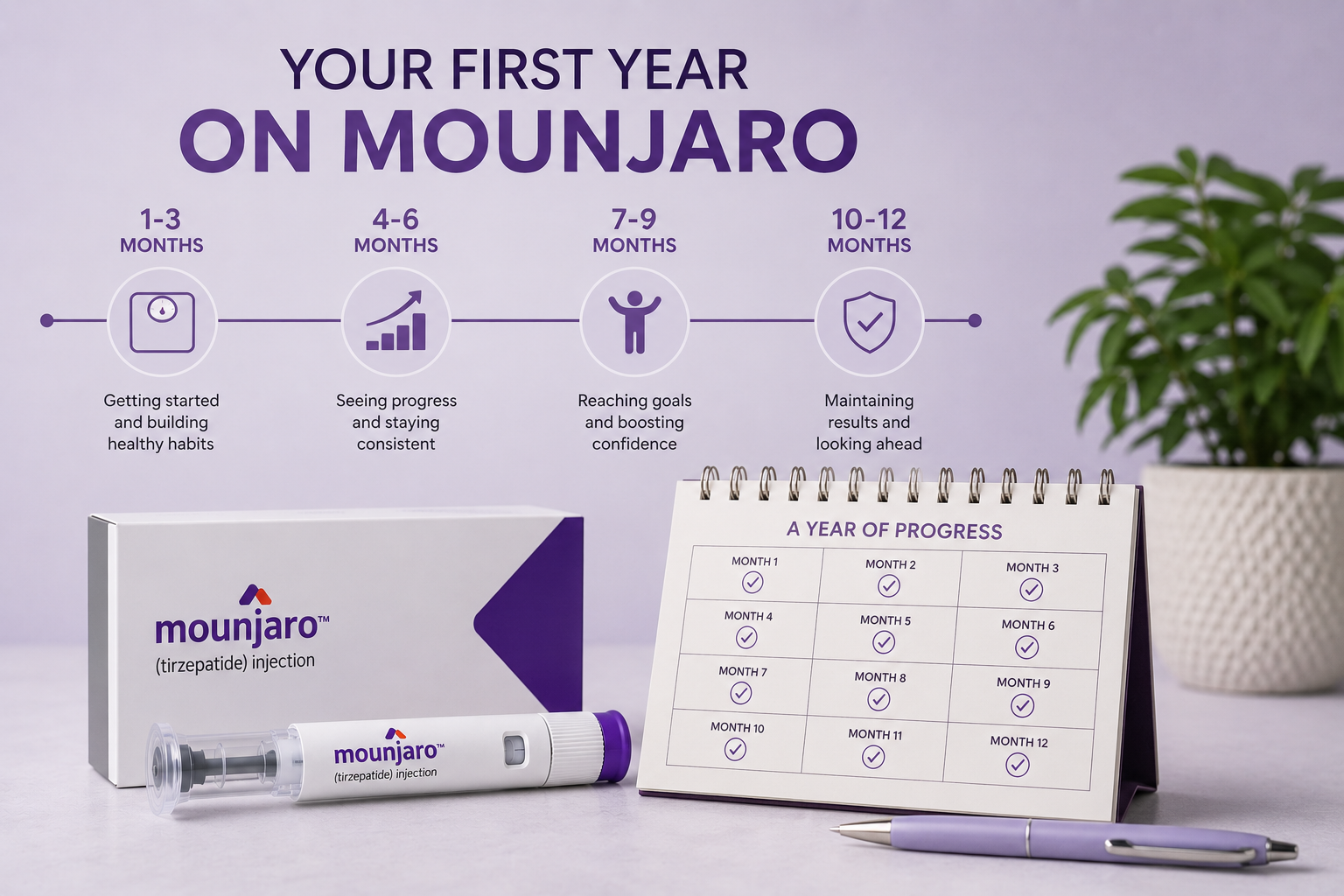


Mounjaro is one of the most effective interventions currently available for PCOS in the UK — not because it’s designed specifically for the condition, but because it directly addresses PCOS’s core drivers: insulin resistance and weight. Most women with PCOS who start Mounjaro report improved cycle regularity, reduced androgen symptoms, and measurable metabolic improvements within three to six months. This guide covers what the evidence shows, what to expect, and the specific considerations for PCOS users that differ from the general GLP-1 picture.
Related reading: GLP-1 for PCOS UK and Mounjaro and Fertility UK.
Why PCOS responds so well to GLP-1 treatment
PCOS is fundamentally a metabolic and hormonal condition. Its core mechanisms — insulin resistance, elevated androgens, disrupted ovulation — are directly addressed by tirzepatide’s dual action on GLP-1 and GIP receptors.
Insulin resistance is the central mechanism. Around 65–80% of women with PCOS have insulin resistance, regardless of weight. High insulin levels suppress sex hormone binding globulin (SHBG), allowing more free testosterone and other androgens to circulate. Elevated androgens disrupt follicle development and prevent regular ovulation. Mounjaro’s direct insulin-sensitising effect — stronger than metformin at equivalent therapeutic doses — breaks this cycle at the root.
Weight loss compounds the benefit. Adipose tissue produces oestrogen and inflammatory cytokines that worsen insulin resistance. Weight loss reduces this effect. Mounjaro’s 15–22% weight loss at 72 weeks produces more insulin sensitivity improvement than any comparable non-surgical intervention.
GIP receptor action is an additional advantage. Semaglutide (Wegovy, Ozempic) acts only on GLP-1 receptors. Tirzepatide acts on both GLP-1 and GIP receptors. The GIP component provides additional insulin-sensitising and adipose-regulatory effects that are particularly relevant for PCOS.
What typically changes on Mounjaro for PCOS
Based on clinical trial data and real-world UK user experience:
Menstrual cycle regularity: often the most noticeable change. Women with previously irregular cycles (oligomenorrhoea — fewer than 8 cycles per year) frequently report cycle regularisation within three to six months. This reflects restored ovulatory function as insulin levels normalise. Not universal, but common enough to be a consistent pattern in PCOS users specifically.
Androgen symptoms: acne, facial hair (hirsutism), and scalp hair thinning driven by androgen excess often improve as insulin-mediated androgen production reduces. These changes take longer than cycle changes — typically six to twelve months for visible improvement in hirsutism, three to six months for acne.
SHBG levels: blood tests typically show rising SHBG (the protein that binds androgens, reducing their free activity) within three to six months. A rising SHBG alongside a falling free androgen index reflects the hormonal mechanism working.
Fasting insulin and HOMA-IR: direct measures of insulin resistance. Most PCOS users on Mounjaro see meaningful reductions. Your GP can test these if you want objective markers of the metabolic improvement.
AMH levels: anti-Müllerian hormone (a marker of ovarian reserve often elevated in PCOS) typically normalises toward the standard range with weight loss and insulin improvement. Not directly relevant to symptoms but useful if you’re monitoring fertility-related markers.
PCOS, Mounjaro, and fertility: the critical caveat
This deserves repeated emphasis because it has significant real-world implications:
Mounjaro often substantially improves fertility in women with PCOS by restoring ovulation. Women who previously had irregular cycles and assumed conception was difficult may find they can conceive unexpectedly. If you don’t want to become pregnant, reliable contraception is essential — and oral contraceptives may have reduced efficacy due to Mounjaro’s gastric emptying effect. See Mounjaro and the Contraceptive Pill UK.
If you do want to conceive, Mounjaro must be stopped at least two months before trying. See Mounjaro and Fertility UK for the full picture.
PCOS and the combined oral contraceptive pill
Many women with PCOS are on the combined oral contraceptive pill (COCP) for cycle regulation, acne management, or contraception. The COCP has its own effects on androgen levels and SHBG. Starting Mounjaro alongside COCP raises two considerations:
- As noted above, COCP absorption may be reduced by Mounjaro’s gastric emptying effect — barrier contraception is needed during dose changes
- As Mounjaro improves insulin resistance and androgen levels, your prescriber may reassess whether the COCP dose or formulation still matches your hormonal picture
Both are worth raising with your GP when starting Mounjaro.
Metformin and Mounjaro for PCOS
Metformin is the most commonly prescribed medication for PCOS with insulin resistance. Many women with PCOS are already on metformin when they start Mounjaro. The combination is generally fine — they work through different mechanisms and both improve insulin sensitivity — but your GP should review the overall picture.
Some prescribers reduce or discontinue metformin once Mounjaro is at therapeutic dose and insulin markers have normalised, avoiding polypharmacy. Others continue both. This is a clinical decision based on your individual markers.
What Mounjaro doesn’t fix in PCOS
Honest limits of what to expect:
- Polycystic ovarian morphology on ultrasound — the multi-follicular appearance of PCOS ovaries on ultrasound typically persists even when metabolic and hormonal markers improve significantly
- Permanent resolution — PCOS is a chronic condition. Stopping Mounjaro without sustained lifestyle changes typically means gradual return of insulin resistance and associated symptoms
- Hirsutism already established — existing terminal hair (coarse, dark facial hair) doesn’t reverse with hormonal improvement. New growth slows or stops; existing hair requires separate management (laser, electrolysis)
- Sleep apnea if severe — PCOS has elevated sleep apnea risk. Mounjaro helps through weight loss but severe OSA may require additional treatment
Tracking progress in PCOS on Mounjaro
Useful markers to monitor alongside scale weight:
- Cycle length and regularity — a simple period tracking app captures this
- Androgen symptoms — a monthly photo of skin and any hirsutism provides objective comparison
- Blood tests every three to six months: fasting insulin, HOMA-IR, free androgen index, SHBG, fasting glucose, HbA1c if diabetic
- Nutritional markers in Cronometer — PCOS is associated with micronutrient deficiencies (zinc, vitamin D, magnesium, B vitamins) that Mounjaro’s reduced food intake can worsen. Check these periodically.
Supplements specifically relevant to PCOS on GLP-1s
Inositol (myo-inositol and D-chiro-inositol): has a small but genuine evidence base for PCOS specifically — improves insulin sensitivity, cycle regularity, and androgen levels. Not a substitute for Mounjaro but a reasonable addition with a good safety profile. Typically 2–4g daily of myo-inositol alone or in a 40:1 ratio with D-chiro-inositol.
Zinc: PCOS is associated with zinc deficiency; zinc regulates androgen activity and supports cycle regularity. See Zinc on GLP-1 UK.
Magnesium: insulin sensitivity improvement. Already common advice for GLP-1 users; doubly relevant for PCOS. See Magnesium on GLP-1 UK.
Vitamin D: deficiency is very common in PCOS and independently worsens insulin resistance. Test levels; supplement to maintain 75+ nmol/L serum 25(OH)D.
Frequently asked questions
Does Mounjaro help with PCOS symptoms?
Yes — through improving insulin resistance and promoting weight loss, both of which are central to PCOS management. Cycle regularity, androgen symptoms, and metabolic markers typically improve within three to six months for most users.
Is Mounjaro better than metformin for PCOS?
For weight loss and insulin sensitivity improvement, Mounjaro substantially outperforms metformin in head-to-head data. Many PCOS specialists consider GLP-1 medications the most effective currently available pharmacological intervention for PCOS with metabolic features. Metformin is often continued alongside rather than replaced.
Will Mounjaro cure my PCOS?
No. PCOS is a chronic condition without a cure. Mounjaro manages the metabolic drivers that produce symptoms. Stopping medication without sustained lifestyle changes typically means gradual symptom return.
Can Mounjaro make PCOS worse?
No clinical evidence supports this. The insulin-sensitising and weight-loss effects of Mounjaro are consistently beneficial for PCOS-associated metabolic features.
Medical disclaimer: PCOS management should involve your GP or specialist gynaecologist. This guide is general information; individual presentations vary significantly.
PCOS, Mounjaro, and the long-term picture
A question worth asking for PCOS users specifically: what does Mounjaro treatment look like at two years, five years?
PCOS is a lifelong condition. The metabolic and hormonal improvements from Mounjaro depend on the medication continuing — if weight is regained after stopping, insulin resistance typically returns and symptoms often follow. This makes long-term treatment planning particularly important for PCOS users compared to someone treating weight gain alone.
Several long-term approaches work for PCOS:
Maintenance dose indefinitely: staying on a lower dose (2.5–5mg weekly) that sustains the insulin sensitivity improvement, even if it no longer produces active weight loss. For PCOS, the ongoing insulin-sensitising effect has value beyond weight management.
Combination with lifestyle: users who build strong resistance training habits and protein-first eating patterns during Mounjaro treatment often maintain insulin sensitivity better post-medication than those who relied on the drug without building supporting habits. Track nutrition in Cronometer to verify protein targets are being hit consistently — the nutritional habits that support PCOS management are measurable and sustainable.
Combination with inositol post-medication: inositol supplementation has a small independent effect on PCOS insulin resistance. Some users transition from Mounjaro to inositol as a maintenance supplement — it won’t replicate GLP-1 effects but provides modest ongoing support.
Discuss long-term management with your GP or gynaecologist before stopping Mounjaro if PCOS was a primary motivation for starting. The plan for stopping should be as deliberate as the plan for starting.
Discover more from Healthy Weight Loss GLP1
Subscribe to get the latest posts sent to your email.