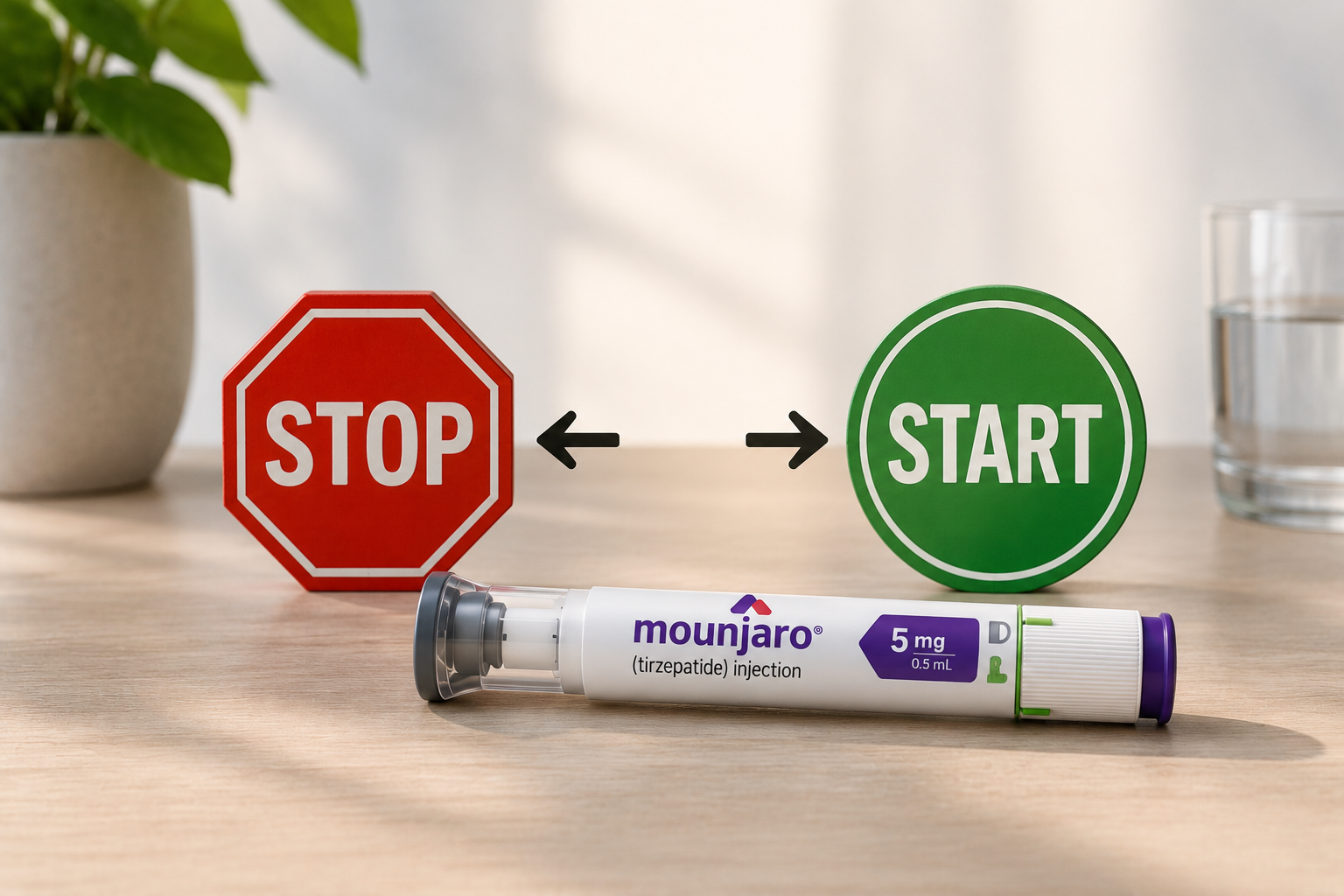


Thyroid conditions and Mounjaro have two separate considerations worth understanding. First, Mounjaro carries a precautionary contraindication for people with a personal or family history of medullary thyroid carcinoma (MTC) or Multiple Endocrine Neoplasia syndrome type 2 (MEN2) — this is a clinical screen performed before prescribing, not a general thyroid concern. Second, hypothyroidism (underactive thyroid) is extremely common in the UK and profoundly affects weight loss — untreated or undertreated hypothyroidism can significantly blunt Mounjaro’s effect. This guide covers both, with specific guidance for the far more common hypothyroid case.
Related reading: Mounjaro Dose Not Working UK and GLP-1 Medication Interactions UK.
The MTC/MEN2 warning: what it actually means
The prescribing information for Mounjaro includes a contraindication for patients with:
- Personal history of medullary thyroid carcinoma (MTC)
- Family history of MTC in a first-degree relative
- Multiple Endocrine Neoplasia syndrome type 2 (MEN2)
This warning stems from animal studies (rats and mice) in which high doses of GLP-1 receptor agonists caused C-cell tumours in thyroid tissue. The MHRA and FDA both require the warning, but importantly:
- The doses used in animal studies were multiples higher than therapeutic human doses
- C-cell tumours are characteristic of rodent thyroid biology; humans have proportionally fewer thyroid C-cells
- No causal link between GLP-1 medications and MTC in humans has been established in population studies
- MTC is a rare cancer (less than 5% of all thyroid cancers)
The precautionary principle appropriately excludes patients with MTC history or MEN2, where even a theoretical elevated risk is unacceptable. For the general population with no such history, the practical thyroid cancer risk from Mounjaro appears negligible.
What this means for you: before starting Mounjaro, your prescriber should ask about personal and family thyroid cancer history. If you have no such history, this contraindication doesn’t apply and isn’t a cause for concern about routine thyroid issues.
Hypothyroidism: the common and consequential interaction
Hypothyroidism affects an estimated 1–2% of the UK adult population actively, with a further 5–8% having subclinical hypothyroidism (elevated TSH but normal T4). Women are approximately five to ten times more likely to have it than men.
Untreated hypothyroidism causes:
- Significantly reduced metabolic rate (the thyroid regulates basal metabolism)
- Weight gain or difficulty losing weight despite reduced calories
- Fatigue, cold intolerance, brain fog, depression
- Higher cholesterol
- Constipation — compounding GLP-1-related constipation
If you have hypothyroidism that is inadequately treated, Mounjaro will be working against a significant metabolic headwind. The medication’s effects on appetite and insulin sensitivity continue, but the reduced metabolic rate from hypothyroidism substantially limits the weight loss response.
Checking your thyroid function before or during Mounjaro
Request a TSH test from your GP if:
- Mounjaro isn’t producing the expected weight loss despite consistent use and good dietary habits (see Mounjaro Dose Not Working UK)
- You have symptoms suggesting hypothyroidism (persistent fatigue, cold intolerance, weight gain despite restricted eating, brain fog, hair loss, dry skin)
- You have a family history of thyroid disease
- You’re female over 40 (higher prevalence group)
- You have other autoimmune conditions (autoimmune thyroid disease clusters with Type 1 diabetes, coeliac disease, Addison’s disease)
- You’ve never had a thyroid check and have been on Mounjaro for 3+ months without expected results
The NHS standard screen is TSH only. A more comprehensive screen includes free T4 (fT4) and sometimes free T3 (fT3) — worth requesting if TSH is borderline or if symptoms persist despite normal TSH.
Levothyroxine and Mounjaro
Levothyroxine is the most commonly prescribed medication in the UK, taken by approximately 4 million people for hypothyroidism. It is a specific case where Mounjaro’s gastric emptying effect requires attention.
Levothyroxine absorption is highly sensitive to timing. It must be taken on an empty stomach, typically first thing in the morning, 30–60 minutes before food or other medications. Even small amounts of food significantly reduce absorption.
On Mounjaro, slowed gastric emptying means any food eaten in the morning remains in the stomach longer. If you take levothyroxine and then eat breakfast while on Mounjaro:
- Food remains in the stomach longer than pre-Mounjaro
- Calcium, iron, and other food components that bind levothyroxine have more contact time with the medication
- Levothyroxine absorption may be reduced, leaving your thyroid less well-controlled
Practical recommendation: take levothyroxine first thing in the morning, then wait at least 45–60 minutes before eating or drinking anything other than water. This is the standard guidance regardless of Mounjaro, but is more important to follow strictly on a GLP-1. Discuss with your GP at your next thyroid review whether your TSH has changed since starting Mounjaro — your levothyroxine dose may need adjusting if absorption has been affected.
Hyperthyroidism and Mounjaro
Hyperthyroidism (overactive thyroid — Graves’ disease being the most common cause in the UK) produces the opposite metabolic picture: elevated metabolic rate, weight loss, anxiety, palpitations, heat intolerance.
Active uncontrolled hyperthyroidism alongside Mounjaro is unusual as a combination because weight loss in hyperthyroidism is typically already occurring. If you have Graves’ disease that’s currently well-controlled with antithyroid medication (carbimazole, propylthiouracil), you can generally start Mounjaro — no specific interaction. Discuss with your endocrinologist.
Thyroid nodules
Thyroid nodules (small lumps in the thyroid gland) are extremely common — found in up to 70% of adults on ultrasound, the vast majority being benign. Having thyroid nodules does not contraindicate Mounjaro unless they are confirmed as MTC (or the patient has been identified as at high MTC risk through MEN2 screening).
If you have known thyroid nodules and are concerned about starting Mounjaro, discuss specifically with your endocrinologist. They can assess whether your specific nodule type and history falls within the contraindication criteria.
Monitoring thyroid on Mounjaro
If you have hypothyroidism on levothyroxine:
- Check TSH at your next standard thyroid review (typically 6–12 monthly in stable patients)
- Mention that you’ve started Mounjaro — your GP may choose to recheck TSH sooner
- Track any new symptoms (increased fatigue, weight changes beyond Mounjaro effect, cold intolerance)
If you start Mounjaro without a recent thyroid check and weight loss is disappointing at 3+ months, a TSH test is one of the most useful investigations — undiagnosed or undertreated hypothyroidism is one of the more common and most addressable reasons for suboptimal GLP-1 response.
Track your micronutrients in Cronometer — specifically selenium and iodine, both essential for thyroid hormone synthesis. On a GLP-1 with reduced food volume, these can be depleted. Selenium is found primarily in Brazil nuts (just two per day provides the RNI), seafood, and meat. Iodine in dairy, seafood, and eggs.
Frequently asked questions
Can I take Mounjaro if I have a thyroid condition?
It depends on the type. Most thyroid conditions — hypothyroidism, hyperthyroidism, Hashimoto’s thyroiditis, Graves’ disease — are not contraindications to Mounjaro. The specific contraindication is medullary thyroid carcinoma (personal or family history) and MEN2. Discuss your specific situation with your prescriber.
Does Mounjaro affect the thyroid?
No direct effect on thyroid function has been established in humans at therapeutic doses. The indirect effect is on levothyroxine absorption if you’re on thyroid medication — follow strict morning timing to minimise this.
Why isn’t Mounjaro working for my weight loss when I have hypothyroidism?
Undertreated or borderline hypothyroidism significantly reduces metabolic rate, blunting Mounjaro’s effect. Check your most recent TSH result — “normal” range is wide (0.5–4.5 in most UK labs) and some patients feel and lose weight best at TSH in the lower half of this range. Discuss optimal TSH targets with your GP.
Is it safe to take levothyroxine and Mounjaro together?
Yes, but monitor thyroid function more closely after starting Mounjaro. Slowed gastric emptying may reduce levothyroxine absorption slightly, requiring a dose review. Take levothyroxine first thing in the morning with water, wait 45–60 minutes before eating.
Medical disclaimer: thyroid management and medication decisions require clinical assessment. Always involve your GP or endocrinologist. Report new symptoms to your prescriber.
Nutrition for thyroid health on a GLP-1
The thyroid requires specific micronutrients that can be depleted on a GLP-1 reduced food intake:
Iodine: essential for T3 and T4 synthesis. UK sources include dairy products, eggs, seafood (white fish, seaweed). Iodine is not in most multivitamins; it’s easy to miss on a reduced-appetite diet. Check in Cronometer — the UK RNI is 140mcg daily. Below this consistently over months can worsen hypothyroid function.
Selenium: essential for converting inactive T4 to active T3 (triiodothyronine) in peripheral tissue. Hashimoto’s thyroiditis (the most common cause of hypothyroidism in the UK) responds positively to selenium supplementation in some studies. UK selenium RNI is 60–75mcg daily. Brazil nuts (2 per day), tuna, chicken, and eggs are good sources. A single Brazil nut contains approximately 90mcg selenium — one to two per day covers the requirement efficiently.
Zinc: also involved in thyroid hormone synthesis and conversion. See Zinc on GLP-1 UK.
Iron: thyroid peroxidase (an enzyme in thyroid hormone production) requires iron. Iron deficiency independently impairs thyroid function, compounding hypothyroidism. Particularly relevant for women with both conditions. See Best Iron Supplement UK.
If you have hypothyroidism and your Mounjaro results are disappointing, a comprehensive nutritional audit — checking iodine, selenium, zinc, and iron in Cronometer alongside TSH and T4 blood tests — gives a complete picture of what’s supporting or inhibiting thyroid function. The nutritional factors are often the most actionable: dietary changes and targeted supplementation are adjustable without waiting for a prescription review.
Discover more from Healthy Weight Loss GLP1
Subscribe to get the latest posts sent to your email.