

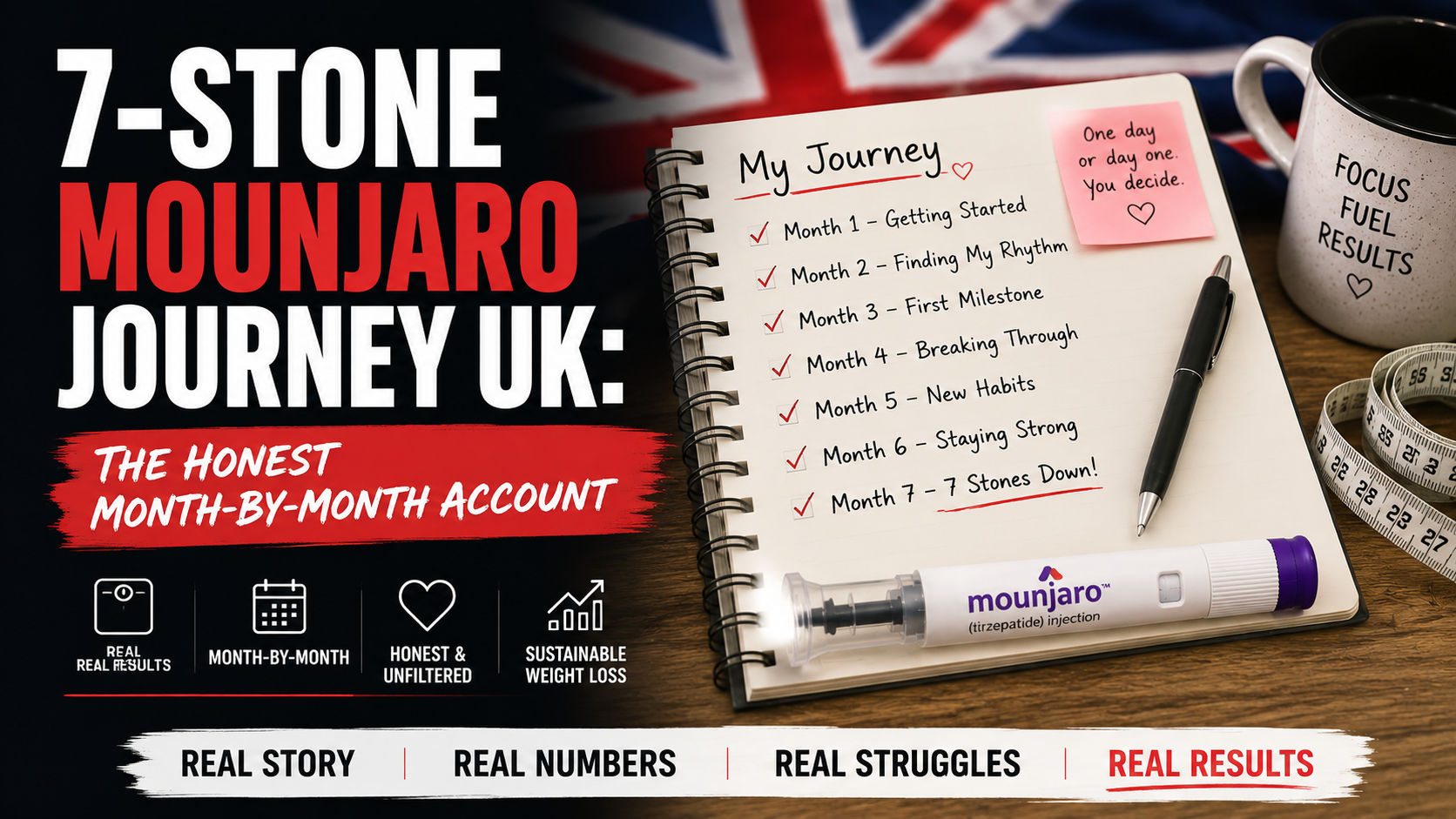
I started Mounjaro in January 2025 at 27 stone. Twelve months later I’d lost 7 stone. That’s the headline. The reality underneath it is messier and more useful: a gallbladder emergency in month fourteen, weeks where the scale didn’t move at all, injection days spent on the sofa, and a relationship with food that changed in ways I didn’t fully expect. This is the honest version of that year — every month, what actually happened, and what I wish I’d known at the start.
For the monthly breakdown of what’s typical: Mounjaro Results Week by Week UK. To follow the weekly documentation: the YouTube channel.
Starting point: January 2025
27 stone (171kg). BMI 47. Joint pain that meant climbing stairs was something I had to think about. Sleep apnea that my partner had been flagging for two years. Energy levels that made getting through a full working day feel like an achievement.
I’d tried everything I think most people in that position try. Diets that worked for three weeks then collapsed. Exercise habits that lasted until the first bad week. The standard advice — eat less, move more — that ignores the fact that the hunger signals in people with significant obesity are genuinely dysregulated in ways that willpower doesn’t fix.
I started researching GLP-1 medications in late 2024. Went private with a UK provider — the provider comparison guide here covers what I found. First injection was January 2025.
Month 1 — 2.5mg: the unexpected part
I expected the nausea. What I didn’t expect was how quickly the background noise about food quieted down. The constant low-level negotiation — what to eat, how much, should I have that, I’ll do better tomorrow — just reduced significantly within the first week. Not completely. Not magically. But noticeably.
Weight in month 1: approximately 5kg down. Most of that was water and gut content rather than fat. The real loss came later.
What I set up in month 1 that paid off for the full year:
- Cronometer for tracking. Set protein target to 1.4g × bodyweight. The first week showed I was hitting 65g on “good” days. I needed 110g+. That gap explained a lot.
- Walking pad. Starting at 2km/h, 20 minutes per day. By month 3 I was doing 45 minutes at 3km/h during calls. The WalkingPad I used is still the one I’d recommend.
- Injection day routine. Same day every week, same location, same time. Habit before it needs to be habit.
Months 2–4 — 5mg then 7.5mg: the visible phase
This is when people started noticing. Not just the scales — clothes fitting differently, the way I moved, energy levels that meant I was finishing days with capacity rather than running on empty.
Month-by-month losses during this phase averaged 3–4kg per month. Total by end of month 4: approximately 16kg from starting weight.
I added resistance training in month 3. Not a full programme — three kettlebell sessions per week, 25 minutes each. The investment was one 16kg kettlebell from Amazon and a mat. Muscle preservation during this phase is something I can’t overstate the importance of.
The supplement stack I settled on by month 4, tracked via Cronometer:
- Lily & Loaf Triple Magnesium — sleep improved within two weeks
- Vitamin D3+K2 — British winters and reduced outdoor time
- Omega-3 — cardiovascular and anti-inflammatory
- Protein powder — to close the gap on days where appetite made hitting targets nearly impossible
I’d done the Lily & Loaf lifestyle analysis in month 2 — it identified magnesium and D3 as the primary gaps based on my symptoms (poor sleep, low energy, frequent headaches). The recommendations were accurate.
Months 5–8 — 10mg: the middle miles
The pace of loss slowed. Not stopped — but the 3–4kg months became 1.5–2kg months. This is metabolic adaptation and it’s entirely normal, but it’s psychologically the hardest phase because the effort feels the same and the visible reward diminishes.
Two things that kept the middle miles moving:
Audiobooks. I started listening while on the walking pad. Got through twelve books in these four months — everything from Jason Fung’s The Obesity Code to Matthew Walker’s Why We Sleep. Understanding the science made the discipline feel purposeful rather than arbitrary. Audible was where all of them came from. The combination of walking and listening is one of the habits that’s genuinely stuck beyond treatment.
Keeping records. Monthly measurements, weekly weigh-ins, Cronometer data. On weeks where the scale stalled, the waist measurement still moved. On weeks where training felt pointless, the protein data showed the work was still going in.
Total by end of month 8: approximately 33kg from starting weight.
Months 9–12 — 12.5mg then 15mg: the final push and the gallbladder
Month 9 started well. By month 10 I was stepping up to 12.5mg. By month 11, 15mg.
Month 14 — February 2026 — the gallbladder. Rapid weight loss significantly raises the risk of gallstone formation and the subsequent gallbladder attack. Mine started as what I thought was indigestion one evening and escalated overnight into upper-right chest and back pain that needed a hospital visit by morning. Emergency cholecystectomy (gallbladder removal) in February 2026.
I’d documented the warning signs that I missed and the conversation with ChatGPT that made me take it seriously — that post is at ChatGPT Saved My Life: Gallstones on GLP-1 UK. The full gallbladder story is covered in the GLP-1 Gallbladder Guide.
The surgery was straightforward. Recovery took three weeks. I was back on Mounjaro within four weeks of the procedure.
Final weight at 12 months (January 2026): 20 stone 7 pounds. 7 stone (44kg) lost from January 2025.
What the numbers don’t capture
The weight is the headline. The reality underneath:
- Sleep apnea resolved by month six. My partner noticed before I did.
- Knee pain that I’d managed with regular ibuprofen for three years — gone by month eight.
- I ran for the first time in four years in month nine. Slowly. With the right trainers. But I ran.
- The relationship with food changed permanently. Not absent appetite — just a different relationship with it. Less desperate, less constant, less loud.
- Three or four weeks where nothing moved on the scale at all. Normal. Inevitable. Temporary.
- A week in month six where I almost stopped the medication because I convinced myself it had stopped working. It hadn’t. I was under-eating protein and drinking more alcohol than usual. Cronometer told me that within three days of logging properly.
The toolkit that made the difference
Everything that mattered across the 12 months, in priority order:
- Protein tracking in Cronometer — the single most important tool. Not the medication, not the training, not the supplements. Knowing my protein intake every day.
- Walking pad — WalkingPad for daily NEAT. More cumulative calorie expenditure than any single training session.
- Resistance training — kettlebell, three times a week. Body composition at the end looks completely different because of this.
- Lily & Loaf supplements — specifically magnesium for sleep and D3+K2 for baseline health. The lifestyle analysis pointed me to the right ones.
- Audiobooks on Audible — understanding the science behind what the medication is doing converts compliance into genuine habit change. Start your free Audible trial here.
- The weekly YouTube documentation — @alanspicerislosingit. Having to show up and be honest about what happened each week was its own accountability mechanism.
What I’d do differently
Three things I’d change if I started again tomorrow:
1. Start the L&L lifestyle analysis in week one. I started in month two. The magnesium gap was there from the start — the poor sleep in month one was unnecessary.
2. Set up Cronometer before the first injection, not after. The two-week baseline before you start the medication gives you the most useful data point: what your “normal” diet looked like before appetite suppression changed everything.
3. Address the gallbladder risk proactively. A low-fat diet for the first six months of treatment, awareness of the symptoms, and earlier GP conversation about gallbladder health. The emergency was avoidable.
Frequently asked questions
How much did Mounjaro cost for 12 months?
Approximately £2,400 in total across the year on a mid-range UK private provider. See the full Mounjaro Cost UK breakdown.
Was Mounjaro worth it?
That post exists: Is Mounjaro Worth It UK? Short answer: yes, unambiguously, for my specific situation.
What happens next — are you still on Mounjaro?
The ongoing story is documented weekly on the YouTube channel. Year two looks very different from year one.
Can I do what you did?
The tools are the same for everyone. The results vary by person, starting weight, dose, and how consistently the supporting habits are built. Start with Cronometer, take the free lifestyle analysis, and get the walking going. The rest builds.
The stats in numbers
| Metric | Start (Jan 2025) | End (Jan 2026) |
|---|---|---|
| Weight | 27 stone (171kg) | 20 stone 1 lb (127kg) |
| Total lost | — | 7 stone (44kg) |
| Mounjaro dose | 2.5mg | 15mg |
| Daily steps (average) | ~2,000 | ~9,000 |
| Daily protein (average) | ~65g | ~130g |
| Resistance training | None | 3× weekly |
| Sleep quality | Poor (sleep apnea) | Significantly improved |
Discover more from Healthy Weight Loss GLP1
Subscribe to get the latest posts sent to your email.