
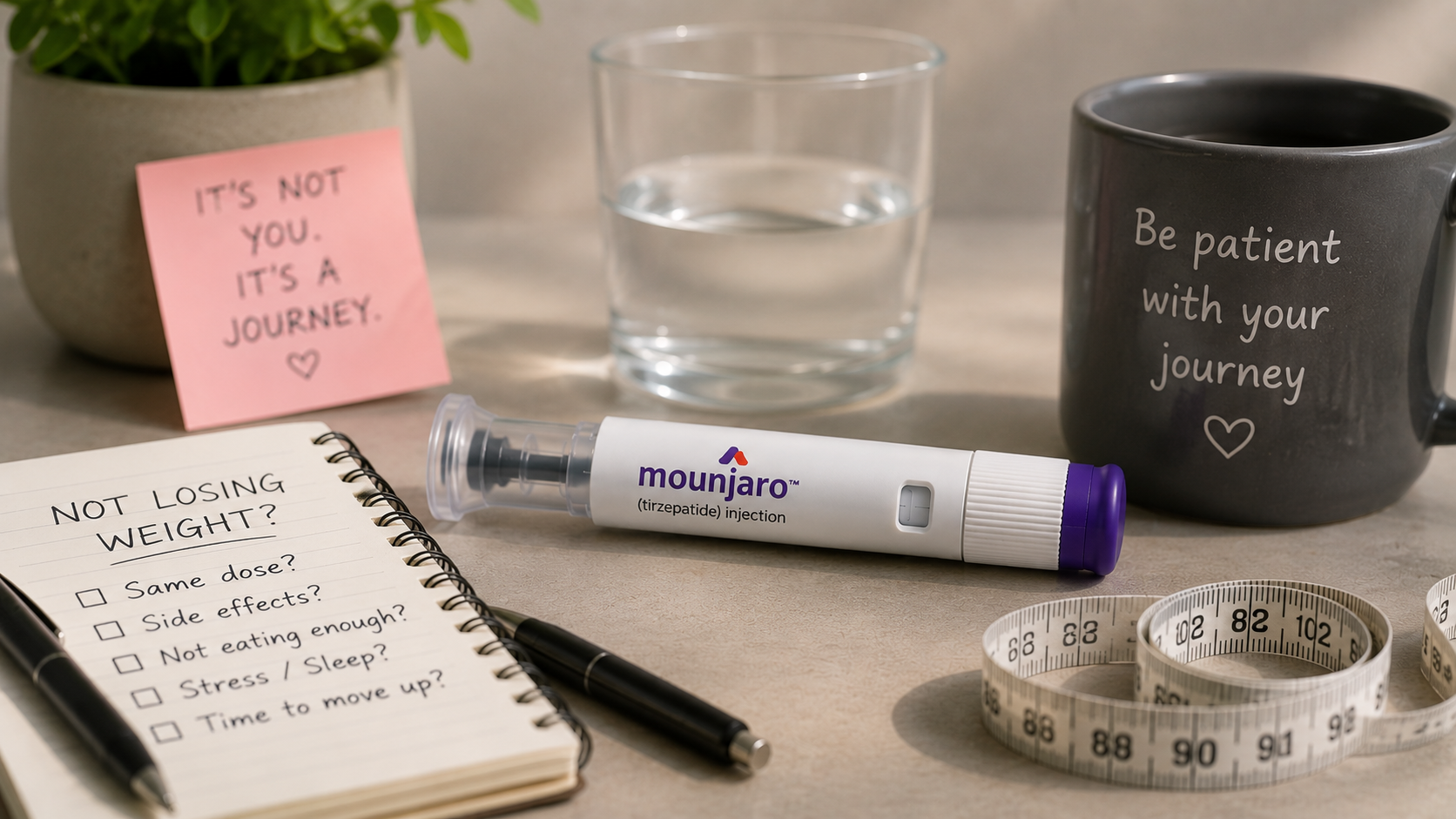
If Mounjaro isn’t working as well as expected, the cause is almost always in one of four categories: the dose is insufficient, diet is undermining the medication’s effect, the medication isn’t being stored or injected correctly, or a health condition is working against it. Genuine non-response to tirzepatide at therapeutic doses is rare — most users who feel the medication has stopped working have an addressable cause. This guide works through every possibility in order of likelihood so you can identify what’s actually happening.
For the plateau context: Mounjaro Plateau UK. For dose guidance: Mounjaro Dose Guide UK.
First: define “not working”
The answer to “my dose isn’t working” depends significantly on what you mean:
- “I’m not losing weight as fast as I was initially” — this is normal; early weight loss includes water weight and glycogen that doesn’t continue
- “Weight loss has plateaued for 3+ weeks despite staying on the medication” — this warrants investigation; most causes are addressable
- “I feel no appetite suppression at all” — this is the clearest signal that either the dose is insufficient or something is interfering with the medication
- “I’m losing weight but much slower than the trial averages” — individual variation is wide; “slower than average” doesn’t mean “not working”
Be precise about which of these describes your experience before assuming the medication has failed.
Cause 1: the dose is genuinely insufficient
Tirzepatide follows a dose-response curve — higher doses produce stronger appetite suppression and more weight loss on average. Some users are “undertreated” at lower doses:
- Food noise returns significantly in the days before your next injection
- Appetite is relatively unchanged from pre-medication baseline
- The medication feels like it’s “wearing off” by days 5–6 each week
Standard titration is one dose level every four weeks. If you’re six to eight weeks into a dose and experiencing these symptoms, contact your prescriber. A step-up may be warranted rather than waiting the full titration schedule.
Important: don’t step up doses without prescriber guidance. Some users push titration too fast and experience significant side effects at doses their system hasn’t been prepared for.
Cause 2: dietary factors undermining the medication
The most common reason Mounjaro users feel it’s not working is that diet is working against the medication’s effect:
Alcohol: liquid calories aren’t suppressed by GLP-1 appetite mechanisms. Regular alcohol consumption can eliminate the entire calorie deficit the medication creates. Even 3–4 drinks per week adds 400–600 extra calories that generate no fullness response. See Mounjaro and Alcohol UK.
High-calorie liquid calories generally: smoothies, juice, lattes with full-fat milk, cream in coffee. These are easy to consume on a low appetite (liquid goes down when solid food doesn’t) but add significant calories without triggering satiety.
Calorie creep in “healthy” foods: nuts, avocado, olive oil, nut butters are all nutritionally valuable but calorie-dense. Untracked, these can add 300–500 daily calories to what feels like a light diet.
Takeaways and restaurant meals: restaurant portion sizes are typically 30–50% larger than home-cooked equivalents, and calorie counts for the same dish vary wildly between establishments. A perceived “small meal out” may have double the calories of the equivalent home-cooked meal.
Run a one-week honest food diary in Cronometer before concluding the medication isn’t working. Include everything. This exercise resolves the question for most users.
Cause 3: injection technique or storage problems
Tirzepatide is a protein that degrades with improper storage or injection. If the medication is damaged, it delivers little or no active ingredient despite the injection going ahead normally:
Temperature exposure: Mounjaro must be refrigerated (2–8°C) until use. If it’s been left out for extended periods (hours in a warm car, left on a windowsill, or stored near heat), the protein structure can denature. The pen will still inject — but degraded tirzepatide has reduced or no activity.
Freezing: frozen and thawed Mounjaro is also compromised. Don’t leave it in a compartment that gets near freezing.
Injection site selection: injecting into lipohypertrophy (lumpy hardened tissue from repeated same-site injections) significantly reduces absorption. Rotate sites systematically. See Mounjaro Injection Day Routine UK.
Incomplete injection: the pen requires a firm 10-second press to deliver the full dose. Removing before the count is complete results in partial delivery.
If storage conditions have been inconsistent, contact your prescriber about replacing pens. This is not an embarrassing admission — storage failures happen and are manageable.
Cause 4: a medical condition working against the medication
Hypothyroidism: untreated or undertreated hypothyroidism severely impairs weight loss — elevated TSH increases fat storage and reduces metabolic rate. If your thyroid function hasn’t been checked recently, a blood test is worthwhile. See Mounjaro and Thyroid Conditions UK.
Insulin resistance that’s particularly severe: very high insulin levels can partially reduce GLP-1 efficacy. If you have type 2 diabetes or metabolic syndrome, ensuring your other diabetes management is optimised (metformin dose, SGLT2 inhibitor addition) supports Mounjaro’s effect.
Polycystic ovary syndrome (PCOS): PCOS-related insulin resistance is often well-addressed by Mounjaro, but if hormone levels haven’t normalised, weight loss may be slower. See Mounjaro and PCOS UK.
Medications that cause weight gain: some medications actively promote weight gain and can partially counteract GLP-1 effects. Most relevant: certain antidepressants (mirtazapine, amitriptyline, olanzapine, quetiapine), some diabetes medications (insulin, sulphonylureas), some antiepileptics (valproate, gabapentin), and some beta-blockers. Review your full medication list with your GP if you’re on any of these.
Cushing’s syndrome (rare): excess cortisol from adrenal or pituitary dysfunction causes significant weight gain regardless of calorie intake or medication. Symptoms: central obesity, facial rounding (“moon face”), purple stretch marks, easy bruising. Very rare but worth mentioning if suspected. Diagnosed with a 24-hour urinary cortisol or late-night salivary cortisol test.
Cause 5: antibodies to tirzepatide (rare)
A very small number of patients develop antibodies to tirzepatide that reduce its effectiveness over time. This is rare and typically identified by complete loss of appetite suppression effect despite confirmed proper storage and injection. Not something you can test for easily — but if all other causes have been ruled out, it’s worth raising with your prescriber. In these cases, switching to a different GLP-1 (semaglutide) may be more effective.
A systematic troubleshooting checklist
- Log one week of food in Cronometer — review calories, alcohol, and liquid calories honestly
- Review injection technique — full 10-second press, correct sites, rotating systematically
- Check storage history — has the medication been kept refrigerated? Any heat exposure?
- Review other medications for weight-gain-promoting drugs
- Book a GP appointment for thyroid function test if not done recently
- Discuss with prescriber whether a dose step is appropriate
What to tell your prescriber
When contacting your prescriber about a dose not working, specific information helps them advise effectively:
- How long you’ve been on the current dose
- Your weight at the start of this dose vs now
- Any change in appetite suppression from when you first started this dose
- Current injection sites and rotation pattern
- Any changes to storage or temperature exposure
- Other medications you’re taking
Frequently asked questions
Can Mounjaro stop working over time?
The medication can become less effective if tolerance develops at a particular dose (common) or if lifestyle factors undermine its effect. Complete loss of appetite suppression is unusual without an identifiable cause — work through the checklist above before concluding the medication has failed.
Should I increase my Mounjaro dose if it’s not working?
Only after ruling out dietary and storage causes first, and only with prescriber guidance. Unnecessary dose increases add side effect risk and cost without addressing the underlying issue.
Does Mounjaro work less well over time as the body adapts?
Metabolic adaptation (body adjusting to lower weight and slower weight loss rate) is real but isn’t the same as the medication losing efficacy. The appetite suppression mechanism continues working; the rate of weight loss slows because of the body weight change, not because the drug is failing.
Medical disclaimer: if Mounjaro seems completely ineffective, discuss with your prescriber before making changes. Do not self-adjust doses or stop treatment for diabetes management without medical guidance.
Building a useful evidence trail for your prescriber
When you contact your prescriber about a dose not working, the quality of the conversation depends on the quality of the information you bring. Vague reports (“I don’t feel like the medication is doing much”) produce vague responses. Specific data produces useful conversations.
Collect and present:
Weight data: your weight at the start of your current dose and today, with dates. This tells the prescriber whether there’s been any progress or a true stall.
Appetite data: rate your appetite suppression on a 1–10 scale (10 = pre-medication normal hunger, 1 = complete absence of appetite) at your current dose. If you’re consistently at 6–8, the dose is underperforming appetite-suppression-wise. If you’re at 2–3 and still not losing weight, the problem is almost certainly dietary or medical rather than insufficient dose.
Food diary: a 7-day Cronometer log showing actual intake. Prescribers are often surprised by how useful this is — it removes guesswork from both sides of the conversation. A week’s data showing 1,400 kcal daily and 130g protein clearly points to the dose being insufficient if weight hasn’t moved. A week’s data showing 1,900 kcal with significant alcohol and hidden calories clearly points elsewhere.
Injection record: dates of injections, current dose, any missed doses, any storage issues. This confirms adherence and rules out the most basic explanations first.
Bringing this to a prescriber appointment — whether in-person or via a written message through your provider’s app — transforms the quality of the clinical response. This approach also works for self-audit: often the process of collecting the data itself answers the question before the appointment happens.
Discover more from Healthy Weight Loss GLP1
Subscribe to get the latest posts sent to your email.