
Mounjaro injections are usually painless or mildly uncomfortable — a brief pinch at insertion. But a meaningful minority of users experience sharper pain, stinging during injection, or lingering soreness afterwards. Most of these are technique or preparation issues that you can fix yourself. This is the practical UK guide to reducing Mounjaro injection discomfort, what causes painful injections, and when pain signals something worth mentioning to your prescriber.
For first-time injection technique see How to Inject Mounjaro First Time. For weekly routine: Mounjaro Injection Day Routine UK.
What “normal” Mounjaro injection sensation should feel like
Baseline expectations:
- At insertion: a brief pinch or scratch, 1–2 seconds. Some users feel nothing at all.
- During the 10-second hold: mild sensation of liquid delivery. Can feel like a gentle pressure or warmth. Many users feel nothing.
- Immediately after: tiny drop of blood occasionally, brief redness at site, maybe a slight tingle.
- Hours after: possibly slight tenderness at the site, similar to a minor bruise. Usually fades within 24 hours.
- Next day: site should feel normal. Small bruise occasionally visible.
If your injections consistently feel much more painful than this, something is usually fixable.
The most common cause: cold medication
Injecting refrigerator-cold medication is the #1 cause of “painful” Mounjaro injections. Cold liquid entering subcutaneous tissue is uncomfortable and can sting for several seconds.
Fix: take the pen out of the fridge 15–30 minutes before injection. Let it warm to room temperature on a surface (not in direct sunlight or a warm spot).
This change alone resolves perceived injection pain for most users who complain. The medication is not damaged by returning to room temperature for 30 minutes. Don’t go above room temperature (don’t put it in warm water, don’t leave it on a radiator); just let ambient air warm it.
Second most common: wet alcohol
Alcohol not fully dried on the skin before injection causes stinging. The alcohol enters the needle track and irritates tissue.
Fix: after wiping with alcohol swab, wait 10–15 seconds for the skin to air-dry. Don’t blow on it (contaminates). Don’t wipe it off with a tissue (defeats disinfection). Just wait.
Third: needle angle and press technique
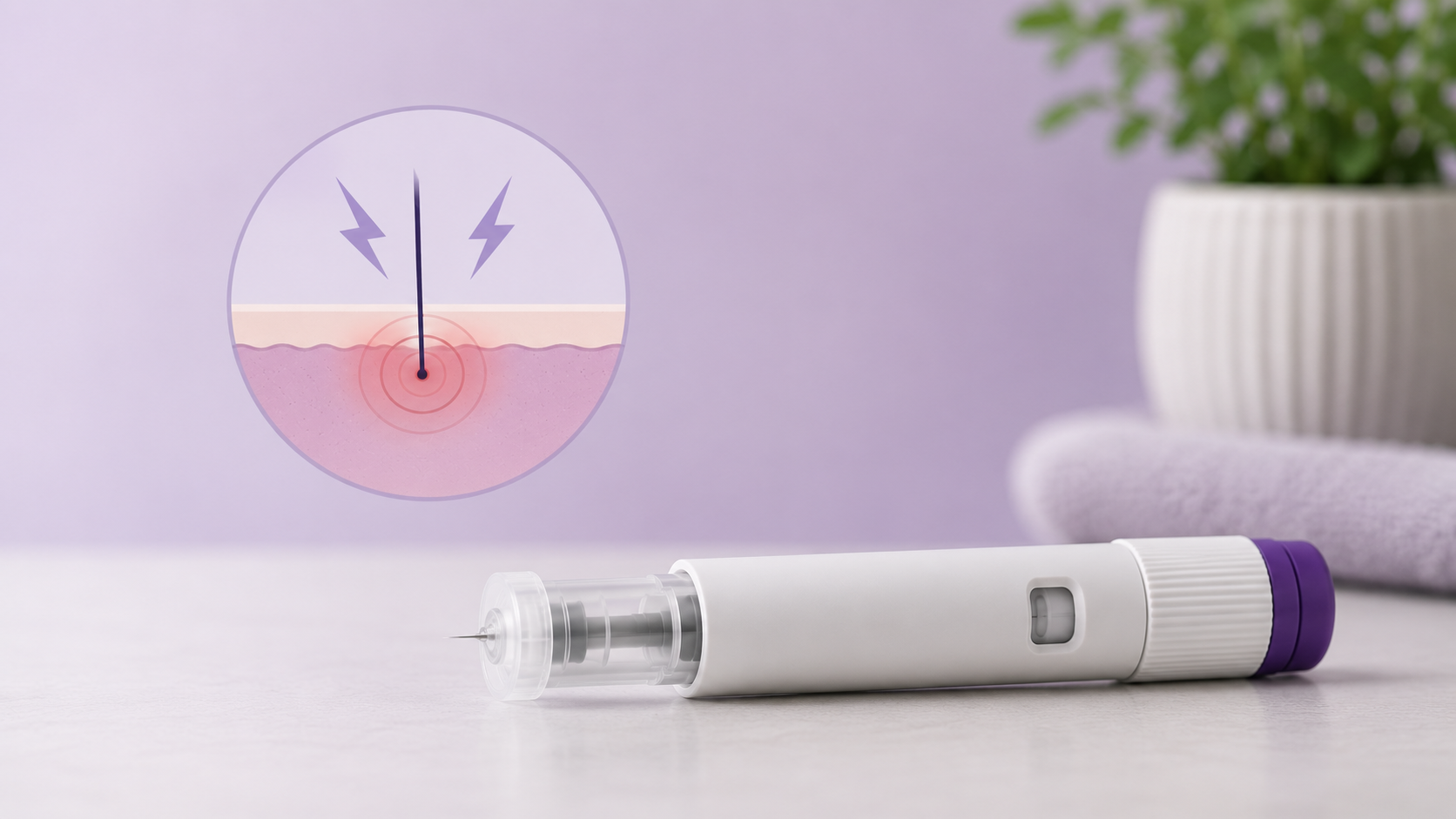
The KwikPen is designed for 90-degree insertion (perpendicular to skin). Common technique errors:
- Injecting at an angle: causes the needle to pass through more tissue and push against skin. Hold the pen straight up, not tilted.
- Not pressing firmly enough: the pen only clicks when fully engaged. Halfway-pressed pens cause longer, more painful needle contact. Press firmly against the skin.
- Pulling the pen before the 10 seconds are up: the needle is still delivering medication; removing it early leaves some medication pooled at skin level, which causes stinging. Count a full 10 seconds.
- Twisting or lifting at an angle on removal: causes more tissue disturbance. Lift straight up.
Fourth: injection site choices
Some sites are consistently less sensitive than others:
- Abdomen: generally low sensitivity, especially 5–10cm out from belly button. Most users find this the most comfortable site.
- Front/outer thigh: variable sensitivity. Some people find this uncomfortable (more nerve endings); others find it fine.
- Upper outer arm (triceps): generally well-tolerated but requires assistance or mirror.
- Areas with scar tissue, stretch marks, or previous injection lumps: more painful; avoid.
- Areas right under skin creases or waistband pressure points: can be more sensitive; choose flatter areas of adipose tissue.
If abdominal injections hurt consistently, try thigh. If thigh hurts consistently, go back to abdomen but a different zone.
The pinch-or-stretch question
Some injection guides recommend pinching a fold of skin; others recommend stretching the skin flat. The Mounjaro KwikPen is designed for stretched skin (press the pen flat against taut skin), not pinched skin.
Why this matters:
- Pinching bunches subcutaneous tissue, sometimes including deeper layers with more nerve endings
- Pinched tissue can cause the needle to reach muscle tissue, which hurts significantly more
- Stretched skin provides the consistent subcutaneous depth the auto-injector is calibrated for
Exception: very lean users with minimal subcutaneous fat may need to gently pinch to create enough tissue depth. If you’re not in this category, don’t pinch.
Slow down the pen removal
A small tweak that helps some users: after the 10-second count, pause an extra 2–3 seconds before removing the pen. Some users remove the pen quickly while a tiny amount of medication is still being delivered, which can cause a pain spike.
Count to 15 mentally before removing the pen, not just 10. Most pens finish delivery within the first 10 seconds, but the extra buffer ensures everything is complete.
Post-injection tenderness tips
If the injection site is sore for hours after:
- Apply gentle pressure immediately after injection with a clean tissue for 15–30 seconds. Helps prevent small bleeds and reduces local swelling.
- Cool compress if the site feels hot or very tender — ice pack wrapped in cloth for 5–10 minutes after injection. Reduces minor inflammation.
- Avoid rubbing the site. Rubbing redistributes medication and can worsen soreness.
- Avoid hot showers for 1–2 hours after injection if skin feels irritated.
- Don’t apply creams or moisturisers directly to the injection site for at least 1–2 hours.
- Wear loose clothing over the site if possible for the rest of the day.
Bruising: normal vs concerning
Minor bruising (a coin-sized patch of blue/purple that fades over 3–7 days) is common and not concerning.
More concerning patterns:
- Large bruises (larger than a 50p coin) every injection
- Bruises that take more than 2 weeks to resolve
- Deep hematomas (feel lumpy under the skin)
- Bruises accompanied by severe pain, heat, or redness spreading beyond the bruise
If you’re experiencing consistent large bruising:
- Check whether you’re on any blood-thinning medications (aspirin, warfarin, clopidogrel, etc.)
- Verify your injection technique with a video (phone recording of your next injection)
- Talk to your prescriber — occasionally a different injection site or slight technique tweak resolves it
Lumpy tissue (lipohypertrophy)
If you inject the same spot repeatedly, subcutaneous tissue can develop lumpy, hardened areas (lipohypertrophy). This is well-documented with insulin injection and applies to Mounjaro too.
Consequences:
- Injection into these lumps is often less painful (lumpy tissue has fewer nerves)
- But medication absorption is erratic — some users get reduced efficacy because the lumps don’t absorb reliably
- Long-term, the lumps can look and feel cosmetically unpleasant
Prevention: rotate sites systematically (see Mounjaro Injection Day Routine UK). Don’t inject the same spot repeatedly.
If you already have lumpy areas, avoid them for 2–3 months to let tissue recover.
Specific pain patterns and what they mean
“It stings only during the actual injection”
Usually cold medication or wet alcohol. Warm the pen, dry the alcohol, try again.
“It hurts when the needle goes in but is fine afterward”
Likely technique — angle, pressure, or site. Review and adjust.
“It’s fine during the injection but sore for hours after”
Usually normal post-injection tenderness. Apply pressure, consider ice, avoid rubbing. If this pattern is new, consider whether you’ve been injecting a repeatedly-used site.
“Sharp shooting pain during or after injection”
May indicate you hit a small nerve branch. Rare but possible. Usually resolves within minutes to hours. If it persists or recurs at the same spot, avoid that specific area in future.
“Burning feeling that persists for a day”
Could be an inflammatory reaction to the medication or preservatives. Not common. If it happens repeatedly, mention to prescriber — occasionally users develop mild hypersensitivity.
“Pain spreading beyond the injection site, with redness and heat”
Possible skin infection. Rare but possible if bacteria entered via the needle track. Contact GP or NHS 111 for assessment. Typically managed with a short course of oral antibiotics if confirmed.
“Severe pain with fever, nausea, or systemic symptoms”
Unusual. Could indicate significant reaction. Seek urgent medical attention.
When to talk to your prescriber
Mention injection issues at your next titration review if:
- Injections are consistently painful despite correcting cold/technique issues
- You’re developing lumpy areas despite rotation
- Bruising is consistently severe or slow to resolve
- You’ve had episodes of sharp or unusual pain that concern you
- You’re avoiding injections because of pain anticipation
Contact prescriber urgently (or NHS 111) if:
- Signs of infection at an injection site
- Severe reactions beyond normal
- Unexplained persistent pain
- Any significant injection-related concern
For genuine needle phobia
A subset of users have genuine needle phobia that persists despite objectively minor injection sensation. For these users:
- Graded exposure can help: repeated successful injections with someone supportive present often reduces phobic response over weeks
- Cognitive strategies: watching TV or listening to music during injection reduces anticipatory focus
- Distraction techniques: counting backwards, pressing another body part firmly during injection, deep breathing
- Professional support: CBT or therapy specifically for injection phobia is available and effective
- Topical anaesthetic: EMLA cream applied 45 minutes before injection numbs the skin surface. Available OTC at UK pharmacies. Useful for severe phobia; not typically needed otherwise.
For users who genuinely cannot reduce needle phobia through behavioural approaches, alternative medications (possibly oral options, if appropriate) can be discussed with prescribers.
Topical anaesthetic specifics
EMLA (lidocaine and prilocaine cream) can be used before Mounjaro injection for needle-phobic users:
- Apply a generous layer to the injection site
- Cover with a clear film dressing (Tegaderm or similar, usually included)
- Wait 45–60 minutes for full numbing effect
- Remove film, wipe off excess cream, clean with alcohol swab as usual
- Inject as normal
Available OTC at most UK pharmacies; £10–£15 for a small tube that lasts several months.
Side effects: minor redness at application site is normal. Allergic reactions rare but possible (test on small area first if you’ve never used it).
The psychology of injection pain
A nuance worth acknowledging: anticipation amplifies pain perception. Users who dread their weekly injection often experience more pain than users who approach it as routine.
Practical implications:
- Established routine (same day, same location) reduces anticipation
- Anchoring the injection to something neutral or positive (favourite TV show, specific music) shifts the mental association
- Focusing on what follows (breakfast, a workout, a call with friends) rather than the injection itself helps
- Over time, most users find weeks 8–12 markedly less stressful than weeks 1–4 even if technique is identical
This isn’t dismissive of genuine pain — it’s noting that pain has a psychological component that routine and familiarity reduce.
What not to do
- Don’t skip doses because of anticipated pain. Missed doses cost you weeks of progress.
- Don’t inject into bruised or scarred areas to avoid “wasting” a good site.
- Don’t heat pens in warm water or microwave (damages the medication).
- Don’t inject harder or longer than the 10-second protocol to “make sure it went in.”
- Don’t massage or vigorously rub the site after injection.
- Don’t give up on the medication because of injection discomfort — in almost all cases, the discomfort is fixable.
The summary
Most Mounjaro injection pain is preventable with simple technique adjustments: warm the pen, dry the alcohol, 90-degree angle, firm press, full 10-second count, lift straight up. Rotate sites every week on a 4-week cycle. Apply gentle pressure after injection. For genuine needle phobia, topical anaesthetic or behavioural support can help. For persistent unexplained pain or signs of infection, contact your prescriber.
For the wider injection context: How to Inject Mounjaro First Time, Mounjaro Injection Day Routine UK.
Medical note: if pain is severe, unusual, or accompanied by other symptoms, contact your prescriber or NHS 111. Injection-related adverse events can be reported to the MHRA Yellow Card Scheme.
Discover more from Healthy Weight Loss GLP1
Subscribe to get the latest posts sent to your email.