
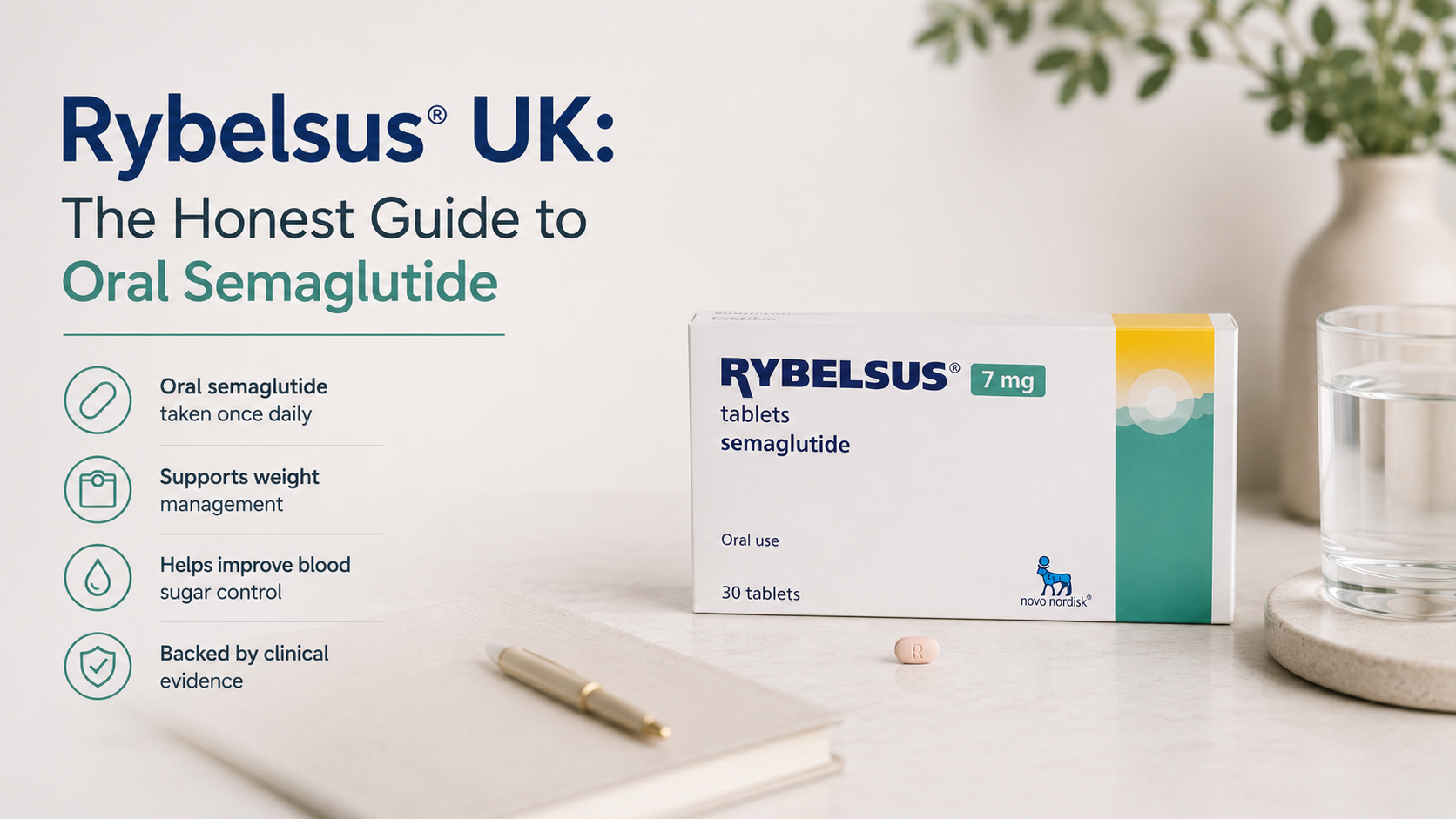
Rybelsus is semaglutide in tablet form — the same active ingredient as Ozempic and Wegovy, delivered daily as an oral pill instead of a weekly injection. Currently licensed in the UK only for type 2 diabetes (not weight management), it offers a needle-free alternative for some users but with significant trade-offs: lower bioavailability, specific dosing rules (empty stomach, wait 30 minutes before eating), lower efficacy than injectable semaglutide at equivalent doses, and typically not prescribed for weight management. This is the honest UK explainer.
For related medication context see Tirzepatide vs Semaglutide UK and Ozempic vs Wegovy UK.
The short answer
Rybelsus is:
- Manufacturer: Novo Nordisk
- Active ingredient: semaglutide (same as Ozempic and Wegovy)
- Form: oral tablet, taken daily
- UK indication: type 2 diabetes (not currently licensed for weight management)
- Dose strengths: 3mg, 7mg, 14mg tablets
- Dosing: once daily, on empty stomach, with small sip of water, no food or drink for 30 minutes after
For UK adults considering GLP-1 treatment for weight management, Rybelsus is generally not an option because it’s not licensed for this indication. If you’re looking at oral alternatives to injectable GLP-1s, the option is mostly not available in the UK weight-management context in 2026.
How oral semaglutide works
Semaglutide’s challenge: peptide drugs are normally destroyed by stomach acid and digestive enzymes. Rybelsus solves this with a specific formulation technology that temporarily suppresses stomach acid and enables a small fraction of semaglutide to cross the stomach lining into circulation.
Mechanism:
- Tablet taken on empty stomach with minimal water
- Sodium N-(8-[2-hydroxybenzoyl]amino)caprylate (SNAC) — an absorption enhancer — temporarily raises stomach pH in a small area around the tablet
- This neutralised zone allows semaglutide to be absorbed through the gastric mucosa into the bloodstream
- Bioavailability is only ~1% (compared to nearly 100% for injected semaglutide) but at higher doses this translates to therapeutic blood concentrations
The absorption process is why the dosing rules are so specific — food or drink disrupts the local pH environment and dramatically reduces absorption.
The dosing protocol matters a lot
Rybelsus is significantly more demanding to take correctly than injected semaglutide:
Required protocol:
- Take first thing in the morning, before breakfast
- Swallow whole (don’t crush, split, or chew)
- With no more than 120ml (4oz) of plain water
- Wait at least 30 minutes before:
- Eating anything
- Drinking anything else (including coffee, tea, fruit juice)
- Taking other oral medications
Miss any of these rules and bioavailability drops sharply. Taking Rybelsus with breakfast can reduce absorption by 30–50%. Taking with larger volumes of water reduces absorption. Taking with any other medication simultaneously reduces both medications’ absorption.
Why this matters in practice
Real-world adherence to the Rybelsus protocol is mixed:
- Morning routine has to accommodate 30+ minutes of water-only
- Travel and holidays disrupt the routine
- Other morning medications need rescheduling
- If you forget and drink coffee straight away, that day’s dose is substantially wasted
Users who follow the protocol carefully get therapeutic benefit; users who take it casually with breakfast don’t get equivalent benefit to the injected form.
Efficacy comparison
Rybelsus for diabetes
PIONEER trials showed Rybelsus:
- HbA1c reduction of about 1–1.5% at 14mg daily (similar to injected semaglutide)
- Weight loss of about 3–5kg at 14mg daily over 26–52 weeks (less than injected semaglutide’s typical 5–10kg)
- Cardiovascular outcomes similar to injected semaglutide
For diabetes control, Rybelsus is a reasonable alternative to injectable semaglutide for people who strongly prefer oral medication and can follow the dosing protocol.
Rybelsus for weight loss
This is where it gets complicated. Rybelsus is not licensed for weight management in the UK, but:
- Higher-dose oral semaglutide (25mg, 50mg) showed weight loss of 13–15% in OASIS trials (similar to injected Wegovy)
- These higher doses are not currently available in UK commercial supply
- Novo Nordisk has indicated plans to seek approval for higher-dose oral semaglutide for weight management, but timelines remain unclear
If oral semaglutide for weight loss becomes commercially available in the UK in future, it would likely be at the 25mg or 50mg daily dose rather than the current 3–14mg diabetes range.
Why it’s not commonly used for weight loss in the UK currently
Practical and regulatory factors:
1. Not licensed for weight management. UK prescribers typically won’t prescribe off-label for weight loss when on-label alternatives (Wegovy, Mounjaro) are available.
2. Current dose range is sub-therapeutic for weight loss. 3–14mg daily was optimised for glycaemic control, not weight management.
3. Protocol burden. Daily dosing with strict morning routine is less convenient than weekly injection for most users.
4. Variable absorption. Bioavailability varies significantly between individuals and depends heavily on protocol adherence. Clinicians can’t predict how much medication you’ll actually absorb.
5. Cost. At diabetes doses, Rybelsus is comparable in cost to injected semaglutide; higher doses (if approved) may be more expensive.
Who currently takes Rybelsus in the UK
Users typically include:
- Adults with type 2 diabetes on NHS pathways where Rybelsus is prescribed
- Adults who specifically can’t tolerate injections (severe needle phobia)
- Adults for whom injection logistics are impossible (e.g., certain workplace situations)
- Occasional users transitioning between injectable GLP-1s
It’s rarely first-line for weight management purposes.
Comparison table
| Feature | Rybelsus | Ozempic | Wegovy |
|---|---|---|---|
| Active ingredient | Semaglutide | Semaglutide | Semaglutide |
| Form | Oral tablet | Injection | Injection |
| Frequency | Daily | Weekly | Weekly |
| Indication (UK) | Diabetes | Diabetes | Weight management |
| Max dose available | 14mg | 2mg | 2.4mg |
| Weight loss effect | Modest (3–5kg) | Moderate (5–10kg) | Substantial (12–15%) |
| Bioavailability | ~1% | ~100% | ~100% |
| Dosing burden | High (strict morning protocol) | Low (once weekly) | Low (once weekly) |
Side effect profile
Rybelsus shares the GLP-1 side effect profile but with some differences:
- Nausea: common, typically more pronounced at higher doses
- Diarrhoea: more common than with injected semaglutide (possibly related to local GI exposure)
- Abdominal pain, constipation, vomiting: standard GLP-1 profile
- Food noise reduction: present but less pronounced than higher-dose injectable forms
- Injection-site reactions: not applicable (no injection)
Pancreatitis and gallbladder effects are shared risks with other GLP-1s.
Drug interactions
Rybelsus affects absorption of other medications taken close to it because of the local stomach acid modification. Affected medications may include:
- Levothyroxine (thyroid medication)
- Oral contraceptives (small effect)
- Certain antibiotics
- Iron supplements
- Calcium supplements
Other medications should generally be taken 30+ minutes after Rybelsus, not at the same time. Patients on multiple oral medications need careful timing — often the practical limiter of Rybelsus uptake.
Switching from injected to oral semaglutide (and vice versa)
Direct conversion isn’t precise because bioavailability differs dramatically. Rough equivalences used clinically:
- Ozempic 0.5mg weekly ≈ Rybelsus 7mg daily (roughly)
- Ozempic 1mg weekly ≈ Rybelsus 14mg daily (roughly)
- No direct oral equivalent to Wegovy 2.4mg weekly currently
Switching should be done with prescriber oversight, allowing a short washout period between forms and re-titrating appropriately.
The future of oral GLP-1s
Several developments in the pipeline worth watching:
Higher-dose oral semaglutide (50mg): Phase 3 trials showed efficacy comparable to injected Wegovy. Regulatory approval for weight management may follow; UK availability uncertain in 2026.
Orforglipron (Eli Lilly): non-peptide oral GLP-1 agonist in Phase 3 trials. Taken once daily without the strict Rybelsus protocol (no empty stomach requirement). Trial data promising; not yet approved.
Retatrutide: triple-agonist (GLP-1, GIP, glucagon) in trials, including oral formulations. Early data suggests weight loss potentially superior to tirzepatide.
Oral GLP-1 options are expanding. Within 2–5 years, non-injectable options with better efficacy and easier dosing may be standard alternatives.
Regulatory and scientific context
How Rybelsus got approved
Rybelsus entered UK markets in 2020, following European approval in April 2020 and US FDA approval in September 2019. Approval was based on the PIONEER trial programme — 10 trials covering over 9,500 patients with type 2 diabetes. Key findings:
- PIONEER 1: Rybelsus monotherapy reduced HbA1c by 0.8–1.5% depending on dose
- PIONEER 4: Rybelsus 14mg was non-inferior to Victoza 1.8mg (daily liraglutide injection) for HbA1c reduction and produced greater weight loss
- PIONEER 6: Cardiovascular outcomes trial showed non-inferior cardiovascular risk profile compared to placebo
The trials established Rybelsus as a clinically effective oral GLP-1 for diabetes, making it a meaningful alternative to injectable GLP-1s in this indication.
The SNAC absorption enhancer
The key innovation that makes Rybelsus possible is SNAC (sodium N-[8-(2-hydroxybenzoyl)amino]caprylate). This compound:
- Temporarily suppresses stomach acid in a small local area around the dissolving tablet
- Allows semaglutide (normally destroyed by stomach acid) to survive long enough for absorption
- Is excreted without systemic effects
- Is generally well-tolerated at the doses used
SNAC technology is relevant to pharmaceutical research beyond semaglutide — it’s being studied for oral delivery of other peptide medications that normally require injection.
The oral GLP-1 pipeline
Several other oral GLP-1 medications are in development or recently approved elsewhere:
- Orforglipron (Eli Lilly): non-peptide small-molecule GLP-1 agonist. Phase 3 trials complete; approval expected 2026–2027 for both diabetes and weight management. Unlike Rybelsus, orforglipron doesn’t require empty-stomach dosing. Expected to be a major entry into oral weight management.
- Danuglipron (Pfizer): Phase 2 trials discontinued in 2023 due to liver safety concerns, but Pfizer has continued research on other oral GLP-1 candidates.
- Higher-dose oral semaglutide: 25mg and 50mg doses studied in the OASIS trial programme for weight management. Weight loss outcomes comparable to injected Wegovy. UK approval and availability uncertain in 2026.
By 2027–2028, oral GLP-1 treatment for weight management may be a standard option. For now, Rybelsus remains focused on diabetes.
Rybelsus and alcohol
No specific alcohol interaction different from other GLP-1s. Standard guidance applies: moderate use, watch for amplified nausea during titration weeks. See Everyday Life Questions in the complete guide for broader alcohol context.
Rybelsus during pregnancy
Not recommended. Discontinue at least 2 months before trying to conceive. Same guidance as other GLP-1s.
Cost in the UK
At diabetes-licensed doses (up to 14mg), Rybelsus monthly cost through private UK channels is broadly similar to injected semaglutide — £150–£250 per month depending on provider and dose.
Through NHS diabetes pathways, it’s available as a standard prescription for eligible patients (prescription charge only).
When it might make sense to consider
Despite being rarely first-line, Rybelsus could be worth discussing with a prescriber if:
- You have type 2 diabetes and need glycaemic control alongside weight management considerations
- You have severe injection phobia that would prevent adherence to injected medications
- You have specific contraindications to injectable medications (rare)
- You’re in a specific clinical trial or research context
- You’re waiting for access to higher-dose oral semaglutide or orforglipron
For general weight management in the UK in 2026, Mounjaro or Wegovy remain the practical choices.
The summary
Rybelsus is oral semaglutide, taken daily with strict morning protocol. Currently UK-licensed for type 2 diabetes only, not weight management. Efficacy for weight loss at current doses is modest; higher weight-loss-specific doses may become available in future. The protocol burden (empty stomach, wait 30 minutes) reduces real-world adherence. For most UK adults considering GLP-1 treatment for weight management in 2026, Rybelsus isn’t currently a practical option — Mounjaro and Wegovy remain the main choices.
For related content: Tirzepatide vs Semaglutide UK, Ozempic vs Wegovy UK, and the Complete GLP-1 Weight Loss Guide.
Medical note: medication choice and switching should always involve a qualified prescriber who knows your full medical history. This is educational content, not medical advice.
Discover more from Healthy Weight Loss GLP1
Subscribe to get the latest posts sent to your email.