
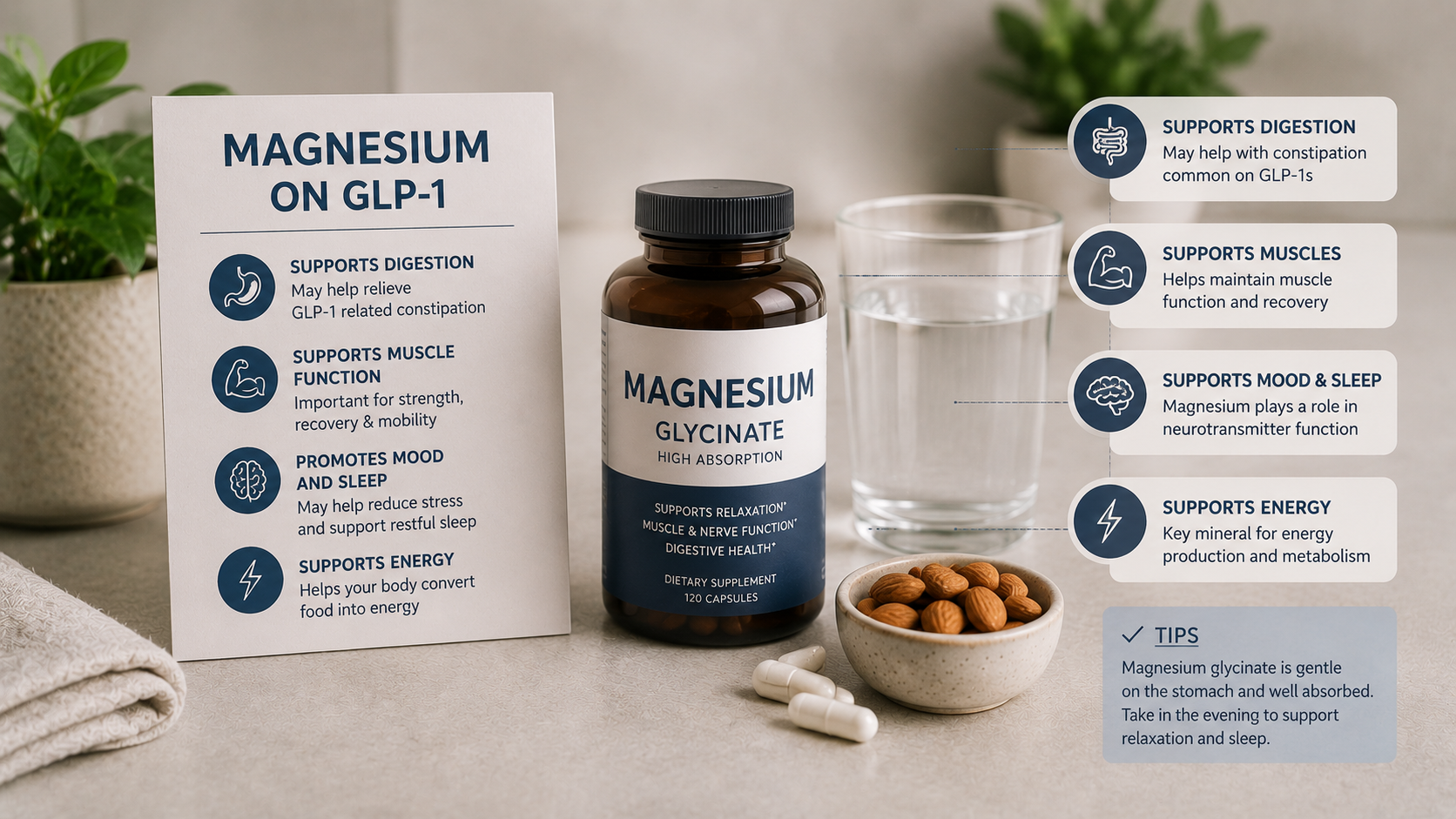
Magnesium is the supplement most commonly worth adding on a GLP-1 in the UK, and the reason is simple: the UK population is already broadly low in magnesium, and reduced food volume on Mounjaro or Wegovy makes the gap worse. The effects of low magnesium on a GLP-1 user are specific and recognisable — poor sleep, muscle cramps, constipation, anxiety, and fatigue — and the fix is inexpensive and well-tolerated. The form matters: glycinate or malate over oxide. This is the guide to getting it right.
Related reading: Magnesium for Weight Loss UK, Lily & Loaf Triple Magnesium Review UK, and Supplements on GLP-1 Starter Stack UK.
Why magnesium depletes on GLP-1s
Three factors converge:
1. UK baseline is already low. An estimated 70%+ of UK adults don’t meet the recommended dietary intake for magnesium. The UK diet — heavy in processed foods, refined grains, and low in leafy greens, nuts, and seeds — is naturally magnesium-poor.
2. Reduced food volume on Mounjaro. If you’re eating 40–60% fewer calories than before starting GLP-1 medication, you’re eating 40–60% less of every food-sourced nutrient, including magnesium. The foods highest in magnesium (dark chocolate, pumpkin seeds, almonds, black beans, leafy greens) are not typically what people default to when appetite is low.
3. GLP-1 itself may increase magnesium excretion. Tirzepatide improves insulin sensitivity, and insulin affects magnesium transport. As glucose metabolism improves, magnesium dynamics shift — some researchers suggest this increases the daily requirement. Evidence here is less definitive, but it’s consistent with clinical observation.
What low magnesium looks like on a GLP-1
The symptoms of magnesium deficiency are non-specific but form a recognisable cluster in GLP-1 users:
- Difficulty sleeping or poor sleep quality despite being tired
- Muscle cramps, particularly in legs and feet overnight
- Constipation (magnesium draws water into the bowel and stimulates peristalsis)
- Fatigue that persists despite adequate sleep
- Anxiety or irritability — magnesium modulates GABA activity and nervous system excitability
- Headaches, including tension headaches
- Heart palpitations — magnesium is essential for cardiac muscle function
- Low mood
Many of these overlap with Mounjaro’s own early side effects, which is why magnesium deficiency is often missed — users assume it’s the medication rather than an addressable nutritional gap.
The forms of magnesium: what to take and what to avoid
This is where most people go wrong. Magnesium supplements vary enormously in bioavailability and GI effects:
Best forms for GLP-1 users
Magnesium glycinate (bisglycinate): magnesium bound to the amino acid glycine. Highest bioavailability of any magnesium form, minimal GI side effects, absorbed in the small intestine regardless of stomach acid levels. Glycine itself has sleep-supporting and anti-anxiety properties. The best all-round choice. Slightly more expensive than oxide but worth it. Standard dose: 200–400mg elemental magnesium.
Magnesium malate: bound to malic acid. Good bioavailability, particularly supports energy production (malic acid is involved in the Krebs cycle). Useful if fatigue is the primary concern alongside deficiency. Less sedating than glycinate.
Magnesium threonate: the only form shown to cross the blood-brain barrier effectively. More expensive. Particularly relevant for cognitive function and anxiety rather than general deficiency correction.
Forms to avoid or use carefully
Magnesium oxide: cheapest form, lowest bioavailability (around 4% absorbed). Sold widely in UK pharmacies. At high doses it acts as a laxative — this may actually be useful for constipation on GLP-1s but provides little systemic magnesium benefit.
Magnesium citrate: moderate bioavailability. Also has a laxative effect at doses above 400mg. Useful specifically for constipation management; less ideal as a general magnesium supplement.
Magnesium chloride (topical/bath flakes): evidence for transdermal absorption is weak. Bath soaks may provide modest relaxation benefits but are not a reliable way to correct deficiency. Don’t rely on them as your primary magnesium source.
UK products worth considering
Lily & Loaf Triple Magnesium: contains glycinate, malate, and citrate — covers bioavailability, energy production, and gut motility in a single supplement. A well-designed combination for GLP-1 users. See the full review. Available direct at Lily & Loaf.
Lily & Loaf Double Magnesium: glycinate and malate. More straightforward combination, slightly lower cost. See Lily & Loaf Double Magnesium Review UK.
Nature’s Best Magnesium Bisglycinate: pure glycinate, good quality UK manufacturer, reliable.
Bulk Magnesium Bisglycinate: powder form, allows more precise dosing, cost-effective. Slightly harder to take than capsules — mix into water or a shake.
How to check your dietary magnesium before supplementing
Before adding a supplement, check what you’re actually eating. Log three days of food in Cronometer and check the magnesium total. The UK RNI is 270mg daily for women and 300mg for men. Most people doing this exercise find they’re hitting 150–200mg from food alone — a 100–150mg daily gap that a moderate supplement fills efficiently.
Foods highest in magnesium per 100g:
- Pumpkin seeds: 592mg
- Dark chocolate (70%+): 228mg
- Almonds: 270mg
- Cashews: 292mg
- Black beans (cooked): 70mg
- Spinach (cooked): 87mg
- Edamame: 61mg
- Brown rice (cooked): 44mg
If nuts and seeds are already part of your daily eating, your dietary intake may be closer to the target than you think. If they’re not (common on GLP-1s where portion sizes are small and snack motivation is low), the gap is likely significant.
Dosing and timing
Dose: 200–400mg elemental magnesium daily. Start at 200mg if you’re sensitive to supplements generally. The upper tolerable intake is 400mg from supplements (dietary magnesium doesn’t have this limit). Don’t exceed 400mg from supplement sources without medical guidance.
Timing: magnesium glycinate before bed works well — the glycine component supports sleep. Magnesium malate can be taken at any time (morning or lunch if you want the energy benefit during the day).
With or without food: glycinate and malate absorb well with or without food. Take with food if you experience mild GI discomfort.
Avoiding interactions: magnesium may reduce absorption of certain antibiotics (tetracyclines, fluoroquinolones) and some thyroid medication — take at least two hours apart. Check with your pharmacist if you’re on regular prescription medication.
When to expect results
Sleep improvements often appear within one to two weeks of consistent supplementation. Constipation relief (particularly with citrate or oxide forms) can occur within 24–48 hours. Energy and mood improvements typically appear within two to four weeks as tissue stores replete. Muscle cramp reduction usually within two to three weeks.
If symptoms persist after four weeks of adequate supplementation, blood magnesium testing is worthwhile — ask your GP for a serum magnesium test. Note: serum magnesium can be normal even when tissue stores are depleted (only 1% of body magnesium is in the blood), so a normal test doesn’t rule out functional deficiency.
Frequently asked questions
Should all GLP-1 users take magnesium?
Not automatically — but it’s worth checking intake in Cronometer first. If you’re consistently below 250mg daily from food, a supplement is a reasonable addition. If you’re already hitting 300mg+ from nuts, seeds, and legumes, supplementation adds less benefit.
Which magnesium is best for constipation on Mounjaro?
Magnesium citrate or oxide, taken at night, draws water into the bowel and stimulates movement. Effective but laxative-like — start with a lower dose (100–150mg) and adjust. If constipation is severe, see Constipation on GLP-1: What Actually Helps UK.
Which magnesium is best for sleep on Mounjaro?
Magnesium glycinate, 200–400mg taken 30–60 minutes before bed. The combination of high bioavailability and glycine’s calming effect makes it the most consistently effective form for sleep quality.
Can I take too much magnesium?
From supplements, the upper safe limit is 400mg daily. Above this, GI symptoms (loose stools, nausea) become more likely. Very high doses in susceptible individuals can cause low blood pressure. Dietary magnesium doesn’t carry this risk.
Disclosure: Lily & Loaf links use affiliate code aff=12026950. This site earns a small commission if you purchase through them at no extra cost to you.
Magnesium and weight loss: the indirect benefits
Beyond addressing deficiency symptoms, adequate magnesium supports several processes directly relevant to GLP-1 weight loss:
Insulin sensitivity: magnesium is a cofactor in over 300 enzymatic reactions, including those involved in glucose metabolism. Adequate magnesium supports the insulin sensitivity improvements that Mounjaro is driving — deficiency partially undermines this mechanism.
Sleep quality: as noted above, magnesium glycinate improves sleep quality. Better sleep reduces ghrelin and cortisol, both of which slow fat loss on GLP-1s when elevated.
Constipation relief: constipation on GLP-1s creates false weight stalls — the scale doesn’t move because intestinal content doesn’t clear, not because fat loss has stopped. Magnesium citrate or oxide resolves this, revealing the underlying fat loss progress that was already happening. Many users who “break a plateau” with magnesium were already losing fat — the magnesium just cleared the bowel content masking it.
Exercise performance: magnesium is required for ATP energy production and muscle contraction. Low magnesium reduces exercise capacity — relevant for GLP-1 users doing resistance training to preserve muscle. Adequate magnesium means better training sessions, which means better muscle preservation, which means better body composition outcomes.
These mechanisms make magnesium one of the supplements with the most well-supported indirect benefit for GLP-1 treatment outcomes, not just symptom management. If you’re prioritising a single supplement addition on Mounjaro and you haven’t already started magnesium glycinate, this is typically the highest-value choice.
Discover more from Healthy Weight Loss GLP1
Subscribe to get the latest posts sent to your email.