
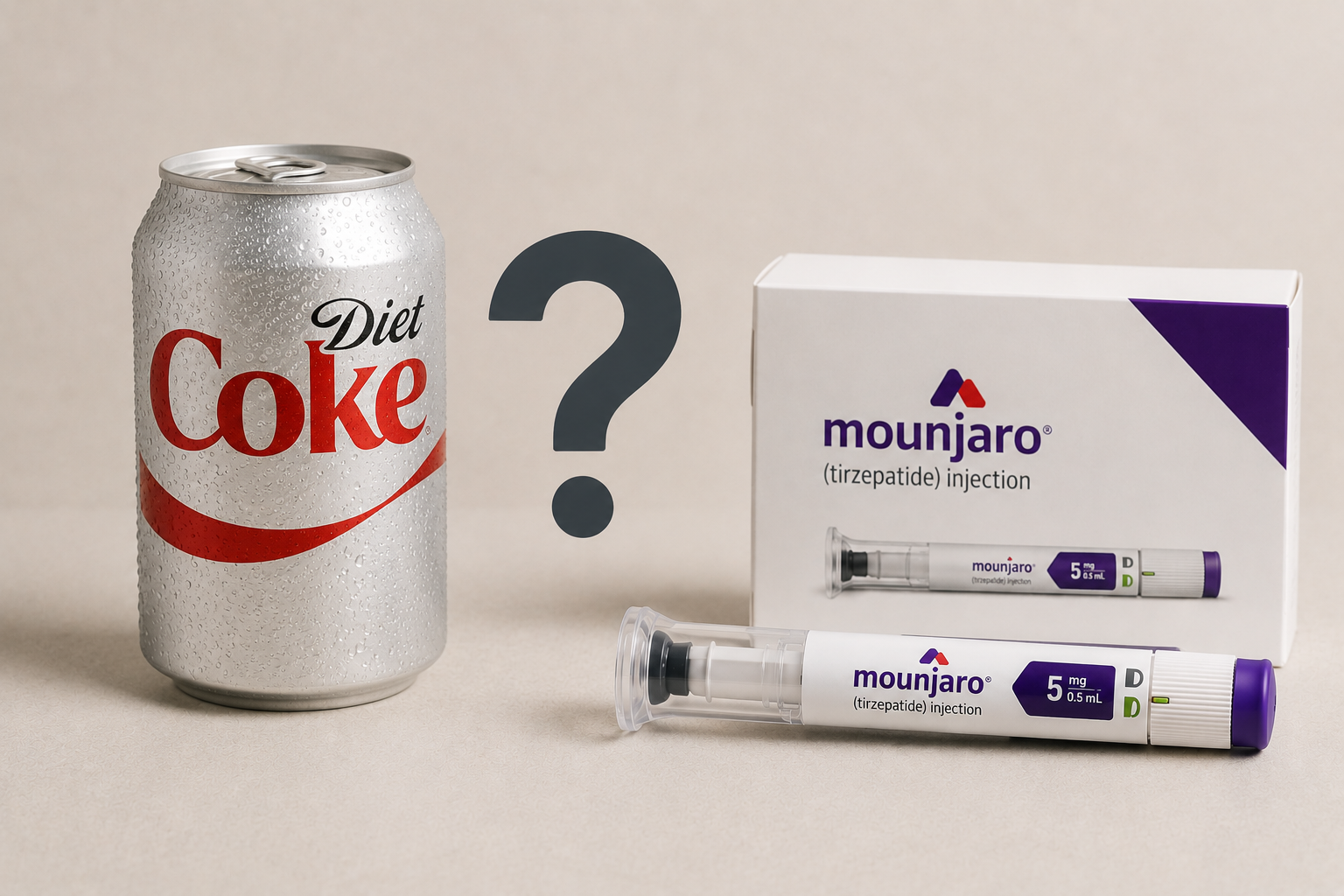
Diet Coke on Mounjaro is generally fine. There’s no direct drug interaction between artificial sweeteners and tirzepatide, and the zero-calorie profile means it doesn’t conflict with weight loss goals. The caveats worth knowing: carbonation can worsen reflux and bloating on slowed gastric emptying, caffeine adds up if you’re already drinking coffee, and some users find sweet-tasting zero-calorie drinks keep the “sugar reward” wiring more active than they’d like. This is the honest UK answer to “can I drink Diet Coke on Mounjaro?”
For other common lifestyle questions see Can I Drink Coffee on Mounjaro UK and Can I Take Paracetamol on Mounjaro UK.
The short answer
Yes. Diet Coke, Coke Zero, Pepsi Max, Diet Pepsi, and other artificial-sweetener diet sodas are all compatible with Mounjaro. No drug interaction. Zero calories means no conflict with weight loss.
Most UK Mounjaro users continue their normal diet soda habits. Some notice side effects change (mainly bloating and reflux) and scale back; others notice nothing different.
The nuances worth understanding
Carbonation and slowed gastric emptying
GLP-1 medications slow gastric emptying. Fizzy drinks deliver a lot of gas into a stomach that’s already retaining contents longer than usual. Result:
- More visible bloating after fizzy drinks than pre-Mounjaro
- More burping or feeling “gassy”
- Worse reflux, especially if lying down shortly after drinking
- Sometimes a brief sensation of fullness that’s disproportionate to calories consumed
None of this is dangerous. It’s just more noticeable than before. Users who find fizzy drinks newly uncomfortable on Mounjaro often switch to still alternatives (still water with cordial, sparkling water with less aggressive carbonation, iced tea).
Caffeine stacking
A can of Diet Coke contains ~42mg caffeine; a can of Coke Zero is similar; Pepsi Max is ~46mg. Not high in isolation. But if you’re already drinking 2–3 coffees a day (150–300mg caffeine) and adding 3–4 diet sodas (130–170mg caffeine), total daily caffeine can creep toward 400–500mg, which is where most adults start noticing side effects (jitteriness, poor sleep, anxiety).
On a GLP-1 where nausea and fatigue are already in the picture, excessive caffeine compounds these. Worth auditing total intake if you feel consistently wired or can’t sleep.
Caffeine-free diet sodas (7up Free, Sprite Zero, caffeine-free Diet Coke) solve this cleanly.
Artificial sweeteners and appetite
This is the most debated area and the honest answer is: evidence is mixed.
Some research suggests artificial sweeteners can:
- Maintain “sweet taste preference” that keeps cravings for sweet foods active
- Affect gut bacteria in ways that may influence metabolism (in some studies)
- Trigger insulin release in a subset of people (also mixed evidence)
Other research suggests artificial sweeteners are essentially inert at typical consumption levels and represent a reasonable substitute for sugar-sweetened drinks.
For Mounjaro specifically, the medication is doing most of the appetite and craving work regardless of whether you drink diet sodas. If diet sodas feel useful for managing sweet cravings, that’s fine. If you notice you crave sweets more when drinking them, try reducing and see what happens.
Sweet taste and the “food reward” system
A more nuanced point: part of GLP-1 treatment is your brain rewiring to find food less rewarding. Sweet taste is one of the most powerful reward signals. Regular diet sodas keep the sweet-reward circuit firing, which for some users slows the rewiring process.
Not a big effect; not a reason to quit diet sodas. But if you’re months into treatment and still finding sweet cravings loud, experimenting with 2–4 weeks of reduced diet soda can be informative. Some users report the transition makes water and plain sparkling water much more satisfying.
Diet sodas vs regular sodas on Mounjaro
Regular (sugar) Coke vs Diet Coke is not a subtle distinction on a GLP-1:
- A can of regular Coca-Cola: ~139 calories, 35g sugar
- A can of Diet Coke or Coke Zero: ~0 calories, 0g sugar
On reduced appetite where you may be eating 1,200–1,600 calories per day, a single regular Coke is ~10% of daily intake with zero satiety value. Two regular sodas in a day is 280 calories that don’t touch your hunger. This is one of the clearer “diet version wins” cases on a GLP-1.
If you genuinely prefer regular cola taste and it’s part of a specific meal experience, occasional regular Coke is fine. Daily regular Coke on a GLP-1 meaningfully dents your deficit.
Specific sweeteners: aspartame, sucralose, stevia
A quick note on sweetener types:
Aspartame (in Diet Coke, Diet Pepsi, many UK diet sodas): most-studied artificial sweetener; regulatory safety confirmed by FSA, EFSA, FDA. Some people find taste metallic; intolerance is rare.
Sucralose (in Coke Zero, some Pepsi Max formulations, many “Zero” products): also widely approved. Generally well-tolerated.
Acesulfame-K: often combined with aspartame or sucralose in diet drinks. No specific concerns at typical intake.
Stevia (plant-based non-calorie sweetener): used in some “naturally sweetened” zero-sugar drinks. Gentle on stomachs for most people.
None of these has a specific Mounjaro interaction. Individual tolerance varies; if a specific sweetener gives you headaches or GI upset, try drinks with different sweeteners.
Hydration considerations
Diet sodas count as hydration — they’re mostly water. But they don’t contribute electrolytes and the caffeine in some can be mildly diuretic.
Ratios that work:
- For every 2 cans of diet soda, drink 1–2 glasses of plain water
- If diet soda is your main fluid source, consider adding an electrolyte drink 3–4 times a week
- If you get headaches, constipation, or fatigue, dehydration is often the underlying cause — increase water, not soda
See Electrolytes on GLP-1 UK for the bigger hydration picture.
When diet sodas might genuinely cause issues
Specific scenarios to watch for:
1. IBS flares: aspartame and some sweeteners (sorbitol, mannitol in “sugar-free” chewing gum and sweets) can trigger IBS symptoms. On a GLP-1 where GI sensitivity is already elevated, symptoms can be worse.
2. Headaches: aspartame specifically causes headaches in a small subset of sensitive individuals. If you’ve had migraines historically and they’re worse on Mounjaro, track whether diet soda correlates.
3. Dental health: diet sodas are acidic (phosphoric acid) and erode tooth enamel over time. No specific Mounjaro interaction, just general health guidance.
4. Reflux: the carbonation + acidity + caffeine combination worsens reflux. On slowed gastric emptying, this is especially noticeable. If you’re having reflux issues, diet sodas are an obvious thing to trial-remove.
5. Bone density concerns: some (contested) evidence suggests very high cola intake affects calcium metabolism. Not a concern at normal consumption, but if you’re drinking 5+ cans a day and have other bone density risk factors, reduce.
Reasonable consumption
“Reasonable” isn’t a precise number but a useful frame:
- 1–2 diet sodas per day: no real concerns for most people
- 3–5 per day: okay, but audit caffeine total and watch for bloating/reflux
- 6+ per day: worth questioning the habit. Often more about behavioural dependence on the ritual than enjoyment of each drink.
If your consumption has crept up since starting Mounjaro (substituting drinks for snacks because drinks don’t trigger nausea), that’s a pattern worth noticing. Not wrong; just worth being deliberate about.
Alternatives when you want to cut back
If you decide to reduce diet soda consumption:
Sparkling water: carbonation without sweetness. Lime or lemon wedge adds flavour.
Sparkling water with a splash of cordial: familiar flavour, lower sweetness than soda.
Flavoured sparkling water (Dash, Ugly, Vive): naturally-flavoured zero-calorie drinks without artificial sweeteners. Widely available in UK supermarkets.
Unsweetened iced tea: if you like caffeine but want less sweetness.
Kombucha: low-calorie, fermented, some sweetness from fermentation. Watch sugar content on sweet varieties.
Infused water: cucumber, lemon, berries, mint. Tastes less plain than plain water.
Not everyone needs to cut back. Diet soda in moderation is fine on Mounjaro. These are just options if you want them.
Diet sodas and weight loss plateaus
A common question: “Are diet sodas slowing my weight loss?”
Short answer: not meaningfully for most people. Zero calories in means zero calories in.
The more likely plateau causes:
- Total calorie intake has drifted higher (often via hidden calories in sauces, dressings, takeaways, alcohol)
- You’ve reached a new dose that your body is adapting to
- Protein intake has drifted lower (compromising lean mass retention)
- Activity level has decreased
- Normal fluctuation (weight loss is non-linear)
Cutting diet soda rarely breaks a plateau because diet soda wasn’t causing the plateau. Focus on the harder-hitting variables first.
Long-term perspective
If you’re going to be on Mounjaro for 2, 5, or more years, a long-term question: what habits do you want to carry forward? Some GLP-1 users use their treatment period as an opportunity to reset dietary patterns:
- Gradually reducing diet soda to 1–2 per day (or less)
- Finding satisfying non-sweet drinks that become new defaults
- Using the reduced food reward sensitivity of GLP-1 treatment to break habits that were hard pre-medication
This isn’t moralistic. Diet soda is not “bad” and keeping it in your life is fine. But if you’ve been wanting to reduce consumption and couldn’t pre-Mounjaro, the medication period is often when the change is easiest.
Common questions
“Will switching to Coke Zero instead of Diet Coke make a difference?” No meaningful difference. Coke Zero uses sucralose plus acesulfame-K; Diet Coke uses aspartame plus acesulfame-K. Both zero calories, both compatible with Mounjaro. Taste preference is the real differentiator.
“Does fizzy drink bloating on Mounjaro settle over time?” Sometimes. For many users, the amplified bloating eases after 2–3 months as gastric emptying rate adjustments stabilise. For others, it remains throughout treatment and is one of the lasting trade-offs. You’ll know within a couple of months which camp you’re in.
“Is it okay to drink Diet Coke before injecting?” Yes. No interaction with the injection, no impact on absorption. Some users report the combination of post-injection nausea plus carbonation is uncomfortable, so timing your diet soda for between injection peaks (days 3–5) can feel better than day-of.
“Can I have Diet Coke instead of water for hydration?” It counts toward hydration (it’s mostly water), but shouldn’t be your main source. Aim for at least half your daily fluid intake from plain water or unflavoured tea/coffee, with diet sodas as supplementary rather than primary.
“What about ‘zero-calorie’ Coca-Cola flavoured drinks with natural flavours?” Products like Coca-Cola Zero Sugar Lemon, Cherry Zero, etc. use the same sweetener base as Coke Zero with added flavour compounds. Compatible with Mounjaro; same caveats as standard diet sodas.
“Tonic water on Mounjaro?” Slimline tonic is effectively a diet soda (artificially sweetened, carbonated). Regular tonic has ~15g sugar per small bottle, more than you’d guess. Slimline is the Mounjaro-compatible choice.
The summary
Diet Coke and other diet sodas are fine on Mounjaro. No drug interaction, zero calories, compatible with weight loss. Watch for: amplified bloating and reflux from carbonation on slowed gastric emptying, caffeine stacking with coffee, and occasional individual sensitivities to specific sweeteners. Drink some water alongside. If consumption has crept up, question the habit but don’t feel obligated to eliminate.
For other common questions: Can I Drink Coffee on Mounjaro UK, Electrolytes on GLP-1 UK, and the Complete GLP-1 Weight Loss Guide.
Medical note: this is general information. Specific concerns about diet sodas and your individual situation should be discussed with your prescriber. Individual tolerance varies.
Discover more from Healthy Weight Loss GLP1
Subscribe to get the latest posts sent to your email.