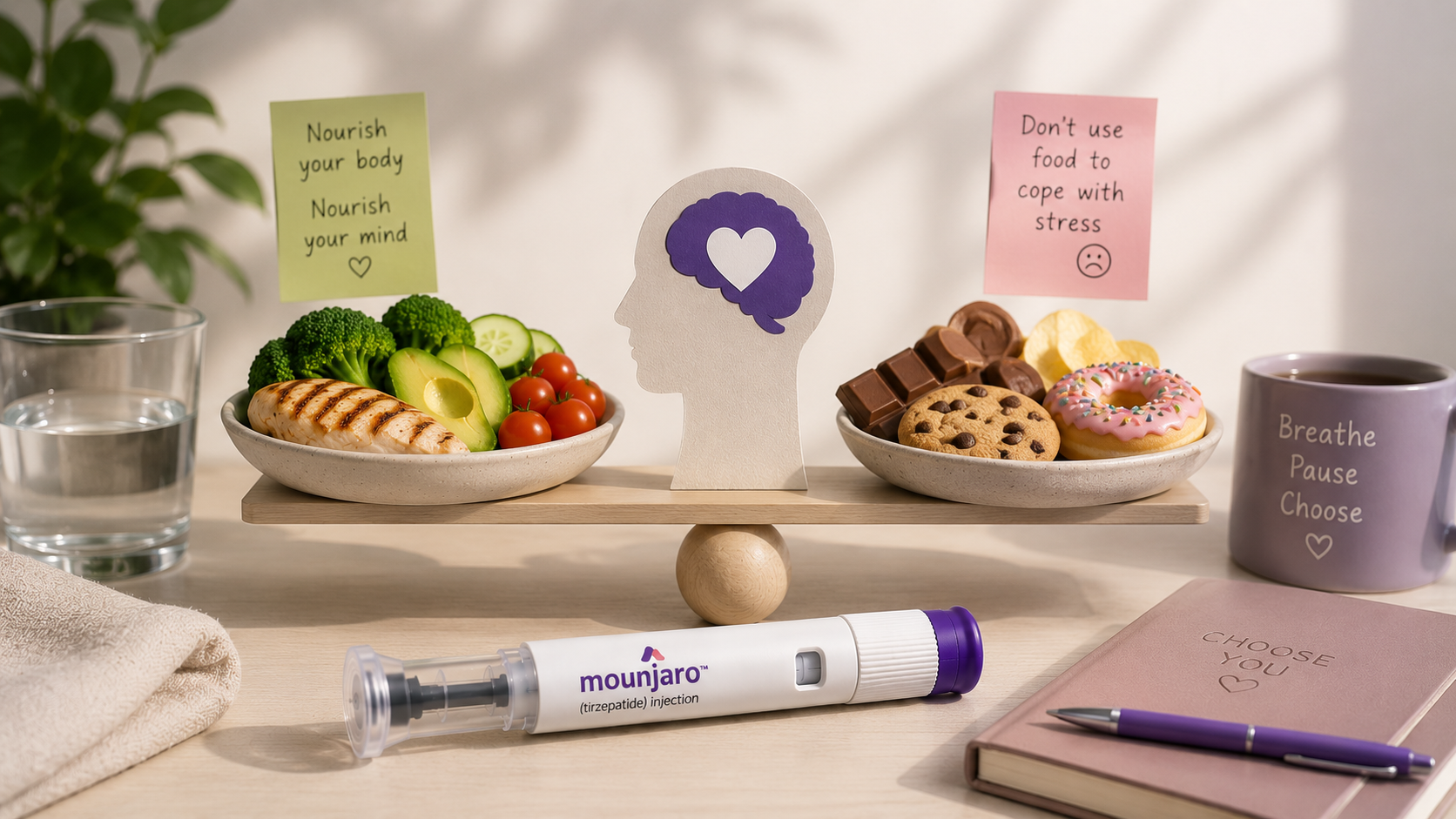


If you have a history of disordered eating — a previous eating disorder diagnosis, sub-clinical patterns, or a fraught relationship with food and your body — starting a GLP-1 medication involves specific considerations that most general GLP-1 information doesn’t cover. This post is written for UK adults with a history of disordered eating who are NOT currently in active disorder, and who are thinking about or taking a GLP-1 under medical supervision. If you’re currently struggling with an eating disorder, this post isn’t for you; specialist support is — see resources at the end.
For the broader mental health context see The Mental Side in the Complete Guide. For identity shifts during weight loss: Identity Shift After Weight Loss UK.
Important framing
Two things before the main content:
1. This post is explicitly NOT medical advice about whether you should take a GLP-1 with a history of disordered eating. That decision belongs with you, a GP who knows your full history, and ideally an eating-disorder-informed clinician who can assess current risk. Every person’s history is different; some people with ED histories do well on GLP-1s, some experience complications. The assessment is individual.
2. “History of disordered eating” here means a past — not active — pattern. If you’re currently in an active eating disorder — current restriction below medical safety, current bingeing/purging, current excessive exercise driven by ED thoughts — a GLP-1 is almost certainly not the right intervention right now, and adding one to active disorder carries real harm risk. Support resources for active ED are at the bottom of this post.
Why this combination deserves specific attention
GLP-1 medications interact with eating behaviour in ways that are generally positive — less food noise, smaller portions, reduced hedonic eating — but can be complicated in the context of an ED history for several reasons:
1. The mechanism overlaps with some ED-adjacent patterns. Reduced appetite, easier restriction, smaller portions: these are medication effects that can feel pleasant to anyone, but for someone whose history involves restriction, they can surface old thought patterns.
2. Weight loss can re-trigger old body image and control dynamics. Even welcome weight loss can activate patterns that felt closed. The reflection in the mirror changes, clothes fit differently, people comment — any of which can re-engage dormant ED cognitions.
3. The loss of food noise can feel paradoxical. Some people who’ve spent years in recovery learning to trust hunger and fullness cues find the silencing of hunger on a GLP-1 disorienting. The tools they built for recovery (listen to your body, eat regularly, don’t restrict) don’t map cleanly onto medication-suppressed hunger.
4. Clinical supervision is often thinner. Private GLP-1 prescribing in the UK rarely includes systematic ED screening or ongoing psychological check-ins. The responsibility for monitoring oneself falls largely on the user.
None of this means GLP-1s are contraindicated for all people with an ED history. It means the decision and the ongoing management deserve care.
Signs that suggest it’s not the right time
If any of these apply to you right now, it’s worth pausing and speaking to an eating-disorder-informed professional before starting or continuing a GLP-1:
- You’re currently restricting food below what medical professionals would consider healthy
- You’re binge-eating or purging (by vomiting, laxatives, compensatory exercise, or extreme restriction)
- You’re exercising compulsively — exercise that’s driven by feeling “I must” rather than choosing to
- You’re weight-cycling rapidly between significant extremes
- Your hair is falling out, your period has stopped (if you have one), your heart rate or temperature is abnormally low — physical signs of insufficient intake
- You’re pre-occupied with food, weight, or body image in ways that interfere with your daily life, relationships, or work
- You’d describe your current relationship with food as actively fraught, not just complicated
If any of these apply, the GLP-1 question is secondary. Your first call should be to a GP or ED specialist. Resources below.
For people with a history who are in recovery
If your ED history is firmly in the past — you’ve done recovery work, your current relationship with food is stable, and your weight has been in a range your body finds sustainable — the considerations are more nuanced.
Before starting
Things worth doing if you’re considering a GLP-1 with an ED history:
- Disclose your history to your prescriber. Fully. Not just “I had anorexia 10 years ago” — details about what the recovery looked like, what your triggers are, and what you want the prescriber to watch for. If the prescriber is dismissive of this context, consider a different prescriber.
- Have a safety plan before starting. Who will you tell if you notice old patterns re-emerging? At what point would you stop the medication? What does “re-emerging” look like specifically for you?
- Consider reconnecting with ED-informed support ahead of time. Even if you’re not seeing a therapist regularly, a check-in with someone familiar with ED recovery before starting a GLP-1 is reasonable. Can be a one-off; doesn’t need to be ongoing.
- Set specific monitoring points. Agree with yourself (and ideally with a trusted person) what you’ll check in on at weeks 4, 8, 12. This post’s own content gives some prompts below.
- Be honest about the appeal. If part of the appeal of a GLP-1 is “finally, effortless restriction,” that’s a signal to engage ED-informed thinking first. GLP-1s are not safe restriction tools; they’re medical weight management tools with psychological implications.
During treatment
Ongoing monitoring questions, ideally written down somewhere you revisit:
- Am I eating enough to meet minimum physical needs (protein, nutrients, calories appropriate to my body and activity)?
- Am I listening to hunger and fullness cues, even the quieter ones on medication?
- Am I enjoying food, or is food becoming mostly functional/suppressed?
- Am I rigid or ritualistic about meals in ways that feel familiar from my ED history?
- Am I checking my body repeatedly in mirrors, with measurements, with weigh-ins?
- Am I exercising for health/enjoyment, or for compensation?
- Am I having thoughts about my body that feel like old ED patterns vs new neutral observations?
- Am I isolating, or hiding my eating patterns from people close to me?
- Is my mood stable, or am I becoming more withdrawn, anxious, or flat?
Any one of these going in a bad direction isn’t automatically a crisis; two or three moving in the wrong direction is a signal to pause and engage support.
What to do if old patterns re-emerge
If you notice old patterns returning — genuine restriction beyond medication effect, bingeing, compulsive exercise, body-checking cycles, increasing food preoccupation — the right next step depends on severity but usually includes:
- Tell someone in your support network. Isolation is how ED patterns entrench.
- Contact your GP or an ED-informed clinician. Describe what’s happening honestly.
- Consider pausing the GLP-1 while you work out what’s going on. Continuing medication while actively destabilising eating patterns is usually not helpful.
- Reconnect with whatever recovery resources previously helped. Whether that’s therapy, a specific book or workbook, a support group, or a trusted clinician.
Pausing a GLP-1 temporarily is not failure. It’s appropriate clinical self-care. The medication will still be there in a month or three if you want to resume; your recovery is the priority.
Specific GLP-1 dynamics worth naming
The “I should eat less than the medication already makes me eat” trap
On a GLP-1 you naturally eat less. For someone with a restrictive ED history, the temptation can be to push further — “if eating less is good, eating less than less is better.” This is ED thinking; the medication is not permission to restrict below physical needs.
Practical countermeasure: set a minimum daily protein target (1.2–1.6g per kg bodyweight) and a minimum meal structure (e.g. three meals plus one snack per day, regardless of appetite). These become non-negotiable, not negotiated based on hunger.
The “weight loss validates my worth” trap
Rapid weight loss on a GLP-1 can activate old belief systems about body-as-measure-of-value. This is worth naming explicitly: the medication changes your body; it doesn’t change your worth, and your worth was never weight-dependent.
Practical countermeasure: track non-weight markers of success explicitly. Physical strength, energy, mood stability, sleep quality, clothes fitting comfortably. Write these down weekly or monthly. Keep weight tracking to once per week at most.
The “now I finally have control” trap
Restrictive EDs often involve a sense of control. GLP-1s can feel like that control finally handed to you externally — which can be disorienting for someone whose ED was about managing the sense of control itself. If your ED recovery involved learning to loosen rather than tighten food control, a medication that re-engages that sense of control needs conscious management.
Practical countermeasure: keep a small area of your eating deliberately un-optimised. A regular “just for enjoyment” food each week that has no performance purpose. A meal with friends where you don’t track, weigh, or monitor. The counter to rigidity is built-in small flexibilities.
The “finally, food is no longer a battle” experience
This one can be overwhelmingly welcome, and that’s fine. For people whose ED history involved constant battling with food thoughts, the silence on a GLP-1 can feel like a relief bordering on revelation. Allow yourself that. Don’t feel you have to be suspicious of positive changes.
The caveat: the silence is medication-mediated, not healed. If you come off the medication, food noise returns; the underlying patterns may still be there. So use the medication window as an opportunity for deeper recovery work (therapy, habit rebuilding, identity work around food) rather than just a break from the problem.
Community versus clinical perspectives
A note on online communities:
ED recovery communities online have varied views on GLP-1s. Some see them as incompatible with recovery principles; others see them as another tool that can be integrated thoughtfully. Both perspectives contain legitimate concern.
What’s useful is nuanced discussion. What’s less useful is prescriptive “you shouldn’t be on this” or “this is the best thing ever.” If an online community’s approach to GLP-1s feels dogmatic in either direction, you might be better served by clinical support rather than peer opinion.
Working with an ED-informed clinician
If you’re looking for specialist support, a clinician with specific eating disorder experience is important — this is not generic mental health support. Options in the UK:
- NHS eating disorder services — accessed via GP referral. Specialist services exist in most regions; waiting lists can be long.
- Private ED-specialist therapists — search the BPS directory or BEAT’s clinician list for specialists in your area.
- BEAT Helpline — free, trained helpline support. Good first point of contact if you’re unsure what you need.
- Specialist dietitians — registered dietitians with ED experience can help with the nutritional side of managing GLP-1s alongside ED history.
A one-off specialist consultation before or during GLP-1 treatment is often hugely valuable even if you’re not signing up for ongoing therapy.
A note on GP care
If your GP is your main medical contact, make sure:
- They know your ED history
- They know you’re taking a GLP-1 (even if privately prescribed)
- They have your consent to liaise with any private prescriber if concerns emerge
- You have a plan for regular check-ins that include wellbeing, not just weight
Some GPs have specific ED training; most don’t. Either way, your GP is an important continuity point if something destabilises.
UK support resources for active eating disorders
If you’re struggling right now, not just considering the future, please use these:
- BEAT Eating Disorders — UK’s leading ED charity. Helpline: 0808 801 0677 (adults) and 0808 801 0711 (youth). Webchat and online resources.
- NHS Eating Disorders — main NHS resource page, including how to get help.
- Your GP — still the correct first clinical contact in most cases.
- First Steps ED — another UK charity offering support services.
- Samaritans (116 123) — for moments of crisis, any reason.
There is no judgement, no minimum severity, and no prior diagnosis required to use any of these. If you’re struggling and not sure, call anyway; they will help you work out what you need.
The honest summary
A GLP-1 with a history of disordered eating is a considered decision, not a contraindication. Some people with recovered ED histories do very well on these medications; some find them destabilising. The outcome depends on where you are in your recovery, the quality of your support system, the ongoing monitoring you build in, and your honesty with yourself and clinicians about how it’s going.
If you’re considering starting a GLP-1 with an ED history, the preparation work matters more than the decision itself. Disclose fully, set monitoring points, maintain professional support as needed, and be willing to pause if things destabilise.
For the broader weight management context: Complete GLP-1 Weight Loss Guide. For weight loss and identity: Identity Shift After Weight Loss UK. For the mental side: The Mental Side.
This article is for people with a history of disordered eating who are not currently in active disorder. If you are currently struggling with an eating disorder, this article is not the right resource — please contact BEAT (0808 801 0677), your GP, or another ED-informed professional. This is educational content, not medical advice; decisions about GLP-1 treatment with an ED history belong with you and qualified clinicians who know your full history.
Discover more from Healthy Weight Loss GLP1
Subscribe to get the latest posts sent to your email.