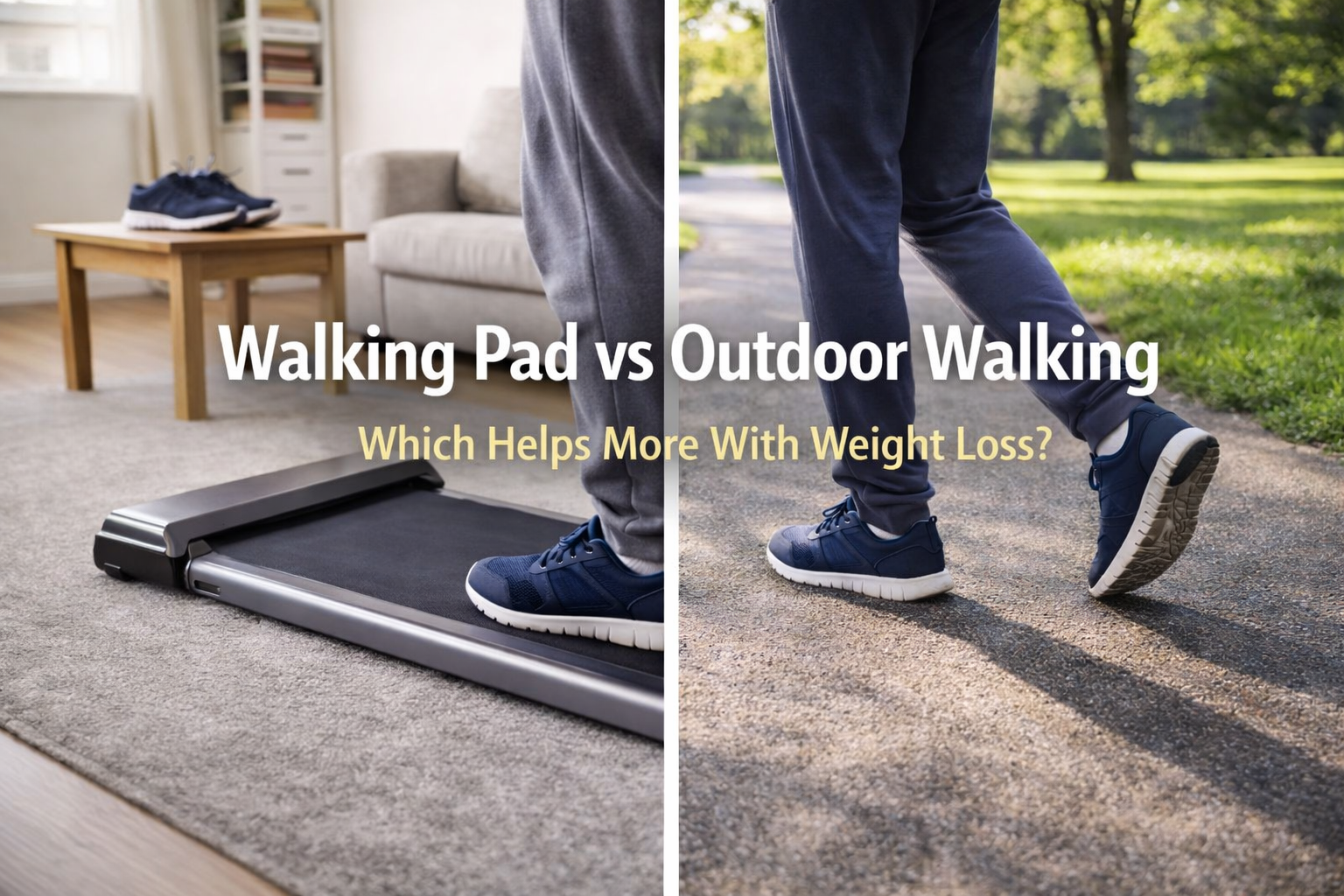

A walking pad is one of the most knee-friendly exercise options available — and for people with osteoarthritis, post-surgical knees, or chronic knee pain that makes outdoor walking uncomfortable, it’s often the single best tool for building daily movement without aggravating joints. The flat, consistent surface eliminates the terrain variation that stresses damaged cartilage; the slow controlled pace removes the impact spikes of outdoor walking on uneven ground; and the ability to stop immediately means you’re never stuck half a mile from home when pain increases unexpectedly. This guide covers which models work best for bad knees, what pace and duration is safe to start with, and how to progress sensibly.
Browse walking pads: WalkingPad UK → For the full range comparison: Best Walking Pads UK.
Why walking pads are good for bad knees
The knee joint stress during walking depends on three factors: body weight, pace, and surface. A walking pad addresses the second and third:
Consistent flat surface. Outdoor pavements have camber, cracks, and uneven sections that cause micro-changes in knee alignment with every step. For a healthy knee this is irrelevant; for a knee with osteoarthritis, worn cartilage, or post-surgical instability, each micro-alignment change adds stress to the joint surface. A walking pad surface is perfectly flat, perfectly consistent, and perfectly predictable.
Controlled pace. Outdoor walking pace tends to vary with gradient, pedestrian avoidance, and terrain. Pace variability increases knee impact. A walking pad runs at a constant user-set speed — typically 1.5–3.5km/h for knee-sensitive users — eliminating this variation.
Immediate stop. If knee pain increases unexpectedly, you step off immediately. No walk back required. This safety feature specifically reduces the common pattern where knee-pain sufferers overdo outdoor walks and pay for it the next day.
Body weight reduction over time. This is the biggest long-term benefit. Every kilogram of body weight reduces knee loading by approximately 3–4kg per step. A user losing 20kg on Mounjaro reduces their knee loading by 60–80kg per stride — a more significant knee treatment than most medical interventions. See Mounjaro and Joint Pain UK.
Best walking pads for bad knees: what features to prioritise
| Feature | Why it matters for bad knees | What to look for |
|---|---|---|
| Cushioning/deck thickness | Absorbs impact per stride | Thick deck (15mm+), soft running surface |
| Low speed range | Knee rehab starts slow (1–1.5km/h) | Minimum speed 0.5–1.0km/h |
| Handrail option | Balance support for unstable knees | Folding handrail or A-frame handlebar |
| Emergency stop | Immediate halt if pain increases | Magnetic safety key + app stop |
| Weight capacity | Heavier users need higher-rated decks | 100–130kg minimum; 150kg+ for heavier users |
| Step height | Getting on/off without high knee flex | Low step-on height (8–12cm) |
WalkingPad models best suited to knee issues
The WalkingPad range includes models with varying deck cushioning and speed ranges. For bad knees specifically:
WalkingPad C2 / similar base models: runs from 0.5km/h, soft deck cushioning, low step-on profile. The most knee-friendly starting option in the range. Available in the UK through the main WalkingPad site.
WalkingPad R2 / models with handrail: the fold-up handrail provides stability for users with balance concerns alongside knee issues — common after knee surgery or with severe osteoarthritis. Slightly more stability-focused than the slim C2.
For budget alternatives with adequate cushioning: browse cushioned walking pads on Amazon UK →
Starter protocol for bad knees
The most common mistake with knee pain and exercise is doing too much too soon during a pain-free window. A conservative progressive start prevents the boom-bust cycle:
| Week | Speed | Duration | Frequency | Pain rule |
|---|---|---|---|---|
| 1–2 | 1.0–1.5 km/h | 10–15 min | Once daily | Stop if pain above 3/10 |
| 3–4 | 1.5–2.0 km/h | 15–20 min | Once daily | Stop if pain above 3/10 |
| 5–6 | 2.0–2.5 km/h | 20–30 min | Once or twice daily | Stop if pain above 3/10 |
| 7–8 | 2.5–3.0 km/h | 30–40 min | Twice daily if comfortable | Stop if pain above 3/10 |
The 3/10 rule: 0 = no pain, 10 = worst imaginable pain. Pain at 1–2/10 during walking (mild awareness of the knee) is acceptable and expected. Pain at 3/10+ is a signal to reduce speed or stop. Pain above 4/10 after a session warrants rest and possible GP consultation.
What to avoid on a walking pad with bad knees
- Running or jogging: even at 5–6km/h, the impact per stride increases significantly. Stay in the walking zone (under 4km/h)
- Incline settings: incline dramatically increases knee extensor load. Keep the pad flat
- Very long sessions without breaks: 20–30 minutes with a rest is better than 60 minutes continuously for inflamed joints
- Walking immediately after a cortisone injection: typically advised to rest for 24–48 hours after knee injections before resuming walking
Supporting the knee health journey with nutrition
Three nutrients with specific evidence for joint health:
Omega-3 (EPA+DHA): anti-inflammatory effect on joint tissue. 2g+ EPA+DHA daily. Lily & Loaf Daily Balance Omega →
Collagen peptides: joint cartilage matrix support. 10–15g hydrolysed collagen daily, taken with vitamin C for optimal synthesis. Lily & Loaf Collagen Plus →
Vitamin D: inadequate vitamin D is associated with faster cartilage degradation in OA. Supplement to maintain 25(OH)D above 75 nmol/L. Lily & Loaf D3+K2 →
Not sure which supplements are most relevant to your specific joint symptoms? Take the free Lily & Loaf lifestyle analysis →
The knowledge layer
Understanding the biomechanics of knee osteoarthritis — why weight matters more than almost any other single factor, what the cartilage degradation process looks like, and what slows it — is available in detail in audiobook form. Start your free Audible trial → and search for rheumatology or joint health titles. For GLP-1 users specifically, understanding how weight loss reduces joint load reinforces the motivation to keep daily walking consistent even when immediate joint improvement feels slow.
Frequently asked questions
Is a walking pad safe with knee osteoarthritis?
Yes — walking is recommended for knee OA, and a walking pad’s flat surface and controlled pace makes it safer than outdoor walking for most OA sufferers. Start slowly and use the 3/10 pain rule. Discuss with your GP or physiotherapist before starting if your OA is severe or post-surgical.
Which walking pad has the most cushioning for joint protection?
The WalkingPad models with thick running decks offer good cushioning for joint-sensitive users. Look for models with soft-surface descriptions. The R2 handrail model adds stability support alongside cushioning.
How soon after knee replacement can I use a walking pad?
Typically 6–8 weeks post-operatively, once your physiotherapist has cleared you for low-impact walking. The walking pad’s flat, controlled surface is often the first exercise equipment recommended post-knee-replacement. Follow your physiotherapist’s specific guidance for your recovery timeline.
Will losing weight on Mounjaro help my knee pain?
Significantly yes. Each kilogram lost reduces knee loading by 3–4kg per stride. Most Mounjaro users with knee pain report substantial improvement — often eliminating the need for regular NSAIDs — by months six to twelve of treatment. See Mounjaro and Joint Pain UK.
Walking pad vs other low-impact options for bad knees
| Exercise | Knee stress level | Practicality at home | Calorie burn |
|---|---|---|---|
| Walking pad (2.5km/h) | Low | Excellent | Moderate |
| Static cycling | Low-moderate | Good | Moderate-high |
| Swimming | Very low | Requires pool | High |
| Yoga/Pilates | Low (with modification) | Excellent | Low |
| Elliptical trainer | Low | Possible but bulky | Moderate-high |
| Outdoor walking | Low-moderate (terrain dependent) | Weather dependent | Moderate |
The walking pad’s advantages over alternatives for bad-knee users specifically: available immediately (no travel, no booking), controllable speed and immediate stop, flat surface that eliminates terrain-related stress, and the ability to integrate into working hours rather than requiring a dedicated session. For most UK adults with knee pain who are also using GLP-1 medication, the combination of a walking pad (for daily steps) and a yoga mat for floor-based mobility work covers the complete low-impact movement picture. See Best Yoga Mat UK for the floor work component.
The nutritional support for joint recovery is as important as the exercise approach. Omega-3 for inflammation, collagen for cartilage matrix, and vitamin D for bone density all compound the mechanical benefits of reduced body weight and appropriate low-impact movement. Check which of these you currently need: take the free Lily & Loaf lifestyle analysis →
Frequently asked questions about bad knees and walking pads
What speed is safe on a walking pad with knee pain?
Start at 1.0–1.5km/h and increase only when pain is consistently below 2/10 at the current speed. Most users with osteoarthritis settle at 2.0–2.5km/h as their comfortable walking speed within 2–3 weeks. Never push through pain above 3/10 — pain is information, not a barrier to overcome.
Do I need special footwear on a walking pad with bad knees?
Supportive trainers (not bare feet, not hard-soled shoes) significantly reduce impact per stride. See Best Running Trainers UK for cushioned options suitable for low-speed walking. Motion-control or stability features are worth considering if you overpronate — a physio or podiatrist can assess this.
For more on low-impact daily movement: Best Yoga Mat UK for the floor work component, and Mounjaro and Joint Pain UK for the full medical picture of how GLP-1 weight loss affects joint conditions over 12 months of treatment.
Consistent daily movement at an appropriate pace — even 15 minutes — keeps joint fluid circulating, reduces morning stiffness, and maintains the muscular support around damaged joints that protects cartilage far better than rest alone. The walking pad makes this achievable without any of the practical barriers that stop most knee pain sufferers from moving consistently.
Discover more from Healthy Weight Loss GLP1
Subscribe to get the latest posts sent to your email.