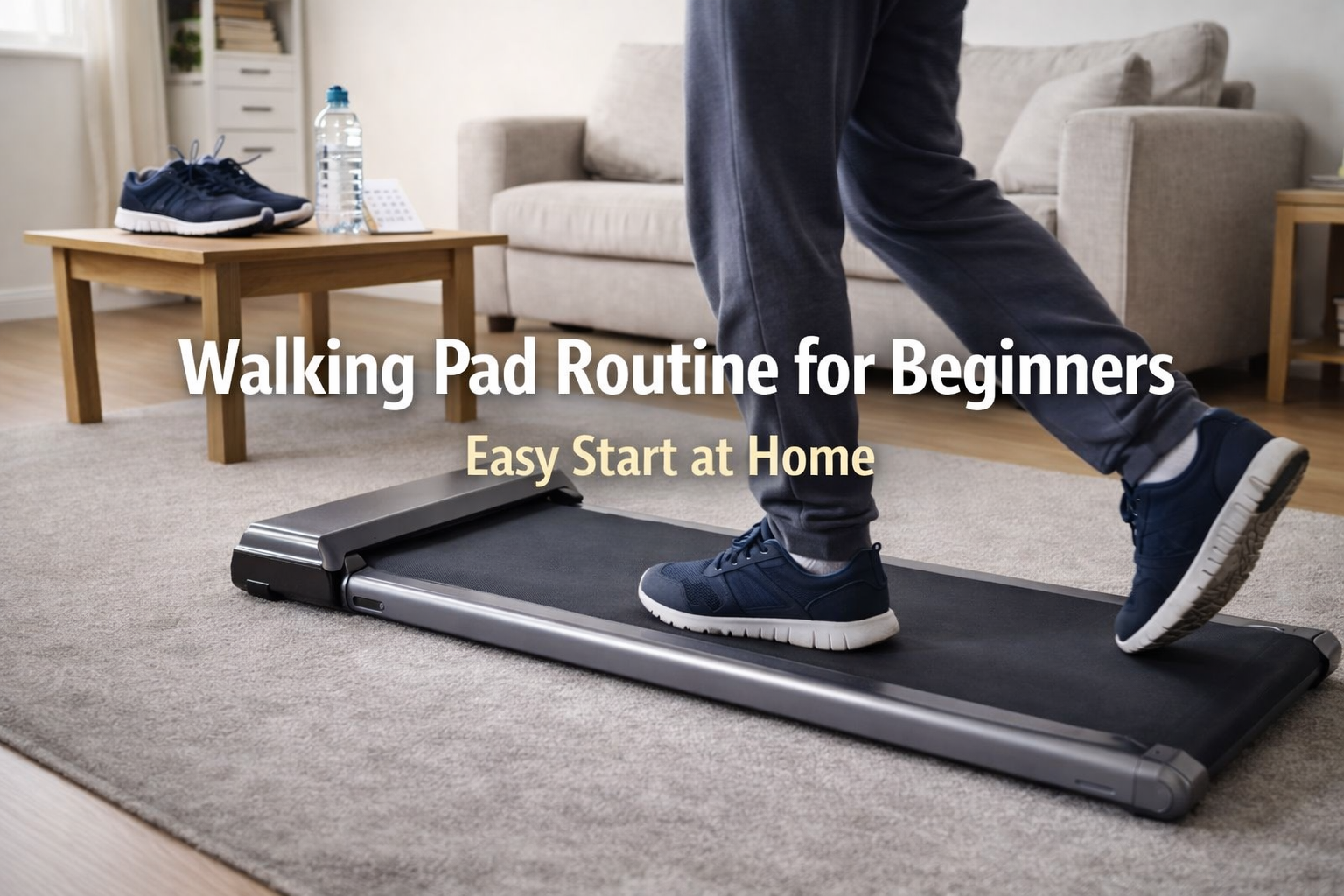

A walking pad burns 140–320 calories per hour depending on your weight and walking speed. At the typical desk-walking pace of 2.5km/h, an 85kg person burns approximately 195 calories per hour — modest per session, but transformative at daily consistency. Over a full year of 45-minute daily walking pad sessions, that accumulates to approximately 45,000–55,000 extra calories burned — equivalent to 6–7kg of fat loss from walking alone, without any change to diet. This guide gives you the exact calorie data for every common walking speed and body weight.
Get your walking pad: WalkingPad UK → or see alternatives at Best Walking Pads UK.
Calories burned on a walking pad: the complete table
Based on METs (metabolic equivalents) for treadmill walking, adjusted for standard conditions:
| Speed | 60kg person | 75kg person | 90kg person | 110kg person | 130kg person |
|---|---|---|---|---|---|
| 1.5 km/h | 95 kcal/hr | 118 kcal/hr | 142 kcal/hr | 173 kcal/hr | 205 kcal/hr |
| 2.0 km/h | 120 kcal/hr | 150 kcal/hr | 180 kcal/hr | 220 kcal/hr | 260 kcal/hr |
| 2.5 km/h | 150 kcal/hr | 188 kcal/hr | 225 kcal/hr | 275 kcal/hr | 325 kcal/hr |
| 3.0 km/h | 180 kcal/hr | 225 kcal/hr | 270 kcal/hr | 330 kcal/hr | 390 kcal/hr |
| 3.5 km/h | 210 kcal/hr | 263 kcal/hr | 315 kcal/hr | 385 kcal/hr | 455 kcal/hr |
| 4.0 km/h | 240 kcal/hr | 300 kcal/hr | 360 kcal/hr | 440 kcal/hr | 520 kcal/hr |
Calories burned per session at typical durations
| Session | Speed | 60kg | 80kg | 100kg | 120kg |
|---|---|---|---|---|---|
| 20 min | 2.5 km/h | 50 kcal | 65 kcal | 83 kcal | 100 kcal |
| 30 min | 2.5 km/h | 75 kcal | 98 kcal | 125 kcal | 150 kcal |
| 45 min | 2.5 km/h | 113 kcal | 146 kcal | 188 kcal | 225 kcal |
| 60 min | 2.5 km/h | 150 kcal | 195 kcal | 250 kcal | 300 kcal |
| 2 × 30 min | 2.5 km/h | 150 kcal | 195 kcal | 250 kcal | 300 kcal |
The cumulative impact: why consistency beats intensity
Single-session calorie numbers look modest. The cumulative annual picture is where the walking pad’s real value becomes clear:
| Daily habit | Daily calories | Annual calories | Fat loss equivalent |
|---|---|---|---|
| 20 min at 2.5km/h (90kg) | 83 kcal | 30,295 kcal | ~3.9 kg |
| 45 min at 2.5km/h (90kg) | 188 kcal | 68,620 kcal | ~8.8 kg |
| 60 min at 3.0km/h (90kg) | 270 kcal | 98,550 kcal | ~12.6 kg |
| 2×30 min at 2.5km/h (90kg) | 250 kcal | 91,250 kcal | ~11.7 kg |
A 90kg person doing 45 minutes at 2.5km/h daily burns the caloric equivalent of approximately 8.8kg of fat over one year — with zero change to diet and no dedicated workout time.
This is why the walking pad is particularly valuable for GLP-1 users: the medication handles appetite and hormonal regulation; the walking pad handles daily energy expenditure. Together, they address the two primary drivers of body weight from different angles.
How walking pad calorie burn compares to other exercise
| Activity (90kg person, 45 min) | Calories burned | Daily consistency (typical) |
|---|---|---|
| Walking pad at 2.5km/h | ~169 kcal | High — integrated into work/TV time |
| Walking pad at 3.5km/h | ~236 kcal | High |
| Gym session (moderate intensity) | ~350–450 kcal | Low — requires travel, planning |
| Cycling (moderate) | ~360 kcal | Moderate — weather dependent |
| Swimming | ~405 kcal | Low — requires pool access |
| Kettlebell workout | ~270–360 kcal | Moderate — 3×/week is realistic |
The walking pad burns fewer calories per session than a gym workout — but its daily consistency advantage means it typically produces more total weekly calorie expenditure than three gym sessions per week, simply because it actually happens every day.
Tracking walking pad calories in Cronometer
Log walking pad sessions in Cronometer‘s exercise diary for the most accurate calorie expenditure tracking. Search “treadmill walking” and enter your duration and speed. The app calculates expenditure based on your entered body weight.
Important for GLP-1 users: don’t eat more to “compensate” for walking pad calories unless you’re already below your calorie minimum. The walking calories add to the natural GLP-1 deficit — which is the goal. Only add back if tracking shows you’re already under 1,000–1,100 kcal daily.
The most efficient walking pad setup for maximum calorie burn
Highest-calorie approach within a desk-walking context: two 30-minute sessions daily at 3.0–3.5km/h rather than one 60-minute session at 2.5km/h. The two-session approach provides roughly the same calorie expenditure with smaller intervals that are easier to integrate into a working day.
Try the 30-Day Walking Pad Challenge UK to build this habit progressively from wherever you’re starting.
Nutritional support for daily walking
Daily walking slightly elevates electrolyte and protein needs. Magnesium is the most commonly depleted electrolyte in walkers — muscle cramps during or after sessions are a classic magnesium deficiency symptom. Lily & Loaf Triple Magnesium → Not sure what else your body needs alongside increased daily movement? Take the free lifestyle analysis →
For the walking science — why NEAT specifically drives fat loss, how GLP-1 interacts with physical activity, why walking beats running for most people’s total daily expenditure: start your free Audible trial → and search “exercise science” for titles covering the physiology behind these numbers.
Frequently asked questions
How many calories does a walking pad burn per hour?
Approximately 140–390 calories per hour depending on your body weight and walking speed. At the typical desk-walking pace of 2.5km/h, most users burn 150–300 kcal per hour. Use the table above for your specific weight and speed.
Is a walking pad good for weight loss?
Yes — particularly for daily consistency. The calorie burn per session is modest, but daily use over 12 months accumulates to 40,000–90,000 extra calories burned — equivalent to 5–11kg of fat loss on top of any dietary change. See Can a Walking Pad Help You Lose Weight for the full analysis.
Does walking speed on a pad significantly affect calorie burn?
Yes — increasing from 2.0km/h to 3.0km/h increases calorie burn by approximately 50%. However, the most important variable is duration: 60 minutes at 2.5km/h burns more than 30 minutes at 3.5km/h. Sustainable pace over longer duration is more effective than unsustainable speed over short sessions.
The walking pad ROI: is it worth it?
The calorie data above translates into a straightforward return-on-investment calculation. A WalkingPad at £299 (mid-range model) costs approximately £0.82/day over a year. The daily calorie burn at 45 minutes at 2.5km/h (90kg user) is approximately 169 kcal — equivalent to approximately £0.05 per kcal burned (cheaper than any gym membership per calorie).
But the financial comparison misses the main point. The walking pad’s value is not in calorie burn per session — it’s in daily consistency that isn’t achievable any other way. A gym membership that gets used three times per week produces 3 × exercise sessions weekly. A walking pad produces 7 sessions weekly at no additional time cost because sessions happen during activities that would occur anyway (work, TV, calls). The adherence advantage is the ROI.
For the full cost comparison across all weight loss tools: Weight Loss Cost UK 2026 and Walking Pad ROI vs Gym UK.
The nutritional foundation that makes every calorie burned more productive: protein at target, micronutrients at target, magnesium for recovery. Take the free lifestyle analysis → to find out what your body specifically needs alongside your new walking habit. And for the science behind why walking specifically (rather than running or gym work) is often the most effective long-term fat-loss activity for GLP-1 users: start your free Audible trial →
Does body weight significantly affect walking pad calorie burn?
Yes — a 130kg user burns approximately 70–80% more calories per hour than a 60kg user at the same speed. This means heavier GLP-1 users at the start of treatment get proportionally more calorie benefit per walking pad session — and as weight drops, the calorie burn per session decreases. This is entirely normal and expected; the consistency of the habit matters more than the per-session calorie figure as weight falls. Track overall step count and weekly total exercise time rather than obsessing over calorie numbers that will naturally change as treatment progresses.
Step count vs calorie burn: which matters more?
For GLP-1 users, step count is actually the more meaningful metric to track than calories burned from walking. Here’s why:
- Step count is directly linked to NEAT (non-exercise activity thermogenesis) — the largest controllable component of daily calorie expenditure for most people
- Research consistently uses step count (not calories) as the predictor of cardiovascular and metabolic health outcomes
- Step count doesn’t change with body weight the way calorie burn does — as you lose weight, your calorie burn per step decreases, but the health benefits per step stay consistent
Target 8,000–10,000 daily steps as the primary metric. Calorie data from the table above is useful context but shouldn’t be the primary focus. Log steps in Cronometer‘s exercise diary or link your fitness tracker (Apple Watch, Fitbit, Garmin) to the app for automatic step tracking. The weekly step average tells you more about the programme’s success than any calorie calculation.
For the challenge that builds the 8,000-step daily habit: 30-Day Walking Pad Challenge UK. For the pad that makes it happen: WalkingPad UK →
At the end of a year of consistent walking pad use, the cumulative calorie expenditure adds up to a figure that no gym subscription or dietary intervention alone typically achieves — simply because the habit runs every day, integrated into time that was already allocated to something else. That’s the walking pad’s unique advantage: not the calories per session, but the consistency per year.
Discover more from Healthy Weight Loss GLP1
Subscribe to get the latest posts sent to your email.