
The evidence for probiotics and weight loss is more modest than supplement marketers suggest, but there’s a legitimate role for well-formulated probiotics on a GLP-1: gut motility support, constipation mitigation, and potentially modest adjunctive help with weight management. This is the honest 2026 UK guide to picking a probiotic that’s worth taking (and avoiding the many that aren’t).
For the broader supplement stack see Supplements Worth Taking in the Complete Guide. For constipation specifically: Constipation on GLP-1.
What probiotics actually do (and don’t do)
The evidence base, honestly summarised:
Strong evidence: specific strain-specific formulations can reduce antibiotic-associated diarrhoea, shorten duration of acute diarrhoea, and support recovery of gut flora after antibiotic courses. For irritable bowel syndrome, specific formulations (particularly those containing Bifidobacterium infantis 35624 or certain Lactobacillus strains) have moderate evidence for symptom improvement.
Moderate evidence: specific strains can support regularity and modestly improve constipation. Some evidence for mild immunomodulatory effects (reduced duration of common colds, for example).
Weaker / emerging evidence: modest weight management adjunctive effects, particularly with Lactobacillus gasseri, Lactobacillus rhamnosus, Bifidobacterium lactis. Small effect sizes but consistent direction across some trials.
Poor evidence: broad “gut health” benefits, “immune boost,” “bloating reduction” beyond IBS contexts, “energy improvement.” Marketing claims often outrun the data.
For a GLP-1 user, the realistic expectation: a good probiotic may help slightly with constipation, may support gut recovery if you’ve been on antibiotics recently, and may offer modest adjunctive support to weight management. It’s not a game-changer. It’s a sensible add-on, not a core intervention.
Why GLP-1 users specifically might benefit
Two mechanisms:
1. Slowed gastric emptying and reduced fibre intake shift gut motility. Constipation is a common GLP-1 side effect (see Constipation on GLP-1). Certain probiotic strains support regularity.
2. Reduced food intake alters gut microbiome diversity. Eating less food and fewer varieties of food can reduce the diversity of organisms in the gut. Supplementation doesn’t necessarily restore this, but it can support some of the commonly beneficial strains.
Neither mechanism is dramatic but both are real.
The CFU numbers game (and why it mostly doesn’t matter)
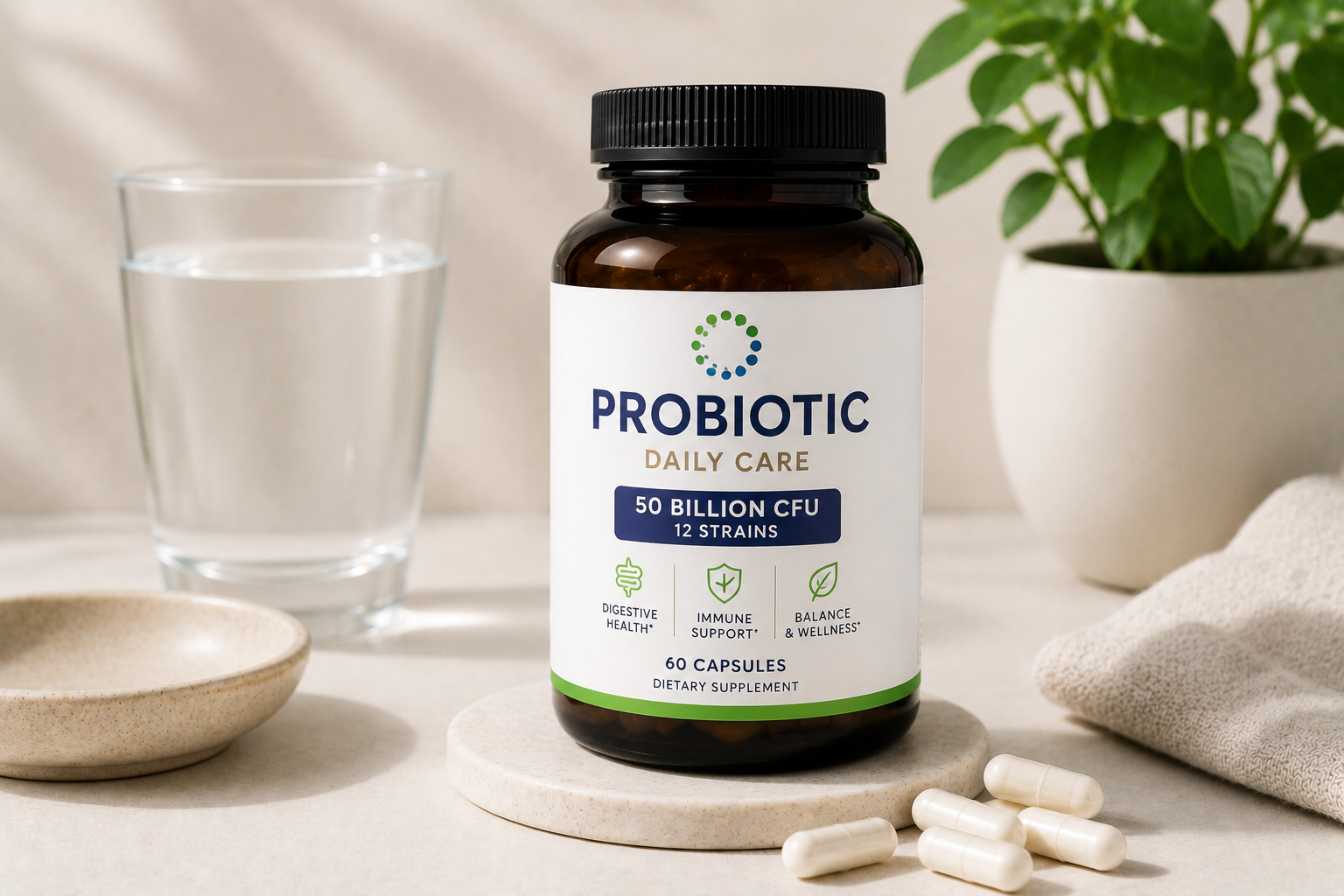
Probiotic marketing pushes CFU (colony-forming units) as the key metric. You’ll see “10 billion CFU!” “50 billion CFU!” on labels.
The reality: beyond about 5–10 billion CFU of appropriate strains, more isn’t meaningfully better. What matters far more is:
- Which specific strains are in the product (named to strain level, e.g. “Lactobacillus rhamnosus GG” not just “Lactobacillus”)
- Whether those strains have evidence for the effect you want
- Whether the strains survive to reach the gut in viable quantities (storage conditions, acid-resistant encapsulation, shelf stability)
- Whether the CFU count quoted is the count at manufacture or the count at expiry (some brands degrade by 50%+ before you buy the bottle)
A 5 billion CFU product with three well-evidenced strains in acid-resistant capsules is better than a 100 billion CFU mystery-blend.
Strains to look for (and why)
Strains with evidence relevant to GLP-1 users:
For regularity / constipation
- Bifidobacterium lactis HN019 — multiple trials showing improved transit time
- Bifidobacterium animalis DN-173 010 — similar, including trials in IBS populations
- Lactobacillus reuteri DSM 17938 — some evidence for functional constipation
For general gut health and diversity
- Lactobacillus rhamnosus GG (LGG) — extensively studied, broad gut support, one of the best-characterised probiotic strains
- Bifidobacterium longum — associated with healthy colonic function
- Lactobacillus acidophilus NCFM — well-studied, shelf-stable, gut-active
For weight management adjunct (modest evidence)
- Lactobacillus gasseri BNR17 — some evidence for visceral fat reduction in trials
- Bifidobacterium lactis B420 — modest evidence for waist circumference reduction
- Akkermansia muciniphila — emerging evidence for metabolic health, now available in some supplements as pasteurised form
For IBS or IBD co-management
- Bifidobacterium infantis 35624 (sold as Alflorex in UK) — strong IBS evidence
- VSL#3 formulation — stronger evidence, typically prescribed rather than over-the-counter
UK probiotic picks for 2026
Best all-rounder: Symprove
Liquid probiotic with 4 strains including Lactobacillus rhamnosus and Lactobacillus acidophilus. Around £80 for a 4-week course.
Symprove is the UK’s most clinically-studied probiotic and the one with the best independent evidence for actually delivering viable organisms to the gut. The water-based (rather than dairy-based) format avoids early digestion which kills many probiotic organisms before they reach the intestine.
Downsides: it’s expensive (£80+ per 4-week course), it needs to be taken first thing in the morning on an empty stomach, and it needs refrigeration. For someone who wants the best-evidence option and can accept the price and regimen, this is the premium pick.
Buy from: Symprove on Amazon UK.
Best for GI motility: Optibac Every Day EXTRA
6 strains including Bifidobacterium lactis HN019, Lactobacillus acidophilus NCFM. 20 billion CFU. Around £25–£35 for 30 capsules.
Optibac is a UK-brand range of probiotic products with specific formulations for specific outcomes. “Every Day EXTRA” is their general-purpose formulation with strains chosen for gut function including motility support. UK formulated, third-party tested, clear strain identification on labels.
Shelf-stable (no refrigeration required), single daily capsule, reasonable price for the quality. For most GLP-1 users looking for a probiotic without the Symprove price tag, this is the sensible pick.
Buy from: Optibac Every Day EXTRA on Amazon UK.
Best for IBS overlap: Alflorex (Bifidobacterium infantis 35624)
1 strain, 1 billion CFU. Around £25 for 30 capsules.
If you have IBS or IBS-like symptoms alongside or worsened by GLP-1 use, Alflorex is the single-strain product with the strongest IBS-specific evidence base. Not a general probiotic but a targeted intervention for people whose GI symptoms need specific support.
Shelf-stable, one capsule daily. Gives the strain 4–8 weeks to establish; evaluate at that point.
Buy from: Alflorex on Amazon UK.
Best budget: Bio-Kult Advanced Multi-Strain Formula
14 strains, 2 billion CFU per capsule. Around £15–£20 for 60 capsules.
UK-brand, long-established, reasonable value. Multi-strain approach with broad coverage. Not the most clinically-rigorous in specific strain identification down to strain level, but adequate quality for general use. Shelf-stable, widely available in UK pharmacies and supermarkets.
Buy from: Bio-Kult on Amazon UK.
Best for metabolic support: Lily & Loaf Pro-10 Plus
10 strains including Lactobacillus gasseri, Bifidobacterium lactis. 10 billion CFU. UK-formulated.
Includes strains with some evidence for metabolic and weight management adjunct use. UK-brand, clean formulation, acid-resistant capsule technology, shelf-stable. Good option for GLP-1 users specifically looking for a formulation with some relevance to the weight loss context.
Buy from: Lily & Loaf Pro-10 Plus.
Whole-food probiotic sources
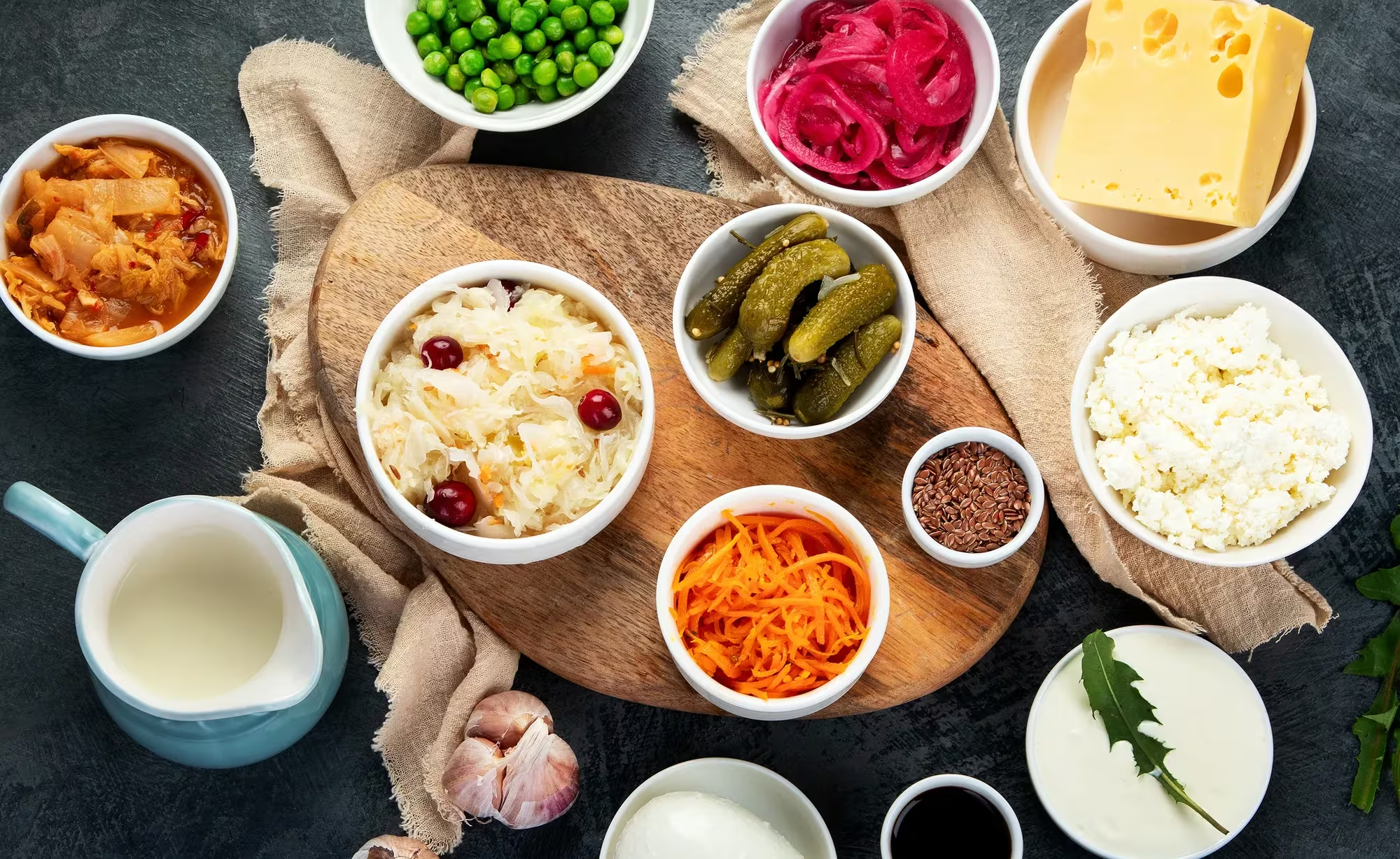
Before reaching for a supplement, consider food sources of beneficial microbes:
- Greek yogurt and Skyr — contain live cultures; check for “live and active cultures” on label
- Kefir — fermented dairy drink with 10+ strains naturally; one cup provides meaningful CFUs
- Sauerkraut (fresh, refrigerated, unpasteurised) — genuinely fermented contains lactobacilli
- Kimchi — same principle
- Miso and tempeh — fermented soy products with beneficial organisms
- Kombucha (check sugar content if buying commercial)
Many people find a combination of daily kefir or live yogurt plus an occasional supplement course works better than supplements alone.
Note: shelf-stable sauerkraut and kimchi from supermarkets (long-dated, non-refrigerated) have often been pasteurised, killing the live organisms. For probiotic benefit, look for “unpasteurised” and “live” on the label, in the refrigerated section.
Prebiotics: the often-forgotten half
Probiotics (live organisms) work better when supported by prebiotics (fibres that feed beneficial organisms). UK food sources of prebiotic fibre:
- Onions, garlic, leeks (inulin)
- Jerusalem artichokes (very high inulin)
- Bananas (particularly slightly unripe)
- Oats (beta-glucan)
- Legumes (resistant starch)
- Asparagus
- Apples (pectin)
A supplemented probiotic without prebiotic support reaches a gut that may not nurture it. Keeping fibre and whole-food prebiotics in the diet is what makes a probiotic investment worthwhile.
Timing and usage
When to take: most products recommend first thing in the morning or with a meal. Consistency matters more than exact timing; pick a routine and stick with it.
With or without food: depends on the product. Acid-resistant capsules can be taken any time; less-protected formulations often specify with food or just before a meal for survival through the stomach.
During antibiotics: take probiotics at least 2 hours away from antibiotic doses to avoid killing the probiotic organisms before they reach the gut.
Expected timeline for benefit:
- GI regularity changes: often noticeable within 1–2 weeks
- General gut health markers: 4–8 weeks
- IBS symptom improvement (if relevant): 4–12 weeks to evaluate
- Weight-management adjunct effects: 8–12 weeks if they’re going to happen
If you haven’t seen any benefit by 8 weeks, the product isn’t working for your specific situation. Try a different formulation or reassess whether a probiotic is the right intervention.
What to avoid
- “Trillion CFU” products. Marketing hype. The viability of organisms matters far more than the raw count.
- Probiotics without named strains. If the label says “Lactobacillus acidophilus” without the strain designation (e.g. NCFM), you don’t know what you’re getting or what evidence supports it.
- Products stored at room temperature that claim refrigerated-level activity. Shelf stability is a legitimate product claim with the right encapsulation; claims that exceed the technology are marketing.
- “Weight loss probiotic” products with miracle claims. No probiotic delivers dramatic weight loss. Modest metabolic support, yes; transformation, no.
- Gummy probiotics. Often low CFU, added sugar, questionable viability through manufacturing process.
- Random soil-based organism products. Poorly characterised, variable quality, some risk in immunocompromised users.
When probiotics aren’t for you
Probiotic supplementation is safe for the vast majority of adults, but there are specific contexts where caution is warranted:
- Immunocompromised (chemotherapy, HIV with low CD4, post-transplant, on immunosuppressant medications): live bacterial supplementation needs medical input
- Central venous catheters in place: avoid to reduce rare bloodstream infection risk
- Severe acute pancreatitis: some evidence of harm in this specific context
- Critical illness / ICU setting: not appropriate without clinical direction
For healthy adults on a GLP-1 without any of the above, probiotics are low-risk and worth considering if symptoms suggest they’d help.
The realistic single-sentence summary
Probiotics are a sensible-but-not-essential part of a GLP-1 supplement stack; they help modestly with regularity and potentially support overall gut health and weight management as adjuncts, but they’re not a miracle, and the whole-food sources (live yogurt, kefir, fermented vegetables) probably deliver more real-world benefit per pound than most supplements.
My recommendation in one line
For most UK GLP-1 users: daily kefir or Skyr as the foundational whole-food probiotic, plus a 4-week Optibac Every Day EXTRA course quarterly for targeted support. For IBS: Alflorex. For premium / best-evidence: Symprove. For budget: Bio-Kult.
For the broader supplement picture: Supplements Worth Taking. For the constipation angle specifically: Constipation on GLP-1.
Disclosure: some links above are affiliate links. Medical note: if you are immunocompromised, in critical illness, or on immunosuppressive medications, talk to your doctor before taking live probiotic supplements.
Discover more from Healthy Weight Loss GLP1
Subscribe to get the latest posts sent to your email.