
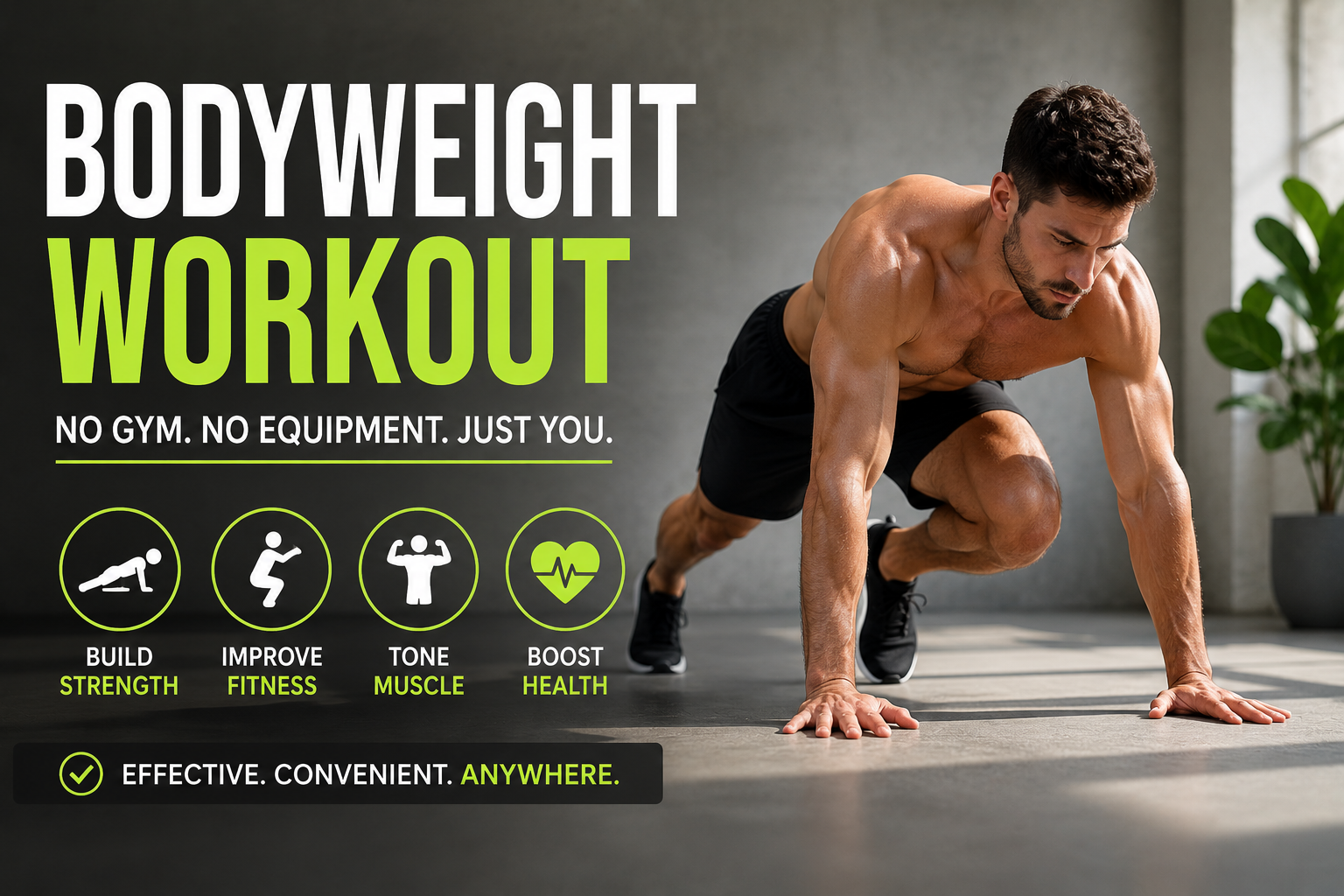
Bodyweight training is the single most accessible way to start preserving muscle on a GLP-1 — no equipment, no gym, no cost. For many people, a structured bodyweight programme for 2–3 months before investing in dumbbells is the realistic entry point into strength training. This is a 3-day beginner bodyweight programme for UK home use, with progression plan, form cues, and honest advice on when to move to weighted training.
For the dumbbell version of this programme see Dumbbell Workout for GLP-1 Beginners UK. For the broader exercise framework: Exercise While Losing Weight in the Complete Guide.
Why bodyweight training works on a GLP-1
Three reasons it’s a legitimate starting point rather than a compromise:
1. Muscle doesn’t know the difference between bodyweight resistance and weighted resistance. What builds and preserves muscle is progressive overload — gradually increasing difficulty over time. A push-up does this just as well as a dumbbell bench press for most beginners.
2. Body awareness and movement quality come first. Many beginners benefit from learning movement patterns (squat, hinge, push, pull, core) with just their body before loading them. Fewer injuries, better long-term form, cleaner transition to weights later.
3. Zero friction. No equipment decisions, no kit delivery waits, no gym commute, no equipment failures. You can start today, in your living room, in 20 minutes.
The trade-off: bodyweight training eventually caps out. For most beginners that cap is 3–6 months in; for some it’s earlier. When it does, adding weights accelerates progress significantly. See the dumbbell programme for the next step.
Equipment (minimal but worth having)
The programme below needs nothing beyond your body and floor space. A few optional additions make it slightly better:
- Exercise mat — £15–£30. Makes floor work more comfortable and protects knees and wrists.
- Resistance bands — £15–£25 for a set. Adds variable resistance for some exercises, particularly useful for upper back (band pull-aparts, face pulls). Not essential but useful.
- Sturdy chair — you probably have one. Used for step-ups, dips, elevated push-ups.
- A pull-up bar (optional) — £25–£50. Doorway-mounted bars work well. Opens up pull-ups, chin-ups, hanging leg raises. Worth it once you’ve built some strength.
Total optional investment: under £100. Most people start with just a mat.
The 3-day programme
Three sessions per week, 25–40 minutes each. Typical pattern: Monday, Wednesday, Friday. Leave at least one rest day between sessions.
Same structure as the dumbbell programme for continuity:
- Day A: Lower body focus
- Day B: Upper body push focus
- Day C: Upper body pull focus
Each session: 5-minute warm-up, 6 main exercises, 3 sets each, 8–15 reps per set (higher reps than weighted training because bodyweight load is lighter), 60 seconds rest between sets.
Day A: Lower body
- Bodyweight squat. Feet shoulder-width, toes slightly out, squat to parallel or below, stand up. 3 × 12–15
- Reverse lunge. Step back into a lunge, knee to 90°, return. Alternate legs. 3 × 10 per leg
- Glute bridge. Lying on back, feet flat, drive hips up, squeeze glutes at top, lower slowly. 3 × 15
- Step-up (on sturdy chair or low step). Step up with one leg, drive through heel, step down. Alternate. 3 × 10 per leg
- Calf raise (standing). Rise onto toes, lower slowly. 3 × 20
- Plank hold. 3 × 30–60 seconds
Day B: Upper body push
- Push-up (knee or full). Start on knees if needed; progress to full. 3 × 8–12
- Pike push-up (for shoulders). Downward dog position, lower head toward floor, press back up. 3 × 8–10
- Incline push-up (hands on chair or table). Easier progression. 3 × 12–15
- Triceps dip (on sturdy chair). Hands on chair edge, feet on floor, bend elbows to lower body, press up. 3 × 10–12
- Wall walk hold. Walk feet up wall while walking hands closer to wall; hold inverted position briefly. 3 × 20 seconds (skip if not comfortable; replace with additional pike push-ups)
- Dead bug. Lying on back, opposite arm and leg extensions, core braced. 3 × 10 per side
Day C: Upper body pull
- Inverted row (under sturdy table). Lie under table, grab edge, pull chest to underside. 3 × 8–12
- Band pull-apart (with resistance band, if available). 3 × 15
- Superman. Lying face down, lift arms and legs off floor. 3 × 10
- Reverse snow angel. Face down, arms extend forward, sweep arms to sides along floor. 3 × 12
- Prone Y-T-W. Face down, lift arms in Y position, hold; T position, hold; W position, hold. 3 × 5 per position
- Bird dog. On all fours, extend opposite arm and leg, hold, return. 3 × 10 per side
Warm-up (5 minutes, every session)
- 2 minutes marching on the spot or walking
- 10 arm circles forward, 10 backward
- 10 bodyweight squats (slow)
- 10 hip circles each direction
- 5 cat-cow stretches
- 2 minutes gentle dynamic stretching (leg swings, torso rotations)
Form cues that matter most
Five principles that cover most bodyweight form issues:
1. Core braced throughout. Every exercise. Brace like you’re about to absorb a punch. Protects the spine, strengthens the core as a bonus.
2. Full range of motion. Partial push-ups, partial squats — skip the hardest part where most benefit lives. If you can’t do the full range, use an easier progression rather than a partial harder one.
3. Controlled tempo. 2 seconds down, 1 second up for most exercises. Resist the temptation to bounce or use momentum.
4. Neutral spine in squats and lunges. Chest up, shoulders back, lower back maintains its natural curve. No rounding, no over-arching.
5. Shoulders down and back on push exercises. Don’t let shoulders creep up toward ears during push-ups and dips. Actively pull them back and down.
Film yourself on early sessions. Phone on a chair, side angle. Watch back; most form issues are obvious from the footage.
The 12-week progression
Bodyweight training progresses through three mechanisms: more reps, harder variations, and tempo changes.
Weeks 1–2: Learn the movements. Focus on form. Use easier progressions (knee push-ups, incline push-ups) without guilt.
Weeks 3–4: Add reps. If you did 8 reps at week 1 with good form, aim for 10 by end of week 3, 12 by end of week 4. Build work capacity.
Weeks 5–6: Progress to harder variations. Knee push-ups → full push-ups. Incline push-ups → standard push-ups. Squat → slower-tempo squat (4 seconds down, 1 second up). Pike push-up → elevated pike push-up.
Weeks 7–8: More reps at harder variations. Build to 12–15 reps at week-5 difficulty level.
Weeks 9–10: Progress variations again. Full push-up → diamond push-up (narrower hand position) or decline push-up (feet elevated). Squat → Bulgarian split squat (rear foot elevated). Inverted row → closer-to-horizontal body angle.
Weeks 11–12: Consolidation. Aim for full sets at current progression with clean form.
By week 12, a typical progression might be: 3 sets of 12–15 full push-ups, 3 sets of 15 bodyweight squats, 3 sets of 12 single-leg hip thrusts (progression from bridges), 3 sets of 10 Bulgarian split squats per leg, 3 sets of 8 inverted rows at near-horizontal angle. This is a meaningful strength foundation.
Exercise substitutions
If an exercise doesn’t work for you (equipment, joint issues, space), alternatives:
- Can’t do push-ups at all? Wall push-ups (standing, hands on wall) → incline push-ups (hands on chair or table) → knee push-ups → full push-ups.
- Knee issues prevent squatting deeply? Squat to a chair (lower as far as comfortable), box squats, wall sits.
- No stable surface for inverted rows? Resistance band pull-aparts, prone Y-T-W progressions, band face pulls.
- Can’t hold a plank for 30 seconds? Start with knee plank (on forearms and knees rather than toes), build up.
- Lunges hurt knees? Step-ups onto low surface, glute bridges, hip thrusts.
When to move to weighted training
Signs that bodyweight training has done its job and you’re ready for weights:
- You can do 12–15 full push-ups with clean form
- Bodyweight squats feel too easy even at slow tempo
- Lunges feel easy even with slow tempo and pause at the bottom
- Plank hold for 90+ seconds feels comfortable
- You can do 8–10 inverted rows at near-horizontal angle
Most people hit this point around month 3–6 of consistent training. If you’re still struggling at week 12, stay bodyweight longer — there’s no rush. If you’re breezing through at week 6, consider adding dumbbells or moving to weighted versions earlier.
For the dumbbell transition: Dumbbell Workout for GLP-1 Beginners UK. For dumbbell equipment: Best Adjustable Dumbbells UK 2026.
Common beginner bodyweight mistakes
1. Skipping the easier progressions out of pride. Full push-ups with bad form build bad form. Knee push-ups with perfect form build perfect form, then transition to full push-ups. Start where you are.
2. Adding too much volume too fast. 3 sessions a week, 3 sets each. Don’t try to do 5 sets from day one or add extra sessions; your connective tissue needs weeks to adapt to new loads.
3. Not taking rest days. Training every day doesn’t speed progress; it accumulates fatigue and increases injury risk. Three well-executed sessions a week beats six mediocre ones.
4. Comparing to social media fitness. You’re watching people who’ve been training for years. Your week 4 is not their week 4. Compare to your own week 1.
5. Not eating enough protein. Muscle doesn’t build from training alone; it builds from training + protein. 1.6–2.0g per kg bodyweight daily. See The Nutrition Stack.
6. Training on peak-side-effect days. Day 1–2 after a new dose step on Mounjaro is not the day to push hard. Rest or do a light mobility session.
Walking as the essential complement
Alongside bodyweight strength training, daily walking (8,000–10,000 steps) is the essential cardio complement. Most GLP-1 weight loss programmes underperform without consistent walking alongside. Not running, not HIIT, not anything fancy — just walking, daily, as a non-negotiable habit.
For more: Exercise While Losing Weight.
What success looks like at week 12
- Visibly better posture
- Clothes fitting differently (more muscle in places, less fat in others)
- Everyday activities easier — stairs, carrying shopping, getting up off the floor
- You can do 12–15 full push-ups, 15+ bodyweight squats, a 90-second plank
- Greater proportion of your weight loss being fat rather than lean tissue (if you have body composition tracking)
- Habit of 3 training sessions a week firmly established
This is the foundation. From here you either continue bodyweight at harder progressions, or transition to dumbbells for faster strength growth.
My recommendation in one line
For UK GLP-1 users who haven’t done structured strength training before, start with 12 weeks of bodyweight training 3 days a week. It costs nothing, builds real strength foundation, and sets up the move to dumbbells. Add a £20 exercise mat and resistance band set if you want minor comfort and progression additions; delay any bigger purchases until you’ve built the habit.
For the dumbbell next step: Dumbbell Workout for GLP-1 Beginners UK. For the broader exercise framework: Exercise While Losing Weight.
Medical note: general guidance for adult beginners with no injury history. If you have joint, back, cardiac, or other ongoing medical concerns, check with your GP or physio before starting. Stop if any exercise causes sharp pain.
Discover more from Healthy Weight Loss GLP1
Subscribe to get the latest posts sent to your email.