
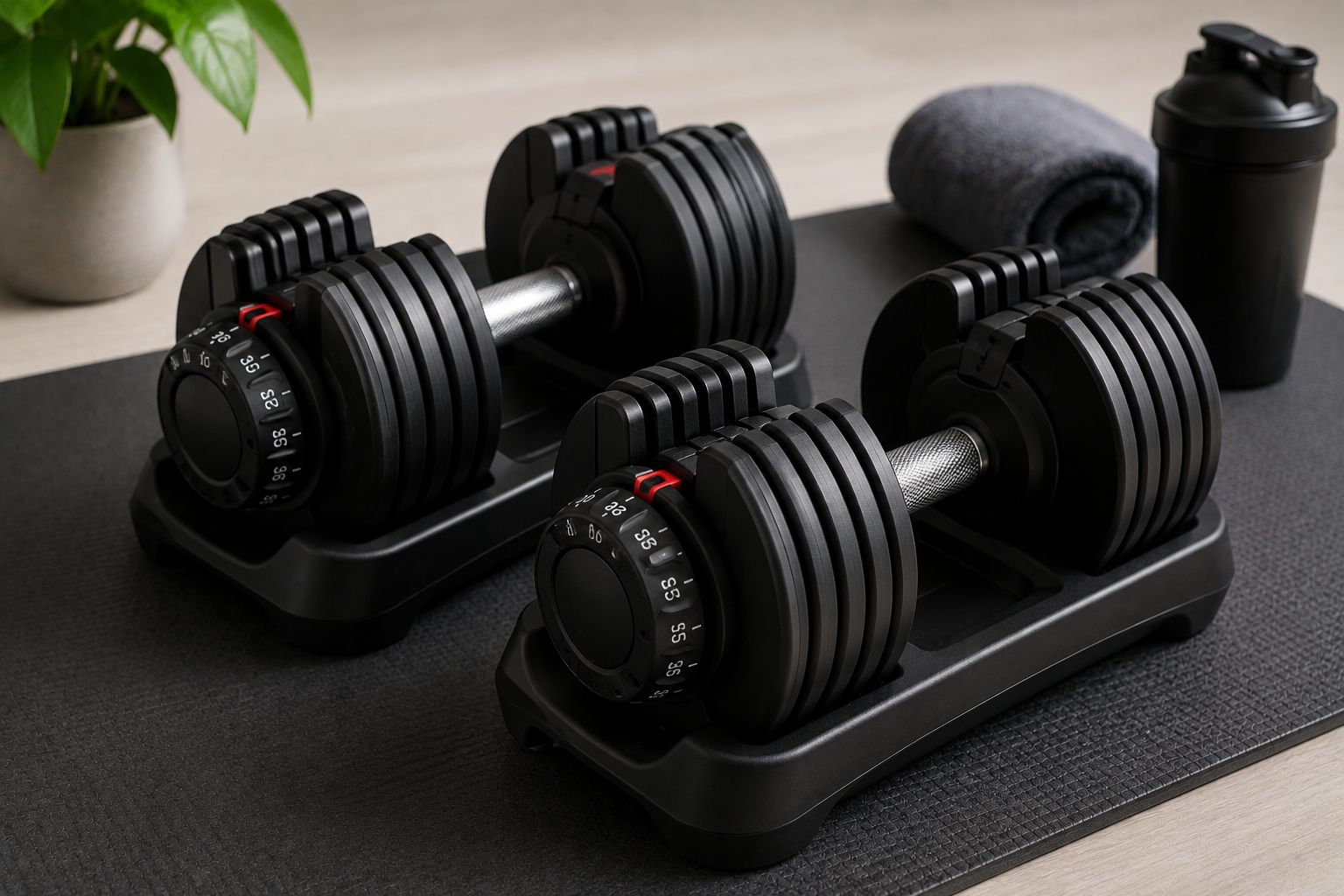
Adjustable dumbbells are the single highest-ROI home gym purchase for most GLP-1 users. One pair replaces 10–15 pairs of fixed dumbbells, saves floor space, and scales with your strength for years. This is the honest 2026 UK guide to the adjustable dumbbells worth buying, plus realistic advice on whether you need them at all.
For the beginner dumbbell programme that uses them see Dumbbell Workout for GLP-1 Beginners UK. For the broader strength-training rationale on GLP-1s: Exercise While Losing Weight in the Complete Guide.
Why adjustable dumbbells make sense for home strength training
Three reasons they’re the correct purchase for most home lifters:
1. Space efficiency. A full rack of fixed dumbbells from 2.5kg to 25kg in 2.5kg increments is 20 pairs of dumbbells and a 2-metre-long rack. An adjustable set covers the same range in the footprint of a single pair on a small stand. Huge difference if you don’t have a dedicated gym space.
2. Cost efficiency at scale. A full range of fixed dumbbells up to 25kg each costs £400–£600+ depending on quality. A good adjustable set covering the same range costs £250–£500 once. Break-even is usually within the first year of use.
3. Strength scaling. You don’t outgrow an adjustable pair. On a beginner programme you might be starting with 5kg curls and 10kg rows; six months in, those numbers might be 8kg and 17kg. A fixed set requires buying new pairs; adjustables just click into new settings.
The trade-off: adjustable dumbbells are mechanically more complex, slightly bulkier per weight level, and take 3–10 seconds to change weight compared to instant with fixed dumbbells. For home use, these are minor inconveniences; for commercial gym use, fixed dumbbells still dominate.
The three main adjustable dumbbell mechanisms
Not all adjustable dumbbells work the same way. The mechanism affects usability, durability, and feel.
Dial-based (most common)
You rotate a dial on each end to select the weight, then lift the handle out of the base. The base holds the unused weight plates in place. Fast weight changes (3–5 seconds), feels like a normal dumbbell when lifting, but the handle is slightly longer and bulkier than a fixed dumbbell of the same weight.
Bowflex SelectTech 552 and 1090, plus several clones, use this mechanism.
Slider / twist-lock
You twist or slide mechanisms to engage selected weight plates onto a handle. Usually slightly slower weight changes than dial-based (5–10 seconds). Build feel varies widely; the best versions feel premium, the worst feel flimsy.
Core Home Fitness, PowerBlock classic designs, some premium European brands use variations of this.
Traditional spin-lock (oldest mechanism)
Plates slide onto a handle, secured by collars that spin on. The cheapest adjustable dumbbell format; very slow weight changes (30–60 seconds per change). Typically found at the lowest price point — £40–£80 for a full set.
Worth it if budget is genuinely tight. Otherwise, dial-based mechanisms save enough time to justify the higher price.
What matters when buying
Five things to actually check:
1. Weight range. 2–24kg per hand covers most beginner-to-intermediate needs. 2–41kg covers all but the strongest intermediate lifters. For GLP-1 users on a beginner-to-intermediate progression, 2–24kg is the sweet spot.
2. Weight increment granularity. 2.5kg increments are adequate for most exercises. 1kg increments at the lower end are really useful for small-muscle exercises (lateral raises, triceps kickbacks) where 2.5kg jumps feel dramatic.
3. Dumbbell length. Adjustable dumbbells are typically slightly longer than fixed ones of the same weight. For exercises with the dumbbells close together (close-grip press, some rowing variations), a shorter dumbbell is more comfortable.
4. Build quality / drop tolerance. If you’re lifting heavy, eventually you’ll drop a dumbbell. Some adjustables tolerate this; some break at the plate-selection mechanism. Check reviews for drop resistance.
5. Mechanism reliability. Dial-based mechanisms can jam over time, particularly if the dumbbells are stored in dusty garage conditions. Premium brands have better-sealed mechanisms and warranties that matter.
UK adjustable dumbbell picks for 2026
Best all-rounder: Bowflex SelectTech 552i
2.3kg to 24kg per hand in 16 increments. £400–£500 for the pair.
The benchmark the whole category is measured against. Dial-based selection, weight changes in 3–5 seconds, solid build quality, 2-year warranty. Original Bowflex engineering (US-designed, currently manufactured in Taiwan for UK distribution). The 552i (updated 2020) has improved mechanism durability over older models.
The mechanism is well-engineered. Weight plates snap firmly into the handle with no rattle. The handle itself feels like a normal dumbbell — balance is reasonable, grip is textured rubber, no sharp edges.
Downside: at £400+ this is the premium pick, not the budget one. And the dumbbells are slightly longer than a fixed pair of equivalent weight — mildly awkward for some close-grip movements.
Buy from: Bowflex SelectTech 552i on Amazon UK.
Best heavy-duty: Bowflex SelectTech 1090i
4kg to 41kg per hand. Around £650–£750 for the pair.
The bigger sibling for intermediate-to-advanced lifters. Same dial mechanism as the 552i but with a substantially wider weight range. Starts heavier (4kg minimum rather than 2.3kg), ends much heavier (41kg), suitable for users who already lift and want equipment that will scale with them for the next several years.
Not the right first purchase for a beginner. Worth upgrading to if you’ve outgrown a 552i-class pair.
Buy from: Bowflex SelectTech 1090i on Amazon UK.
Best UK-brand mid-market: Mirafit Adjustable Dumbbells
2.5kg to 25kg per hand (varies by model). Around £200–£350 for the pair.
Mirafit is a well-established UK fitness equipment brand with a strong reputation for value. Their adjustable dumbbells use a dial mechanism similar to Bowflex but at a lower price point. Build quality is good-not-premium — the mechanism feels a bit more plasticky than Bowflex, but it works reliably and the company supports UK customers well.
For someone wanting dial-based adjustables without the Bowflex price, this is the sensible pick. UK warranty, UK-based customer service, cheaper shipping than Amazon for premium US brands.
Buy from: Mirafit Adjustable Dumbbells on Amazon UK or directly from mirafit.co.uk.
Best value: JLL 20kg Adjustable Dumbbell Set (spin-lock)
Up to 20kg per hand, spin-lock mechanism. Around £80–£120 for the pair with all plates.
The budget pick for someone who wants actual adjustable dumbbells without spending £200+. Spin-lock mechanism means slow weight changes (30–60 seconds), but for beginners doing a structured 3-day programme, you’re probably only changing weights once or twice per session. JLL is a UK-brand budget fitness company; their products aren’t premium but they work.
Worth it if you genuinely can’t stretch to £200+ and are committed to the programme. Upgrade path: if you’re still using them at month 6 and hitting capacity limits, sell and move up to dial-based.
Buy from: JLL Adjustable Dumbbells on Amazon UK.
Best premium quick-change: NEAT Dumbbells or Jordan Fitness Ignite
Commercial-quality hex-style adjustable dumbbells up to 40kg+. £600–£1,200 per pair.
For home gym enthusiasts or commercial settings. Hex-head adjustable dumbbells from Jordan Fitness or NEAT feel closer to traditional fixed dumbbells than dial-based adjustables. Premium build quality, lifetime durability, can be dropped on standard flooring without damage. Price reflects commercial-grade build.
Overkill for most home users. Genuinely worth it if you’re building a long-term home gym and want equipment that will last 20+ years.
Buy from: Jordan Fitness on Amazon UK or direct from jordanfitness.co.uk.
When adjustable dumbbells aren’t the right buy
Three scenarios where a different approach makes more sense:
1. You’re just starting and not sure you’ll stick with it. Spend £30–£50 on a single pair of fixed 5kg or 8kg dumbbells, plus resistance bands (£15 for a set). Do bodyweight-plus-light-dumbbell training for 4–6 weeks. If you’re consistently training and progressing, buy adjustables then. Don’t spend £400 on dumbbells you might not use.
2. You have a gym membership already. No need for home equipment. A gym membership plus 1–2 home resistance bands for travel days covers all your needs.
3. You live in a tiny flat with no storage space even for adjustable dumbbells. Resistance bands plus bodyweight work. 90% of the strength benefit for beginners without the space requirement. See Bodyweight Workout for GLP-1 Beginners UK.
What you’ll pair with adjustable dumbbells
Three accessories worth considering with your dumbbells:
1. Dumbbell stand or storage tray. Elevates them off the floor and makes them easier to pick up without bending fully down. Bowflex and Mirafit sell branded stands; generic ones work too. £50–£100.
2. Exercise mat. For floor exercises (glute bridges, dead bugs, planks) and for setting dumbbells down without damaging floors. £20–£40. Decathlon’s own-brand mats are good value.
3. Resistance bands. Complement dumbbells for exercises where band resistance profiles work better (band pull-aparts, face pulls, lighter isolation work). £15–£25 for a set.
A bench is a genuinely useful addition once you’ve been training 3–6 months, but not essential for beginners. All the beginner dumbbell movements can be done from the floor, standing, or on a stable chair.
Common adjustable dumbbell complaints
Three issues that come up in reviews, and what’s real vs what’s exaggerated:
“They’re too long at lower weights.” Legitimate complaint. Because the handle has to accommodate all the possible weight plates, even the lightest setting is the full handle length. Not a dealbreaker but noticeable on close-grip exercises.
“The mechanism jams.” Happens occasionally, usually from storage in dusty or humid conditions. Premium brands (Bowflex) have better-sealed mechanisms. Keep them in a clean, dry space and the issue is rare.
“They feel less stable than fixed dumbbells.” Early models had rattles; current generation products are tighter. Genuinely well-engineered adjustables feel indistinguishable from fixed dumbbells during use.
“You can’t drop them.” Correct. Adjustable dumbbells should not be dropped from height — the mechanism is not designed for it. If you’re doing exercises where you might fail and drop the weight, train at weights you know you can control. For most beginners this is a non-issue.
The value calculation
Compared to a gym membership at £25–£50 per month (UK average), a £400 adjustable dumbbell set pays for itself in 8–16 months if you’re using it instead of the gym for strength work. Less if you were paying for a premium gym.
Compared to fixed dumbbells covering the same range, adjustable sets typically save 30–50% on equipment costs once you factor in storage and the full range of weights.
Compared to not training at all on a GLP-1: the cost of losing muscle mass that could have been preserved is significant — reduced metabolic rate, worse body composition, worse functional strength. The monetary cost of the dumbbells is small next to the cost of not training.
My recommendation in one line
For most UK GLP-1 users at beginner-to-intermediate level: Bowflex SelectTech 552i is the correct buy if budget allows; Mirafit Adjustable Dumbbells if you want UK-brand value; JLL spin-lock if budget is genuinely £100 or below. Don’t buy the premium commercial-grade options unless you’re building a serious long-term home gym.
For the programme that uses them: Dumbbell Workout for GLP-1 Beginners UK. For the rest of the kitchen and exercise gear worth buying: Kitchen Gear Worth Buying.
Disclosure: some links are affiliate links. Medical note: if you have joint issues or injury history affecting lifting, talk to a physio before starting a dumbbell programme regardless of what equipment you buy.
Discover more from Healthy Weight Loss GLP1
Subscribe to get the latest posts sent to your email.