
When I started my weight-loss journey at 375lbs, “how long to lose a stone” was not the question I was asking. But it is the question most UK adults searching for weight loss help are asking — and it is one of the most poorly answered questions on the internet.
Most answers give you a range so wide it is useless, or a number so optimistic it sets people up to fail. What you actually need is a specific, honest answer based on your starting point, your approach, and what the research consistently shows about sustainable fat loss. That is what this guide gives you.
📋 On this page
- The straight answer
- The maths of losing a stone
- Week-by-week timeline
- How starting weight affects your timeline
- What affects how fast you lose
- Losing a stone by age — 30s, 40s, 50s, menopause
- Comparing methods
- What to eat to lose a stone
- Exercise beyond walking
- What realistic progress looks like
- Losing a stone with specific conditions
- Why you might be stuck
- The psychology of losing a stone
- A practical plan
- Nutritional support
- What happens after a stone
- Weight conversion table
- FAQs
What is a stone in weight — and why it matters
One stone equals 14 pounds, or approximately 6.35 kilograms. It is the unit most UK adults instinctively use for body weight milestones. Losing a stone is a psychologically meaningful target — significant enough to be visible in the mirror and on the scales, achievable enough within a few months with the right approach.
To put it in context:
- One stone is approximately 6.35kg
- For a person weighing 15 stone (95kg), losing one stone is a 6.7% body weight reduction
- Research shows that losing 5–10% of body weight produces meaningful improvements in blood pressure, blood sugar, cholesterol, joint pain, and sleep apnoea
- One stone of pure fat tissue is approximately 22,000 calories of stored energy
- Most people notice visible changes — in the face, waist, and how clothes fit — after losing a stone
The maths of losing a stone
One pound of body fat contains approximately 3,500 calories. One stone is 14 pounds. To lose one stone of pure fat requires a total calorie deficit of approximately 49,000 calories — 14 multiplied by 3,500.
Spread over time:
| Daily deficit | Weekly fat loss | Time to lose a stone | Sustainability |
|---|---|---|---|
| 250 calories | ~0.5lb | 28 weeks (~7 months) | Very high — almost effortless |
| 500 calories | ~1lb | 14 weeks (~3.5 months) | High — the evidence-based standard |
| 750 calories | ~1.5lb | 9–10 weeks (~2.5 months) | Good — manageable for most |
| 1,000 calories | ~2lb | 7 weeks (~2 months) | Moderate — requires discipline |
| 1,500 calories | ~3lb | 5 weeks | Low — difficult to sustain |
| 1,750 calories | ~3.5lb | 4 weeks (1 month) | Very low — not advisable for most |
Why aggressive deficits backfire
A 1,750 calorie daily deficit to lose a stone in a month sounds appealing. In practice it creates serious problems:
- Metabolic adaptation: the body reduces its metabolic rate in response to severe restriction — sometimes by 300–500 calories per day — meaning the actual deficit is far smaller than planned
- Muscle loss: at very low calorie intakes the body breaks down muscle for energy. Losing muscle slows metabolism permanently until the muscle is rebuilt
- Unsustainability: most people abandon very aggressive diets within 2–4 weeks, regaining the lost weight and more
- Hormonal disruption: severe restriction drops leptin (fullness hormone) sharply, increases ghrelin (hunger hormone), and elevates cortisol — creating an increasingly difficult hormonal environment for continued loss
The 500 calorie daily deficit is the sweet spot. It produces consistent, visible progress (a stone in 14 weeks), preserves muscle, avoids severe metabolic adaptation, and is sustainable enough to actually maintain.
Week-by-week: what losing a stone looks like in practice
| Week | Typical scale change | Cumulative loss | What is actually happening |
|---|---|---|---|
| 1 | 2–5lbs down | 2–5lbs | Glycogen and water depletion — scale drops fast, not all fat |
| 2 | 1–2lbs down | 3–7lbs | True fat loss begins; hunger often peaks this week |
| 3–4 | 1–1.5lbs per week | 5–10lbs | Routine establishing; energy may dip as body adapts |
| 5–6 | 1–1.5lbs per week | 7–12lbs | Visible changes appearing; clothes fitting differently |
| 7–8 | 0.5–1.5lbs per week | 9–14lbs | Possible mini-plateau as metabolism adapts; first stone in reach |
| 9–10 | 0.5–1lb per week | 10–16lbs | Stone achieved for most people on a consistent 500 cal deficit |
| 11–14 | 0.5–1lb per week | 12–20lbs | Stone achieved for all consistent dieters; momentum to continue |
How your starting weight affects your timeline
One of the most important and least discussed factors in weight loss timelines is starting weight. Heavier people lose weight faster — all else being equal — because their Total Daily Energy Expenditure (TDEE) is higher.
| Starting weight | Approx TDEE (sedentary) | 500 cal deficit leaves | Expected weekly loss | Stone in approx |
|---|---|---|---|---|
| 12 stone (76kg) | ~1,800 kcal | ~1,300 kcal | ~1lb | 14 weeks |
| 15 stone (95kg) | ~2,100 kcal | ~1,600 kcal | ~1–1.2lb | 12–14 weeks |
| 18 stone (114kg) | ~2,400 kcal | ~1,900 kcal | ~1.2–1.5lb | 9–12 weeks |
| 22 stone (140kg) | ~2,800 kcal | ~2,300 kcal | ~1.5–2lb | 7–9 weeks |
| 27 stone (171kg) | ~3,200 kcal | ~2,700 kcal | ~2–2.5lb | 6–7 weeks |
TDEE estimates based on sedentary activity. Adding regular walking or exercise increases TDEE and therefore potential weekly loss.
How loss rate changes as you progress
As you lose weight, your TDEE decreases — because you are moving less mass and your body has adapted. The same eating pattern that produced 2lbs of weekly loss at 27 stone may only produce 1lb per week at 20 stone. This is expected. It means you need to periodically reassess your intake and activity level to maintain the same effective deficit.
What affects how fast you lose a stone
The calorie deficit is the primary driver, but several other factors either accelerate or slow the process in ways that matter practically.
Age
Metabolic rate declines approximately 1–2% per decade after age 30. A 50-year-old’s metabolism is roughly 10–15% slower than a 25-year-old’s — smaller than most people assume, but real. The practical effect is that the same 500 calorie deficit may produce 12–14lbs per stone for a younger person and 10–12lbs for someone over 50 over the same period.
Sex
Men typically have higher muscle mass and therefore higher metabolic rates than women of the same weight, meaning men tend to lose weight somewhat faster on the same calorie deficit — typically 10–20% faster in practice. Women are also more likely to experience hormonal influences (menstrual cycle, perimenopause) that create water retention fluctuations masking fat loss on the scales.
Activity level
Exercise and daily movement increase TDEE, creating a larger deficit from the same food intake. The best combination for fat loss specifically — rather than just scale weight loss — is daily moderate activity (walking) combined with two to three resistance training sessions per week. This combination preserves muscle while burning fat.
Sleep quality
Poor sleep shifts weight loss from fat to muscle, increases hunger hormones, and impairs the hormonal environment for fat burning. People who sleep 7–9 hours per night lose more fat per pound of total weight loss than people sleeping under 6 hours — even on identical calorie intakes. Sleep is not optional; it is part of the weight loss process.
Stress levels
Chronic stress elevates cortisol, which promotes abdominal fat storage and actively opposes fat release. You can be in a genuine calorie deficit while elevated cortisol slows the rate at which your body accesses stored fat.
Protein intake
Higher protein intake preserves muscle during a deficit, maintains higher metabolic rate, produces greater satiety, and burns more calories during digestion. People eating adequate protein consistently lose more fat and less muscle than those eating low protein on the same calorie intake.
Consistency over time
The single most important factor. A moderate deficit maintained for 12 consecutive weeks produces better results than an aggressive deficit maintained for 4 weeks followed by abandonment. Consistency over time is more predictive of total weight loss than the aggressiveness of the initial approach.
Losing a stone by age — what changes and what to do about it
Losing a stone in your 30s
The 30s are typically the last decade where metabolic rate remains close to its youthful peak. Most people in their 30s can lose a stone in 10–14 weeks on a 500 calorie deficit. The main challenges are time pressure — careers, young children, busy lives — and the beginning of the decline in muscle mass that accelerates through the 40s and 50s. Adding resistance exercise now pays dividends for decades.
Losing a stone in your 40s
By the 40s, metabolic rate has typically dropped 5–10% from its 25-year-old peak. More significantly, muscle mass starts declining more noticeably — approximately 1% per year from age 40 if not actively maintained through exercise. The result is that the same diet that worked at 30 may produce slower results at 45.
What works in your 40s:
- Increase protein to 1.8–2.0g per kg — higher protein preserves the muscle that is increasingly vulnerable to being lost
- Add resistance training — 2–3 sessions per week of bodyweight or weight-bearing exercise prevents the muscle loss that slows metabolism
- Prioritise sleep aggressively — sleep quality typically worsens in the 40s; the metabolic effects of poor sleep are the same regardless of age
- Expect 14–16 weeks for a stone rather than 12–14
Losing a stone in your 50s
The 50s bring a meaningful further drop in metabolic rate, typically 10–15% below the 25-year-old baseline. For men, declining testosterone adds to muscle loss acceleration. For women, perimenopause and menopause change the entire hormonal landscape of weight loss.
At 50+, losing a stone typically takes 14–18 weeks on the same approach that might take 10–12 weeks at 35. The solution is not eating dramatically less — it is being more deliberate about every component: protein, resistance training, sleep, and stress management.
Losing a stone during perimenopause and menopause
Menopause is one of the most significant — and least fairly discussed — challenges to weight loss in midlife women. Declining oestrogen causes several simultaneous changes that directly affect weight:
- Fat redistribution: fat that previously sat on hips and thighs moves to the abdomen, where it is both more metabolically active and more resistant to loss
- Muscle loss acceleration: oestrogen has a protective effect on muscle mass; its decline accelerates the muscle loss that slows metabolism
- Disrupted sleep: hot flushes and night sweats impair sleep quality, elevating cortisol and hunger hormones
- Insulin resistance: menopause is associated with reduced insulin sensitivity, making blood sugar harder to regulate and promoting fat storage
- Reduced metabolic rate: the hormonal shift reduces BMR directly, independent of muscle loss
During perimenopause and menopause, losing a stone typically takes 16–20 weeks and requires a more deliberate approach. The most effective strategies are:
- Increase protein to 1.8–2.0g per kg — non-negotiable at this stage
- Prioritise resistance training 3 times per week — this is the most powerful counter to muscle loss and metabolic slowdown
- Manage sleep aggressively — magnesium supplementation supports sleep quality; cool sleeping environments help with hot flushes
- Reduce refined carbohydrates — improving insulin sensitivity matters more at this stage
- Accept a slower timeline — 16–20 weeks for a stone is a success at menopause, not a failure
🌿 Lily & Loaf Double Magnesium — sleep quality, muscle recovery and stress support
Magnesium glycinate — one of the forms in Double Magnesium — is the most researched form for sleep quality improvement. Sleep is particularly disrupted during perimenopause and menopause, and consistently poor sleep is one of the main reasons weight loss stalls in midlife women. Double Magnesium taken in the evening supports sleep quality, muscle recovery, nervous system regulation, and cortisol management — all directly relevant to weight loss outcomes at any age.
Comparing methods — how fast does each approach produce a stone?
| Method | Typical weekly loss | Stone in approx | Sustainability | Key notes |
|---|---|---|---|---|
| 500 cal/day deficit (diet only) | ~1lb | 14 weeks | High | Evidence-based standard; best long-term foundation |
| 500 cal deficit + 10,000 steps | 1.5–2lb | 7–10 weeks | High | Best overall approach for most people |
| Intermittent fasting (16:8) | 0.5–1.5lb | 10–28 weeks | Medium | Works if it helps you eat less; no metabolic magic beyond total calories |
| Low carb / keto | Fast initially (water), then ~1–1.5lb fat | 8–14 weeks | Medium | Large initial drop is mostly water — true fat loss takes same time as conventional deficit |
| Very low calorie (<800 kcal) | 2–3lb short term | 5–7 weeks | Very low | Causes muscle loss and metabolic adaptation; almost always leads to regain |
| GLP-1 medication | 1.5–3lb | 5–10 weeks | High with support | Most effective pharmacological approach; needs nutrition system to sustain results |
| Walking only (no diet change) | 0.5–1lb | 14–28 weeks | High | Slower alone; highly effective combined with dietary adjustment |
| Resistance training only | 0.5–1lb (scale); body comp improves more | 14–28 weeks (scale) | High | Scale underestimates results as muscle is added; body composition changes faster than scale suggests |
What to eat to lose a stone — the practical version
The question “what should I eat to lose a stone” is one of the most-searched weight loss queries in the UK. The answer is less complicated than the diet industry suggests, and more important than most calorie-counting guides acknowledge.
Build every meal around protein
Protein is the most important single food variable for weight loss quality. Aim for 1.6–2.0g per kg of your target body weight per day. The easiest way to do this is to choose your protein source first when planning any meal, then build the rest of the meal around it.
Best protein sources for a calorie deficit:
- Chicken breast, turkey, white fish — high protein, low calorie
- Eggs and egg whites — versatile, affordable, excellent protein
- Greek yoghurt (0% fat) — high protein, minimal calories, works as a snack or breakfast
- Cottage cheese — very high protein per calorie, underrated
- Tinned tuna, salmon, mackerel — high protein, omega-3s included
- Prawns — almost all protein, minimal calories
- Lentils, chickpeas, black beans — protein plus fibre, slower digesting
Fill half your plate with non-starchy vegetables
Vegetables are the most calorie-efficient way to create volume and satiety. Broccoli, spinach, courgette, cucumber, peppers, cauliflower, green beans, and salad leaves all provide substantial food volume for minimal calories. Eating a large volume of vegetables with every meal is one of the most effective appetite management strategies available — you feel genuinely full while maintaining a significant deficit.
Choose carbohydrates that work with you, not against you
Carbohydrates are not the enemy, but some choices work significantly better during a deficit than others. The key distinction is glycaemic response — how quickly a food raises blood sugar and triggers insulin release.
Better carbohydrate choices during weight loss:
- Oats — slow releasing, high fibre, genuinely filling
- Sweet potato — more nutrients and fibre than white potato
- Brown rice, wholegrain bread — slower digesting than refined alternatives
- Lentils, beans — carbohydrate plus protein plus fibre simultaneously
- Fruit — natural sugars plus fibre plus micronutrients
Carbohydrates to reduce during a deficit:
- White bread, white rice, white pasta in large portions — fast digesting, short satiety
- Sugary cereals, pastries, biscuits — high calorie density, low satiety, short fullness duration
- Ultra-processed snack foods — engineered to override fullness signals
Do not fear fat — but be precise with it
Dietary fat is essential for hormone production, fat-soluble vitamin absorption, and brain function. The problem during a calorie deficit is calorie density: fat contains 9 calories per gram versus 4 for protein or carbohydrates. This means small amounts of oil, nuts, cheese, or avocado add substantial calories.
Fat does not need to be eliminated — but it needs to be measured. A tablespoon of olive oil is 120 calories. A 30g handful of almonds is 170 calories. These are worth their nutritional value, but they need to be counted accurately.
A simple day’s eating for a stone-loss deficit
This is not a meal plan — it is an illustration of how a 1,500–1,700 calorie day with high protein and good satiety can look in practice:
- Breakfast: 200g Greek yoghurt (0%), 40g oats, handful of berries, teaspoon of nut butter — approximately 380 calories, 30g protein
- Lunch: large salad with 150g chicken breast, half avocado, cherry tomatoes, cucumber, balsamic drizzle — approximately 420 calories, 40g protein
- Snack: 2 hard-boiled eggs and an apple — approximately 200 calories, 13g protein
- Dinner: 150g salmon, large portion of roasted broccoli, cauliflower and peppers, 100g sweet potato — approximately 500 calories, 35g protein
- Total: approximately 1,500 calories, 118g protein — leaving 200–400 calories of flexibility for drinks, condiments, or a small additional snack

Exercise beyond walking — what actually accelerates a stone of loss
Walking is covered in detail in the companion guide (How Many Steps a Day to Lose Weight UK), but exercise beyond walking deserves specific attention when the goal is losing a stone efficiently and with good body composition outcomes.
Resistance training — the most underused tool
Resistance training (weights, bodyweight exercises, resistance bands) does not burn as many calories per session as cardio — but it produces something cardio alone cannot: increased muscle mass, which permanently raises metabolic rate.
Each kilogram of muscle burns approximately 13 calories per day at rest. Adding 2–3kg of muscle — achievable in 12 weeks of consistent resistance training — raises BMR by approximately 30–40 calories per day. That compounds over months and years. More practically, resistance training during a calorie deficit prevents the muscle loss that otherwise occurs, keeping metabolic rate higher and making each successive pound of loss come from fat rather than muscle.
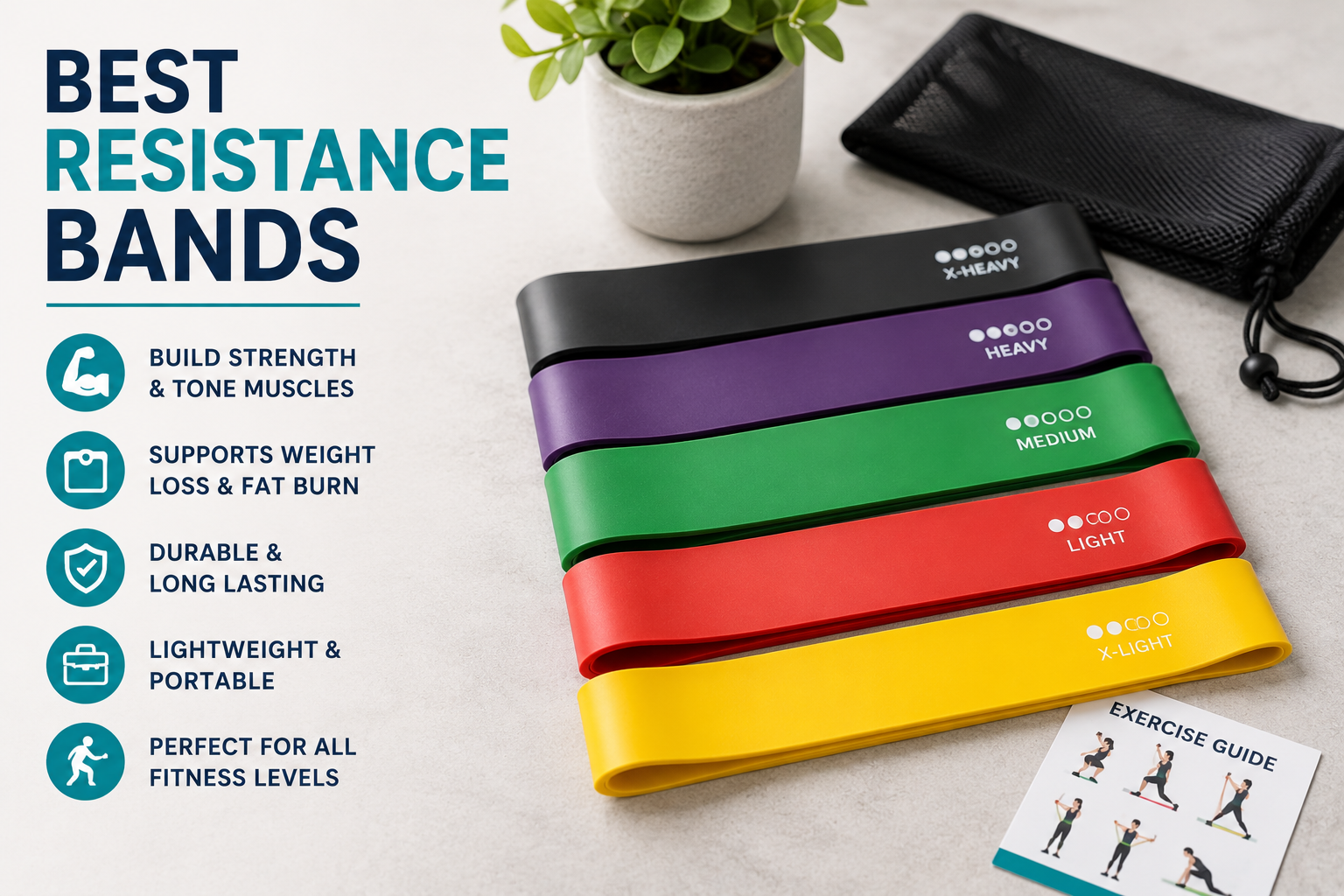
Two to three 30–45 minute sessions per week is the evidence-based recommendation. This does not require a gym — bodyweight squats, lunges, push-ups, and resistance band exercises are sufficient, particularly in the first 12 weeks.
Swimming
Swimming is one of the best full-body calorie-burning exercises available and has near-zero joint impact — making it particularly valuable for heavier people, those with knee or hip problems, or anyone post-surgery. A 30-minute moderate swim burns approximately 200–300 calories. It also builds muscle across the entire body, particularly the upper body which walking does not address.
Cycling
Cycling — stationary or outdoor — burns 400–700 calories per hour depending on intensity and weight, with minimal joint impact. It is particularly effective for people who find walking insufficient challenge but cannot yet run due to weight or fitness. The calorie burn per hour of cycling is significantly higher than walking, making it a useful tool for accelerating progress once a basic fitness base is established.
HIIT (High Intensity Interval Training)
HIIT produces the highest calorie burn per minute of any common exercise form and continues to elevate metabolic rate for several hours after the session (the “afterburn” or EPOC effect). It is not appropriate for people just starting exercise, those with joint problems, or those who are significantly overweight without modified low-impact versions. For people who are ready for it, 2–3 20-minute HIIT sessions per week can add 300–500 extra calories of burn to the weekly total and meaningfully accelerate a stone of loss.
The most effective exercise combination for a stone of loss
| Exercise type | Frequency | Primary benefit | Additional weekly calorie burn |
|---|---|---|---|
| Walking (7,000–10,000 steps) | Daily | NEAT, insulin sensitivity, baseline burn | 2,000–3,500 kcal |
| Resistance training | 2–3x per week | Muscle preservation, metabolic rate | 600–1,000 kcal |
| Swimming or cycling | 1–2x per week | Additional calorie burn, cardiovascular fitness | 400–1,400 kcal |
| Combined total | 3,000–5,900 kcal per week |
That combined exercise total — on top of a dietary deficit — means a stone of loss is achievable in 6–8 weeks for many people starting from a significant base weight.
What realistic progress actually looks like
One of the most common reasons people give up on a working diet is expecting linear progress and getting alarmed by normal variation. Real weight loss does not look like a steady downward line. It looks erratic on a day-to-day basis with a clear downward trend over weeks.
- Week 1: large drop (mostly water) — scale goes down 3–5lbs
- Week 2: slower drop or a slight rise — scale barely moves or ticks up slightly as water balance shifts
- Week 3: progress resumes — steady 1lb loss
- Week 4: nothing — scale flat for 5–7 days despite nothing changing
- Week 5: sudden drop — scale drops 1.5lbs seemingly overnight, catching up
This “whoosh” pattern — caused by the body temporarily retaining water in fat cells as fat is released before flushing — is normal and well-documented. People who understand it persist through the flat periods; people who do not understand it quit precisely when they are about to see results.
How to track weight without losing your mind
- Weigh daily at the same time (morning, after toilet, before eating) and record every reading
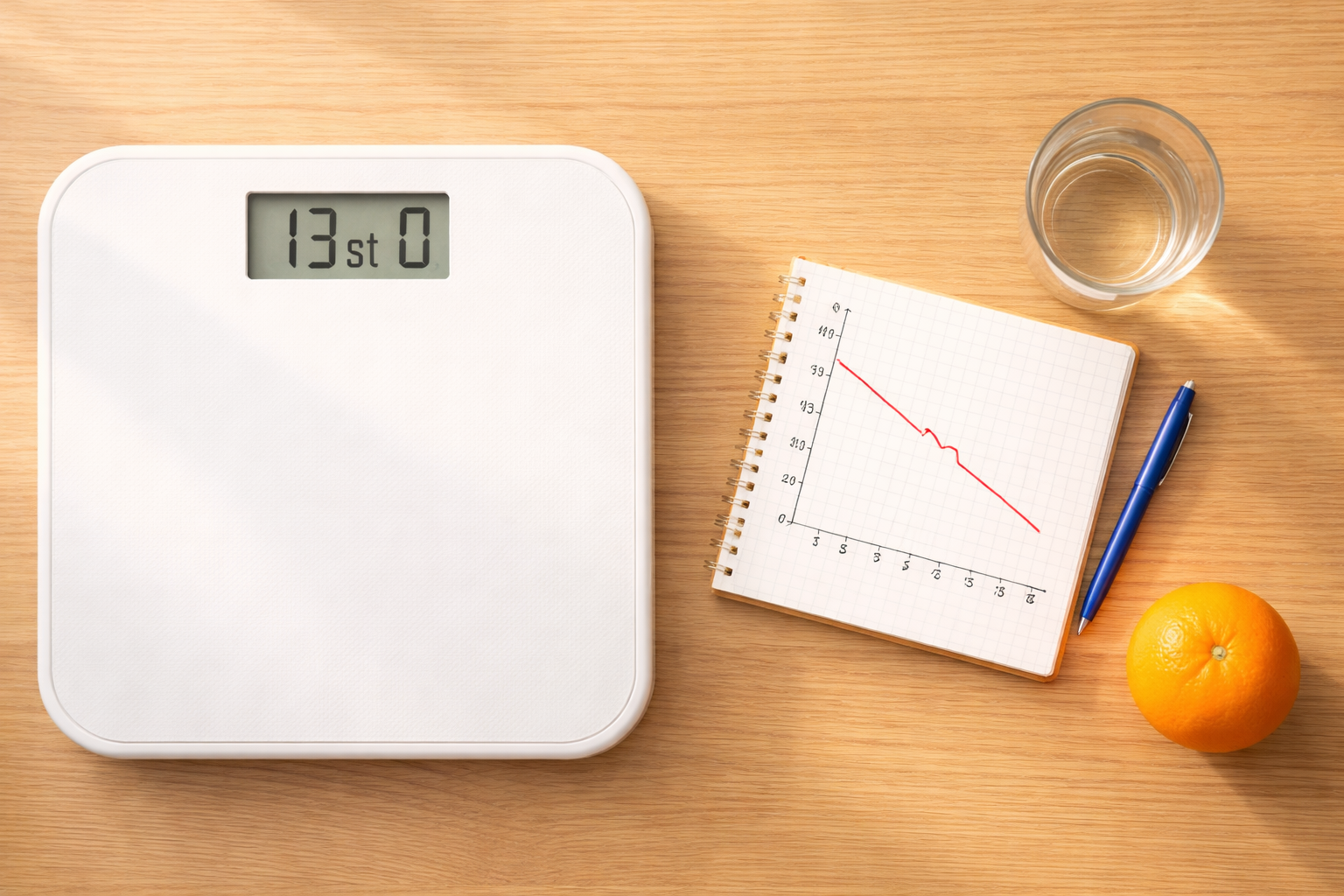
- Take a 7-day rolling average — this smooths fluctuations and shows the genuine trend
- Look at the 4-week trend, not individual days
- Take body measurements monthly — waist, hips, chest, thighs — these often show progress when scales are static
- Take progress photos every 2–4 weeks — visual change is frequently ahead of scale change
Losing a stone with specific conditions
Losing a stone with PCOS
Polycystic ovary syndrome involves insulin resistance, elevated androgens, and disrupted hormonal signalling that collectively make weight loss harder and fat storage (particularly abdominal) more pronounced. Women with PCOS often find conventional calorie counting produces slower results than expected because insulin resistance means their bodies store fat more readily at the same calorie intake.
What works for PCOS weight loss:
- Prioritise lower glycaemic carbohydrates — reducing the blood glucose spikes that drive insulin release and fat storage
- Increase protein significantly — 1.8–2.0g per kg minimum
- Add resistance training — improves insulin sensitivity more than cardio alone
- Walk after meals — even 10 minutes reduces post-meal glucose response meaningfully
- Expect a stone to take 16–20 weeks rather than 12–14 — and count this as normal, not failure
- Consider discussing inositol supplementation with your GP — there is reasonable evidence for its role in improving insulin sensitivity in PCOS
Losing a stone with an underactive thyroid (hypothyroidism)
Hypothyroidism reduces basal metabolic rate by 15–40%, making weight loss significantly harder regardless of how carefully you eat. If you have been eating less for months with minimal progress and have other hypothyroid symptoms (fatigue, feeling cold, hair loss, constipation, low mood), a thyroid function test through your GP is a worthwhile first step before assuming the diet is the problem.
If you have treated hypothyroidism and your levels are well-controlled, weight loss should proceed normally — though possibly slightly slower than average. If they are not well-controlled, dietary effort alone will not produce consistent results.
Losing a stone after gallbladder removal
Post-cholecystectomy, the body’s ability to handle large portions of fat changes. Without the gallbladder to store and release bile in concentrated boluses, fat digestion becomes more dependent on continuous low-level bile flow. This means:
- Very high fat meals may cause discomfort or diarrhoea in the weeks and months after surgery
- A lower-fat approach to dieting is more comfortable — emphasising lean protein, vegetables, and complex carbohydrates rather than high-fat foods
- Digestive enzyme supplements may help fat absorption and reduce discomfort
- Weight loss can proceed normally once the initial recovery period is complete — typically 4–8 weeks post-surgery for keyhole procedures
For more detail see the complete gallbladder removal guide.
Losing a stone after having a baby
Most healthcare professionals recommend waiting 6–8 weeks postpartum before deliberately restricting calories. The body needs adequate nutrition for healing and, if breastfeeding, for milk production. A gentle deficit of 250–300 calories is typically advisable postpartum, aiming for 0.5–1lb of loss per week — making a stone achievable in 14–28 weeks.
Breastfeeding burns an additional 300–500 calories per day, which can accelerate loss — but energy needs are also higher, and severe restriction during breastfeeding affects milk supply. The principle is the same as general weight loss: moderate deficit, high protein, adequate sleep (challenging with a newborn), and patience.
Why you might be stuck despite doing everything right
If you are following a reasonable diet and activity plan and not losing weight, one or more of the following is almost certainly occurring. Full detail in the companion guide (Why Am I Not Losing Weight Even Though I’m Eating Less?), but the most relevant factors for someone trying to lose a stone:
The deficit has shrunk
As your weight drops, your TDEE drops with it. A diet creating a 500 calorie deficit at your starting weight may only be creating a 200 calorie deficit now. Periodic recalculation of your targets — every 4 weeks — is required, not optional.
Weekends are cancelling weekdays
A consistent 500 calorie deficit Monday to Friday (2,500 weekly deficit) is entirely negated by 1,000 calories above maintenance on both weekend days (2,000 weekly surplus). Net result: 500 calorie weekly deficit — one seventh of a pound of fat loss per week. Most people who feel they are “being so good” but not losing weight have this pattern without realising it.
The scale is not showing fat loss
Water retention from increased exercise, hormonal cycles, high sodium, or stress can mask weeks of genuine fat loss. If clothes are fitting better or measurements are improving, fat loss is occurring even if the scale is static.
Metabolic adaptation
After 10–12 weeks of sustained restriction, the body reduces its metabolic rate in ways that narrow the effective deficit. A 2–4 week diet break at maintenance calories allows partial metabolic recovery before the next phase.
The psychology of losing a stone — why most people stop at 10lbs
There is a well-documented pattern in weight loss behaviour: people who set out to lose a stone often stop between 8 and 12 pounds. They have made real progress. The initial motivation has faded. Life has got in the way. The deficit feels harder than it did in week one. And the gap between where they are and “a stone” feels both small and somehow insurmountable.
Why motivation fades
Initial weight loss motivation is typically driven by novelty, visible early results (often inflated by water weight loss), and the emotional energy of a new start. By weeks 4–6, the novelty is gone, the pace of loss has slowed to its real rate, and the gap between effort and visible reward feels wider. This is normal — and it is the exact point where most people give up, regardless of how well they were actually doing.
Why the last few pounds of a stone take the longest
There are two reasons the final stretch to a stone milestone often stalls. First, as noted throughout this guide, your TDEE has dropped as you have lost weight — the same effort produces less result at 10lbs down than it did at the start. Second, the psychological pressure of being close to a milestone creates a specific form of self-sabotage. Research on goal proximity suggests that being close to a target can paradoxically increase the likelihood of abandoning it — through either overconfidence (“I’m nearly there, I can relax”) or anxiety about what happens after the goal is reached.
What actually maintains momentum
- Process goals not outcome goals: focusing on daily behaviours (hitting protein target, daily steps, 7 hours sleep) rather than the number on the scales removes the motivational volatility of scale fluctuation
- Non-scale victories: tracking and celebrating changes in energy, sleep quality, fitness level, how clothes fit, and blood pressure rather than treating the scales as the only measure of success
- Planned flexibility: building in one higher-intake day per week rather than trying to be perfect every day reduces the psychological pressure that leads to all-or-nothing abandonment
- Visual progress tracking: progress photos and body measurements often show faster and more encouraging change than the scale, particularly in the 6–12 week period when metabolism adaptation is most likely to stall scale progress
- Community and accountability: people who share their goals — even just with one other person — are significantly more likely to maintain behaviour change over 12+ weeks than those who diet alone

A practical plan for losing a stone
This is the approach that produces safe, consistent fat loss rather than rapid water weight loss followed by regain.
Step 1 — find your actual maintenance calories
Use a TDEE calculator (search “TDEE calculator UK”) using your current weight, height, age, and honest activity level. Most people are more sedentary than they think — if in doubt, use the sedentary setting and add exercise separately.
Step 2 — set a 500 calorie daily deficit
Eat 500 calories less than your maintenance level per day. For most UK adults this falls between 1,400–2,200 calories depending on size and activity. Do not go below 1,200 (women) or 1,500 (men) without medical supervision.
Step 3 — build meals around protein first
Aim for 1.6–2.0g of protein per kg of your target body weight. Choose your protein source first when planning each meal, then add vegetables and a moderate portion of carbohydrates. This naturally controls calories while preserving muscle.
Step 4 — walk 7,000–10,000 steps daily
Daily walking is the most sustainable way to increase calorie burn without triggering compensatory hunger. See the full guide on how many steps to lose weight UK for a practical 8-week progression.
Step 5 — add resistance training twice a week
Two 30–45 minute sessions per week of bodyweight or weight-bearing exercise preserves the muscle that keeps your metabolism working efficiently. This is the single most important addition beyond walking.
Step 6 — protect your sleep
7–9 hours per night is a metabolic requirement for efficient fat loss. No diet compensates fully for chronic sleep deprivation.
Step 7 — track weekly averages
Daily weigh-ins averaged over 7 days reveal the genuine trend. Single daily readings tell you nothing reliable about fat loss.
Step 8 — reassess every 4 weeks
Recalculate your TDEE and adjust targets as you lose weight. What worked at your starting weight needs updating as you progress.
🌿 Lily & Loaf Daily Essentials Bundle — daily nutritional support during weight loss
When eating at a calorie deficit, getting sufficient protein, micronutrients, and gut-supporting nutrients from food alone becomes harder. The Daily Essentials Bundle provides Daily Fuel (21g protein, 15 vitamins and minerals, 5g fibre), Daily Balance (Omega 3-6-9 for hormonal health and inflammation), and Daily Flora (15 probiotic strains for gut health and energy metabolism). A practical all-in-one daily routine for anyone actively losing weight.
Nutritional support while losing a stone
Eating at a calorie deficit reduces total food intake, which reduces micronutrient intake. Several key nutrients become particularly important to support during active weight loss.
🌿 Lily & Loaf Daily Fuel — protein with vitamins, minerals and fibre
21g of complete protein per serving with all 8 essential amino acids, plus 15 vitamins and minerals including iron, B12 and magnesium, and 5g of fibre. Designed for people whose food intake is reduced. A protein-rich breakfast or post-walk meal that keeps protein high without using too much of the day’s calorie budget.
🌿 Lily & Loaf Triple Magnesium — for sleep, stress and muscle recovery
Combines three bioavailable forms of magnesium for optimal absorption. Best taken in the evening — supports sleep quality, muscle recovery, and cortisol regulation overnight. Particularly useful for people who are dieting and exercising more, experiencing the sleep disruption, muscle soreness, and elevated stress that often accompany a new weight loss programme.
🌿 Lily & Loaf Electrolytes — hydration and energy during activity
Sugar-free formula delivering sodium, potassium, magnesium, B vitamins, vitamin C and zinc. As you increase activity to lose a stone faster, electrolyte losses through sweat increase. Low electrolytes cause fatigue, muscle cramps, and headaches that are frequently mistaken for hunger — leading people to eat more when what they actually need is better hydration.
🌿 Lily & Loaf Vitamin D3+K2 — essential for UK weight loss
Vitamin D is stored in body fat and released as fat is lost. During active weight loss many people experience a functional deficiency as stored vitamin D is rapidly used. Supports normal muscle function, immune health, mood, and bone integrity — all of which matter when exercising more and eating less. The K2 component directs calcium to bones rather than soft tissues, important when reducing dairy intake during a calorie deficit.
What happens after you lose a stone
Losing a stone is an achievement worth genuinely celebrating. It is also the point at which many people make one of two mistakes — stopping entirely, or immediately attacking the next stone with the same approach without acknowledging what has changed.
The metabolic reality after a stone of loss
After losing a stone, your TDEE has dropped — because you are lighter. The diet that created a 500 calorie daily deficit at your starting weight may now only create 300–350 calories of deficit. To maintain the same rate of loss you need to either reduce intake slightly, increase activity slightly, or both. This is not failure — it is the normal consequence of weighing less.
Consider a maintenance period
Spending 4–6 weeks eating at maintenance after a stone of loss serves several important purposes:
- Leptin recovers — hunger normalises and the hormonal environment becomes more favourable for the next phase
- Metabolic rate partially recovers from adaptation
- Your body adapts to the new lower weight as its new normal — this reduces regain risk
- Psychological sustainability improves — a planned break is far healthier than an unplanned one
The health benefits of a stone of loss
- Blood pressure typically reduces by 4–8 mmHg with a 5–10% body weight loss
- Blood sugar regulation improves — HbA1c typically drops measurably
- Joint pain reduces — each pound of body weight lost reduces knee joint load by approximately 4lbs
- Sleep quality often improves — particularly sleep apnoea, strongly linked to excess weight
- Energy levels increase — carrying less mass requires less energy for the same activities
- Mood and self-efficacy typically improve
UK weight conversion table — stones, pounds and kilograms
One of the most searched weight-related queries in the UK is converting between stones, pounds, and kilograms. Here is the full reference table from 8 stone to 30 stone — bookmark it or screenshot it for easy reference.
| Stone | Pounds (lbs) | Kilograms (kg) | Common reference |
|---|---|---|---|
| 8 st | 112 lbs | 50.8 kg | Lower healthy weight range (average height) |
| 8 st 7 | 119 lbs | 54.0 kg | |
| 9 st | 126 lbs | 57.2 kg | |
| 9 st 7 | 133 lbs | 60.3 kg | |
| 10 st | 140 lbs | 63.5 kg | |
| 10 st 7 | 147 lbs | 66.7 kg | |
| 11 st | 154 lbs | 69.9 kg | |
| 11 st 7 | 161 lbs | 73.0 kg | |
| 12 st | 168 lbs | 76.2 kg | Average UK woman’s weight |
| 12 st 7 | 175 lbs | 79.4 kg | |
| 13 st | 182 lbs | 82.6 kg | |
| 13 st 7 | 189 lbs | 85.7 kg | |
| 14 st | 196 lbs | 89.4 kg | Average UK man’s weight |
| 14 st 7 | 203 lbs | 92.1 kg | |
| 15 st | 210 lbs | 95.3 kg | |
| 15 st 7 | 217 lbs | 98.4 kg | |
| 16 st | 224 lbs | 101.6 kg | BMI 30+ at average UK height (obese threshold) |
| 16 st 7 | 231 lbs | 104.8 kg | |
| 17 st | 238 lbs | 108.0 kg | |
| 17 st 7 | 245 lbs | 111.1 kg | |
| 18 st | 252 lbs | 114.3 kg | |
| 18 st 7 | 259 lbs | 117.5 kg | |
| 19 st | 266 lbs | 120.7 kg | |
| 19 st 7 | 273 lbs | 123.8 kg | |
| 20 st | 280 lbs | 127.0 kg | |
| 20 st 7 | 287 lbs | 130.2 kg | |
| 21 st | 294 lbs | 133.4 kg | |
| 21 st 7 | 301 lbs | 136.5 kg | |
| 22 st | 308 lbs | 139.7 kg | |
| 22 st 7 | 315 lbs | 142.9 kg | |
| 23 st | 322 lbs | 146.1 kg | |
| 23 st 7 | 329 lbs | 149.2 kg | |
| 24 st | 336 lbs | 152.4 kg | |
| 24 st 7 | 343 lbs | 155.6 kg | |
| 25 st | 350 lbs | 158.8 kg | |
| 25 st 7 | 357 lbs | 161.9 kg | |
| 26 st | 364 lbs | 165.1 kg | |
| 26 st 7 | 371 lbs | 168.3 kg | |
| 27 st | 378 lbs | 171.5 kg | Alan’s starting weight (375 lbs / 27 stone) |
| 27 st 7 | 385 lbs | 174.6 kg | |
| 28 st | 392 lbs | 177.8 kg | |
| 28 st 7 | 399 lbs | 181.0 kg | |
| 29 st | 406 lbs | 184.2 kg | |
| 29 st 7 | 413 lbs | 187.3 kg | |
| 30 st | 420 lbs | 190.5 kg |
Quick conversion formulas
- Stones to kg: multiply stones by 6.35 (e.g. 15 stone × 6.35 = 95.25 kg)
- Stones to lbs: multiply stones by 14 (e.g. 15 stone × 14 = 210 lbs)
- Kg to stones: divide kg by 6.35 (e.g. 95 kg ÷ 6.35 = 14.96 stone)
- Lbs to stones: divide lbs by 14 (e.g. 196 lbs ÷ 14 = 14 stone)
- Kg to lbs: multiply kg by 2.205 (e.g. 95 kg × 2.205 = 209.5 lbs)
How much is a stone in kg?
One stone is exactly 6.35029 kg — commonly rounded to 6.35 kg for everyday use.
How much is a stone in pounds?
One stone is exactly 14 pounds.
How many kg is half a stone?
Half a stone is 7 lbs, or approximately 3.175 kg.
How many kg is 2 stone?
Two stone is 28 lbs, or approximately 12.7 kg.
Related reading on this site
- Why Am I Not Losing Weight Even Though I’m Eating Less?
- How Many Steps a Day to Lose Weight UK
- Weight Loss Plateau: What Actually Helps
- How to Reduce Muscle Loss During Weight Loss
- Sleep and Weight Loss: What Actually Helps
- Supplements for Weight Loss: UK Starter Stack
- GLP-1, Gallstones and Gallbladder Removal UK

Frequently asked questions
How long does it take to lose a stone in the UK?
At a safe and sustainable rate of 1–2lbs per week, losing a stone (14lbs) takes 7–14 weeks. A 500 calorie daily deficit produces approximately 1lb per week — a stone in 14 weeks. Adding daily walking of 7,000–10,000 steps increases this to 1.5–2lbs per week, achieving a stone in 7–10 weeks.
Can you lose a stone in a month?
Losing a stone in one month requires a daily deficit of approximately 1,750 calories — aggressive and unsustainable for most people, with significant muscle loss and metabolic slowdown as side effects. It is physically possible for very heavy people with large maintenance calorie levels, but 8–12 weeks is a healthier and more realistic timeline for most.
How long does it take to lose a stone walking?
10,000 steps per day burns approximately 300–500 calories depending on weight. Combined with a modest dietary adjustment, a stone is achievable in 8–12 weeks. Walking alone without dietary changes takes approximately 16–20 weeks at consistent 10,000 daily steps.
Is losing a stone in 8 weeks realistic?
Yes — for people who are significantly overweight and maintain a consistent 700–800 calorie daily deficit with regular activity. For people closer to a healthy weight, 8 weeks is ambitious but possible at the upper end of healthy loss rates.
How long does it take to lose a stone at 50?
At 50, metabolic rate is approximately 10–15% lower than at 25, meaning a stone typically takes 12–16 weeks rather than 10–14. Prioritising protein and adding resistance training makes a significant difference at this age.
How long does it take to lose a stone for a woman?
Women typically have lower muscle mass and therefore lower metabolic rates than men of the same weight, meaning loss is slightly slower. At a 500 calorie daily deficit, most women lose a stone in 14–18 weeks. Hormonal cycles, perimenopause, and PCOS can all extend this timeline.
What is the fastest healthy way to lose a stone?
The fastest sustainable approach combines a 500–750 calorie daily deficit, adequate protein (1.6–2g per kg), consistent daily activity (7,000–10,000 steps), resistance training twice per week, 7–9 hours of sleep, and stress management. This combination can produce 1.5–2lbs per week — a stone in 7–10 weeks.
Why am I not losing a stone faster?
The most common reasons are underestimating calorie intake, metabolic adaptation, insufficient protein, poor sleep, elevated cortisol from stress, and weekend eating that cancels the weekly deficit. Full detail at: Why Am I Not Losing Weight Even Though I’m Eating Less?
Does losing a stone make a difference to how you look?
Yes — a stone of loss is typically visible in the face, jawline, and midsection. Most people find clothes fit noticeably better and body measurements reduce by 1–2 inches around the waist. The visual impact is greater at lower starting weights where a stone represents a higher percentage of total body weight.
How long does it take to lose a stone with intermittent fasting?
Intermittent fasting produces weight loss at the same rate as conventional calorie restriction when total calorie intake is equivalent. Most people using 16:8 fasting lose a stone in 10–16 weeks. It works by helping some people eat less overall — not through metabolic changes specific to the fasting window.
How long does it take to lose a stone on a low carb diet?
Low carb diets produce a large initial scale drop of 2–5lbs in week one due to glycogen and water depletion, followed by steady fat loss of approximately 1–1.5lbs per week. Including the water weight drop, many people see a stone on the scales within 5–8 weeks of starting low carb, though true fat loss takes 10–14 weeks.
How long does it take to lose a stone after having a baby?
Most healthcare professionals recommend waiting 6–8 weeks postpartum before restricting calories. With a gentle deficit of 250–300 calories, aiming for 0.5–1lb per week, a stone is achievable in 14–28 weeks. If breastfeeding, avoid more aggressive deficits to protect milk supply and recovery.
Discover more from Healthy Weight Loss GLP1
Subscribe to get the latest posts sent to your email.