

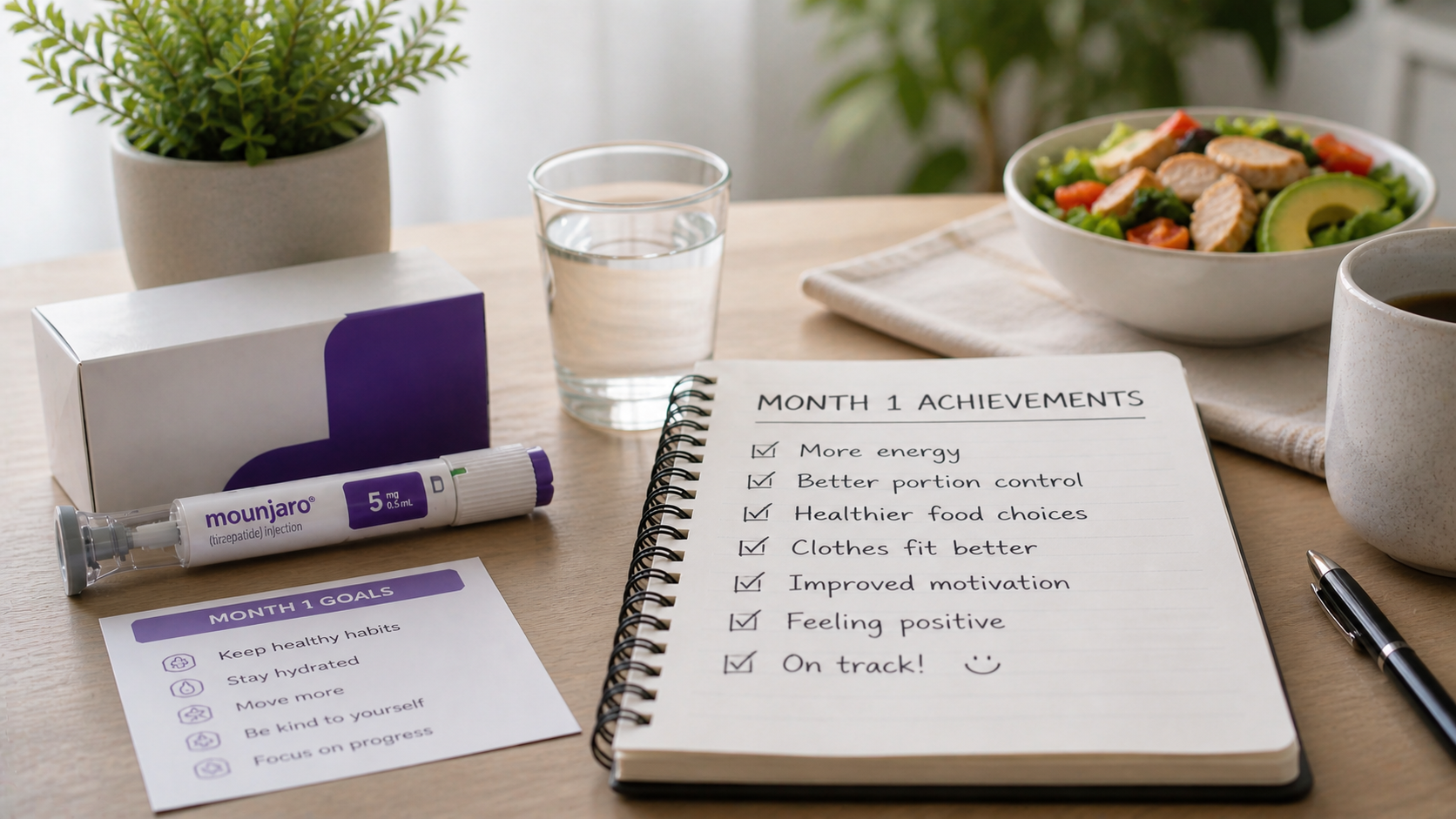
The first month on Mounjaro is an adjustment month, not a weight loss month. Expect 2–6 lbs of loss (mostly water in the first fortnight), a new food relationship by the end of week two, and steadily easing side effects once your body adapts to the 2.5mg starter dose. This is the honest month-by-month timeline of what actually happens, based on my own first month in 2025 and the SURMOUNT-1 trial adaptation pattern.
For day-by-day detail of week one specifically, see First Week on Mounjaro UK. For the broader 12-month arc, the Complete GLP-1 Guide. This post covers specifically weeks 1–4.
Understanding the 2.5mg dose: why month one is different
Tirzepatide (Mounjaro) is always titrated from 2.5mg for the first four weeks. The 2.5mg dose is deliberately sub-therapeutic — it’s not the dose that drives the headline weight loss figures you’ve read about. Its job is to let your body adapt to the medication so that by the time you step up to 5mg (the first therapeutic dose), you’ve built some tolerance to the gastrointestinal effects and your body has adjusted to the slower gastric emptying.
This is why month one weight loss is typically modest: 2–6 lbs in most users, mostly driven by water weight shifts and a modest calorie deficit from reduced appetite, not by the dramatic fat loss that kicks in from month 2 onward. If you’re expecting to drop 14 lbs in month one, you’ll be disappointed; if you understand the adaptation design, you’ll see week 1 of each new dose-step as an investment period.
Week 1: The adjustment (covered in detail separately)
Brief summary — see the week one post for day-by-day detail.
- Days 0–1: minimal effect, slightly reduced appetite
- Days 2–3: peak side effects (nausea, fatigue, some reflux)
- Days 4–5: symptoms ease noticeably
- Days 6–7: stabilising into a new eating rhythm
- Typical scale change: -2 to -4 lbs (mostly water)
- Mental shift: first experience of genuinely quieter food noise
The dominant feeling by end of week 1: “I can eat less without it being an effort.”
Week 2: Finding the rhythm
Week 2 is when most people settle into their new baseline on 2.5mg. You’ve already ridden out the worst of early side effects, and the medication has become routine rather than an event.
What changes:
- Appetite suppression stabilises. Not the “I can’t face food” of week one day 3, but a consistent, comfortable “I’m full after half a meal” sensation throughout the day.
- Second weekly injection arrives. Day 7 is your second dose. Most people experience a mild echo of week-one side effects for 24–48 hours afterwards, but milder because the body is adapted.
- Meal sizes shrink naturally. You start to notice you’re plating smaller amounts without consciously trying. Restaurant portions look wildly large.
- Snacking urge disappears. This is the biggest qualitative shift for most. The mid-afternoon crisp run, the post-dinner biscuit, the compulsive grazing — all significantly reduced or gone.
- Water intake needs conscious effort. You’ll genuinely forget to drink because the satiety signal obscures the thirst signal. Water bottles with time markings help.
- Energy mostly back to normal. Some people still feel mild fatigue; most are back to pre-medication baseline by end of week 2.
Typical scale change by end of week 2: -3 to -7 lbs cumulative. Most of this is water and reduced stomach/gut content rather than fat, but the number starts moving meaningfully.
What to do in week 2:
- Establish your protein target and hit it (1.6g per kg body weight minimum) — it’s harder than before and requires planning
- Start tracking what you’re actually eating for a week so you know your new calorie level
- Introduce the core supplements: multivitamin, omega-3, vitamin D3/K2
- Resume normal exercise intensity if you paused in week 1
- Weigh once (not daily) and photograph monthly — weekly weigh-ins start from week 3 onwards
Week 3: This is my life now
Week 3 is when most people stop thinking of themselves as “new to Mounjaro” and start thinking of it as the way they eat and live. The medication has become invisible — a Sunday evening injection and a different relationship with food.
What’s happening:
- Third injection has come and gone with barely any side effects. This is now routine.
- Psychological shifts start registering. The constant low-hum of food noise that may have been background soundtrack to your adult life has quietened. For some this is relief; for others, it reveals how much space food thinking was taking up. See The Mental Side in the Complete Guide.
- Digestion is a bit different. Slower transit throughout. You may go to the bathroom every other day rather than daily. Constipation can appear around now if you haven’t been proactive about fibre and hydration.
- Your relationship with alcohol may have changed dramatically. One drink hits like three. Many people naturally drink less.
- Sleep quality shifts. Often better (less reflux, less bloat), occasionally different (vivid dreams, slightly earlier waking). Both are common.
Typical scale change by end of week 3: -4 to -10 lbs cumulative depending on starting weight and how well you’ve been eating. People at higher starting weights (25+ stone) often see bigger drops in absolute terms; people closer to healthy BMI see smaller drops as a percentage of body weight is modest on the starter dose.
What to do in week 3:
- Start weekly weigh-ins (same day, same time, same conditions)
- Take first monthly photos (front, side, back, same outfit)
- Add strength training if you hadn’t already — see Strength Training on GLP-1
- Check in with yourself mentally. Food noise change can be unsettling; see The Mental Side if something feels off
Week 4: The dose-step decision
Week 4 is your final week at 2.5mg. At the end of week 4 (usually the day you take your fourth injection, which makes it day 28 from your start), you step up to 5mg.
5mg is the first therapeutic dose. This is where meaningful weight loss starts. It’s also where side effects can return briefly, because each dose step triggers a similar adaptation period to week one, though usually milder because your body has partial tolerance.
What to expect at the 5mg step-up:
- Mild echo of week-one side effects on day 2–3 after the 5mg injection — typically milder than the original week one
- Noticeable further reduction in appetite
- A more dramatic weight loss pattern starting in week 5–6
Before you step up, it’s worth a titration review with your prescriber: how have you tolerated 2.5mg, any concerns, is your prescriber happy to progress to 5mg. Good providers will proactively check in at this point.
Typical scale change by end of week 4: -5 to -12 lbs cumulative. The month-one figure varies widely by starting weight and individual adaptation.
What the trial data says vs real-world expectations
The SURMOUNT-1 trial showed mean weight loss of 16% body weight on 5mg maintenance over 72 weeks — but that’s after adaptation, not in month one. The typical month-one trial pattern on 2.5mg starter dose is 1–3% body weight loss.
For a 100kg starting weight, that’s 1–3 kg (2.2–6.6 lb) in month one. For 120kg starting weight, 1.2–3.6 kg (2.6–7.9 lb). For 80kg starting weight, 0.8–2.4 kg (1.8–5.3 lb). Real-world results often show slightly higher week-one figures (more water loss) and slightly lower cumulative month-one figures (more adaptation realism).
This is why the answer to “how much will I lose in month one?” is “probably less than you hoped, and that’s fine.” The real numbers come from months 2–6.
Common month-one mistakes
1. Weighing daily. The scale moves 1–3 lb in either direction on a normal day for normal reasons (sodium, hormones, digestion, hydration, sleep). Daily weighing surfaces noise and breeds anxiety. Weekly weighing shows signal.
2. Cutting calories aggressively on top of the medication. The medication is already creating a calorie deficit. Cutting further risks muscle loss, fatigue, and a week-three crash. Eat less, but not drastically less; let the medication do the deficit.
3. Not prioritising protein. Weight loss without muscle preservation means losing weight you don’t want to lose. Hit 1.6g per kg protein from day one. See The Nutrition Stack.
4. Skipping exercise because of fatigue. Resistance training preserves muscle. Skipping it means a bigger percentage of your weight loss will be lean tissue. If you can only manage walking in week one, do walking; but pick resistance back up by week 2.
5. Not paying attention to hydration. Mild dehydration in month one is extremely common and amplifies every side effect. 2–3 litres a day of fluid from water, tea, broths, electrolytes.
6. Panicking at week 2 plateau. There’s often a brief flat spot between the initial water drop of week 1 and the adapted pattern of weeks 3–4. This isn’t a plateau requiring action — it’s the normal adaptation curve. Don’t change anything; wait.
7. Trying to push the dose up early. Don’t ask your prescriber to skip to 5mg before day 28 unless there’s a genuine tolerance reason. The 4-week adaptation period at each dose exists because rushing it causes worse side effects and doesn’t improve outcomes.
8. Not tracking what you’re eating at all. A week or two of food tracking in weeks 2–3 calibrates you to what you’re actually eating on the new appetite pattern. “About 1,200 calories” and “actually 1,650 calories” can feel the same when you’re eating less than before.
What I wish I’d known going into month one
Four things:
1. The food relationship change is the real story, not the scale. You’ll judge yourself by the weight number, but the deeper shift is the food-noise quieting, the reduced snacking compulsion, the ability to walk past chocolate without internal argument. That’s what makes month-1 trajectories stick.
2. The first dose-step matters more than the second. Going from 2.5mg to 5mg is the biggest single change in month-two effects. Prepare for a small week-one-style adaptation around day 28–30.
3. Your tolerance is individual, not universal. Some people sail through 2.5mg and struggle at 15mg. Others struggle at 2.5mg and find each step easier. You can’t predict from week one how you’ll do on later doses.
4. Your life is still your life. Easy to treat month one as a siege with everything on hold. Don’t. Keep normal meals with friends (just eat less). Keep your exercise (just gentle in week 1). Keep your routines. The medication fits around your life, not the reverse.
What success looks like at end of month 1
A successful first month looks like:
- You’ve tolerated the medication well enough to continue and step up to 5mg
- Your appetite is clearly, consistently reduced and you’ve adapted to smaller meals
- You’ve hit your protein target most days
- You’ve walked regularly and, by week 3, returned to resistance training
- You’ve lost somewhere between 2 and 12 lbs depending on starting weight
- You’ve photographed, measured, and weighed yourself once so you have a proper baseline
- You’ve set up the habits (hydration, protein, walking, supplements, meal prep) that will carry you through months 2–12
If all of those are ticked, you’re ready for the real work.
What happens next
Month two on 5mg is where the Mounjaro reputation is earned. Weight loss picks up. Appetite suppression becomes properly effective. The habits you built in month one carry the loss forward. The side-effect pattern repeats but milder each time as your body adapts faster with each step.
For the full arc through month 12: Complete GLP-1 Weight Loss Guide. For the specific mental side of the first several months: The Mental Side. For what happens when you eventually plateau: Plateaus and What to Do About Them.
Medical note: Individual responses vary substantially. This is a general framework for what most people experience, not a promise. If you’re struggling in month one, contact your prescriber — don’t push through alone.
Discover more from Healthy Weight Loss GLP1
Subscribe to get the latest posts sent to your email.