
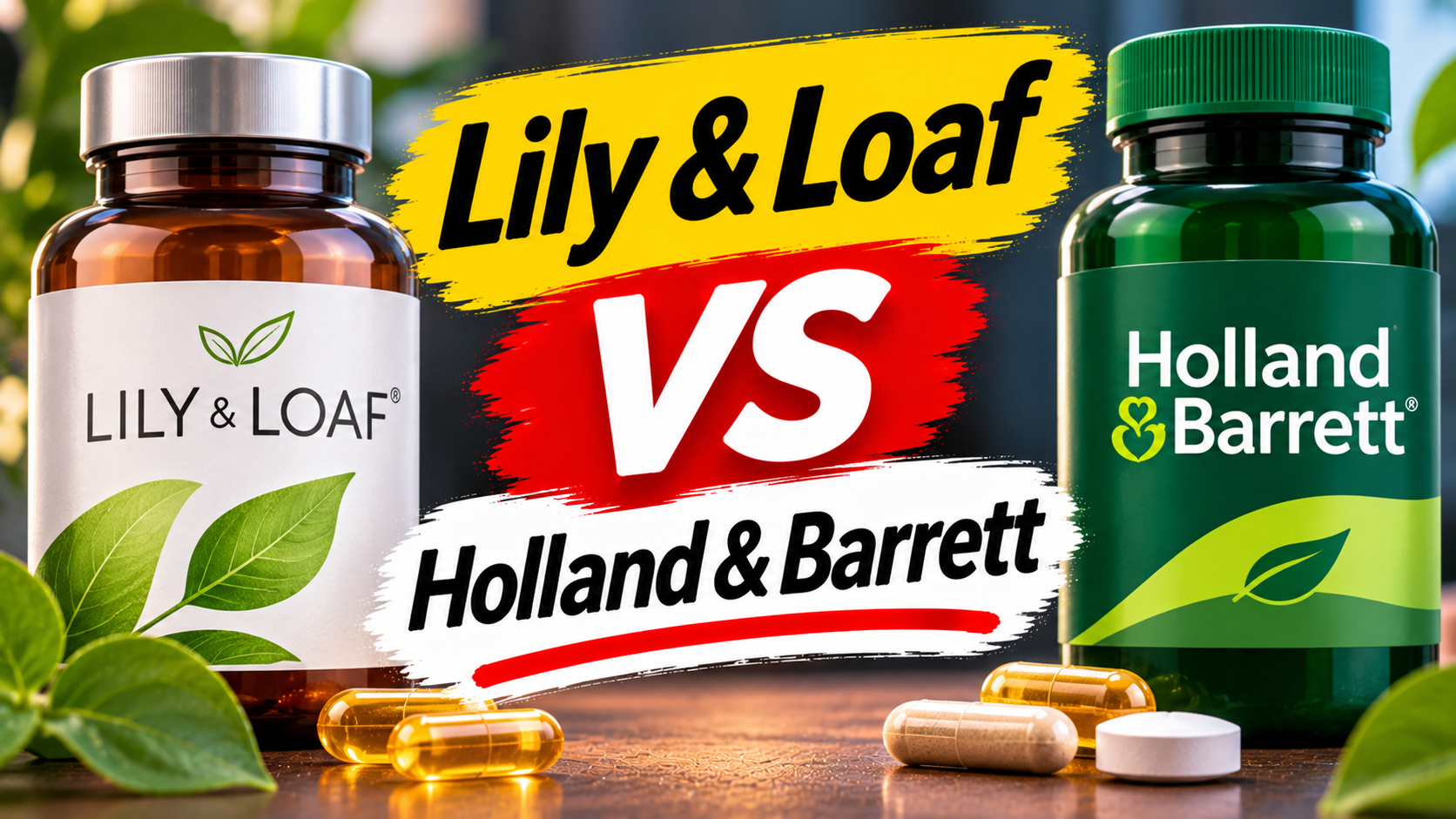
Holland & Barrett is the UK’s largest health supplement retailer. Lily & Loaf is a smaller brand with a curated range and higher average price points. For GLP-1 users choosing between them, the question isn’t simply which is cheaper — it’s which products actually deliver what the label promises, at a formulation quality that makes a meaningful difference to the deficiencies GLP-1 treatment produces. This is the honest comparison across the specific supplement categories that matter most for Mounjaro and Wegovy users.
Browse Lily & Loaf: lilyandloaf.com → Take the free supplement quiz: lifestyle analysis →
The formulation difference that matters most: magnesium
Magnesium is the most commonly depleted supplement for GLP-1 users and the most dramatic example of formulation quality differences between brands.
| Magnesium form | Bioavailability | Best for | Common in |
|---|---|---|---|
| Magnesium oxide | Very low (~4%) | Laxative effect only | Many H&B budget products |
| Magnesium citrate | Moderate (~30%) | Constipation, general supplement | H&B higher-tier products |
| Magnesium glycinate | High (~50–80%) | Sleep, anxiety, muscle function | L&L Triple Magnesium |
| Magnesium malate | High | Energy, fatigue | L&L Triple Magnesium |
| Magnesium taurate | High | Cardiovascular, nervous system | L&L Triple Magnesium |
A GLP-1 user buying the cheapest Holland & Barrett magnesium (often magnesium oxide) and taking 400mg daily is absorbing approximately 16mg of actual magnesium — a clinically irrelevant dose. The same user taking Lily & Loaf Triple Magnesium (glycinate, malate, taurate blend) is absorbing 200–320mg — a clinically meaningful dose.
This is not a marginal quality difference. It’s the difference between a supplement that works and one that doesn’t — at a total price difference of approximately £3–5 per month.
Category-by-category comparison
Vitamin D3
Holland & Barrett: D3 (cholecalciferol) available at competitive prices. Quality is generally adequate — vitamin D3 is relatively straightforward to manufacture consistently. H&B’s D3 is a reasonable choice. The difference is usually the K2 combination: H&B sells D3 and K2 separately (additional cost and inconvenience) while L&L combines them in a single formulation.
Lily & Loaf: D3+K2 combination ensures calcium is directed to bone rather than soft tissue — an important consideration for users taking high-dose D3 over months. Marginally higher price than H&B D3 alone, but more comprehensive for the same number of capsules.
Verdict: L&L D3+K2 wins for GLP-1 users taking D3 for extended periods. H&B D3 alone is adequate for short-term use or users already taking K2 separately.
Omega-3
Holland & Barrett: fish oil capsules at various potencies. The key question is EPA+DHA content per capsule versus total fish oil content — many budget H&B omega-3 products are 1,000mg fish oil but only 300mg EPA+DHA. At GLP-1 therapeutic doses (2g+ EPA+DHA daily), this requires 6+ capsules per day.
Lily & Loaf: Daily Balance Omega concentrates EPA+DHA, requiring fewer capsules for therapeutic doses. Also available in triglyceride form (higher bioavailability than ethyl ester form).
Verdict: check EPA+DHA content per capsule, not total fish oil. H&B products are adequate if you find a high-concentration product; L&L removes the search.
Zinc
Holland & Barrett: zinc gluconate and zinc picolinate both available. Reasonably priced and generally adequate quality. H&B’s zinc products are a reasonable budget choice — this is a category where the quality difference is smaller than magnesium.
Lily & Loaf: zinc included in several formulations alongside complementary nutrients. The combination approach (zinc + selenium + vitamin C in Biotin Plus, for example) can be more convenient than individual purchases.
Verdict: H&B zinc is adequate and more affordable than L&L for standalone zinc supplementation. The L&L advantage is in combination products that bundle zinc with complementary nutrients.
Probiotics
Holland & Barrett: large probiotic range at varying price points. Strain diversity is inconsistent across the range — some products specify strains and CFU counts; others don’t. GLP-1 users need specific strains (Lactobacillus and Bifidobacterium species) at clinically relevant CFU counts (10 billion+).
Lily & Loaf: Daily Flora Probiotic with specified multi-strain formulation and guaranteed CFU counts. Designed for gut health support specifically.
Verdict: for probiotics, strain and CFU specification matters. L&L provides clearer formulation transparency than many H&B probiotic products. Worth the premium for this category.
Price comparison: the realistic monthly cost
| Category | H&B monthly cost (adequate quality) | L&L monthly cost | Difference |
|---|---|---|---|
| Magnesium (glycinate form) | £8–12 | £15–18 | ~£6 |
| D3+K2 combination | £8–12 (bought separately) | £10–14 | £2–4 cheaper at L&L |
| Omega-3 (high EPA+DHA) | £8–15 | £12–18 | ~£4 |
| Probiotic (multi-strain) | £10–20 | £15–20 | ~£3 |
| Full stack monthly | £34–59 | £52–70 | ~£15–20 more for L&L |
The premium for L&L over a quality H&B stack is approximately £15–20 per month — the difference is primarily the magnesium formulation. Whether that premium is worth it depends on which categories you’re buying. For magnesium specifically: the premium is worth it because the formulation quality difference is real and meaningful. For zinc and D3 standalone: H&B is adequate.
Where to use Lily & Loaf vs Holland & Barrett
Always use Lily & Loaf for: magnesium (the glycinate formulation difference is significant), probiotic (strain transparency), D3+K2 combination (convenient and well-formulated)
H&B is adequate for: standalone zinc, vitamin C, general B vitamins, collagen (if using)
Use the free quiz to decide: rather than buying both and comparing, take the free Lily & Loaf lifestyle analysis → which identifies your specific priority supplements. The products the analysis recommends from L&L are the ones where the formulation quality difference justifies the premium; you can fill remaining gaps from H&B.
Frequently asked questions
Is Lily & Loaf better than Holland & Barrett?
For specific categories — particularly magnesium, probiotics, and D3+K2 — L&L’s formulation quality justifies the premium. For simpler supplements (zinc, vitamin C, basic B vitamins), H&B’s pricing is competitive with adequate quality. Use the lifestyle analysis to identify which categories need premium formulations.
Are Holland & Barrett supplements safe?
Yes — Holland & Barrett products meet UK supplement safety standards. The quality difference with L&L is formulation efficacy (bioavailability of specific nutrients), not safety.
Where can I get the best deal on Lily & Loaf supplements?
Directly from lilyandloaf.com → The subscription option (auto-renewing monthly delivery) provides a saving versus single-order pricing. The lifestyle analysis is free and helps you order only what you actually need — avoiding the waste of buying a full range when a targeted stack is more appropriate.
For the nutritional science behind why bioavailability differences matter — why 4% absorption magnesium oxide is genuinely not the same as 60% absorption magnesium glycinate — start your free Audible trial → and any functional nutrition title covers the supplement pharmacology in accessible format.
The decision framework: how to choose
Rather than a blanket recommendation of one brand over the other, the most cost-effective approach is category-by-category:
Always choose Lily & Loaf:
Magnesium (the glycinate formulation quality difference is real and meaningful), probiotics (strain transparency and CFU counts), D3+K2 combination. These are categories where formulation matters significantly.
H&B is adequate:
Standalone zinc gluconate or picolinate, vitamin C, basic multivitamin if using a general supplement. These categories have smaller formulation quality variation between brands.
The personalised path:
Take the free Lily & Loaf lifestyle analysis → first. The analysis identifies your specific priority supplements — the ones where the L&L formulation quality difference most significantly affects your outcomes. For categories outside the top recommendations, H&B’s pricing is competitive and adequate.
This hybrid approach — L&L for the most formulation-sensitive categories, H&B for simpler supplements — typically costs £30–45/month rather than the £52–70 of a full L&L stack, while capturing most of the quality benefit where it matters most. Track everything in Cronometer‘s supplement diary to ensure the combination is providing the nutrient totals you’re targeting. And for the science behind why bioavailability specifically matters more than price: start your free Audible trial →
Frequently asked questions
Is Lily & Loaf better quality than Holland & Barrett?
For specific products — particularly magnesium (glycinate vs oxide formulation) and probiotics (strain specification) — Lily & Loaf’s formulation quality produces meaningfully better outcomes. For simpler products like basic zinc or vitamin C, H&B is adequate. The difference matters most for the nutrients most commonly deficient in GLP-1 users.
Does Lily & Loaf ship to all UK addresses?
Yes — Lily & Loaf ships across the UK including Scotland, Wales, and Northern Ireland. Free delivery is available above an order threshold. See current shipping terms at lilyandloaf.com →
The most practical starting point is the free Lily & Loaf lifestyle analysis → — it identifies your specific priority supplements, which are the ones where the L&L formulation quality difference most matters. For everything outside those priorities, H&B is a reasonable budget alternative. This targeted approach typically reduces total supplement spend by £15–25/month versus buying the full L&L range, while maintaining quality where quality specifically affects outcomes. Track everything in Cronometer’s supplement diary to verify the combined stack is hitting your daily nutrient targets.
Both brands are legitimate. Both produce safe products. The difference is formulation quality in specific categories — primarily magnesium, probiotics, and D3+K2 combination. For GLP-1 users whose most common gaps are exactly in those categories, the quality difference justifies the premium. Use the free lifestyle analysis → to confirm which specific products matter most for your situation, then make informed decisions about which brand provides the right quality for each. This targeted approach beats buying either brand comprehensively and gets you the right supplements at the right quality for the most reasonable total cost.
Discover more from Healthy Weight Loss GLP1
Subscribe to get the latest posts sent to your email.