
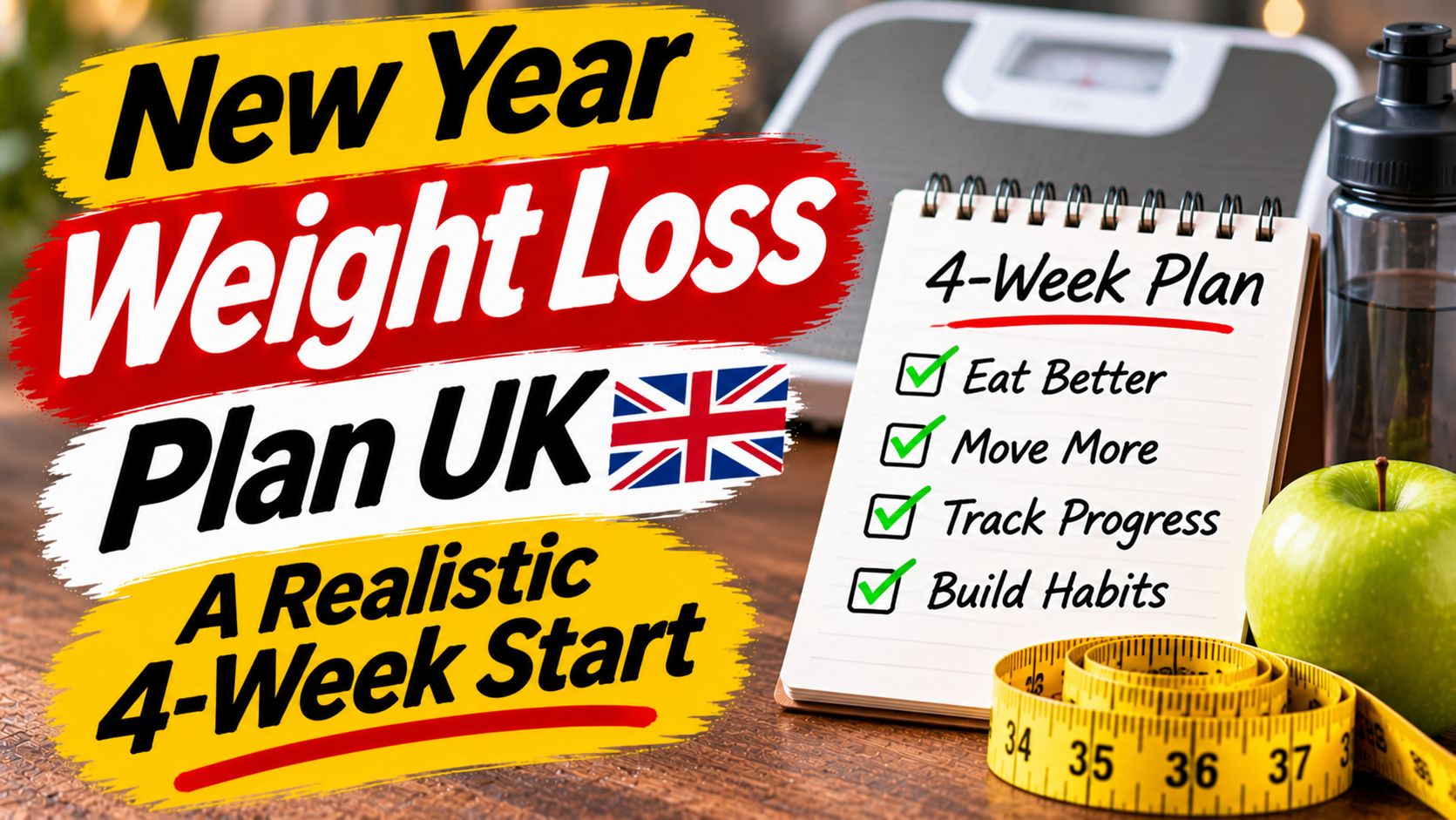
A realistic New Year weight loss plan starts with one week of honest food logging, then adds a modest calorie target, more protein and daily movement over the next three weeks. Small changes you can keep beat a dramatic January that’s over by February.
Last updated: 14 November 2026 · By Alan Spicer
Not medical advice. I share what has worked for me on GLP-1 medication and link the evidence. Talk to your GP or prescriber before changing your diet, medication or activity.
If you have, or have had, an eating disorder, speak to your GP before counting calories. Beat offers UK support.
Every January the same promises come round: detoxes, crash diets and complete overhauls. I’m on GLP-1 medication and have lost 7 stone in 18 months, and I don’t think January needs to be dramatic. Here’s a simple four-week start built on tracking, protein and movement.
Why listen to me
I have been on GLP-1 medication since January 2024 and lost 7 stone in 18 months. I’m not a doctor or dietitian: I share what worked for me, what didn’t, and the evidence behind it. My day job is YouTube consulting, which you can read about on alanspicer.com.
⚡ QUICK ANSWER
A realistic New Year weight loss plan: week 1, log everything without changing it; week 2, set a modest calorie target (the NHS average is about 2,000kcal for women and 2,500kcal for men to maintain); week 3, add protein to each meal; week 4, build to 150 minutes of activity a week, as the NHS recommends.
What’s a realistic New Year weight loss plan?
A realistic New Year weight loss plan adds one habit a week for four weeks: logging, a calorie target, protein and activity. Each step builds on the last, so nothing feels like a big overhaul.
| Week | Focus | What to do |
|---|---|---|
| 1 | Log honestly | Track everything you eat and drink, without changing it |
| 2 | Set a target | Choose a modest calorie target and start working to it |
| 3 | Add protein | Include a protein food at every meal |
| 4 | Move more | Build towards 150 minutes of activity a week |
Source: NHS, Understanding calories; NHS physical activity guidelines for adults.
Week 1: how do you start?
Start by logging everything you eat and drink for seven days without changing anything. That first week shows your real starting point, which is usually different from what people expect.
- Download a calorie app and set your details.
- Log every meal, snack and drink, including alcohol, milk and oil.
- Weigh in once at the start and once at the end of the week.
- At the end of the week, look at your average daily calories and protein.
A 2019 trial found people who logged most often lost the most weight, and the time it took fell to under 15 minutes a day by month six. Quick logging makes this step easy.
Week 1, logged in seconds
CaveCals lets you log by photo, voice, barcode or typing. It’s free to download with no account needed.
Free on iPhone and Android. iPhone code ALANSPICER: one month free on the yearly plan.
Week 2: how many calories should you eat?
In week two, set a modest calorie target a little below your maintenance level. The NHS average is about 2,000kcal a day for women and 2,500kcal for men to maintain weight, and a calorie app can work out your own number from your age, height, weight and activity.
Avoid going very low. Very low calorie diets should only be done with medical supervision, and a target you can keep is worth more than a fast start. My guide to how many calories to eat to lose weight explains how to pick one.
Week 3: why add protein?
Add protein in week three because it helps you feel full on fewer calories and protects muscle while you lose weight. Aim to include a protein food at every meal.
- Breakfast: eggs, Greek yoghurt or cottage cheese.
- Lunch: chicken, tuna, beans or lentils with salad or vegetables.
- Dinner: fish, lean meat or tofu with vegetables and a sensible portion of carbs.
- Snacks: yoghurt, a protein bar or a handful of nuts.
My protein calculator gives you a daily target to aim for. Most calorie apps show protein alongside calories, so you can track both at once.
Week 4: how much activity do you need?
In week four, build towards the NHS guideline of at least 150 minutes of moderate activity a week, plus strengthening activities on at least 2 days. Brisk walking counts.
You don’t need a gym. A daily 20 to 30 minute walk gets you to 150 minutes, and bodyweight exercises at home cover strengthening. Spread activity across the week rather than doing it all at once.
150
minutes of moderate activity a week (NHS)
2
days of strengthening activity a week (NHS)
2,000
kcal a day, average woman to maintain (NHS)
2,500
kcal a day, average man to maintain (NHS)
Sources: NHS physical activity guidelines; NHS Understanding calories.
How do you stick to it past January?
You stick to a New Year plan by keeping the habits small and measuring progress weekly. YouGov found that of people who made resolutions for 2025, 38% kept all of them, 33% kept some and 24% kept none.
- Log daily, but judge progress by weekly averages.
- Set one goal a week rather than five.
- Plan for weekends, when habits slip most.
- Track non-scale wins, like how your clothes fit or how far you can walk.
- Find a buddy: a friend to check in with makes it easier to keep going.
Fast logging helps more than willpower. My favourite way to log is Voice Log in CaveCals: I tell it what I had and it turns it into food entries with calories and macros. Meal Scan has been a life changer for me, and Quick Add makes repeat meals quick and painless. If you want a buddy, CaveCals Clans let you check in together without sharing your food.
Should you do Dry January too?
Adding Dry January can help, because drinks carry a lot of calories. The NHS says a pint of 5% beer can contain up to 222 calories and a 175ml glass of 12% wine up to 158.
You don’t have to give up completely to benefit; cutting back helps too. If you overdid it over the holidays, my after-Christmas guide covers the first week back.
A calm start to the year
Set a calorie plan in CaveCals, log your first week and build from there. Free on iPhone and Android.
Free on iPhone and Android. iPhone code ALANSPICER: one month free on the yearly plan.
Is a New Year plan different on GLP-1 medication?
On GLP-1 medication the same four steps work, but the emphasis shifts towards eating enough protein rather than eating less. A small appetite can make it easy to under-eat.
I’ve lost 7 stone in 18 months on GLP-1 medication; my results are my own and not a promise. Follow your prescriber’s advice on your medication and targets, and see my post on counting calories for beginners if tracking is new to you.
Your four-week New Year plan
- Week 1: log everything without changing it
- Week 2: set a modest calorie target
- Week 3: add protein to every meal
- Week 4: build to 150 minutes of activity a week
People also ask
What’s the best way to start losing weight in the New Year?
Start by logging what you eat for a week without changing anything. That shows your real starting point, and you can then set a modest calorie target and make one change at a time.
How much weight can I lose in January?
It varies from person to person, and the first week often includes extra fluid from Christmas. A steady, modest deficit is more realistic than a fixed target, and your GP can advise on a healthy pace for you.
Should I do a New Year detox?
No special detox is needed for weight loss. Your body clears alcohol and waste itself; regular meals with protein and vegetables, plenty of water and less alcohol do the job.
How do I stick to a New Year diet?
Keep it small and specific: log your food daily, set one weekly goal and track progress weekly. YouGov found 24% of people who made 2025 resolutions kept none, so habits you can keep matter more than big promises.
Frequently asked questions
How many calories should I eat in January?
Aim for a modest deficit from your maintenance calories. The NHS average is about 2,000kcal a day for women and 2,500kcal for men to stay the same weight, and a calorie app can work out your own target.
Do I need to exercise to lose weight in the New Year?
You can lose weight through diet alone, but activity helps your health and makes the deficit easier. The NHS recommends at least 150 minutes of moderate activity a week, plus strengthening on 2 days.
Should I cut out carbs or sugar in January?
You don’t have to cut out whole food groups. Total calories decide weight change. Reducing sugary drinks and snacks is an easy way to cut calories without cutting out foods you enjoy.
What should I eat on a New Year weight loss plan?
Base meals on protein (eggs, chicken, fish, yoghurt, beans) and vegetables, with sensible portions of carbs. Protein and vegetables fill you up for fewer calories.
How do I track my weight loss in January?
Weigh in once a week at the same time of day, and log food daily. Weekly averages tell you more than daily weigh-ins, which go up and down with food and fluid.
What if I slip up in the first week?
Carry on with your next meal. One bad day doesn’t undo a week, and your weekly average matters more than any single day.
Is a New Year plan different on GLP-1 medication?
The habits are the same, but the focus is often on eating enough protein rather than eating less. Follow your prescriber’s advice on your medication and targets.
Should I do Dry January as part of my plan?
It can help, because drinks are high in calories: the NHS says a pint of 5% beer can be up to 222 calories. Even cutting back makes a difference.
Final thoughts
A realistic New Year weight loss plan is four small steps: log honestly, set a modest calorie target, add protein, and move more. None of it is dramatic, which is exactly why it lasts past January.
Start with the first week of logging. Download CaveCals free, set a calorie plan in about a minute and log by photo or voice, so tracking doesn’t eat into your day.
About Alan Spicer
I have been on GLP-1 medication since January 2024 and lost 7 stone in 18 months. I write about what works day to day: protein, calorie tracking, walking and side effects, with the evidence linked. I’m not a medical professional, so please speak to your GP before making changes. Away from this site I’m a YouTube consultant (alanspicer.com) and I film my progress on Alan Spicer is Losing It.
Related reading
- How to Lose Weight After Christmas (UK)
- How to Count Calories for Beginners (UK Guide)
- Best Calorie Tracker App UK (2026): Free and Paid Apps Compared
- How Many Calories Should I Eat to Lose Weight UK?
- Protein Calculator UK: Exactly How Much You Need by Weight and Age
- Calorie Tracker App With Friends: Track Together, Keep Food Private
SNAP IT. SAY IT. SCAN IT. FIND IT.
The calorie counter I use
CaveCals is free to download with no account needed. Barcode scanning, search and Quick Add are free, and you get 10 free photo and voice logs to try.
Get it on iPhone Get it on Android
iPhone code ALANSPICER: one month free on the yearly plan. Calorie plans and AI results are estimates, not medical advice.
Sources: [1] NHS: Understanding calories. [2] NHS: Physical activity guidelines for adults. [3] NHS Better Health: Lose weight. [4] Harvey J et al. Log Often, Lose More, Obesity 2019. [5] YouGov: New Year’s resolutions for 2026. [6] NHS: Calories in alcohol.
Disclosure: some links on this page are affiliate links (including CaveCals). If you sign up or buy, I may earn a commission at no extra cost to you. I only recommend what I use or would use. Programme terms change, so check current terms on each site.
Discover more from Healthy Weight Loss GLP1
Subscribe to get the latest posts sent to your email.