
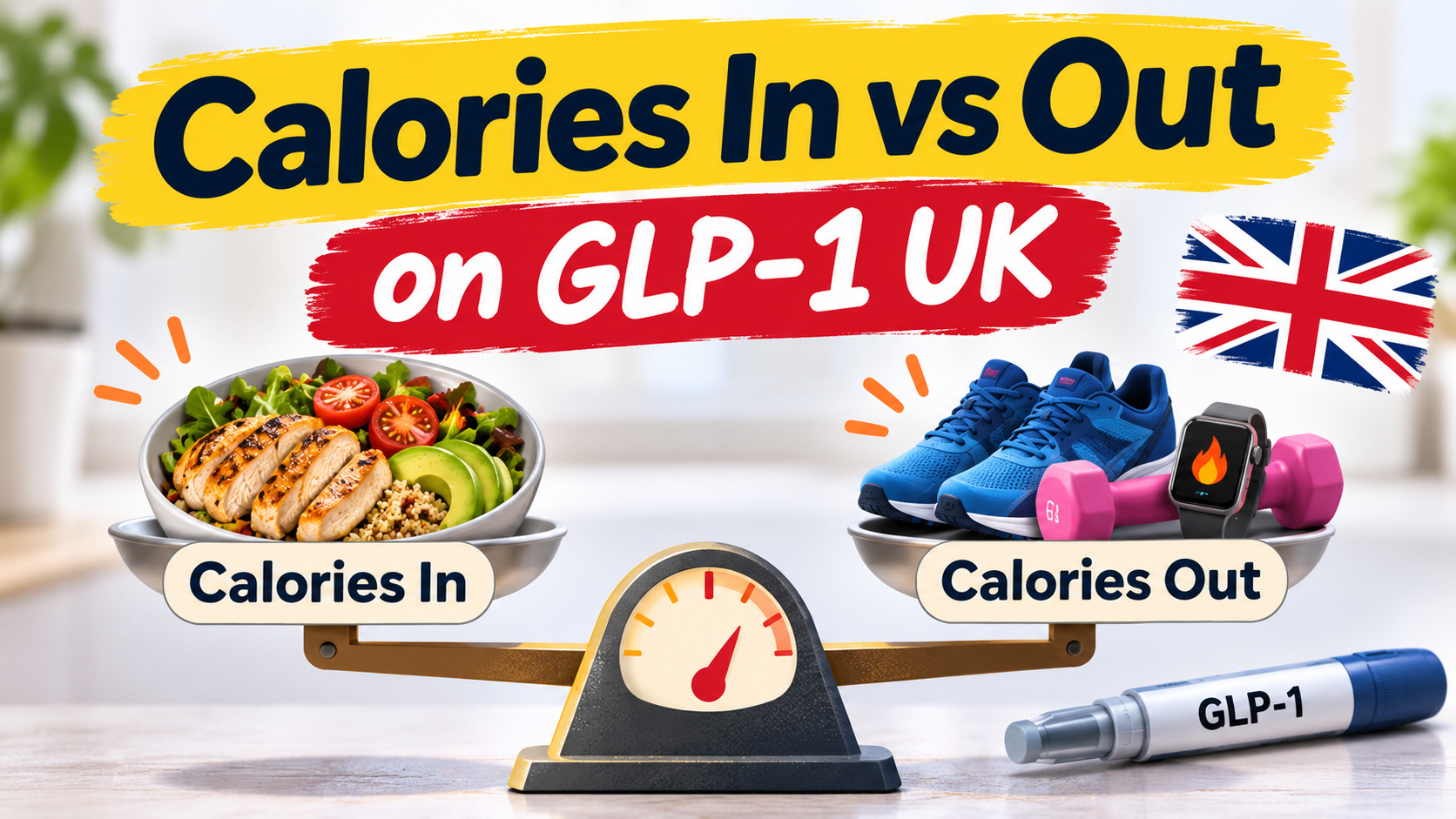
The standard calorie-in/calorie-out calculation doesn’t account for GLP-1 medication. Mounjaro and Wegovy change the calorie equation in three ways: they reduce intake through appetite suppression, they improve insulin sensitivity which changes how calories are partitioned between fat and muscle, and they alter the energy expenditure side through effects on brown adipose tissue activity. This guide explains what standard TDEE calculators get wrong for GLP-1 users, gives the corrected calculation for UK adults on treatment, and explains what to actually track versus what to ignore.
Track your actual intake: Cronometer free →
What TDEE calculators miss for GLP-1 users
Standard Total Daily Energy Expenditure (TDEE) calculators estimate your maintenance calories and apply a deficit from there. For GLP-1 users, three factors make this calculation less accurate:
1. Metabolic adaptation is faster on GLP-1. Rapid weight loss triggers metabolic adaptation — the body reduces resting metabolic rate as a defence against energy deficit. At GLP-1 rates of weight loss (15–22% in 72 weeks), this adaptation is significant. Standard calculators don’t account for adaptation that’s already occurred.
2. Improved insulin sensitivity changes calorie partitioning. Better insulin sensitivity means more dietary calories go toward lean tissue (muscle) and fewer toward fat storage, even at the same total calorie intake. A 1,400 kcal day with good insulin sensitivity produces better body composition outcomes than 1,400 kcal with poor insulin sensitivity — but a TDEE calculator treats both identically.
3. The deficit is already built in. GLP-1 medication creates the deficit through appetite suppression. Adding a manually calculated deficit on top risks going below the nutritional floor. The relevant calculation isn’t “what deficit should I create?” — it’s “am I eating enough to protect muscle?”
The GLP-1-adjusted calorie framework
Instead of TDEE minus deficit, use this three-number framework:
| Number | What it is | How to find it |
|---|---|---|
| Floor | Minimum safe daily intake | Women: 1,000–1,100 kcal; Men: 1,200–1,400 kcal |
| Target | Optimal intake range for fat loss + muscle preservation | Women: 1,200–1,500 kcal; Men: 1,500–1,800 kcal |
| Ceiling | Above this, weight loss stops | Calculate via TDEE estimate; typically 1,800–2,200 kcal |
For most GLP-1 users, the medication naturally lands you in the Target range. The monitoring role is ensuring you’re above the Floor — not creating additional deficit.
Your estimated TDEE on GLP-1 (corrected for adaptation)
Use this adjusted table rather than a standard calculator. It applies a 10–15% metabolic adaptation downward correction appropriate for users 6+ months into active GLP-1 weight loss:
| Body weight (current) | Sedentary | Lightly active (daily walking) | Active (training 3×/week) |
|---|---|---|---|
| 60 kg | 1,450–1,550 kcal | 1,600–1,750 kcal | 1,800–2,000 kcal |
| 75 kg | 1,650–1,800 kcal | 1,850–2,050 kcal | 2,100–2,350 kcal |
| 90 kg | 1,850–2,000 kcal | 2,100–2,300 kcal | 2,350–2,600 kcal |
| 110 kg | 2,100–2,300 kcal | 2,350–2,600 kcal | 2,650–2,950 kcal |
| 130 kg | 2,350–2,550 kcal | 2,650–2,900 kcal | 3,000–3,300 kcal |
Your daily intake on GLP-1 will typically be 500–800 kcal below these estimates — that’s the medication-generated deficit. The role of tracking is ensuring you stay above the Floor, not enforcing a specific deficit.
What to actually track vs what to ignore
Track these (meaningful and actionable):
- Daily protein (grams) — the most important number. Set a gram target in Cronometer and monitor weekly average
- Weekly average total calories — check that you’re above the Floor; don’t try to hit an exact daily number
- Fibre (30g daily target) — constipation management
- Monthly micronutrient check — iron, B12, zinc, magnesium, vitamin D
Don’t obsess over these:
- Exact daily calorie numbers — the medication handles this; daily fluctuations are normal
- Specific carbohydrate and fat percentages — protein adequacy matters far more than macro ratios
- Exercise calorie compensation — unless already below Floor, don’t eat more to replace walking calories
The walking pad calorie interaction
Daily walking adds 140–300 kcal of expenditure (see Walking Pad Calories Burned UK). This increases the effective deficit by 140–300 kcal — which is the intended effect. You don’t need to eat these calories back unless your total daily intake is already near or below the Floor.
Use Cronometer‘s exercise diary to log walking pad sessions. The app automatically adjusts your calorie “remaining” figure based on exercise. If this pushes you above the Floor but below the Target range, you’re in the right zone.
The protein calculation matters more than the calorie calculation
For GLP-1 users, focusing on protein grams is more impactful than focusing on total calories. Why: protein adequacy determines whether weight lost comes from fat (good) or muscle (bad). Total calories determine whether weight is lost at all. Since the medication handles total calorie control, protein is the lever with the most available impact.
Full protein guide: Protein Calculator UK. Full protein audit: Am I Eating Enough Protein on Mounjaro UK.
Micronutrient quality inside the calories
At 1,200–1,500 kcal daily, getting all essential micronutrients from food alone is very difficult. The free Lily & Loaf lifestyle analysis identifies which nutrients are most likely to be deficient in your specific eating pattern and symptom profile — fill the nutritional gaps efficiently rather than trying to address every potential deficiency from a generic list.
The science behind why calorie quality matters as much as calorie quantity — why 1,200 kcal of protein and vegetables produces better outcomes than 1,200 kcal of mixed food — is the subject of several excellent audiobooks. Start your free Audible trial → and try The Obesity Code or The Glucose Revolution for the most accessible UK-relevant treatment of this topic.
Frequently asked questions
How many calories should I eat per day on Mounjaro?
The medication creates the deficit automatically. Monitor that you’re above the minimum floor (1,000–1,100 kcal for women, 1,200–1,400 kcal for men) and that protein is at target. Let the medication set the deficit; focus on nutritional quality within it. See Calorie Deficit on Mounjaro UK.
Should I count calories on a GLP-1?
Track protein (in Cronometer) as your primary metric. Calories are worth monitoring to ensure you’re above the Floor, not as the primary management tool. The GLP-1 manages calorie intake; you manage protein quality within whatever intake the medication produces. See How to Track Macros on Mounjaro UK.
Does exercise burn enough calories to matter on Mounjaro?
Walking consistently burns 40,000–90,000 extra calories annually — equivalent to 5–11kg of additional fat loss. Not from any single session, but from daily consistency. Combined with GLP-1 appetite suppression and resistance training for muscle preservation, daily walking is a meaningful contributor to total outcomes.
The practical monitoring routine for GLP-1 users
Rather than daily calorie obsession, a practical monitoring routine for GLP-1 users that takes approximately 10 minutes per week:
Daily (2 minutes): log meals in Cronometer. Check the protein bar is approaching target. Note anything unusually low.
Weekly (5 minutes): review the weekly average protein. Check that average calories are above the Floor. Note any days where intake dropped very low (below 800 kcal) — these need investigation rather than celebration.
Monthly (3 minutes): check the micronutrient summary for the past month. Flag anything consistently red. Act on it with dietary change or supplement.
This routine is less intensive than traditional calorie counting but more nutritionally comprehensive — it catches the protein gap and the micronutrient gaps that traditional calorie counting misses entirely. Combined with the Lily & Loaf lifestyle analysis (retaken every 3–6 months as symptoms evolve), it provides ongoing nutritional management that is genuinely adequate for most GLP-1 users without requiring obsessive daily tracking.
For the conceptual understanding of why the old calorie in/out model is incomplete — why insulin sensitivity, meal timing, and food quality affect outcomes beyond the calorie number — start your free Audible trial → and download The Obesity Code (Fung) or The Glucose Revolution (Inchauspé) to understand what GLP-1 medication is actually changing in your metabolism.
Do I need to eat more on training days to compensate for exercise?
Only if your total daily intake (food plus exercise calories logged in Cronometer) drops below your minimum floor. For most GLP-1 users, training sessions of 30–60 minutes don’t require additional eating because the medication-generated deficit already accounts for the variation. Where users consistently train at high intensity and feel depleted on training days, a small protein-focused addition (25g whey shake post-training) addresses the need without dramatically changing total calories. See Am I Eating Enough Protein on Mounjaro UK for the specific training-day protein picture.
The tables and framework in this guide provide a foundation. The specific numbers that apply to you — your actual TDEE, your actual intake, your actual protein average — come from logging in Cronometer. Theory tells you what to target; tracking shows you where you actually are. The gap between the two is where the actionable information lives. Start logging today; the first week of data will immediately show you whether you’re above the Floor, hitting the protein target, and in the right range. Everything flows from knowing those three numbers accurately.
The framework in this guide — Floor, Target, Ceiling — is simple enough to keep in mind without reference to a table after the first few weeks. Know your Floor (don’t go below it), aim for the Target range, and let the medication handle the deficit. Track protein as the quality metric within that framework. Everything else follows from those three numbers.
Discover more from Healthy Weight Loss GLP1
Subscribe to get the latest posts sent to your email.