
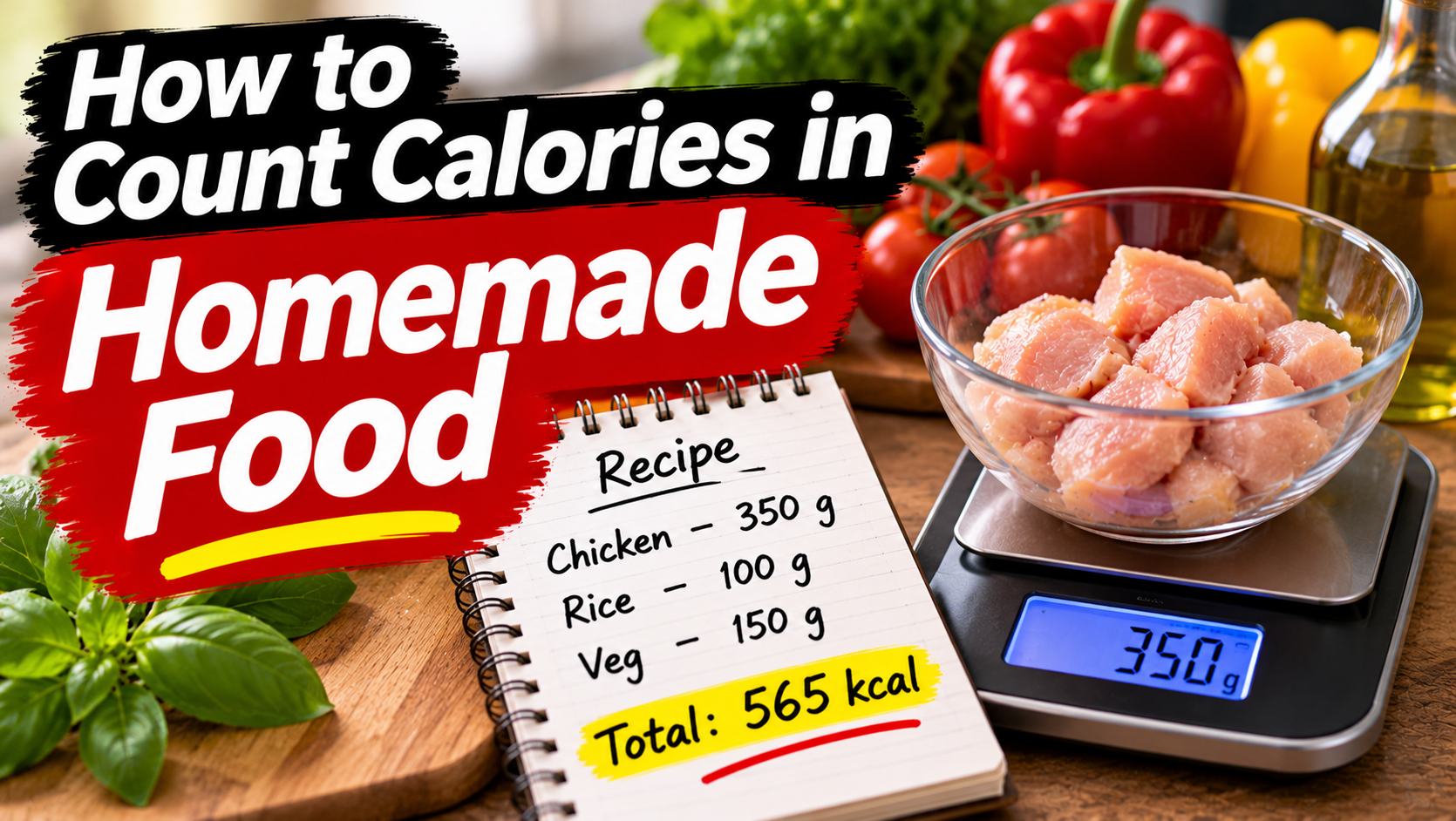
To count calories in homemade food, weigh each raw ingredient, add up their calories from the labels, weigh the finished dish, then divide to get calories per 100g or per portion. Do it once for a recipe you make often, save it, and you’ll never need to work it out again.
Last updated: 12 November 2026 · By Alan Spicer
Not medical advice. I share what has worked for me on GLP-1 medication and link the evidence. Talk to your GP or prescriber before changing your diet, medication or activity.
If you have, or have had, an eating disorder, speak to your GP before counting calories. Beat offers UK support.
Home-cooked food is the hardest thing to log, because there’s no barcode. The fix is a simple method you do once per recipe. I’ve laid out the steps with a worked bolognese using UK government food data, plus quick shortcuts in CaveCals for nights when the scales stay in the cupboard.
Why listen to me
I have been on GLP-1 medication since January 2024 and lost 7 stone in 18 months. I’m not a doctor or dietitian: I share what worked for me, what didn’t, and the evidence behind it. My day job is YouTube consulting, which you can read about on alanspicer.com.
⚡ QUICK ANSWER
To count calories in homemade food, weigh each raw ingredient and add up their calories, weigh the whole cooked dish, then divide total calories by cooked weight to get calories per 100g. Weigh your portion and multiply. Save the recipe in your calorie app so it’s one tap next time.
How do you count calories in homemade food?
You count calories in homemade food by adding up the raw ingredients, weighing the finished dish and dividing. It sounds fiddly, but you only do it once per recipe.
- Weigh the empty pan or dish and note it down.
- Weigh each raw ingredient as you add it and note the calories from its label.
- Add up the calories of all the ingredients.
- Weigh the finished dish in the pan, then subtract the pan’s weight.
- Divide total calories by cooked weight and multiply by 100 to get calories per 100g.
- Weigh your portion and multiply by the calories per gram.
Save the result as a recipe or saved meal in your app, and it’s one tap from then on.
Worked example: homemade bolognese
Here’s a simple bolognese worked out with UK government food data (CoFID). Your brands will differ slightly, so use your own labels where you can.
| Ingredient (raw) | Weight | kcal per 100g (CoFID) | Calories |
|---|---|---|---|
| Beef mince, raw | 500g | 225 | 1,125 |
| Onions, raw | 150g | 35 | 53 |
| Tomatoes, canned | 800g | 19 | 152 |
| Garlic, raw | 10g | 98 | 10 |
| Oil | 1 tablespoon | Check your bottle’s label | Add it |
| Total (before oil) | 1,340 |
Source: McCance and Widdowson’s Composition of Foods Integrated Dataset 2021 (Public Health England); quantities are a worked example.
Say the finished sauce weighs 1,300g once cooked (weigh yours: it depends how long you reduce it). That’s 1,340 ÷ 1,300 = about 103 calories per 100g, before the oil. A 325g portion is about 335 calories. Add 75g of dried pasta at about 343 calories per 100g (CoFID), roughly 257 calories, and the plate is about 592 before oil and cheese.
Swap regular mince for extra-lean (about 130 calories per 100g raw in CoFID) and the sauce drops to roughly 865 calories in total.
Save it once, log it forever
In CaveCals you can build a saved meal from what you’ve logged, a photo, your voice or by hand, then log it with one tap. Recipe import from a link or photos is part of Cave Cals+.
Free on iPhone and Android. iPhone code ALANSPICER: one month free on the yearly plan.
Should you weigh ingredients raw or cooked?
Weigh ingredients raw when you’re adding up a recipe, because most labels and food databases give raw values. Then weigh the finished dish, because that’s what you’ll portion out.
| Food | Weigh it… | Why |
|---|---|---|
| Pasta and rice | Dry, before cooking | Labels show dry values; cooked weight varies with water |
| Meat | Raw | Loses water when cooked, so cooked weight varies |
| Sauces and stews | Whole pot, cooked | To split the total into portions |
| Oil and butter | Measured with a spoon or scales | Small amounts, lots of calories |
What do people forget when counting homemade food?
The thing people forget most is cooking fat. A spoon of oil or a knob of butter adds a noticeable amount of calories, and it disappears into the food, so photos and guesses miss it too.
- Oil and butter used for frying.
- Cheese grated on top.
- Stock cubes, sauces and pastes.
- Bits eaten while cooking.
- Second helpings from the pot.
What are the quick ways to log home cooking?
If you’re not weighing, a photo or a voice description is the next best thing. Neither is exact, but both are far better than not logging.
| Method | How | Accuracy |
|---|---|---|
| Weigh and calculate | The six steps above | Highest |
| Saved meal | Log a recipe you’ve calculated once | High, and one tap |
| Recipe import (Cave Cals+) | From a link, photos or pasted text, saved per serving | High if the recipe matches what you cooked |
| Photo (Meal Scan) | Snap the plate, check the portions | Moderate; add oil yourself |
| Voice Log | Describe the meal and amounts | Depends how specific you are |
Meal Scan has been a life changer for me on home-cooked plates: I take a picture and it works out the foods, calories and macros. Voice Log is my favourite: I describe the meal like I’m telling a friend and it does the rest. A 2023 review found AI photo estimates ranged from 0.10% to 38.3% off measured values, so check portions before you save.
How do you portion meal prep?
You portion meal prep by weighing the whole batch once cooked and dividing it into equal tubs. If the batch has 1,800 calories and you split it into four equal portions by weight, each is 450 calories.
Label each tub with the calories, or save it as a saved meal in your app. When you eat one, it’s a single tap. Meal prep makes calorie counting much easier because you do the maths once for several meals.
How much protein is in your homemade meal?
Work out protein the same way as calories: add up the protein in each raw ingredient and divide by portions. In the bolognese above, 500g of raw mince at about 19.7g protein per 100g (CoFID) gives roughly 99g of protein across the whole sauce.
Most calorie apps add protein up for you as you log the ingredients. If you’re on GLP-1 medication with a small appetite, protein per portion is worth knowing. My protein calculator gives you a daily target to aim for.
Home cooking, logged in seconds
Snap your plate, say what you made or log a saved meal in CaveCals. Free to download, no account needed.
Free on iPhone and Android. iPhone code ALANSPICER: one month free on the yearly plan.
How do you get started this week?
Pick the two or three meals you cook most and calculate them properly this week. Those few recipes probably cover most of your home cooking, and once they’re saved, logging becomes quick.
If you’re new to all of this, my beginner’s guide to counting calories explains how to set a target first, and the photo calorie counter guide covers logging without scales.
Your homemade-food plan for this week
- Weigh the empty pan before you cook
- Weigh and log every raw ingredient, including oil
- Weigh the finished dish and work out calories per 100g
- Save it as a meal so next time it’s one tap
People also ask
How do you calculate calories in a homemade meal?
Add up the calories of every raw ingredient, weigh the cooked dish, and divide total calories by the cooked weight to get calories per gram. Multiply by the weight of your portion.
Should I weigh food raw or cooked for calories?
Weigh ingredients raw when you add up a recipe, because labels give raw values. Then weigh the finished dish so you can work out calories per portion of the cooked food.
How do I count calories in soup or stew?
Use the same method: total the raw ingredients, weigh the whole pot when cooked (subtract the pan’s weight), and work out calories per 100g. Ladle your portion into a bowl on the scales.
Is there an app that calculates recipe calories?
Yes. CaveCals’ recipe import (Cave Cals+) saves a recipe per serving from a link, photos or pasted text, and you can build saved meals for free from what you’ve logged.
Frequently asked questions
Why weigh the cooked dish?
Cooking changes weight: water evaporates from sauces and pasta absorbs water. Weighing the finished dish lets you split the total calories accurately, however much the weight changed.
How do I subtract the weight of the pan?
Weigh the empty pan before you start and write it down, or weigh the pan with food and subtract. Many digital scales have a tare button that zeroes the pan’s weight.
What if I don’t weigh anything?
Take a photo and use an app estimate, or log your best guess of each ingredient. It’s less accurate, but logging something is better than skipping the meal.
Do cooking oil calories count?
Yes, and they’re easy to forget. Oil is high in calories, so measure it with a spoon and check the bottle’s label for calories per tablespoon.
How do I count calories for a recipe I share with my family?
Work out the whole dish’s calories and cooked weight, then weigh just your portion. Everyone else can eat as much as they like without affecting your figure.
Are food label calories accurate for raw ingredients?
UK labels follow Food Standards Agency rules and give a reliable figure per 100g. Use the label of the exact product where you can, as brands differ.
How long does it take to count a recipe?
About five extra minutes the first time. After that, save it as a recipe or saved meal and it takes one tap.
What’s the easiest way to log a home-cooked dinner?
A photo or voice log. In CaveCals you can snap the plate with Meal Scan or describe it with Voice Log and check the estimate, which takes seconds.
Final thoughts
Counting calories in homemade food takes one extra step: weigh the raw ingredients, weigh the cooked dish and divide. Do it once for each regular recipe, save it, and your home cooking is as easy to log as anything with a barcode.
On nights when weighing isn’t happening, a photo or a quick voice description gets you close. Download CaveCals free to save your recipes as meals and log the rest by photo or voice.
About Alan Spicer
I have been on GLP-1 medication since January 2024 and lost 7 stone in 18 months. I write about what works day to day: protein, calorie tracking, walking and side effects, with the evidence linked. I’m not a medical professional, so please speak to your GP before making changes. Away from this site I’m a YouTube consultant (alanspicer.com) and I film my progress on Alan Spicer is Losing It.
Related reading
- How to Count Calories for Beginners (UK Guide)
- Photo Calorie Counter App UK: Log Food by Taking a Picture
- How to Use CaveCals: Set Up in 10 Minutes
- Best Calorie Tracker App UK (2026): Free and Paid Apps Compared
- CaveCals Review UK (2026): The Calorie Counter I Use
- Protein Calculator UK: Exactly How Much You Need by Weight and Age
SNAP IT. SAY IT. SCAN IT. FIND IT.
The calorie counter I use
CaveCals is free to download with no account needed. Barcode scanning, search and Quick Add are free, and you get 10 free photo and voice logs to try.
Get it on iPhone Get it on Android
iPhone code ALANSPICER: one month free on the yearly plan. Calorie plans and AI results are estimates, not medical advice.
Sources: [1] McCance and Widdowson’s Composition of Foods Integrated Dataset 2021 (CoFID), Public Health England. [2] Food Standards Agency: Packaging and labelling. [3] Shonkoff E et al. AI-based digital image dietary assessment, Annals of Medicine 2023. [4] NHS: Understanding calories.
Disclosure: some links on this page are affiliate links (including CaveCals). If you sign up or buy, I may earn a commission at no extra cost to you. I only recommend what I use or would use. Programme terms change, so check current terms on each site.
Discover more from Healthy Weight Loss GLP1
Subscribe to get the latest posts sent to your email.