
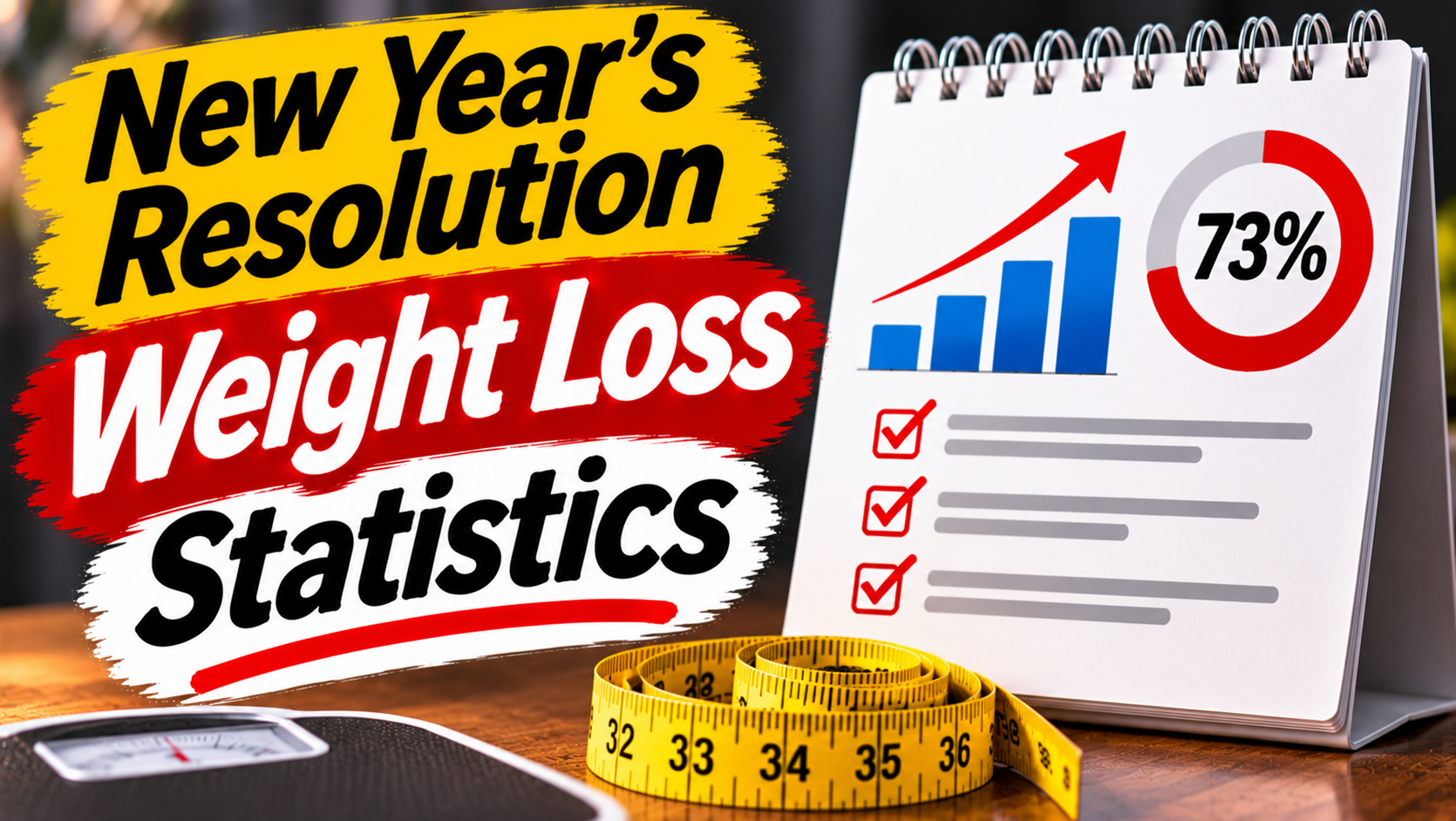
19% of Britons said they’d make a New Year’s resolution for 2026, and 17% of those planned to lose weight, according to YouGov. Of people who made resolutions for 2025, 38% kept all of them and 24% kept none. Meanwhile 64% of adults in England are overweight or living with obesity, and about 1.6 million British adults used GLP-1 medication for weight loss.
Last updated: 14 November 2026 · By Alan Spicer
Not medical advice. I share what has worked for me on GLP-1 medication and link the evidence. Talk to your GP or prescriber before changing your diet, medication or activity.
If you have, or have had, an eating disorder, speak to your GP before counting calories. Beat offers UK support.
Weight loss is one of the most common New Year’s resolutions in the UK, and one of the most commonly dropped. I’ve pulled together the latest figures from YouGov, the government’s obesity data and recent research on GLP-1 use and food logging, with every source linked, so you can see the real picture behind January’s good intentions.
Why listen to me
I have been on GLP-1 medication since January 2024 and lost 7 stone in 18 months. I’m not a doctor or dietitian: I share what worked for me, what didn’t, and the evidence behind it. My day job is YouTube consulting, which you can read about on alanspicer.com.
⚡ QUICK ANSWER
19% of Britons said they’d make a resolution for 2026, and among them 17% planned to lose weight, 23% to get fit or exercise more and 11% to eat more healthily (YouGov, December 2025). Of those who made 2025 resolutions, 38% kept all, 33% kept some and 24% kept none.
How many Britons make New Year’s resolutions about weight?
19% of Britons said they’d make a New Year’s resolution for 2026, and among them 17% planned to lose weight, according to YouGov’s December 2025 survey. Health goals topped the list: 23% planned to get fit or exercise more and 11% to eat more healthily.
19%
of Britons planned a resolution for 2026
17%
of resolvers planned to lose weight
38%
of 2025 resolvers kept all their resolutions
64%
of adults in England overweight or living with obesity
Sources: YouGov Dec 2025; OHID Obesity Profile May 2024.
What were the top New Year’s resolutions for 2026?
Health pledges topped the UK’s resolutions for 2026, according to YouGov. Here are the top resolutions among people who planned to make one:
| Resolution | Share of resolvers |
|---|---|
| Get fit or exercise more | 23% |
| Lose weight | 17% |
| Eat more healthily | 11% |
| Be “more healthy” (non-specific) | 10% |
| Save more or spend less | 7% |
| Be a better person | 5% |
| Improve financial management | 4% |
| Spend more time with loved ones | 4% |
| Find or change jobs | 4% |
Source: YouGov, What New Year’s resolutions are Britons making for 2026?, 17 December 2025.
How many people keep their New Year’s resolutions?
Of Britons who made resolutions for 2025, 38% said they kept all of them, 33% kept some and 24% kept none, according to YouGov’s December 2025 survey. In a separate January 2025 survey, 26% said they stick to their resolutions all year.
| Outcome for 2025 resolutions | Share |
|---|---|
| Kept all of them | 38% |
| Kept some but not all | 33% |
| Kept none | 24% |
Source: YouGov, 17 December 2025 (base: the 11% who said they made resolutions for 2025).
Who makes New Year’s resolutions?
Younger adults are far more likely to make resolutions. YouGov found 37% of 18–24-year-olds planned resolutions for 2026, compared with 11% of people over 65.
A January 2025 YouGov survey found 29% had set resolutions for 2025, with improving physical health the most common (66%). The two surveys were run at different times with different wording, so they shouldn’t be read as a trend.
Make your resolution measurable
Track what you eat for a week in CaveCals and turn “lose weight” into numbers you can work with. Free, with no account needed.
Free on iPhone and Android. iPhone code ALANSPICER: one month free on the yearly plan.
How many people in the UK are overweight?
In 2022 to 2023, 64.0% of adults in England were overweight or living with obesity, and 26.2% were living with obesity, according to the government’s Obesity Profile (OHID, May 2024). The share has trended up from 61.2% in 2015 to 2016.
| Measure (England, 2022 to 2023) | Figure |
|---|---|
| Adults overweight or living with obesity | 64.0% |
| Adults living with obesity | 26.2% |
| Men overweight (including obesity) | 69.2% |
| Women overweight (including obesity) | 58.6% |
| Highest rates: ages 55–64 (overweight / obese) | 72.8% / 32.4% |
Source: OHID Obesity Profile, short statistical commentary, May 2024 (gov.uk).
How many people use GLP-1 medication for weight loss?
About 1.6 million adults in Great Britain (2.9%) used GLP-1 medication for weight loss in the year to early 2025, according to a UCL study of 5,260 adults published in BMC Medicine. A further 6.5% of non-users (about 3.3 million) were interested in using it within the next year.
The same study found 15% of recent users reported using a medication not licensed for weight loss in the UK. I’ve been on GLP-1 medication since January 2024 and lost 7 stone in 18 months; my results are my own and not a promise. Anyone considering it should speak to their GP or a regulated provider first. My post on counting calories on Mounjaro covers how food tracking fits alongside the medication.
What habits help people keep a weight loss resolution?
Food logging is one of the best-supported habits for keeping a weight loss resolution. A 2011 review of 22 studies found a consistent link between self-monitoring and weight loss, and the 2019 “Log Often, Lose More” trial found people who lost 10% or more logged in about 2.7 times a day, against 1.7 for those who lost less.
| Habit | Evidence |
|---|---|
| Logging food often | 2.7 vs 1.7 daily logins for bigger vs smaller losers (Harvey 2019) |
| Self-monitoring in general | Consistent link with weight loss across 22 studies (Burke 2011) |
| Cutting alcohol | A pint of 5% beer can be up to 222 calories (NHS) |
| Regular activity | NHS recommends 150 minutes of moderate activity a week |
Source: Harvey et al. 2019; Burke et al. 2011; NHS.
My New Year weight loss plan turns these into four weekly steps, and does calorie counting work? looks at the evidence in more detail.
Log often, without the effort
CaveCals logs food by photo, voice, barcode or typing, so logging several times a day takes seconds. Free on iPhone and Android.
Free on iPhone and Android. iPhone code ALANSPICER: one month free on the yearly plan.
What do these statistics mean for your resolution?
The statistics suggest that making a weight loss resolution is common, keeping it is harder, and small, trackable habits give you the best chance. Around four in ten people who make resolutions keep all of them, so plan for the ones that slip.
Pick one or two specific habits, such as logging every meal and walking daily, and track them weekly. My favourite way to keep logging quick is Voice Log in CaveCals: I tell it what I had and it turns it into food entries with calories and macros. If you’d like company, the January weight loss challenge works well with friends.
Turn your resolution into habits
- Choose one weight loss habit you can do daily
- Track it every day for four weeks
- Review your progress every Sunday
- Add a second habit only when the first feels easy
People also ask
What percentage of New Year’s resolutions are about weight loss?
Among Britons making resolutions for 2026, 17% planned to lose weight, 23% to get fit or exercise more and 11% to eat more healthily, according to YouGov (December 2025). Health pledges topped the list.
How many people keep their New Year’s resolutions?
Of Britons who made resolutions for 2025, 38% said they kept all of them, 33% kept some and 24% kept none, according to YouGov.
How many Britons make New Year’s resolutions?
YouGov found 19% of Britons intended to make resolutions for 2026. Younger people were far more likely: 37% of 18–24s compared with 11% of over-65s.
How many people in the UK are overweight?
In 2022 to 2023, 64.0% of adults in England were overweight or living with obesity, and 26.2% were living with obesity, according to the government’s Obesity Profile.
Frequently asked questions
What is the most common New Year’s resolution in the UK?
Health goals. In YouGov’s December 2025 survey, getting fit or exercising more (23%) was the top resolution among those making one, followed by losing weight (17%) and eating more healthily (11%).
Are fewer people making resolutions?
The surveys aren’t directly comparable. A January 2025 YouGov survey found 29% had set resolutions for 2025, while a December 2025 survey found 19% intended to make them for 2026. Timing and wording differ.
How long do people stick to resolutions?
In YouGov’s January 2025 survey, 26% said they stick to their resolutions all year long.
How many people in the UK use weight loss injections?
About 1.6 million adults in Great Britain (2.9%) used GLP-1 medication for weight loss between 2024 and early 2025, according to a UCL study in BMC Medicine. Another 3.3 million were interested.
Is obesity rising in England?
The share of adults overweight or living with obesity has trended up from 61.2% in 2015 to 2016 to 64.0% in 2022 to 2023, according to the government’s Obesity Profile.
Which age group is most likely to be overweight?
Adults aged 55 to 64 had the highest rates in 2022 to 2023: 72.8% overweight including obesity and 32.4% living with obesity.
Does tracking food help people keep weight loss resolutions?
Research links tracking with more weight loss. A 2019 trial found people who lost 10% or more logged in about 2.7 times a day against 1.7, and a 2011 review of 22 studies found a consistent link between self-monitoring and weight loss.
Can I use these statistics on my own site?
Yes, cite the original sources linked on this page (YouGov, gov.uk, BMC Medicine and PubMed) rather than this article, so readers can check the figures.
Final thoughts
The numbers tell a clear story: health and weight loss top the UK’s New Year’s resolutions, but only around four in ten people who make resolutions keep all of them. Two-thirds of adults in England are overweight or living with obesity, and GLP-1 medication is now used by over a million people.
The habits that help people keep a weight loss resolution are small and measurable, with food logging near the top of the list. If you’re making one this year, start with a week of tracking: CaveCals is free and logs a meal by photo or one sentence.
About Alan Spicer
I have been on GLP-1 medication since January 2024 and lost 7 stone in 18 months. I write about what works day to day: protein, calorie tracking, walking and side effects, with the evidence linked. I’m not a medical professional, so please speak to your GP before making changes. Away from this site I’m a YouTube consultant (alanspicer.com) and I film my progress on Alan Spicer is Losing It.
Related reading
SNAP IT. SAY IT. SCAN IT. FIND IT.
The calorie counter I use
CaveCals is free to download with no account needed. Barcode scanning, search and Quick Add are free, and you get 10 free photo and voice logs to try.
Get it on iPhone Get it on Android
iPhone code ALANSPICER: one month free on the yearly plan. Calorie plans and AI results are estimates, not medical advice.
Sources: [1] YouGov: What New Year’s resolutions are Britons making for 2026? (17 Dec 2025). [2] YouGov: Physical health tops 2025 New Year’s resolutions for Britons (17 Jan 2025). [3] OHID Obesity Profile, short statistical commentary, May 2024. [4] Jackson S et al. GLP-1 use for weight loss in Great Britain, BMC Medicine 2026. [5] Harvey J et al. Log Often, Lose More, Obesity 2019. [6] Burke LE et al. Self-monitoring in weight loss, J Am Diet Assoc 2011. [7] NHS: Calories in alcohol.
Disclosure: some links on this page are affiliate links (including CaveCals). If you sign up or buy, I may earn a commission at no extra cost to you. I only recommend what I use or would use. Programme terms change, so check current terms on each site.
Discover more from Healthy Weight Loss GLP1
Subscribe to get the latest posts sent to your email.