

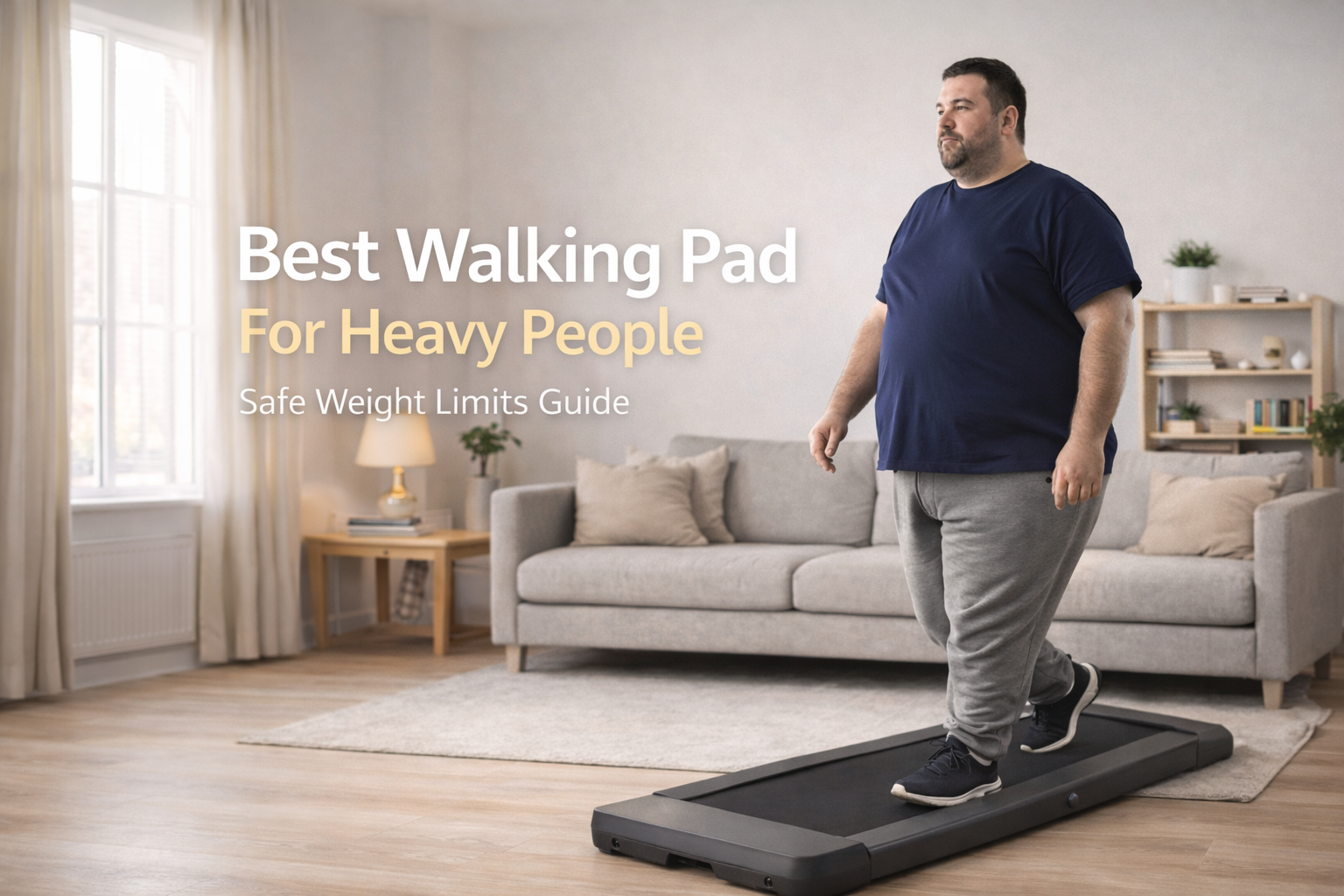
Best Walking Pad for Heavy People in the UK (Safe Weight Limits Guide)
The best walking pad for heavy people in the UK is one with a stable frame, sensible safety margin, and a weight limit that comfortably exceeds your current body weight. For many heavier buyers, that means avoiding the lightest budget models and focusing on sturdier options such as the WalkingPad A1 Pro. If you are getting close to the upper end of walking-pad limits, a foldable treadmill can sometimes be the smarter buy.
This is one of those topics where the wrong machine can be frustrating fast. A walking pad that feels underbuilt, unstable, narrow, or pushed too close to its maximum capacity is far less likely to become part of a sustainable routine. A machine that feels steady and realistic for your size, room, and confidence level is much more likely to get used.
Jump to:
Why trust this guide?
I am not writing this as someone who has always found movement easy. I started my serious weight-loss journey after reaching around 27 stone, and one of the biggest mindset shifts for me was realising that realistic movement matters more than fantasy exercise plans.
That is why this guide is not about pretending a tiny walking pad suits everybody. It is about helping you choose something safe, believable, and worth actually using. You can read more about me here, and if you want food support alongside home movement, there is also a free meal plan here.
Quick answer
If you are a heavier buyer, do not choose purely on price or how slim the machine looks in photos. Choose based on weight capacity, stability, deck size, and how much safety margin you have above your current weight.
For many heavier users, the WalkingPad A1 Pro is the strongest premium walking-pad option because it offers one of the highest supported capacities in the current WalkingPad UK range, while still being compact enough for everyday home use.
If you are close to the upper limit of a walking pad, want more deck stability, or think you may eventually want light jogging rather than just walking, a foldable treadmill may be the smarter long-term purchase.
Best walking pads for heavy people: quick comparison
| Model | Best for | Weight capacity | My take | Link |
|---|---|---|---|---|
| WalkingPad A1 Pro | Best premium walking pad for heavier users | Up to 136 kg | The safest WalkingPad-first recommendation for heavier buyers who still want true walking-pad convenience. | Check WalkingPad UK |
| WalkingPad R3 | Best if you want more treadmill-like flexibility | Up to 120 kg | A better fit for some buyers who want a hybrid feel, but not my first pick once you get close to the upper end. | See WalkingPad options |
| WalkingPad C2 | Best mid-range option for lighter heavy-user brackets | Up to 120 kg | Decent value, but more of a maybe than a blanket recommendation if you want extra reassurance. | View current models |
| WalkingPad X21 | Best for buyers who want a more treadmill-style feel | Up to 110 kg | Good machine, but not the main recommendation for heavier buyers because the capacity ceiling comes sooner. | Browse WalkingPad UK |
| Amazon heavy-duty foldable treadmill | Best fallback for higher-capacity needs | Varies by model | Worth checking if you are above the safer walking-pad bracket or want a wider, more stable deck. | See Amazon alternatives |
Can heavy people use a walking pad safely?
Yes, many heavy people can use a walking pad safely, but only if the machine is genuinely rated for their size and used with a sensible margin rather than right on the limit.
This is where a lot of advice online becomes too vague. Technically, a machine may list a maximum user weight, but that does not always mean it is the best choice if you sit very close to that number. In real life, heavier users usually benefit from more margin, more deck confidence, and more stability than the bare minimum.
That does not mean you need a giant gym treadmill. It just means you should be realistic. If a machine is meant to make movement easier, it should not feel like it is struggling, wobbling, or asking you to trust the spec sheet more than your own instincts.
Walking pad weight limits explained
Here is the practical version.
- Up to 100 kg: most mainstream walking pads are realistic options.
- 100 to 110 kg: you can still consider several walking pads, but it becomes more important to avoid the lightest, cheapest designs.
- 110 to 120 kg: you should start filtering much more aggressively by stated capacity and overall sturdiness.
- 120 to 136 kg: this is where premium, reinforced walking-pad options matter much more, and your shortlist becomes smaller.
- Above 136 kg: a walking pad may no longer be the smartest first recommendation. A sturdier foldable treadmill is often the safer route.
That is why I would not treat all walking pads as interchangeable. A lighter, ultra-budget model aimed at casual desk walking is not the same thing as a sturdier machine built to handle a higher-capacity buyer more confidently.
What actually matters more than just the number?
Weight limit is the headline, but it is not the whole story. Heavier buyers should also care about:
- Frame stability: does it feel planted or flimsy?
- Deck width and walking comfort: a little extra confidence underfoot matters.
- Motor quality: especially for regular daily use.
- Noise and vibration: important in flats and shared homes.
- How you will actually use it: short sessions, under-desk use, TV walking, step goals, or a bit of everything.
If your real goal is easy daily movement, a strong walking pad can be brilliant. If your real goal is “I want something that feels closer to a treadmill,” then pretending otherwise usually wastes money.
Best WalkingPad models for heavier users
1. WalkingPad A1 Pro — best overall for heavier buyers
If I were trying to keep this simple, this would be the main recommendation. The A1 Pro sits at the premium end of the WalkingPad walking-only line, and it is the model that makes the most sense for heavier users who still want true walking-pad convenience rather than a full treadmill footprint.
Why it works:
- higher supported capacity than lighter entry-level models
- compact and easier to live with than a treadmill
- better fit for sustainable walking habits at home
- stronger commercial logic than telling heavier buyers to gamble on the cheapest option
See the A1 Pro and current WalkingPad UK offers
2. WalkingPad R3 — best hybrid-style option if you want more versatility
The R3 makes more sense if you want something a little closer to treadmill territory rather than pure desk-walking simplicity. It can be a good middle-ground buy, especially if you want more flexibility in how you use it.
The catch is simple: if you are already buying from a heavier-user perspective, I would still put the A1 Pro ahead when your main goal is safe, everyday walking-pad use. The R3 becomes more compelling when your use case is broader, not just when your bodyweight is higher.
Browse WalkingPad treadmill-style models
3. WalkingPad C2 — decent value, but more conditional
The C2 is one of those machines that can work for the lower end of the “heavier buyer” category, but I would not automatically push it as the safest pick for everyone. It is more of a value option if you still want a genuine walking pad, but you also need to be honest about how close you are to the limit and how much reassurance you want.
If you want the safest recommendation rather than the cheapest one, the A1 Pro is still the cleaner answer.
4. Models I would be more cautious about for heavier buyers
The more compact or lower-capacity models can still be good products in the right context, but they are not the ones I would lead with for a heavier-user article. If you are choosing specifically because of bodyweight confidence, your shortlist should get narrower, not wider.
That does not mean models like the X21, Z1, or lighter walking pads are bad. It just means this article should not pretend they are the most obvious answer for everyone.
Best use-case recommendations by bodyweight bracket
Under 100 kg
You have the widest choice. Most walking pads are still on the table, so you can prioritise price, space-saving, or under-desk use.
100 to 110 kg
You can still choose from a decent number of walking pads, but this is where I would start valuing stronger builds over the cheapest deal.
110 to 120 kg
This is the zone where selection matters much more. Not every compact walking pad makes equal sense here. You want sturdier designs and a clearer safety margin.
120 to 136 kg
This is where I would focus hardest on WalkingPad’s stronger premium options and be much less interested in lightweight entry models. For many buyers in this range, the A1 Pro is the cleanest match.
Above 136 kg
At this point, I would seriously consider a foldable treadmill instead of forcing a walking pad to fit the brief. You want more stability, more confidence, and more room to grow into the machine.
When a foldable treadmill is the smarter buy
Sometimes the most honest recommendation is not “buy a walking pad anyway.”
If you are above the safer walking-pad bracket, want a wider belt, want something more stable underfoot, or suspect you will eventually want brisk walking and light jogging, a foldable treadmill may be the better long-term investment.
That is especially true if you are comparing what your ego wants with what your room can handle. A walking pad is brilliant when the goal is low-friction movement. A foldable treadmill is better when the goal is more support, more deck confidence, and more headroom.
Browse heavier-duty foldable treadmill alternatives on Amazon
And for the broader category decision, read Walking Pad vs Treadmill vs Foldable Treadmill.
Walking pad vs treadmill for heavier users
| Question | Walking Pad | Foldable Treadmill |
|---|---|---|
| Best for low-friction daily steps | Excellent | Good |
| Best for higher-capacity buyers | Limited shortlist | Usually stronger options |
| Best for under-desk use | Excellent | Sometimes |
| Best for small rooms | Excellent | Good |
| Best for confidence underfoot | Depends on model | Usually stronger |
| Best if you may want jogging later | No | Yes |
The key difference is not that one “burns more fat.” It is that one may be easier to use every day, while the other may feel more reassuring and future-proof if you need higher capacity and more deck confidence.
How much safety margin should you leave?
A practical rule of thumb is to avoid shopping right on the limit if you can help it.
If your bodyweight is very close to a walking pad’s maximum listed capacity, that machine may not be the most comfortable or confidence-building choice even if it technically qualifies. Heavier users usually benefit from some breathing room above their current weight rather than shopping to the absolute ceiling.
I would much rather see someone choose a slightly sturdier model with a little headroom than buy the cheapest option and spend every session wondering whether it feels underbuilt.
Can a walking pad still help with weight loss if you are heavier?
Yes, absolutely. Not because the machine itself is magic, but because walking is one of the easiest forms of movement to repeat consistently.
That is the big advantage. If a walking pad helps you add daily steps, reduce all-or-nothing thinking, and make movement feel possible at home, it can play a very useful role in a wider weight-loss routine.
That is also why I prefer a realistic, calm framing. If you are heavier, the smartest machine is often the one that helps you start, keep going, and avoid turning every session into a dramatic fitness event.
For more on that, read Can a Walking Pad Help You Lose Weight?.
What heavier buyers usually get wrong
- Buying the cheapest walking pad first. Budget matters, but for heavier users, bargain-first thinking can be expensive if the machine feels flimsy or limiting.
- Ignoring safety margin. Technically “within the limit” is not always the same as “best match.”
- Choosing for fantasy workouts instead of real routines. If your real goal is daily walking, buy for that.
- Assuming all walking pads are basically the same. They are not. Capacity, build, and comfort matter far more here.
- Forcing a walking pad when a treadmill would suit you better. Sometimes the more honest answer is to step up a category.
My honest recommendation
If you are a heavier user and want a true walking pad rather than a treadmill, I would start by looking at the WalkingPad A1 Pro. It is the cleanest WalkingPad-first recommendation for this use case because it offers a stronger, more confidence-building setup than the lightest compact options.
If you are getting close to the upper end of walking-pad limits, want more stability, or think your needs may grow, I would widen the shortlist to include foldable treadmills rather than trying to make an underbuilt walking pad do a bigger job than it should.
Check current WalkingPad UK options here
People also ask
What is the best walking pad for a heavy person?
The best walking pad for a heavy person is one with a high supported weight limit, stable frame, and enough safety margin above your current bodyweight. For many UK buyers, the WalkingPad A1 Pro is the clearest premium walking-pad option.
How much weight can a walking pad hold?
It varies by model. Some compact walking pads sit around 100 to 110 kg, while sturdier premium options can go higher. Always check the product page before buying.
Are walking pads safe for overweight people?
They can be, provided the model suits your bodyweight and use case. Heavier users should pay close attention to capacity, stability, and safety margin rather than treating all walking pads as interchangeable.
Is 120kg too heavy for a walking pad?
Not always, but it narrows your shortlist. At 120 kg, the machine choice matters much more, and budget models are less attractive than reinforced premium options or treadmill alternatives.
Is 130kg too heavy for a walking pad?
It depends on the model. At 130 kg, you are moving into a much more selective category, and many buyers may be better served by the strongest available walking-pad option or a foldable treadmill.
What happens if you exceed a walking pad’s weight limit?
You risk reduced stability, extra wear, poorer performance, and a less confidence-building experience. That is why it is better to choose with margin rather than at the absolute limit.

FAQ
Can heavy people use walking pads?
Yes, many can. The key is choosing a model with the right capacity, enough safety margin, and a build that feels steady and believable for everyday walking.
What walking pad weight limit should I choose?
Choose a model that sits comfortably above your current bodyweight rather than one that only just qualifies on paper.
Is a treadmill better than a walking pad for heavy users?
Sometimes. A treadmill can be the better choice if you want extra stability, a wider deck, higher capacity, or the option to progress beyond walking.
Can a walking pad help with weight loss if I am overweight?
Yes. Walking pads can support weight loss by helping you move more consistently, increase daily steps, and build sustainable routines at home.
Is under-desk walking realistic for heavier users?
It can be, but comfort, deck feel, desk setup, and speed expectations all matter. Some heavier buyers may prefer standard walking sessions over trying to work while walking straight away.
Should I buy a walking pad or a foldable treadmill?
Buy a walking pad if your main goal is simple daily movement in a small space. Buy a foldable treadmill if you need more stability, higher capacity, or more flexibility for future use.
Related reading
Friendly note: This article is based on product research, practical home-fitness decision making, and lived experience rather than personal medical advice. If you are managing pain, mobility issues, or a medical condition, speak to a qualified clinician before starting a new exercise routine.
Discover more from Healthy Weight Loss GLP1
Subscribe to get the latest posts sent to your email.

One thought on “Best Walking Pads for Heavy People: Safe Weight Limits Explained”
Comments are closed.