
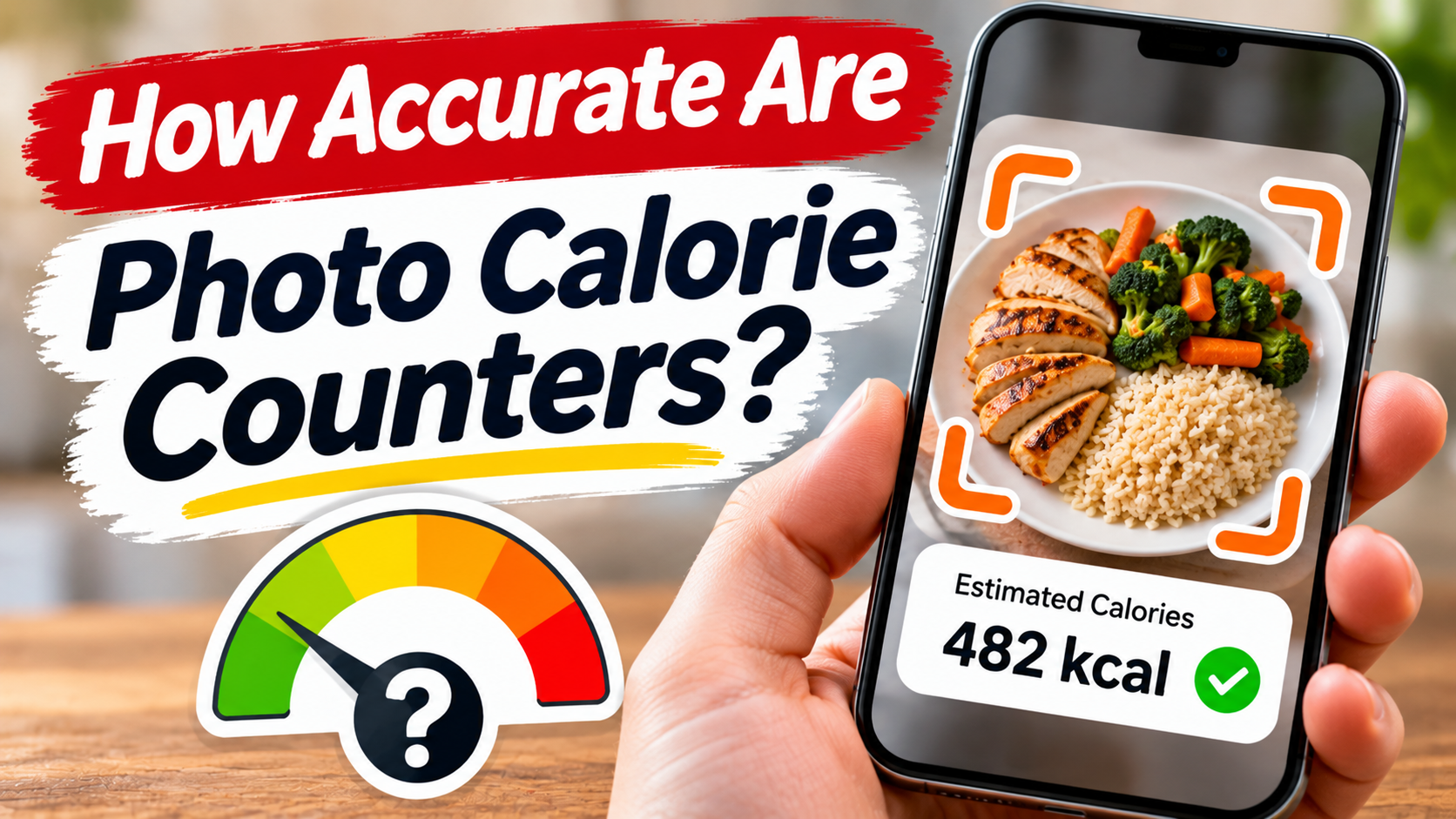
Photo calorie counters are accurate enough to be useful but not exact. A 2023 systematic review of 52 studies found AI calorie estimates from food photos were off by between 0.10% and 38.3% compared with measured values. You get closer by reviewing each estimate, adding hidden oils and sauces, and using barcodes for packaged food.
Last updated: 10 November 2026 · By Alan Spicer
Not medical advice. I share what has worked for me on GLP-1 medication and link the evidence. Talk to your GP or prescriber before changing your diet, medication or activity.
If you have, or have had, an eating disorder, speak to your GP before counting calories. Beat offers UK support.
Meal Scan in CaveCals has been a life changer for me: I take a picture of my meal and it works out what’s on the plate, the calories and the macros. But a photo is an estimate, so it’s worth knowing how far off these apps can be. Here’s what the research says, what trips the AI up, and how to make a photo estimate more accurate.
Why listen to me
I have been on GLP-1 medication since January 2024 and lost 7 stone in 18 months. I’m not a doctor or dietitian: I share what worked for me, what didn’t, and the evidence behind it. My day job is YouTube consulting, which you can read about on alanspicer.com.
⚡ QUICK ANSWER
Photo calorie counters give estimates, not exact figures. A 2023 systematic review of 52 studies found AI calorie estimates were off by between 0.10% and 38.3% compared with measured values. Accuracy is best for separate, visible foods and worst for hidden oils, sauces and mixed dishes, so review each estimate before saving.
How accurate are photo calorie counters?
Photo calorie counters are accurate enough to be useful but not exact. A 2023 systematic review in Annals of Medicine looked at 52 studies of fully automated AI methods that estimate food from photos, and found average calorie errors ranged from 0.10% to 38.3% compared with ground truth such as weighed food.
52
studies in the 2023 systematic review
0.10%
smallest average calorie error found
38.3%
largest average calorie error found
47%
average under-reporting by people guessing (1992 study)
Sources: Shonkoff et al. 2023; Lichtman et al. 1992.
A wide range like that tells you two things. The best systems get very close, and accuracy depends heavily on the food, the photo and the method. The authors couldn’t combine the studies into one figure because methods varied so much.
What does the research say about AI food photos?
The research says AI photo estimates can be very close or well off, and results vary widely between studies. The review screened 14,059 publications and kept 52 papers published between 2010 and 2023.
From the review: 79% of papers used a convolutional neural network (a common type of image AI) for detecting foods. Ground truth was most often calculated from nutrient tables (51%) or weighed food (27%). Errors for food volume (0.09% to 33%) were similar to errors for calories.
The takeaway for anyone using an app: the AI is a fast first draft, and your quick check turns it into a usable number.
Why do photo calorie estimates go wrong?
Photo calorie estimates go wrong mostly because of portion size and hidden ingredients. The camera sees the top of the plate, not how much oil was used or how deep the bowl is.
| Problem | Why it happens | Effect |
|---|---|---|
| Hidden oil and butter | Invisible after cooking | Estimate too low |
| Sauces and dressings | Mixed in or hidden under food | Estimate too low |
| Deep bowls | Depth is hard to judge from above | Portion too small |
| Mixed dishes (curry, stew, pasta bake) | Ingredients overlap | Wrong foods or amounts |
| Similar-looking foods | Full-fat vs light versions look the same | Wrong database match |
| Poor lighting or angle | Foods harder to identify | Missed or wrong items |
How do you make a photo estimate more accurate?
You make a photo estimate more accurate by taking a clear photo and spending ten seconds checking it. These habits fix most errors:
- Take the photo from directly above, before you start eating, in good light.
- Make sure each food is visible and not piled up.
- Review every food the app finds and correct any it got wrong.
- Adjust portions that look too small, especially in bowls.
- Add cooking oil, butter and sauces as separate items.
- Use the barcode scanner for anything packaged.
In CaveCals, every food from a Meal Scan comes up as an editable estimate, so this check takes seconds.
Snap, check, save
CaveCals Meal Scan identifies each food on your plate and lets you adjust the portion before saving. New users get 10 free scans.
Free on iPhone and Android. iPhone code ALANSPICER: one month free on the yearly plan.
Is a photo more accurate than guessing?
A photo estimate you check is far more accurate than guessing from memory. People are poor at estimating what they eat: in a 1992 NEJM study, people who said they couldn’t lose weight under-reported their food intake by 47% on average and over-reported exercise by 51%.
A photo captures what was on the plate at the time, which removes forgetting from the equation. That’s the main reason photo logging helps, even with its errors.
How does photo logging compare with other methods?
Photo logging sits between barcode scanning (most accurate for packaged food) and guessing (least accurate). Here’s how the main methods compare:
| Method | Accuracy | Speed | Best for |
|---|---|---|---|
| Barcode scan | High (label figures) | Very fast | Packaged food |
| Weighing and search | High | Slow | Home cooking when precision matters |
| Photo (Meal Scan) | Moderate; good once checked | Fast | Home-cooked plates, eating out |
| Voice log | Depends on how specific you are | Fast | Mixed meals, after eating |
| Guessing from memory | Low | Fast | Not recommended |
Voice Log is my favourite way to log in CaveCals: I tell it what I had and it turns that into entries with calories and macros. Being specific about amounts makes voice logging as useful as a photo.
Do you need accurate calories to lose weight?
You don’t need perfect calories to lose weight; you need consistent ones. A rough estimate logged every time is more useful than a precise log you keep skipping.
The 2019 “Log Often, Lose More” trial found people who lost 10% or more of their weight logged in about 2.7 times a day, against 1.7 times for those who lost less. Quick methods like photos make frequent logging realistic. If your weight stalls for a few weeks, weigh some meals to recalibrate.
Fast enough to log every meal
CaveCals has photo, voice, barcode and typing in one free app, with no account needed. Use whichever is quickest for each meal.
Free on iPhone and Android. iPhone code ALANSPICER: one month free on the yearly plan.
Which photo calorie app should you use?
Use the photo calorie app that lets you check and edit each food before saving, and doesn’t charge you just to try it. CaveCals gives 10 free Meal Scans, editable estimates and free barcode scanning; Cal AI’s listing says scan results need a subscription.
My photo calorie counter app guide compares the options, and the best calorie tracker app UK page covers ten apps side by side.
How to check photo accuracy yourself
- Weigh three home-cooked meals this week
- Photograph each one with Meal Scan before eating
- Compare the photo estimate with your weighed figure
- Note which foods the photo under- or over-estimates and adjust next time
People also ask
Are AI calorie counters accurate?
They’re accurate enough to be useful. A 2023 review of 52 studies found AI calorie estimates ranged from 0.10% to 38.3% away from measured values, so treat them as a starting point and adjust portions.
Is Cal AI accurate?
Cal AI estimates calories from photos, like other AI apps, so it has the same limits: hidden oils, sauces and mixed dishes are hardest. Its App Store listing says scan results need a subscription.
Are photo calorie apps more accurate than guessing?
Usually, yes. People are poor at guessing: in a 1992 study, people who struggled to lose weight under-reported what they ate by 47% on average. A photo estimate you check is a big step up from memory.
What foods are hardest for photo calorie apps?
Foods cooked in oil or butter, sauces, mixed dishes like curries and casseroles, and food in deep bowls. The camera can’t see fat or judge depth well.
Frequently asked questions
How do photo calorie counters estimate calories?
The app’s AI identifies each food in the photo, estimates its portion size from the image, then looks up calories and macros in a food database. The portion estimate is usually where errors come from.
Why is my photo calorie estimate too low?
The most common reason is hidden fat: cooking oil, butter and creamy sauces don’t show up in a photo. Deep bowls and stacked food also make portions look smaller than they are.
Is barcode scanning more accurate than a photo?
Yes, for packaged food. A barcode pulls the manufacturer’s label figures, while a photo has to estimate what’s on the plate. Use barcodes for packets and photos for meals.
Can I make CaveCals Meal Scan more accurate?
Yes. Take the photo from above in good light, review each food it finds, adjust portions, and add oils or sauces yourself. Every food from a Meal Scan is editable before you save it.
Do I need exact calories to lose weight?
No. Consistency matters more than precision. A 2019 trial found people who logged more often lost more weight, so a quick estimate you log every time beats a perfect log you keep skipping.
Are restaurant calorie figures more accurate than a photo?
Large food businesses in England have had to show calories on menus since April 2022, so where a menu lists calories, search for that item instead of relying on a photo.
Are photo estimates good enough on GLP-1 medication?
For most people, yes. On GLP-1 medication your portions may be small, so a few grams either way matters less than making sure you’re eating enough protein. Speak to your prescriber about your own targets.
Should I weigh food as well as using photos?
Weighing occasionally helps you calibrate. Weigh a few common meals for a week, compare with the photo estimates, and you’ll learn when to nudge a portion up or down.
Final thoughts
Photo calorie counters are accurate enough to be useful but not exact: the research range runs from almost spot on to more than a third out. The difference comes down to what you do after the photo.
Review every estimate, add hidden oils and sauces, and use the barcode scanner for packaged food. Do that and photo logging gives you a reliable picture in seconds. Try CaveCals Meal Scan free: new users get 10 free scans.
About Alan Spicer
I have been on GLP-1 medication since January 2024 and lost 7 stone in 18 months. I write about what works day to day: protein, calorie tracking, walking and side effects, with the evidence linked. I’m not a medical professional, so please speak to your GP before making changes. Away from this site I’m a YouTube consultant (alanspicer.com) and I film my progress on Alan Spicer is Losing It.
Related reading
- Photo Calorie Counter App UK: Log Food by Taking a Picture
- CaveCals Review UK (2026): The Calorie Counter I Use
- Best Calorie Tracker App UK (2026): Free and Paid Apps Compared
- Free Barcode Scanner Calorie Counter UK
- How to Count Calories for Beginners (UK Guide)
- Voice Calorie Tracker App: Log Food by Talking
SNAP IT. SAY IT. SCAN IT. FIND IT.
The calorie counter I use
CaveCals is free to download with no account needed. Barcode scanning, search and Quick Add are free, and you get 10 free photo and voice logs to try.
Get it on iPhone Get it on Android
iPhone code ALANSPICER: one month free on the yearly plan. Calorie plans and AI results are estimates, not medical advice.
Sources: [1] Shonkoff E et al. AI-based digital image dietary assessment methods compared to humans and ground truth: a systematic review, Annals of Medicine 2023. [2] Lichtman SW et al. Discrepancy between self-reported and actual caloric intake, NEJM 1992. [3] Harvey J et al. Log Often, Lose More, Obesity 2019. [4] Cal AI on the UK App Store. [5] CaveCals on the UK App Store.
Disclosure: some links on this page are affiliate links (including CaveCals). If you sign up or buy, I may earn a commission at no extra cost to you. I only recommend what I use or would use. Programme terms change, so check current terms on each site.
Discover more from Healthy Weight Loss GLP1
Subscribe to get the latest posts sent to your email.