
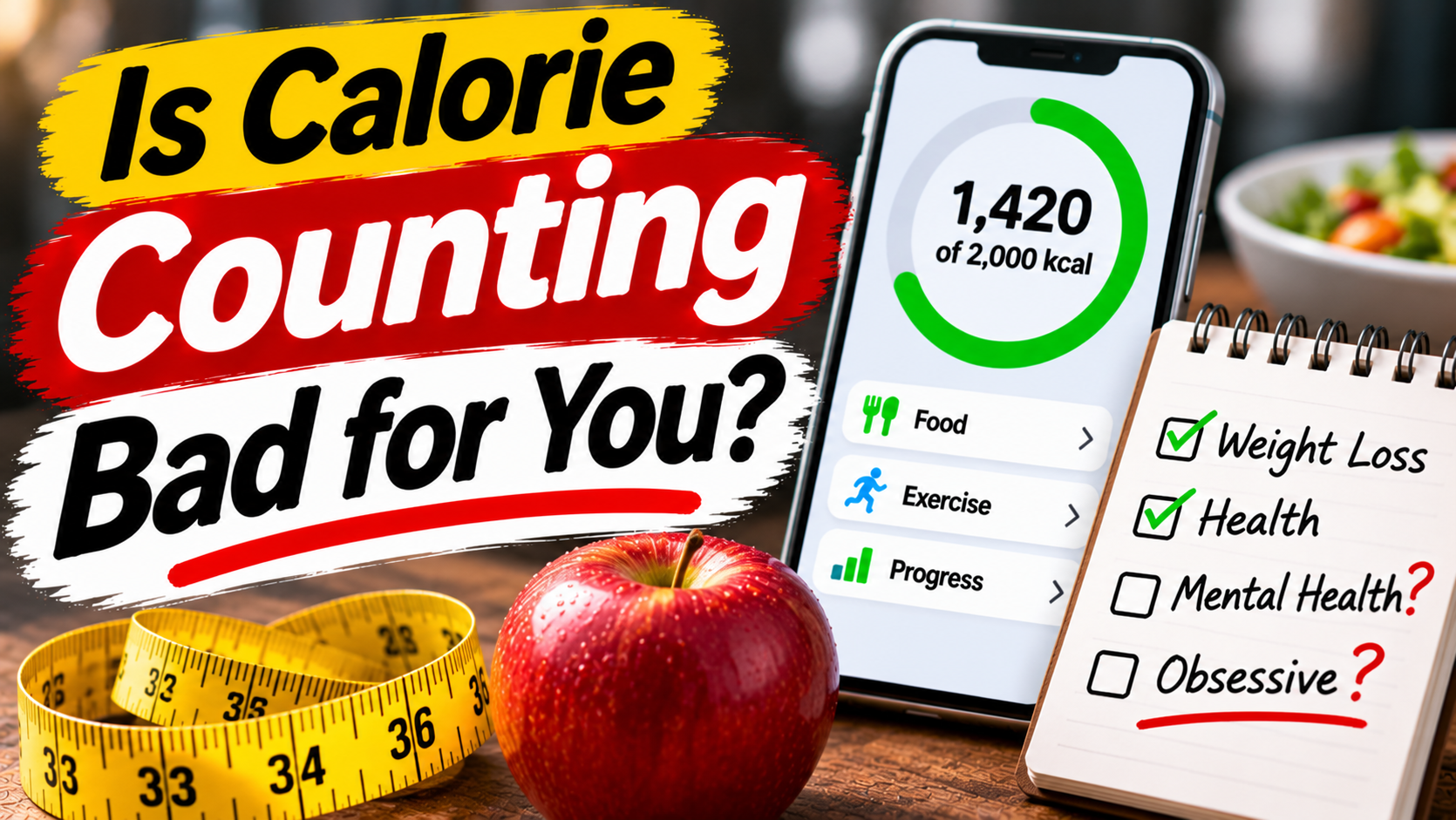
Calorie counting isn’t bad for most people: research links food logging with more weight loss, and it shows you what you’re really eating. But it isn’t right for everyone. Studies link calorie tracking with more eating concerns in some groups, so if counting makes you anxious or you have a history of disordered eating, speak to your GP first.
Last updated: 13 November 2026 · By Alan Spicer
Not medical advice. I share what has worked for me on GLP-1 medication and link the evidence. Talk to your GP or prescriber before changing your diet, medication or activity.
If you have, or have had, an eating disorder, speak to your GP before counting calories. Beat offers UK support.
I count calories now, alongside my GLP-1 medication, and I find it useful. But I also know it isn’t for everyone, and pretending otherwise wouldn’t be honest. Here’s what the evidence says about the benefits and the risks, and how to tell which side of the line you’re on.
Why listen to me
I have been on GLP-1 medication since January 2024 and lost 7 stone in 18 months. I’m not a doctor or dietitian: I share what worked for me, what didn’t, and the evidence behind it. My day job is YouTube consulting, which you can read about on alanspicer.com.
⚡ QUICK ANSWER
Calorie counting isn’t bad for most people and can help with weight loss: a 2011 review of 22 studies linked self-monitoring with weight loss. It can be harmful for some, especially anyone with a history of disordered eating. If counting makes you anxious, restrictive or obsessive, stop and speak to your GP.
Is calorie counting bad for you?
Calorie counting isn’t bad for most people, and it can help with weight loss by showing you what you’re really eating. It can be bad for some people, especially those with a history of disordered eating or who find it makes them anxious or restrictive.
Calorie counting means recording the energy in what you eat and drink. Whether that’s helpful or harmful depends much more on the person than on the method.
What are the benefits of calorie counting?
The main benefit of calorie counting is replacing guesswork with facts. A 2011 review of 22 studies found a consistent link between self-monitoring and weight loss, though the authors rated the evidence quality as weak.
22
studies in a 2011 review linking self-monitoring with weight loss
2.7
logins a day for people who lost 10% or more (vs 1.7)
47%
average under-reporting of food in a 1992 study
3.5m
people in the UK estimated to have an eating disorder (Beat)
Sources: Burke et al. 2011; Harvey et al. 2019; Lichtman et al. 1992; Beat.
People are poor at estimating what they eat: in a 1992 NEJM study, people who struggled to lose weight under-reported their food by 47% on average. Tracking closes that gap. I find it useful alongside my GLP-1 medication, and my video explains why I started.
VIDEO
Why I started calorie counting after 18 months on GLP-1 medication.
Can calorie counting cause an eating disorder?
Research links calorie tracking with more eating concerns in some groups, but it doesn’t prove that counting causes eating disorders. The studies are cross-sectional, which means they show an association at one point in time, not cause and effect.
What the studies found: in a 2017 study of 493 college students, those who used calorie trackers showed higher eating concern and dietary restraint, after accounting for BMI. A 2018 study of 902 US students found more frequent calorie counting and self-weighing, and lower intuitive eating scores, were linked with higher eating disorder severity.
Both studies were of students, mostly young adults, so they may not apply to everyone. They’re still a good reason to watch how counting makes you feel, especially if you’ve struggled with food before.
Who shouldn’t count calories?
People with a current or past eating disorder shouldn’t count calories without speaking to their GP first. That’s the clearest line. Beat’s best estimate is that about 3.5 million people in the UK are living with an eating disorder.
| Calorie counting may suit you if… | Think twice or talk to your GP if… |
|---|---|
| You want to know what you’re really eating | You have, or have had, an eating disorder |
| You can log without guilt or anxiety | Missing a log makes you anxious |
| You focus on weekly averages | You feel bad about any day over target |
| You eat socially without worrying | You avoid meals you can’t count |
| You see it as a short-term tool | Counting feels compulsive |
What are the signs counting isn’t working for you?
The warning signs are anxiety, rigidity and restriction. If any of these sound familiar, stop counting and speak to your GP:
- You feel anxious or guilty when you can’t log something.
- You turn down social meals because you can’t count them.
- You eat far below your target to “bank” calories.
- You think about numbers most of the day.
- You weigh yourself many times a day and feel worse for it.
Help is available. If counting calories is affecting your mood or your relationship with food, speak to your GP. Beat (beateatingdisorders.org.uk) offers UK support for anyone worried about eating.
How can you count calories in a healthy way?
You can count calories in a healthier way by keeping it quick, rough and time-limited. These habits help keep it a tool rather than a rule:
- Decide in advance how long you’ll count, such as two to four weeks.
- Look at weekly averages, not single days.
- Round numbers and don’t chase perfect accuracy.
- Make logging fast, so it doesn’t take over your day.
- Take days off, especially for social meals.
- Track something positive too, like protein or daily walks.
Fast logging helps more than you’d think. My favourite is Voice Log in CaveCals: I tell it what I had in a sentence and it does the rest. Meal Scan has been a life changer for me on home-cooked plates.
Quick, light, no guilt
If you want to try counting, CaveCals makes it fast: photo, voice, barcode or a typed number. It’s free, and you can stop whenever you like.
Free on iPhone and Android. iPhone code ALANSPICER: one month free on the yearly plan.
Is intuitive eating better than calorie counting?
Intuitive eating and calorie counting suit different people; neither is better for everyone. Intuitive eating means eating based on hunger and fullness cues rather than external rules, while calorie counting gives you numbers to work with.
Some people combine them: count for a few weeks to learn what portions look like, then ease off and eat more intuitively with that knowledge. If counting makes you anxious, intuitive eating or a simple food diary without numbers may suit you better.
Is calorie counting different on GLP-1 medication?
On GLP-1 medication, calorie counting is often more about eating enough than eating less. A small appetite can make it easy to fall short on protein, and tracking shows you whether that’s happening.
The same cautions apply: if you have a history of disordered eating, speak to your GP before counting. My post on counting calories on Mounjaro covers this in more detail, and does calorie counting work? looks at the evidence for weight loss.
If you decide to try counting
- Set a time limit, such as two weeks
- Log quickly and look at weekly averages only
- Notice how it makes you feel each day
- Stop and speak to your GP if it causes anxiety or restriction
People also ask
Is calorie counting unhealthy?
Not for most people. Logging food is linked with weight loss and shows you what you eat. It can become unhealthy if it leads to obsession, anxiety or eating too little, which is more likely for people with a history of disordered eating.
Can calorie counting cause an eating disorder?
Research shows an association, not proof of cause. Studies of college students found calorie tracking was linked with more eating concerns and restraint. If you’re at risk, or counting starts to feel compulsive, speak to your GP.
Is calorie counting good for mental health?
It depends on the person. For some it reduces worry by replacing guesswork with facts; for others it increases anxiety. Notice how it makes you feel after a week or two.
Is intuitive eating better than calorie counting?
Neither is better for everyone. Intuitive eating focuses on hunger and fullness cues; calorie counting gives numbers. Some people combine them, counting for a short time to learn portions and then easing off.
Frequently asked questions
What are the benefits of calorie counting?
It shows what you’re really eating, helps you learn portion sizes and gives you facts to work with if your weight stalls. Research consistently links self-monitoring with weight loss, though the evidence quality varies.
What are the risks of calorie counting?
For some people it can lead to obsession, anxiety around food, rigid rules or eating too little. Those risks are higher if you have, or have had, an eating disorder.
What are the signs calorie counting isn’t good for me?
Feeling anxious when you can’t log, avoiding social meals because you can’t count them, cutting calories far below your target, or feeling guilt about normal eating are all signs to stop and talk to your GP.
How many people in the UK have an eating disorder?
Beat’s best estimate is about 3.5 million children, young people and adults in the UK. Help is available through your GP and Beat.
Can I count calories without becoming obsessed?
Many people can. Count for a set period, focus on weekly averages rather than single days, round numbers, and take days off when you want to. Stop if it starts to feel compulsive.
Is it OK to count calories on GLP-1 medication?
For many people it’s a useful food diary, especially for checking protein on a small appetite. Speak to your prescriber about safe targets, and your GP if you have a history of disordered eating.
Do I need to count calories forever?
No. Many people count for a few weeks to learn portions, then check in occasionally. It’s a tool, not a life sentence.
What can I do instead of counting calories?
You can focus on protein and vegetables at each meal, use smaller plates, keep a simple food diary without numbers, or track weekly weigh-ins and how your clothes fit.
Final thoughts
Calorie counting isn’t bad for most people. It shows you what you’re really eating and research links it with weight loss. But it isn’t right for everyone, and it can do harm if it feeds anxiety or restriction.
If it helps you, keep it light: weekly averages, quick logging and no guilt. If it doesn’t, stop, and speak to your GP if you’re worried; Beat offers UK support. For those who want a quick, low-effort food diary, CaveCals is free and you can log a meal with a photo or one sentence.
About Alan Spicer
I have been on GLP-1 medication since January 2024 and lost 7 stone in 18 months. I write about what works day to day: protein, calorie tracking, walking and side effects, with the evidence linked. I’m not a medical professional, so please speak to your GP before making changes. Away from this site I’m a YouTube consultant (alanspicer.com) and I film my progress on Alan Spicer is Losing It.
Related reading
- Does Calorie Counting Work for Weight Loss? The Evidence
- How to Count Calories for Beginners (UK Guide)
- Do You Need to Count Calories on Mounjaro? (UK)
- Best Calorie Tracker App UK (2026): Free and Paid Apps Compared
- How to Stay Motivated to Lose Weight UK (2026): What Works Long Term
- Non-Scale Victories on GLP-1: What Real Progress Looks Like Beyond the Scales
SNAP IT. SAY IT. SCAN IT. FIND IT.
The calorie counter I use
CaveCals is free to download with no account needed. Barcode scanning, search and Quick Add are free, and you get 10 free photo and voice logs to try.
Get it on iPhone Get it on Android
iPhone code ALANSPICER: one month free on the yearly plan. Calorie plans and AI results are estimates, not medical advice.
Sources: [1] Burke LE et al. Self-monitoring in weight loss: a systematic review, J Am Diet Assoc 2011. [2] Harvey J et al. Log Often, Lose More, Obesity 2019. [3] Simpson CC, Mazzeo SE. Calorie counting and fitness tracking technology, Eating Behaviors 2017. [4] Romano KA et al. Self-weighing and calorie counting versus intuitive eating, Eat Weight Disord 2018. [5] Beat: How many people have an eating disorder in the UK?. [6] Lichtman SW et al. NEJM 1992.
Disclosure: some links on this page are affiliate links (including CaveCals). If you sign up or buy, I may earn a commission at no extra cost to you. I only recommend what I use or would use. Programme terms change, so check current terms on each site.
Discover more from Healthy Weight Loss GLP1
Subscribe to get the latest posts sent to your email.