
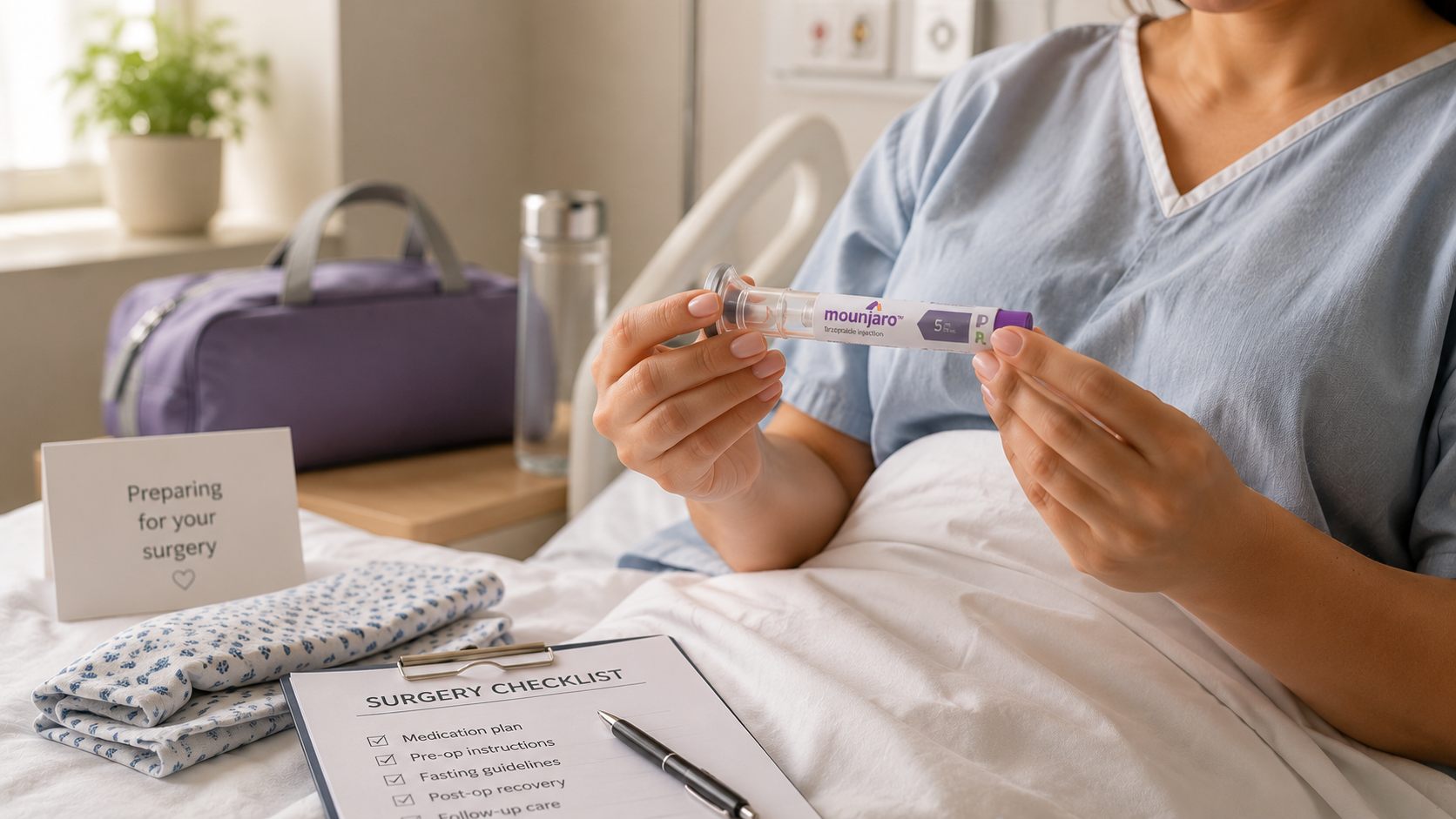
If you’re on Mounjaro and facing planned surgery, anaesthesia, or even dental sedation, you need to tell your surgical team and you likely need to pause the medication for 1–2 weeks before the procedure. The reason is retained stomach contents from slowed gastric emptying, which creates a meaningful aspiration risk during anaesthesia. This is a fast-moving area of guidance and UK anaesthesia bodies have issued specific recommendations that are worth understanding.
For the broader first-month context see First Month on Mounjaro UK. For the full GLP-1 picture: Complete GLP-1 Weight Loss Guide. Alan had an emergency cholecystectomy (gallbladder removal) while on Mounjaro in February 2026, which is part of why this post exists — the surgical team needed to know and it shaped the plan.
Why GLP-1s matter during anaesthesia
General anaesthesia relies on the stomach being empty at the time of surgery. The standard pre-operative fasting guidance (no solid food for 6 hours, clear fluids up to 2 hours before) assumes normal gastric emptying. Normal gastric emptying in a healthy adult clears solid food from the stomach within 4–6 hours.
GLP-1 medications slow gastric emptying substantially. At therapeutic doses, gastric emptying time can increase by 30–70%. Food that would normally have cleared within 4 hours may still be in the stomach 8–12 hours later. For some users the delay is even longer.
The surgical risk: if you have food or fluid in your stomach when anaesthesia is induced, the protective airway reflexes switch off, and stomach contents can travel up the oesophagus and into the lungs. This is aspiration pneumonia and it’s a serious complication. Standard pre-op fasting is designed to prevent it; with a GLP-1 slowing gastric emptying, standard fasting may not be enough.
The Association of Anaesthetists (UK) and the American Society of Anesthesiologists (US) have both issued specific guidance for GLP-1 users facing surgery — reflecting that this is a recognised clinical issue, not a theoretical concern.
Current UK guidance (as of early 2026)
Current UK anaesthesia guidance typically recommends:
For daily GLP-1s (e.g. Saxenda, liraglutide): Consider holding the medication on the day of surgery.
For weekly GLP-1s (Mounjaro, Wegovy, Ozempic, Zepbound): Consider holding the medication for at least 1 week before elective surgery; some surgical teams prefer 2 weeks, particularly for procedures requiring general anaesthesia.
For any urgent/emergency surgery: the surgical team treats you as if you have a full stomach regardless of fasting time — using rapid-sequence induction techniques and other precautions to minimise aspiration risk.
Specific guidance varies by hospital, anaesthetist, and procedure type. Always follow your specific surgical team’s instructions; they have your full medical picture.
Types of surgery this affects
All procedures requiring sedation or general anaesthesia:
- Major surgery (joint replacement, abdominal surgery, cardiac surgery) under general anaesthesia
- Day-case surgery (hernia repair, varicose veins, minor procedures) under general or regional anaesthesia
- Diagnostic procedures (gastroscopy, colonoscopy) under sedation
- Dental surgery under sedation (wisdom tooth extraction, implants, complex work)
- Cosmetic procedures under sedation or general anaesthesia
- Interventional radiology under sedation
- Some fertility treatments requiring sedation (egg retrieval)
Procedures under local anaesthesia only (no sedation, you’re fully awake) typically don’t require pausing GLP-1, because airway protection isn’t affected. Always confirm with your team.
The practical timeline
For elective surgery with a planned date:
4 weeks before surgery: Notify the surgical team that you’re on Mounjaro. Confirm the specific pause duration they recommend (likely 1–2 weeks). Confirm they’ve passed this information to the anaesthetist.
2 weeks before surgery (or 1 week, per your team’s instruction): Take your last dose of Mounjaro. Don’t take any further doses until after surgery and full recovery.
Week before surgery: Normal pre-op assessment. Blood tests, physical exam, any other checks. Confirm at this point that you’re following the medication pause instruction.
24 hours before surgery: Standard fasting rules begin — usually no solid food from midnight (or earlier per specific instruction), clear fluids up to 2 hours before (or per your specific instructions).
Day of surgery: Arrive as instructed. Tell the pre-op nurse, anaesthetist, and surgeon again that you’ve been on Mounjaro and when your last dose was. Repetition of this information is your safety net.
Day of surgery onwards: Don’t restart Mounjaro until your surgical team has cleared you. Usually 1–2 weeks post-op, depending on recovery.
Restarting after surgery
Post-operative restart guidance varies:
- For minor procedures with fast recovery: typically resume at your normal dose after 7–14 days, following surgical team clearance
- For major surgery: may need longer pause, 2–4 weeks, depending on recovery and any complications
- After significant gastrointestinal surgery (bowel resection, major abdominal work): your surgeon may want a longer pause or even dose reduction on restart
- If you’ve missed more than 4 weeks of doses, many prescribers recommend re-titrating from a lower dose (e.g. 2.5mg or 5mg for 2–4 weeks) rather than resuming at your previous maintenance dose — because tolerance can reduce with extended absence
Decision depends on your specific surgery, specific recovery, and specific prescriber. Don’t self-determine the restart date.
The emergency surgery scenario
If you need emergency surgery while actively taking Mounjaro (like Alan’s gallbladder situation):
What the surgical team will do:
- Ask when your last dose was (tell them honestly, exact date/time)
- Treat you as “full stomach” regardless of fasting time
- Use rapid-sequence induction (RSI) technique — a modified anaesthesia approach designed to secure the airway quickly and minimise aspiration risk
- Consider nasogastric tube placement before anaesthesia to empty stomach contents
- Use appropriate intraoperative and recovery monitoring
Modern emergency anaesthesia protocols are designed for patients with potential aspiration risk (eg from pregnancy, severe reflux, diabetes-related gastroparesis). The GLP-1 situation fits within these protocols. Surgical teams can and do safely anaesthetise GLP-1 users for emergency surgery; it’s managed, not avoided.
What you should do:
- Tell the emergency team immediately and repeatedly that you’re on Mounjaro
- Give them the specific pen dose and date of last injection
- Show them the pen if it’s accessible
- Don’t eat or drink anything from the moment you know you might need surgery (even water should be checked with the team)
- Accept that the procedure may be approached with additional precautions
Dental work and sedation
A specific UK context worth noting: dental work under sedation is increasingly common (wisdom teeth, implants, complex restorative work). Many dental sedationists may not automatically think of GLP-1s in pre-op screening.
If you’re having dental sedation:
- Proactively tell the dental team you’re on Mounjaro
- Ask what pause they recommend (may be similar to surgical guidance: 1–2 weeks)
- Don’t assume standard dental-sedation fasting is adequate
- If the dental team seems unfamiliar, ask them to consult with an anaesthetist before proceeding
Routine dental work (fillings, cleanings) under local anaesthetic doesn’t require pausing Mounjaro.
Endoscopy and colonoscopy
These procedures often involve sedation. Additional consideration: GLP-1s can cause retained gastric contents that interfere with the diagnostic view during gastroscopy. Two problems:
- Aspiration risk during sedation (same as general surgery)
- Residual food or fluid in the stomach may prevent the gastroscopist from getting clear views
For these procedures, the preparation window may be longer — often 1–2 weeks off GLP-1 plus extended fasting (sometimes 12+ hours solid food, 4+ hours clear fluids). Follow your specific endoscopy unit’s instructions.
Questions to ask before any procedure
Ask your pre-op team:
- “I’m on Mounjaro/tirzepatide at [dose]. When should I take my last dose before the procedure?”
- “Has this information been passed to the anaesthetist?”
- “Are there any additional pre-op preparations I should do?”
- “When will I be cleared to restart after the procedure?”
- “If I have a concern or complication, what number should I call?”
If the team seems uncertain or dismissive about the GLP-1 question, ask to speak specifically with the anaesthetist who will be involved. Anaesthetists are typically well-versed in this; surgical teams occasionally aren’t, particularly in smaller or less-specialised centres.
What about during pause — will I regain weight?
A 1–2 week pause has modest effects:
- Appetite may increase noticeably in the second week off the medication
- Food noise may return to some degree
- Weight gain during this period is usually 0.5–1.5kg and largely water/glycogen rather than fat
- Once you restart at your previous dose (if cleared by prescriber), appetite suppression returns within 1–2 doses
Don’t panic-eat during the pause window. Maintain your normal nutrition and protein habits. The weight dynamics normalise within a few weeks of restarting.
The surgical mask situation: wearing a medical ID
For people on GLP-1s who travel frequently or face irregular medical situations, a medical ID bracelet or app-based emergency info is worth considering. If you’re unconscious after an accident, a medical team may not know you’re on Mounjaro without this.
Options:
- NHS Alert Cards (from your GP or prescriber) — laminated card for your wallet
- Medical ID bracelet — engraved with key medications
- iPhone/Android medical ID (accessible from lock screen) — add Mounjaro to your medical info section
- MedicAlert membership — more comprehensive but paid service
For most GLP-1 users, adding “taking tirzepatide weekly” to your phone’s medical ID is sufficient.
Communication with your GP after surgery
If you’ve been prescribed Mounjaro privately (as many UK users are), your NHS GP may not automatically be informed of procedure-related pauses and restarts. Best practice:
- Tell your GP in advance that you’ll need to pause for surgery
- Let them know the surgical outcome afterwards
- If your private prescriber requires re-confirmation before restarting, get this sorted early
- If post-op recovery is prolonged, make sure both teams are aware of the GLP-1 status
This is partially paperwork tidying, but it reduces risk of mixed messages between your NHS and private care pathways.
What happened in Alan’s case
Alan’s emergency cholecystectomy in February 2026 illustrates the emergency scenario: acute gallstone pancreatitis required prompt surgery, no time for a pre-op pause. The surgical team was informed immediately, used rapid-sequence induction, and the procedure went well. Recovery was normal. Mounjaro was paused for 2 weeks post-op (to allow standard recovery) and then resumed at the previous dose.
Key learnings from his experience:
- Tell the team immediately, even during an emergency
- Have your prescription information accessible (phone, wallet, or with a trusted person)
- Ask about the restart timeline before discharge
- Don’t self-restart — wait for prescriber clearance
The broader point: surgery while on GLP-1 is manageable, not impossible. The infrastructure exists; you just need to engage it properly.
The summary
Elective surgery while on Mounjaro: pause the medication 1–2 weeks before, tell the surgical team explicitly, follow their pre-op instructions, restart when cleared post-op. Emergency surgery: tell the team immediately, cooperate with their modified anaesthesia approach, resume after recovery per specialist guidance. Dental sedation and endoscopy follow similar principles.
For the broader treatment picture: First Month on Mounjaro UK. For Alan’s gallbladder context: Gallbladder Health on GLP-1s. For everything else: Complete GLP-1 Weight Loss Guide.
Medical note: this is general educational information about GLP-1s and surgery in the UK. Your specific surgical team’s guidance takes precedence over anything in this article. Always disclose your medication list to any surgeon, anaesthetist, or dentist who may sedate or anaesthetise you. Report adverse events to the MHRA Yellow Card Scheme.
Discover more from Healthy Weight Loss GLP1
Subscribe to get the latest posts sent to your email.