
Meal prep containers are among the cheapest, most effective pieces of kitchen infrastructure for anyone trying to eat consistently well on a GLP-1. The right set lets you cook once, portion six meals, and eliminate the daily “what am I eating” decision that derails most people’s nutrition plans. This is the 2026 UK guide to meal prep containers worth buying, how many to get, and how to use them without living in a plastic rotation from hell.
For the broader kitchen setup see Kitchen Gear Worth Buying in the Complete Guide. For the meals you’ll actually prep: High-Protein Lunch on GLP-1 UK and High-Protein Dinner on GLP-1 UK.
Why meal prep containers matter specifically on a GLP-1
Three reasons they earn their space:
1. Reduced appetite cuts both ways. On one hand, you eat less. On the other hand, when you do eat, you need those meals to count nutritionally — protein-forward, balanced, adequate. Meal prep is the simplest way to ensure the food that does get eaten is well-designed, rather than whatever’s in the fridge at 7pm when appetite briefly appears.
2. Decision fatigue hits harder on reduced food noise. The paradox of GLP-1: you think about food less, but you also prepare for food less, which means “what to eat” becomes a bigger friction when it surfaces. Pre-decided, pre-portioned meals solve this cleanly.
3. Portion awareness improves automatically. On reduced appetite you may struggle to judge what a full portion should look like now. Standardised containers give you a portion template — one container = one meal — which prevents the drift toward too-small meals that hurts long-term progress.
What to look for in meal prep containers
Six features that matter:
1. Leak-proof seal. Non-negotiable. Any container you’ll transport in a bag, car, or backpack must seal reliably. Tupperware-era loose lids are not acceptable.
2. Microwave-safe. You’ll reheat most of these meals at work, in a canteen microwave, at home. The container needs to survive this. Check for BPA-free labelling on plastics; glass is inherently fine.
3. Dishwasher-safe. Handwashing 10 containers after meal prep defeats the point. Top-rack dishwasher compatible is the standard you want.
4. Stackable when empty. Containers that don’t stack efficiently when empty eat cabinet space. Look for tapered shapes that nest.
5. Portion size that matches your actual meals. 700–1000ml is the useful range for a lunch or dinner on a GLP-1. Smaller (500ml) is good for breakfasts or snacks. 1500ml+ is family meal prep, not individual meals.
6. Durable material. Cheap polypropylene containers warp after 20–30 dishwasher cycles and start failing to seal. Glass or higher-grade plastic lasts years.
Glass vs plastic: the honest trade-off
Glass advantages
- Doesn’t stain with tomato sauces or curries
- Doesn’t absorb odours
- Lasts indefinitely with care
- Microwave safely without chemical concerns
- Looks better (if that matters to you)
- Oven-safe for cooking-and-storing in the same dish
Glass disadvantages
- Heavy — substantially more to carry
- Can break if dropped
- More expensive upfront
- Bulkier for the same capacity
Plastic advantages
- Light and easy to transport
- Cheaper
- Won’t shatter
- Takes up less space
Plastic disadvantages
- Stains, warps, and absorbs odours over time
- Chemical safety debate around some plastics with hot food
- Shorter useful life (12–24 months typically)
- Needs replacing more often
A sensible approach for most people: a core set of glass containers for home and desk use, plus a handful of plastic ones for situations where weight or breakage risk matters (gym bags, travel, children’s lunches).
UK meal prep container picks for 2026
Best all-rounder glass: Pyrex Cook & Go Set
Multiple sizes (roughly 600ml, 800ml, 1100ml), borosilicate glass with snap-on lids. Around £45–£65 for a 10-piece set.
Pyrex is the UK glass kitchen brand that just works. The Cook & Go range specifically designed for meal prep: oven-safe, microwave-safe, dishwasher-safe, freezer-safe. Snap-on lids seal reliably. Glass is borosilicate — handles thermal shock (cold fridge to hot oven) without cracking.
The lids are plastic (they have to be for microwave safety), but seal well and replaceable individually if needed.
Buy from: Pyrex Cook & Go on Amazon UK.
Best premium glass: OXO Good Grips Glass Lock Containers
Various sizes, snap-lock 4-side seals. Around £60–£90 for a 8-piece set.
OXO’s premium glass containers with Glasslock-style four-sided locking lids. The seal is noticeably more robust than Pyrex’s snap-on style — survives vertical bag transport with soup-like contents without leaking. Glass is slightly thicker; feels more premium.
Worth it if you carry containers daily in a backpack or commute bag. Overkill for home-only use.
Buy from: OXO Glass Lock on Amazon UK.
Best value glass: IKEA IKEA 365+ Containers
Various sizes, tempered glass with plastic lids. Around £3–£6 per container individually.
IKEA’s 365+ range is the budget glass meal prep pick. Lids aren’t as premium as OXO (occasional leaks if tilted), but the glass is solid and the pricing is hard to beat. If you have an IKEA near you, worth a trip to build your set.
Not available via Amazon; buy in-store or at ikea.co.uk.
Best plastic: Rubbermaid Brilliance Leak-Proof Containers
Various sizes, clear plastic with four-corner locking lids. Around £30–£50 for a 10-piece set.
The plastic option that actually stays sealed. Rubbermaid’s Brilliance range is engineered for exactly the meal prep use case: leak-proof, microwave-safe, dishwasher-safe, stain-resistant. Clear plastic lets you see contents. Corner-clip locking is much more secure than standard snap-on lids.
Light enough for gym bags and commute, durable enough to last 2–3 years with regular use. Good choice for people who break glass too often or carry containers daily.
Buy from: Rubbermaid Brilliance on Amazon UK.
Best budget plastic: Komax Biokips or Lock & Lock Classic
Various sizes, plastic with four-latch lids. Around £20–£35 for a 10-piece set.
The budget plastic option that actually works. Lock & Lock’s classic range has been a UK kitchen staple for 20+ years; four-latch lid design that seals reliably. Stackable, microwave-safe, dishwasher-safe. Not as robust as Rubbermaid Brilliance but significantly cheaper.
Buy from: Lock & Lock on Amazon UK.
Best divided meal prep containers: Meal Prep Pro 3-Compartment
3 compartments per container, 1000ml total. Around £25–£35 for 10 containers.
Divided containers keep protein, carbs, and vegetables separate. Useful if you hate soggy salad leaves or want protein-carb-veg visual portion cues. Plastic, microwave-safe, dishwasher-safe. Cheaper than equivalent glass divided containers.
Useful if portioning is your focus. Overkill if you’re happy to let foods mingle.
Buy from: Divided Meal Prep Containers on Amazon UK.
Best single-serving option: Stojo Collapsible Bowls
Silicone collapsible containers, 500–900ml. Around £15–£25 each.
Different category: silicone containers that collapse flat when empty. Incredibly space-efficient in bags, commuter bags, or for travel. Microwave-safe, dishwasher-safe, leakproof. Premium price per unit but genuinely useful for specific use cases.
Worth considering if storage space at work or in your bag is tight.
Buy from: Stojo Collapsible Containers on Amazon UK.
How many containers do you actually need?
Reasonable starting points:
Minimum viable set: 6 containers. Enough to prep 6 meals on a Sunday — 3 lunches for the week plus 3 dinners, or 6 lunches — without re-washing mid-week. All the same size so they stack.
Good household set: 10–12 containers. Mix of sizes: 4–6 large (800–1100ml) for main meals, 4–6 medium (500–700ml) for breakfasts, snacks, or smaller meals.
Serious meal prep set: 15–20 containers. Allows prepping 10+ meals at once, freezing some, and rotating use without cleaning pressure. Worth it if you prep for a family or batch-cook for 2 weeks at a time.
Buy one quality set and add to it rather than collecting mismatched containers from various sources. Matching sizes stack better, pack better, and look less like a chaos cabinet.
Meal prep workflow that actually works
A realistic approach to meal prep on a GLP-1:
Sunday prep: 60–90 minutes
- Protein batch: cook 600–800g of chicken breast or equivalent in the oven or air fryer. Simple seasoning.
- Carb batch: cook 500–700g of cooked weight: brown rice, potato, quinoa, or wholemeal pasta.
- Veg batch: roast a tray of mixed vegetables (broccoli, peppers, onion, courgette) or pre-wash and chop salad greens.
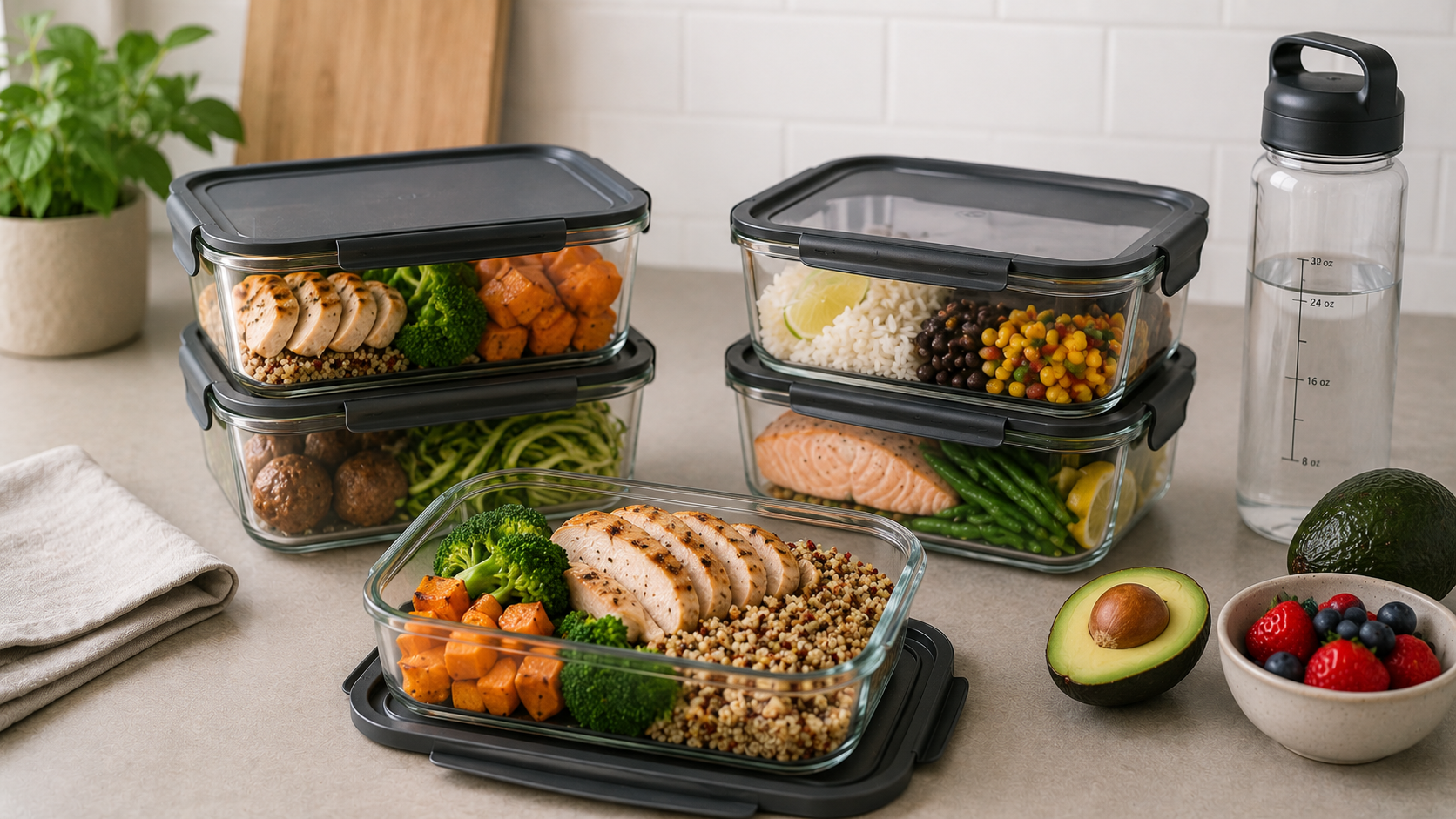
- Portion into containers: 5–6 meals: 150g protein + 100–150g carb + unlimited veg per container.
- Label and fridge: write dates on masking tape; eat within 4 days, freeze any later.
Mid-week refresh: 20 minutes
If you can’t do 6 meals on Sunday, prep 3 on Sunday for Mon/Tue/Wed and another 3 on Wednesday for Thu/Fri/Sat. Splits the workload and keeps meals fresher.
Freeze ahead
Prep 8–10 meals one Sunday, freeze 3–4 for later weeks. Break the freeze-thaw-eat cycle once or twice a month when life gets busy.
Meal prep mistakes that burn people out
1. Over-ambitious first week. Trying to prep 14 meals on day one, with 4 different recipes, for yourself and your partner. Start with 3–5 meals, one recipe, scale up when the habit is built.
2. Eating the same thing for 6 meals in a row. Boredom is a real and legitimate reason meal prep fails. Mix it up with 2 different protein-veg-carb combos across the week, or keep the protein the same and rotate sauces/seasonings.
3. Prepping salads that wilt. Pre-dressed salads lose quality within 24 hours. Pack dressing separately in small containers; add when eating.
4. Forgetting the eating part. Meal prepping 6 meals and then eating out 4 times that week defeats the point. Budget your meals honestly — prep for the meals you’ll actually eat at home.
5. Not accounting for appetite variation. On a GLP-1, your appetite varies day to day. Some days you’ll finish a prepped meal easily; other days you’ll get halfway. Containers that fit back in the fridge for later eating (properly sealed) let you work with this rather than wasting food.
6. Using containers that don’t suit your meals. If you prep soups and stews, you need deep containers with secure lids. If you prep salads and bowls, wider shallow containers work better. Match the container set to the meals you actually cook.
Food safety: how long meals keep
Standard guidance:
- Cooked meats and protein meals: 3–4 days refrigerated, 2–3 months frozen
- Cooked grains (rice, pasta): 3–4 days refrigerated, but reheat thoroughly to avoid bacterial risk
- Cooked vegetables: 3–5 days refrigerated, 8–12 months frozen
- Salads with raw vegetables: 1–3 days refrigerated; better if dressing is separate
- Overnight oats: 3–5 days refrigerated
- Hard-boiled eggs in shell: 7 days refrigerated
- Cooked fish: 2–3 days refrigerated, shorter than meat; freeze if storing longer
Rule of thumb: prep for 4 days’ eating, freeze anything beyond that. Reheat thoroughly (74°C / 165°F internally) to minimise food safety risk.
The summary
Meal prep containers are a £25–£60 investment that genuinely change how consistent your eating is on a GLP-1. Pick 8–10 matching, leak-proof, microwave-safe containers in 2 size categories. Commit to one weekly prep session. Accept boredom as occasional — rotate recipes monthly. The container set earns its place within a few weeks; you’ll wonder how you ate consistently before.
For the meals that fill the containers: High-Protein Breakfast, High-Protein Lunch, High-Protein Dinner. For the broader kitchen setup: Kitchen Gear Worth Buying.
Disclosure: some links are affiliate links. The site earns a small commission at no extra cost to you.
Discover more from Healthy Weight Loss GLP1
Subscribe to get the latest posts sent to your email.