

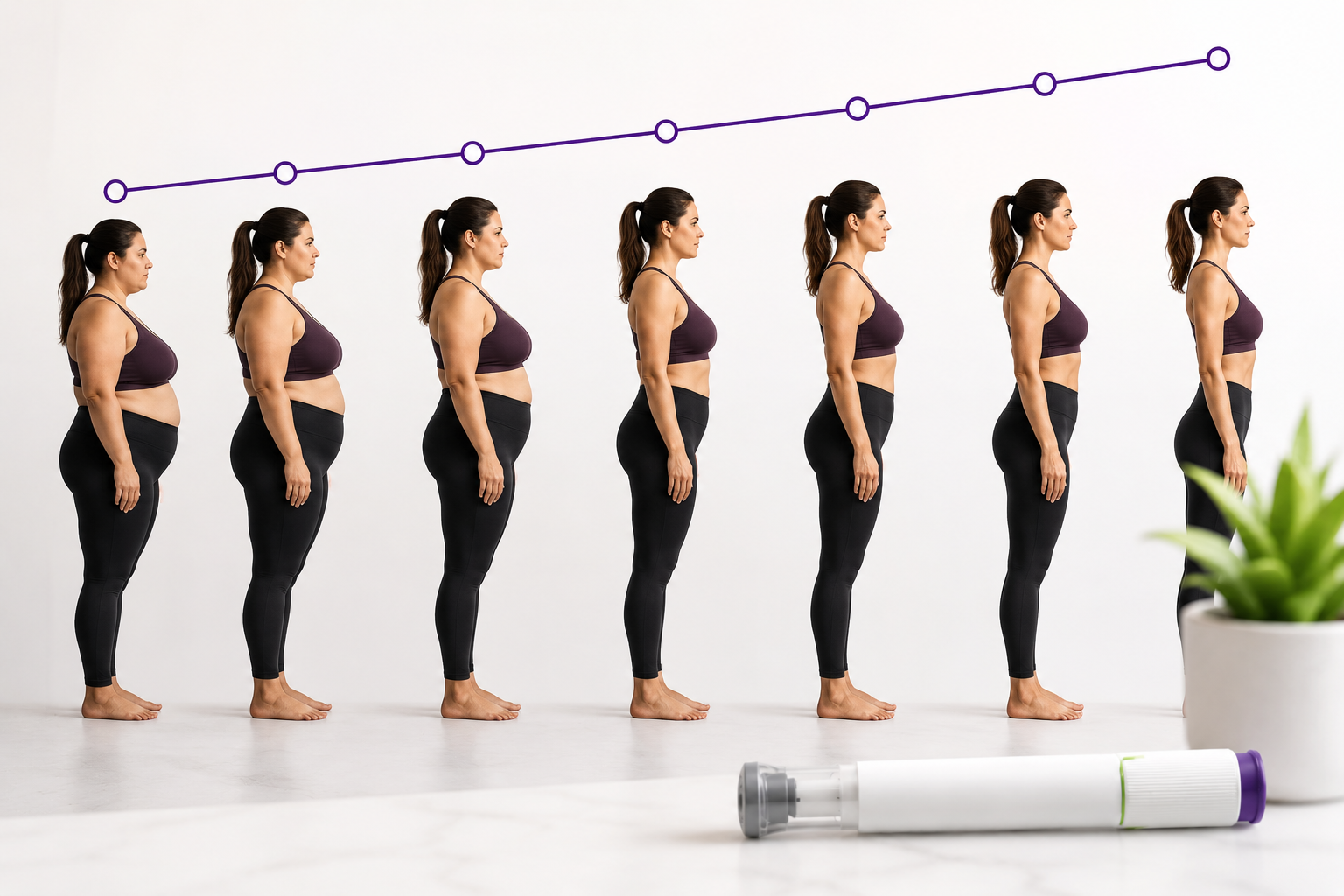
Mounjaro starts working from the first dose, but the results you can actually see take time to build. Most UK users notice appetite change within the first 48 hours, visible weight loss by weeks three to four, and the most dramatic physical changes between months three and six. This week-by-week guide covers what the clinical trials show alongside what real users in the UK report, so you know exactly what to expect — and when to be patient.
For the full treatment picture see the Complete GLP-1 Weight Loss Guide. For the first few weeks specifically: First Week on Mounjaro and First Month on Mounjaro UK.
How to read this guide
The figures below are drawn from the SURMOUNT-1 trial (72 weeks, tirzepatide at 5mg, 10mg and 15mg maintenance doses) plus real-world UK user experience. Your numbers will vary based on starting weight, dose, diet, and activity. Treat the percentages as population averages, not personal targets.
One thing the trials consistently show: almost everyone who stays on the medication and follows the lifestyle guidance loses clinically meaningful weight. The variance is in pace, not direction.
Weeks 1–4: the adjustment phase (2.5mg)
Week 1
The medication is in your system from the first injection. Most users notice reduced appetite within 24–48 hours — not dramatically, but enough to feel different. Portion sizes that seemed normal feel generous. The urge to snack between meals becomes quieter.
Side effects are most likely in week 1: mild nausea, slight fatigue, and sometimes looser stools as your gut adapts to slowed gastric emptying. These are typically mild at 2.5mg and settle within a few days for most people.
Weight loss in week 1 is mostly water weight and reduced gut content. Expect 0.5–2kg. This doesn’t reflect fat loss but it is real weight leaving your body.
Weeks 2–4
Appetite suppression deepens. Many users report their relationship with food changing noticeably — the constant background noise of thinking about food (what some call “food noise”) starts to quiet down. Meals that once felt small feel satisfying. Cravings for high-sugar foods often reduce substantially.
Cumulative weight loss by end of week 4: typically 2–4kg. Individual range is wide — some users report 1kg, others up to 6kg in the first month, often dependent on starting weight and water retention.
Key action this phase: establish your injection day routine, lock in your protein targets, and start tracking in Cronometer so you have baseline data to compare against later.
Weeks 5–8: first dose step (5mg)
Most UK prescribers move patients to 5mg at week 5. This is when the medication begins doing serious work. Side effects can return briefly as your body adjusts to the higher dose — usually 3–7 days of mild nausea or digestive disruption, then settling.
Weight loss noticeably accelerates. The average in clinical trials was around 5% of starting body weight by week 8–12. For a 100kg person, that’s roughly 5kg.
You may notice:
- Eating significantly less than you used to without feeling deprived
- Foods you previously craved (takeaways, biscuits, crisps) losing their appeal
- Feeling full after what feels like a small amount of food
- More stable energy between meals — less of the mid-afternoon crash
This is the phase where starting resistance training matters most. You’re losing weight rapidly — building the habit now protects muscle.
Weeks 9–16: dose 7.5mg
Weeks 9–16 are often where users describe the most dramatic visible changes. Clothes that were tight start fitting properly, then become loose. People in your life who haven’t seen you recently notice. The scale is moving consistently.
Average cumulative weight loss by week 16: 8–12% of starting body weight in clinical trials. Faster losers may be at 14–16%.
Physical changes beyond the scale:
- Blood pressure often drops noticeably, sometimes enough for prescribers to review antihypertensive medications
- Fasting glucose improves for most users, even those without diabetes
- Energy levels typically improve — carrying less weight makes everyday movement easier
- Sleep quality often improves, particularly for users who had sleep apnea
If you haven’t started tracking your meals yet, Cronometer’s verified food database is particularly useful at this stage for making sure protein stays adequate as portion sizes shrink. A common trap: eating less total food but not enough protein, which accelerates muscle loss.
Weeks 17–24: dose 10mg
By now you’re roughly six months in. Many users reach their first major milestone around this point — a stone, two stone, or a specific clothing size they hadn’t worn in years.
Weight loss pace usually moderates compared to months one to three. This is normal physiology, not a sign the medication has stopped working. Your body’s metabolic rate has adapted to the lower weight; the same calorie deficit produces slower absolute weight loss even if the percentage rate is similar.
Average cumulative loss at 24 weeks: 12–15% of starting body weight for most users at 10mg.
This is also when the identity shift starts becoming more pronounced. Your body is different. Your eating patterns are different. The person you see in the mirror is beginning to look unfamiliar in a way that takes adjustment.
Weeks 25–36: dose 12.5mg or holding at 10mg
Whether you step up to 12.5mg depends on your individual progress and prescriber’s guidance. Users who’ve reached their goal weight or are close often stay at 10mg. Those still losing significant weight may step up.
Weeks 25–36 often include the first real plateau — a 2–4 week stall where the scale doesn’t move. This is normal and typically resolves. Common causes: metabolic adaptation, slight calorie drift upward, or a brief stress period affecting cortisol and water retention.
See Mounjaro Plateau UK and How to Break a Weight Loss Plateau UK for specific tactics.
Weeks 37–52: dose 15mg or maintenance phase
The final titration step for most users. At 15mg, average weight loss in SURMOUNT-1 was 22.5% of starting body weight at 72 weeks — the highest in any GLP-1 trial to date.
Weeks 37–52 are typically characterised by:
- Slower but continued weight loss (often 0.5–1.5kg per month)
- Stabilising body composition as muscle preservation training pays off
- Increasing focus on maintenance planning — what does life on this medication look like long-term?
- Beginning to think seriously about what “goal weight” actually means
Weeks 52–72: the long game
Most clinical trials run to 72 weeks for a reason — that’s when the medication reaches full effect for most people. Users who are still losing at week 52 typically continue to do so at a slow but steady pace through week 72.
Total average weight loss at 72 weeks by dose in SURMOUNT-1:
- 5mg: approximately 16% of starting body weight
- 10mg: approximately 21% of starting body weight
- 15mg: approximately 22.5% of starting body weight
For someone starting at 120kg, 22.5% is 27kg. For someone starting at 90kg, it’s just over 20kg. These are averages — some users hit 30%+, others plateau at 12–15%. Both are valid, clinically meaningful outcomes.
What tracking your own results actually looks like
The scale is one measure. Others worth tracking from week 1:
- Waist circumference — often drops faster than scale weight, especially early
- Clothing sizes — objective and motivating
- Energy and sleep quality — rate 1–10 weekly
- Blood pressure — many UK pharmacies measure free
- Protein intake — use Cronometer to verify you’re hitting 1.2–1.6g per kg body weight
- Progress photos — monthly, same lighting, same position. More revealing than the scale over 12 months.
Alan’s own week-by-week journey — from 27 stone down 7 stone over 12 months — is documented on the YouTube channel, including honest breakdowns of the slow weeks and what helped push through them.
When results feel slow
The two most common reasons results feel slower than expected:
1. Protein is too low. On a reduced appetite, it’s easy to eat too little protein. Below 1g per kg bodyweight, muscle loss accelerates, which slows the rate of fat loss (muscle burns more calories at rest). Check your intake in Cronometer — most users are surprised how often they’re falling short.
2. Calorie intake has drifted up without noticing. As the medication effect becomes familiar, portion sizes can quietly creep back. A brief logging week every month or two is enough to catch this early.
See Why Am I Not Losing Weight When Eating Less UK for a fuller breakdown of plateau causes.
Frequently asked questions
How quickly does Mounjaro start working?
The medication is active in your system from the first dose. Appetite changes are often noticeable within 24–48 hours. Visible weight loss typically begins in weeks two to four as the deficit accumulates.
How much weight can I expect to lose in the first month?
Most users lose 2–5kg in the first month. This includes water weight and some fat loss. The rate accelerates from month two onward as the dose increases.
Is it normal for weight loss to slow down after the first few months?
Yes. The rapid early loss includes water and glycogen depletion. From month three onwards, loss is primarily fat and is slower in absolute terms, typically 1–3kg per month depending on dose and lifestyle factors.
When do most people reach their maximum weight loss on Mounjaro?
Clinical trials show the maximum effect around week 60–72. Most of the total weight loss (around 70–80% of it) happens in the first 36 weeks; the remainder accumulates more slowly.
What if I’m not losing weight on Mounjaro?
Non-response is rare but happens. Before concluding the medication isn’t working, review: protein intake (too low?), total calories (drifting up?), sleep (poor sleep raises ghrelin), stress levels, and whether the medication is being stored and injected correctly. See Mounjaro Dose Guide UK for further context.
Do Mounjaro results last?
While on the medication, results hold and continue improving. After stopping, most users regain a significant portion of lost weight within 12–24 months unless strong lifestyle habits have been embedded. This is why the maintenance planning conversation matters before you stop, not after.
Medical disclaimer: results vary. This guide reflects clinical trial averages and general user experience, not guarantees. Discuss your individual progress with your prescriber. Report any concerning changes to your GP or via the MHRA Yellow Card Scheme.
Discover more from Healthy Weight Loss GLP1
Subscribe to get the latest posts sent to your email.