

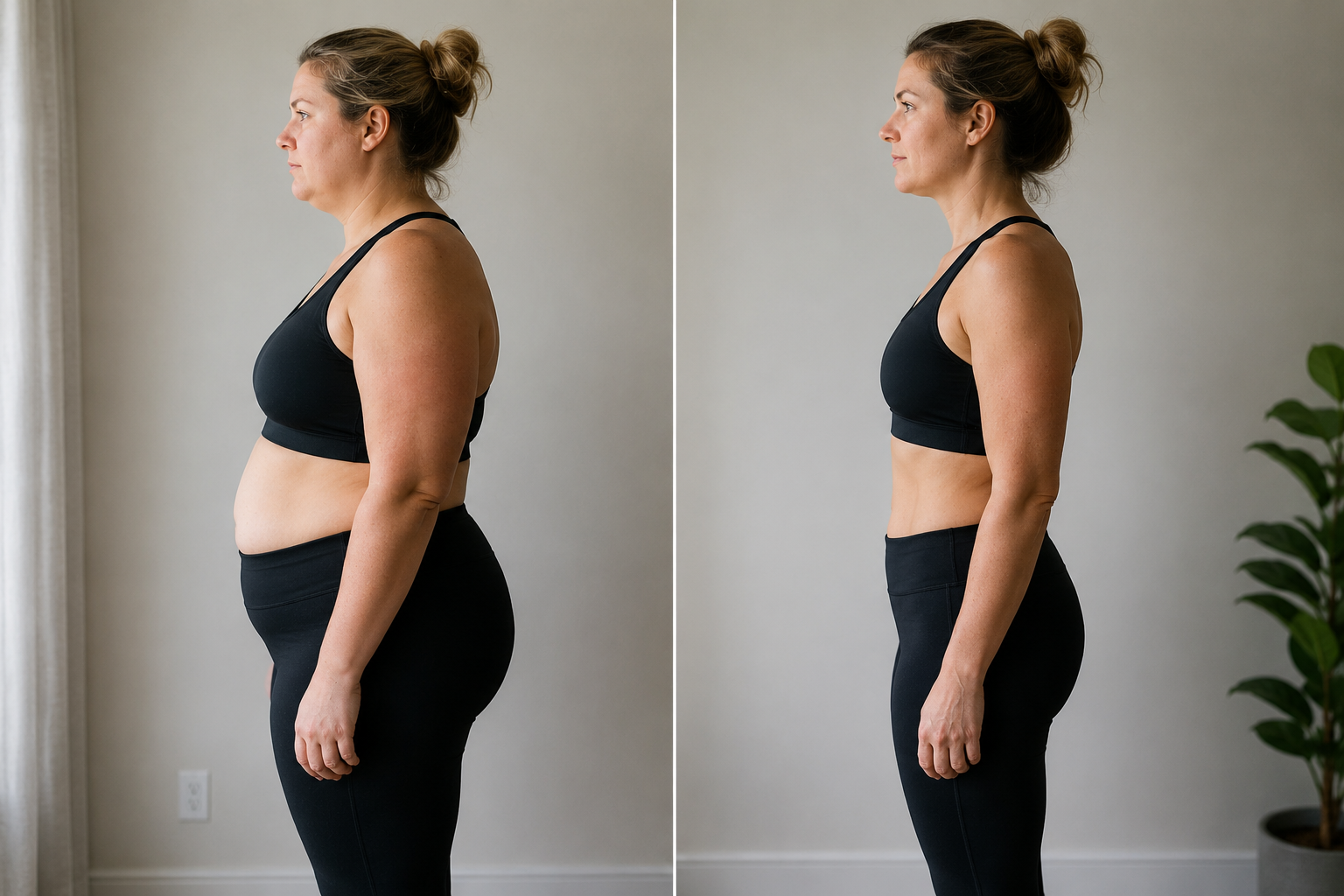
Mounjaro before and after results in the UK consistently show 15–22% body weight loss at 72 weeks for adherent users — which translates to 2–4 clothing sizes, significant improvements in blood pressure, HbA1c, sleep, and joint pain, and for many people a fundamental shift in their relationship with food. The physical results are real, well-documented, and substantial. The harder part to prepare for is what happens beyond the scale — the identity changes, the social adjustments, and the long-term maintenance question. This is the honest UK picture.
For the week-by-week journey: Mounjaro Results Week by Week UK. For Alan’s own documented journey: My 6 Stone Mounjaro Journey and the YouTube channel.
What the clinical trials show
The SURMOUNT-1 trial — the definitive 72-week placebo-controlled trial of tirzepatide for weight management — produced the following weight loss results:
| Dose | Average weight loss | % achieving 20%+ loss | % achieving 15%+ loss |
|---|---|---|---|
| 5mg weekly | 15% of body weight | 32% | 57% |
| 10mg weekly | 19.5% of body weight | 51% | 71% |
| 15mg weekly | 22.5% of body weight | 63% | 78% |
| Placebo | 2.4% of body weight | — | — |
In UK terms: someone starting at 120kg on 15mg Mounjaro would average 27kg of weight loss at 72 weeks. At 100kg starting weight, that’s 22.5kg. These are averages — some users exceed 30%; others plateau at 10–12%. Both are valid outcomes.
What 15–22% weight loss actually looks like
Percentages can feel abstract. Concrete equivalents:
For a 120kg starting weight (roughly 19 stone):
- 15% = 18kg lost — 18 stone down to approximately 15.5 stone
- 22.5% = 27kg lost — approaching 15 stone from under 19 stone
Clothing size change: typically two to four dress sizes or trouser sizes at 15–20% weight loss, depending on body composition. Most users report going from a tight size 22–24 to a comfortable 16–18, or from a 42-inch waist to a 36-inch waist, as representative examples in the 20kg range.
BMI change: 20kg loss from a starting BMI of 40 brings BMI to approximately 33. From BMI 35, to approximately 28 — below the obese threshold.
Beyond the scale: what before and after really means
The numbers tell part of the story. What users consistently report as the most significant changes go beyond them:
Physical changes
- Joint pain: often the most immediate physical improvement, reported within weeks as load on knees and hips reduces. Many users describe the ability to walk further, stand longer, and climb stairs without discomfort as transformative
- Breathing: improved respiratory function, particularly during sleep. Sleep apnea often reduces significantly
- Energy: described as “having a normal amount of energy” rather than chronic fatigue from carrying excess weight
- Mobility: reaching, bending, and everyday movement become easier
- Blood pressure: often falls to normal range without medication changes, or existing medication doses are reduced
Metabolic changes
- HbA1c: improves in most users, normalises in many
- Fasting glucose: often drops to pre-diabetic or normal range
- Triglycerides: typically fall with weight loss
- Cholesterol: HDL usually improves; LDL effect variable
Psychological and social changes
- Clothes shopping: from dreaded to enjoyable for many users
- Social confidence: improved, though not universally — some users find new social attention uncomfortable
- Relationship with food: fundamentally different. Food noise reduced or absent. Eating for nutrition rather than compulsion
- Identity: complex. See the section below
The identity question
This is under-discussed in typical before-and-after narratives, which focus on the physical. The identity changes are real and can be disorienting even when the physical results are excellent.
After significant weight loss on Mounjaro:
- You don’t recognise yourself in mirrors or photos — genuinely, physically disorienting
- Your self-image (the internal picture of what you look like) lags months behind the physical reality
- People who’ve known you for years treat you differently — sometimes more attentively, which has its own uncomfortable implications
- Clothes from before treatment don’t fit. Clothes you buy now won’t fit in six months. There’s a strange borderless phase
- The habits, rituals, and social contexts that were organised around food and weight change
None of this undermines the achievement. But preparation for these changes is part of a realistic before-and-after picture. Alan’s documentation of this on the YouTube channel is more honest about these aspects than most weight loss content. See also Identity Shift After Weight Loss UK.
Tracking your own before and after
Before you start Mounjaro (or from today if you’ve already started), establish your baseline:
Numbers: weight, waist circumference, hip circumference, blood pressure. Recheck monthly.
Photos: front and side, same outfit, same lighting, same time of day. Monthly. These reveal changes the scale misses, particularly body composition changes where fat is being replaced by maintained muscle.
Blood markers: ask your GP for a baseline HbA1c, fasting glucose, cholesterol, and blood pressure at the start. Repeat at six months and twelve months. These numbers tell a story that body weight alone doesn’t.
Nutrition baseline: log one week of normal eating in Cronometer before your first injection. The before picture for food habits is as informative as the before picture for body weight. Revisiting this at six months shows how your eating has changed.
Non-scale markers: note which specific activities are difficult before starting. Walking up stairs without getting breathless. Playing with children or grandchildren without pain. Fitting comfortably in a car seat. Tying shoelaces easily. These functional changes often happen faster than scale changes and are motivating to track.
Realistic expectations by the numbers
Setting expectations based on realistic population data rather than best-case results:
At 12 weeks: typically 4–8% weight loss. Nausea and side effects usually settling. Clothing may fit differently; dramatic physical changes not yet obvious to most people who know you.
At 6 months: typically 12–15% weight loss. One to two dress/trouser sizes. Blood pressure and blood glucose measurably improved. Sleep usually better. Social circle starting to notice and comment.
At 12 months: typically 17–20% weight loss. Body composition has shifted significantly if training has been maintained. Identity adjustment in full swing. Beginning to think about maintenance.
At 72 weeks: near-maximum effect. Average 22.5% at highest dose. Physical results largely stable. Maintenance planning essential.
What doesn’t change
Being honest about this matters more than the before-and-after photos suggest:
- Loose skin after significant weight loss — this is real, largely determined by genetics and speed of loss, and not fully addressed by any topical product. See Loose Skin After Weight Loss on GLP-1 UK
- The underlying tendency to weight regain — Mounjaro treats this biologically but the underlying physiology remains. Most people who stop regain significant weight
- Unrelated mental health issues, relationship problems, or life circumstances
- The need for ongoing effort around nutrition and training — the medication reduces the effort required but doesn’t eliminate it
Frequently asked questions
How much weight will I lose on Mounjaro in the UK?
Clinical trials show an average 15–22.5% of starting body weight at 72 weeks depending on dose. Individual results vary — some users lose more, some less. Most adherent users achieve clinically meaningful weight loss (10%+ of starting weight).
How long does Mounjaro take to show results?
First visible results typically at weeks three to four. Significant physical changes apparent to others usually by months three to four. Maximum results at 60–72 weeks.
Are Mounjaro before and after photos real?
Many are real — the weight loss results are well-documented in clinical trials and real-world data. Be cautious of social media before-and-after posts that may be selectively curated, combine weight loss with other changes (filters, lighting, styling), or represent outlier results rather than typical outcomes.
Will I regain weight after stopping Mounjaro?
Most users regain a significant portion of lost weight after stopping without continued medication. This is physiological — the medication’s appetite suppression is gone, and the underlying obesity biology reasserts. Strong lifestyle habits reduce the regain but rarely eliminate it entirely. See How to Stop Weight Regain After Mounjaro UK.
How to take meaningful before and after photos
Most before-and-after photos that circulate online are more informative about lighting and posture choices than about actual physical change. Taking yours differently produces more honest and useful documentation:
Consistent conditions: same time of day (morning, before eating — least bloated), same room and lighting, same distance from camera. Natural light from a window is more consistent than overhead or artificial lighting, which changes dramatically depending on position.
Consistent pose: arms slightly away from the body (pressed against sides compresses them and creates false narrowing), feet shoulder width apart, chin level. Front and side views each month.
Consistent clothing: fitted clothing reveals changes more clearly than loose clothing. A sports bra and shorts or fitted gym wear shows body shape accurately. Baggy clothing hides progress and makes photos less useful.
Consistent frequency: monthly is ideal — close enough to capture progress, far enough apart for meaningful change to be visible. Weekly photos produce anxious comparison on slow weeks; three-monthly photos miss the gradual progress that motivates continued adherence.
Keep these photos private or share only with people you trust. The function is personal documentation and motivation, not social media content unless you specifically choose to share your journey — as Alan has done on the YouTube channel.
Pair photos with Cronometer nutrient data and body measurements — the three together (visual, nutritional, dimensional) provide a complete picture of how treatment is progressing that the scale alone doesn’t capture.
Discover more from Healthy Weight Loss GLP1
Subscribe to get the latest posts sent to your email.