
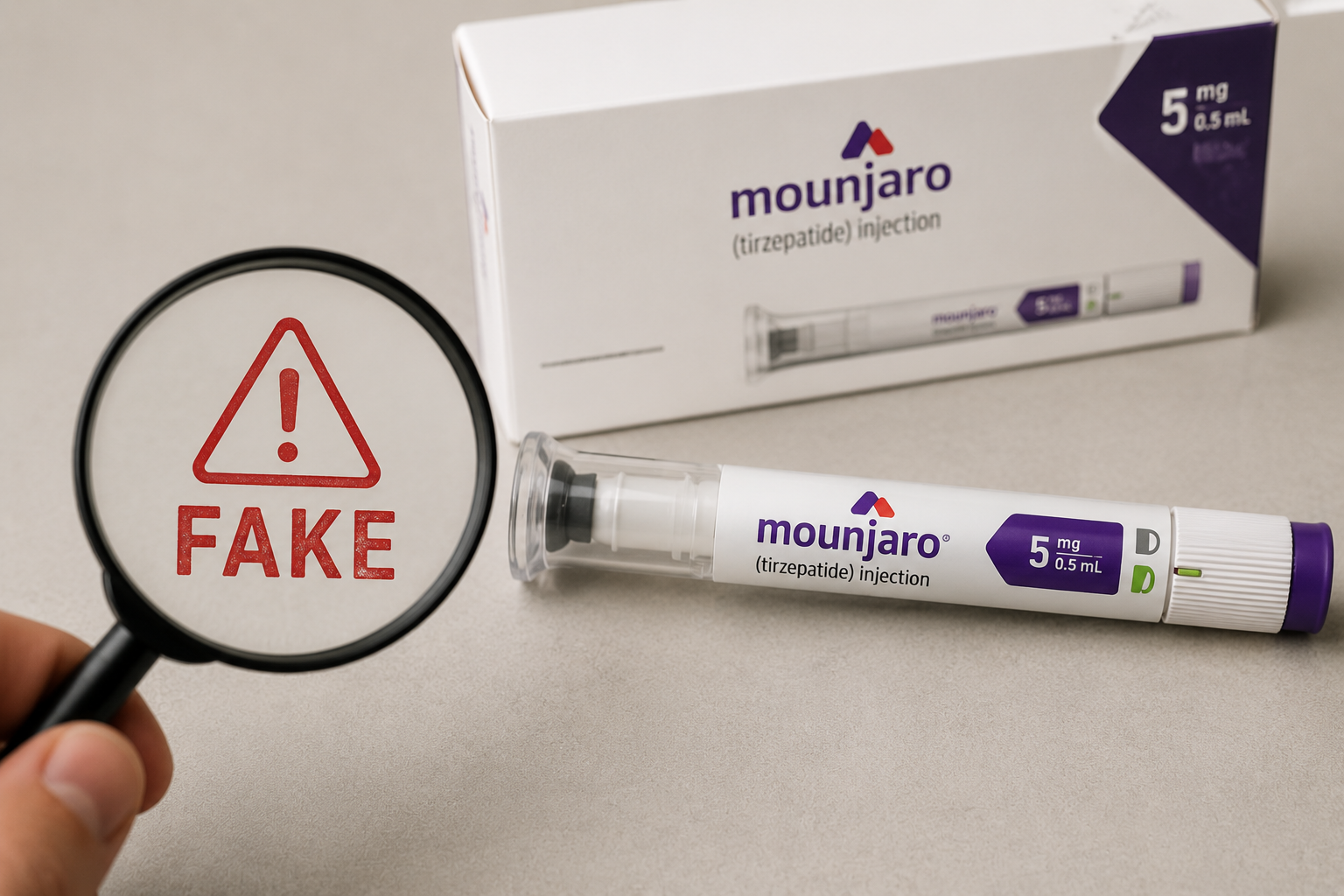
Counterfeit Mounjaro is a real and documented problem in the UK. The MHRA has issued multiple warnings about fake tirzepatide pens entering the UK through unofficial channels, some containing wrong doses, some contaminated, some containing no active ingredient at all. This post is about how to recognise and avoid counterfeit Mounjaro, what channels are safe, and what to do if you suspect you’ve bought a fake.
For the legitimate sourcing guide see How to Get Mounjaro in the UK. For the online prescribing route: Mounjaro Online Prescription UK.
The scope of the problem
Global demand for tirzepatide has outstripped legitimate supply since 2023. Counterfeiters have stepped into the gap, selling fake pens through:
- Social media marketplaces (Facebook Marketplace, Instagram DMs, Telegram groups)
- “Pharmacies” operating without UK regulation (often based overseas)
- Peer-to-peer selling via forum or group chat connections
- Unsolicited email/WhatsApp messages offering “bulk discount” or “supplier direct” pricing
- Some unregulated online marketplaces (not regulated pharmacy e-commerce sites)
The MHRA has seized thousands of suspected counterfeit pens at UK borders. Enforcement action has increased in 2024–2026 but the problem persists because the economics of counterfeiting a high-demand, high-price medication are attractive to bad actors.
What counterfeit Mounjaro can contain
Analysed counterfeit pens have contained:
- Wrong dose of tirzepatide. Substantially higher or lower than stated — wrong-dose medication has caused severe hypoglycaemia, nausea, and hospitalisation in some users.
- Different active ingredients. Some fakes contain semaglutide or insulin instead of tirzepatide.
- No active ingredient. Injecting inert liquid — no effect but no immediate harm.
- Contamination. Bacterial contamination, foreign particles, non-sterile filling conditions.
- Wrong pH or formulation. Even if the right active ingredient, wrong buffers cause unpredictable absorption.
The health consequences range from “no effect” to “severe adverse reaction requiring hospitalisation.” The MHRA has documented hospitalisations linked to counterfeit Mounjaro in 2024 and 2025.
How to spot potential counterfeits
Warning signs on the physical product:
1. Packaging irregularities. Real Mounjaro packaging is consistent in UK supply: specific box design, Lilly/Eli Lilly branding, UK-specific labelling. Counterfeit packaging often has:
- Slightly wrong shade of colours
- Typography differences (fonts, spacing)
- Spelling errors on the box or leaflet
- Different box proportions or closures
- Missing or poorly-printed holograms
- Patient information leaflet in the wrong language or non-UK format
2. Batch number and expiry irregularities. Legitimate UK Mounjaro pens have batch numbers that Eli Lilly UK can verify. Fake pens may have:
- Batch numbers that don’t match any Lilly record
- Expiry dates inconsistent with manufacturing date
- Multiple pens in the same box with different batch numbers
3. Pen construction irregularities. Counterfeit pens sometimes have:
- Different-shaped injection window
- Looser or misfitting caps
- Less precise dose indicator mechanism
- Different “click” sound during use
- Different pen colour or label placement vs legitimate batches
4. Liquid appearance irregularities. The medication should be clear and colourless. Fakes may appear:
- Slightly cloudy or tinted
- With visible particles
- Separating or settled
If you have any doubt, don’t use the pen and contact your prescriber.
Warning signs at the purchasing point
Before you even receive a pen, source red flags:
1. Price too low to be genuine. Legitimate UK Mounjaro (at whatever dose) has a reasonable price range based on what Eli Lilly charges wholesalers. Private prescribers don’t make large margins. If a “pharmacy” is offering Mounjaro at 40–50% below the UK market rate, the most likely explanation is counterfeit.
2. No UK regulatory presence. Check for GPhC pharmacy registration, CQC registration (if clinical service), and UK-registered prescriber credentials. A “pharmacy” without any of these isn’t a UK pharmacy.
3. Payment via cryptocurrency, Western Union, or non-standard methods. Legitimate UK pharmacies accept standard card payment, Direct Debit, or established online payment methods. Requests for crypto, bank transfer to a non-UK account, or peer-to-peer money transfer are major red flags.
4. No prescriber consultation. Legitimate UK Mounjaro requires a prescription, which requires some form of clinical assessment. If a “pharmacy” is selling without any consultation, they’re operating outside UK law and the product source is suspect.
5. Social media sourcing. Instagram DMs, Facebook groups, Telegram channels selling Mounjaro: almost always counterfeit or illegally diverted. The GMC, GPhC, and MHRA do not permit social-media-based medication sales.
6. “Bulk” or “wholesale” offers. Legitimate pharmacies don’t sell to individuals at “wholesale” pricing. Offers of 5, 10, or 20 pens at once to individuals are a red flag for counterfeit distribution networks.
7. International shipping from unexpected countries. Some legitimate EU supplies can reach UK pharmacies through regulated channels. But packages arriving from countries without active UK regulatory relationships (parts of Asia, Eastern Europe, unregulated jurisdictions) are suspect.
Safe sourcing channels in the UK
Reliable, regulated channels:
1. NHS prescription. Via Cohort 1 weight management services or GP under approved criteria. Zero counterfeit risk.
2. UK-registered online pharmacies with GPhC registration. Their pharmacy number should be clearly displayed; verifiable on the GPhC register.
3. UK-registered online weight management clinics with CQC registration. Verifiable on the CQC website.
4. High-street UK pharmacies. Boots, LloydsPharmacy, Well Pharmacy, etc.
5. Private GP services with linked pharmacies. A legitimate UK GP issuing a private prescription to a UK pharmacy is a safe chain.
Sticking to these channels makes counterfeit almost impossible. The cost difference between cheap counterfeits and legitimate channels is not worth the health risk.
Verification you can do yourself
Three verification steps for any Mounjaro you receive:
1. Check prescriber and pharmacy credentials.
- GPhC pharmacy register: pharmacyregulation.org
- GMC doctor register: gmc-uk.org
- CQC registered healthcare services: cqc.org.uk
- If a provider’s details don’t match their public registrations, it’s a concern.
2. Check packaging against reference images. Eli Lilly publishes reference images of legitimate Mounjaro packaging. Your pen should match:
- Shape and proportions
- Colour scheme for the dose
- UK regulatory markings
- Brand typography
- Patient information leaflet format
3. Contact Eli Lilly UK directly if suspicious. If you have specific concerns about a batch number, serial number, or packaging detail, contact Eli Lilly UK customer service. They can verify whether a specific batch is legitimate.
What to do if you suspect counterfeit
If you’ve already received a suspect pen:
Don’t inject.
Contact your prescriber immediately. Describe the concerns. They may be able to verify the source or advise next steps.
Report to the MHRA via the Yellow Card Scheme. Their Fake Meds website: gov.uk fake medicines. Reports help enforcement track counterfeit sources.
If you’ve already injected a suspected counterfeit:
- Contact your prescriber and, if symptoms develop, NHS 111 or your GP
- Report to the MHRA via Yellow Card Scheme
- Document any symptoms (photos, time course) for medical records
- Attend A&E if you experience serious reactions (severe nausea and vomiting, hypoglycaemia symptoms, chest pain, difficulty breathing, severe abdominal pain)
If you bought from an unregulated source:
- Don’t re-purchase from them
- If you have evidence of counterfeit sale, report to Trading Standards or Action Fraud
- Don’t re-sell or pass the suspect pens to anyone else
The “pharmacy in Europe” scenario
Some UK residents source medications from EU pharmacies where prices may be lower. The risk levels:
Low-risk scenarios: Traveling to a country, visiting a regulated pharmacy, obtaining a prescription from a local doctor, buying legitimately-sourced Mounjaro for personal import. This is legally complex under post-Brexit UK medicine import rules but unlikely to be counterfeit if the pharmacy is regulated.
Higher-risk scenarios: Ordering online from a “European pharmacy” that ships to the UK without UK prescription. These are often either: (a) legally borderline operations, or (b) counterfeit operations masquerading as European pharmacies.
For UK residents, using UK-based regulated channels is safer. The cost savings from unregulated EU channels are rarely worth the counterfeit and legal risk.
The “my friend has extra pens” scenario
Using someone else’s prescription medication is illegal in the UK. Practically, if a friend is offering you pens they don’t need (e.g. they changed dose, stopped treatment, got a replacement), the pens are likely genuine (if their source was legitimate) but using them is:
- Legally problematic (prescription medication must be dispensed to the person named on the prescription)
- Clinically problematic (you haven’t had a prescriber assess that the medication is appropriate for you)
- Liability problematic (no insurance, no prescriber, no accountability if something goes wrong)
Don’t do this. Get your own legitimate prescription.
The “telegram group” / “pharmacy direct” offer
A common pattern: someone in a weight-loss community mentions they’ve found a “pharmacy direct” source — usually via Telegram or WhatsApp — selling Mounjaro at 40–60% below UK retail. They may even have pens that look genuine.
These sources are almost always:
- Unregulated pharmacy operations (if they exist at all)
- Counterfeit supply chains with professional-looking packaging
- Eventually, customers end up with quality issues, absent product, or fraud
Even if the source starts out selling genuine product (diverted from legitimate supply), quality deteriorates. Counterfeits get mixed in. Bad batches proliferate. The cost of a fake is the cost of your health.
Don’t buy from these sources regardless of community testimonials. The low price reflects the lack of regulation, not the efficiency of their supply chain.
The economics of counterfeiting
Understanding why this exists:
- Legitimate Mounjaro costs Eli Lilly substantial capital to manufacture (complex bioactive, regulatory-grade facilities)
- Retail price reflects this plus prescription chain markup
- Counterfeiters can produce visually-similar but inert liquid in unregulated facilities for a tiny fraction of the cost
- Margins for counterfeiters are extremely high, creating strong incentive
- Demand exceeds legitimate supply, creating market opportunity
- Enforcement is hard because operations are often offshore
The counterfeit problem isn’t going away until supply and demand rebalance, which depends on manufacturing capacity expansion and possibly wider availability of alternative GLP-1 medications.
What the UK is doing about it
Enforcement activity in 2024–2026:
- MHRA has seized large volumes of suspected counterfeit tirzepatide at UK ports and via online enforcement
- Published warning notices about specific counterfeit batches
- Worked with Meta, Facebook, Instagram to take down pharmacy-marketing accounts
- Coordinated with international regulators on supply chain investigation
- Public warnings via news media about specific counterfeit cases
The MHRA Fake Meds website publishes updates; worth bookmarking if you’re interested.
The summary
Counterfeit Mounjaro is a real risk in the UK in 2026. Avoid it by sourcing exclusively through regulated UK channels: NHS, GPhC-registered pharmacies, CQC-registered clinics, high-street UK pharmacies. Check pharmacy and prescriber credentials before purchasing. Don’t buy via social media, unregulated “European pharmacy” websites, or peer-to-peer sources. If you suspect a pen might be counterfeit, don’t inject, contact your prescriber, and report to the MHRA.
The cost of legitimate Mounjaro is real. The cost of counterfeit is potentially worse — wrong dose, contamination, or complete absence of medication. The £30–£50 per month you might save on a fake supplier is not worth the risk.
For legitimate sourcing: How to Get Mounjaro in the UK, Mounjaro Online Prescription UK, Getting Mounjaro from a UK Pharmacy. For pricing: Cheapest Mounjaro Provider UK 2026.
Safety note: this is an informational article. For specific product concerns, contact Eli Lilly UK (the manufacturer), your prescriber, or the MHRA Yellow Card Scheme at yellowcard.mhra.gov.uk. For health emergencies after suspected counterfeit use, contact NHS 111 or attend A&E. For crime reporting, contact Action Fraud at actionfraud.police.uk.
Discover more from Healthy Weight Loss GLP1
Subscribe to get the latest posts sent to your email.