

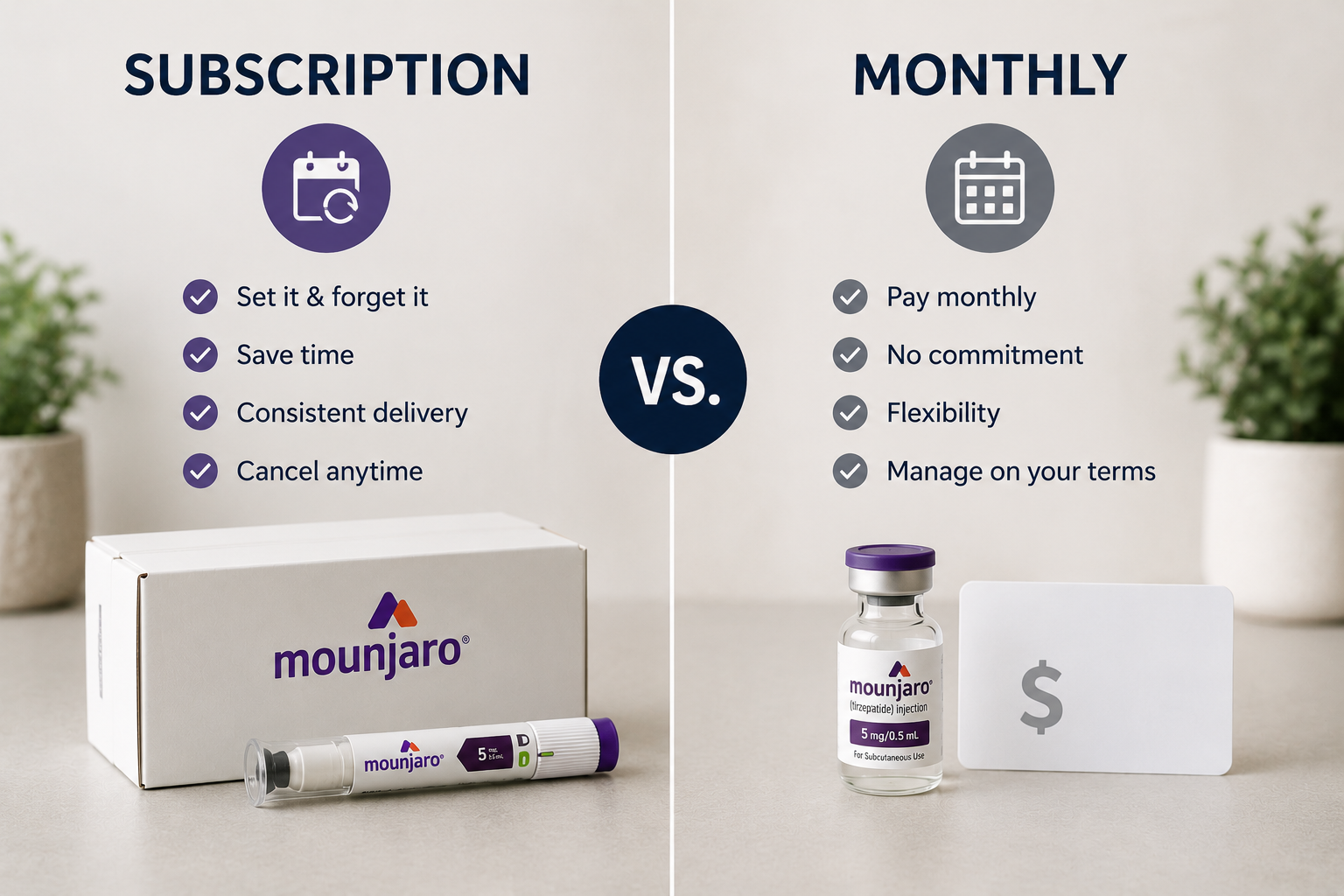
Most UK private Mounjaro providers offer two billing models: pay-per-month (buy each dose individually) or subscription (committed monthly payment, sometimes with discount). Which is right for you depends less on price and more on where you are in your treatment journey. This is the honest 2026 UK guide to subscription vs monthly Mounjaro, including the fine print most provider websites don’t highlight.
For the cheapest current providers see Cheapest Mounjaro Provider UK 2026. For the sourcing overview: How to Get Mounjaro in the UK.
The two models explained
Pay-per-month (one-off purchasing)
You buy each month’s pen as a one-off purchase. Assessment/consultation fees may be charged separately, or bundled into the first month. No ongoing commitment; each month is a fresh decision.
Typical price: £150–£330 per month depending on dose and provider.
Subscription
You commit to a recurring monthly payment (typically 3, 6, or 12 months). Pens are automatically dispatched each month. Often includes “free” consultations, titration reviews, and sometimes nutrition or mental health support add-ons. Discount vs monthly one-off varies by provider.
Typical discount: 10–25% cheaper per month vs one-off purchases, in exchange for commitment.
Which model wins on price
Subscription, usually. Most UK providers structure their pricing to incentivise subscription:
- Monthly pricing includes a consultation fee that’s already paid in the subscription
- Subscription prices are 10–25% lower per month
- Some providers bundle additional services (nutritionist calls, progress tracking) free with subscription
Specific example: a provider charging £250 one-off monthly might offer a 3-month subscription at £210 per month (£630 total for 3 months vs £750 if bought separately).
If you know you’ll continue for 3+ months, subscription almost always wins on price.
Which model wins on flexibility
Monthly one-off, clearly. You can:
- Stop after any month without penalty
- Skip a month if you want to pause (e.g. during surgery recovery)
- Switch providers without contract concerns
- Re-evaluate each month whether you want to continue
Subscription commitments typically include:
- A minimum term (usually 3 months)
- Cancellation rules (30 days’ notice common)
- Dispatch schedules that are fixed (harder to delay if you need a pause)
- Refund policies that vary — some providers refund unused portions, others don’t
The fine print that matters
Questions to ask before signing up for a subscription:
1. What’s the minimum commitment? 3 months is common. 6 months is less common but sometimes cheaper. 12 months is rare and usually not worth the commitment. Never sign longer than 6 months.
2. What happens if I want to pause? Medical reasons (surgery, illness, side effects) should allow pause without penalty. Check the specific policy.
3. What happens if I want to increase or decrease dose? Dose changes mid-subscription should be included at no extra charge. If the provider charges for dose changes, that’s a red flag.
4. What happens if my prescriber deems me ineligible mid-contract? If your prescriber decides the medication isn’t appropriate for you (new medical condition, non-response, side effects), you should be refunded for unused months. Verify this in writing.
5. Are consultations included? Good subscriptions include all required titration reviews. Check specifically that the review before each dose step is included, not charged extra.
6. Can I get same-dose multi-month dispenses? Some providers dispense 3 pens at once (saving repeated shipping); others dispatch monthly regardless.
7. Who owns unused pens if I cancel mid-subscription? Usually you keep any pens already dispensed; you don’t pay for undelivered months.
8. What’s the actual cancellation process? Some providers make cancellation difficult — requiring phone calls, specific forms, or long notice periods. A provider that makes easy online cancellation is a good sign.
When subscription is the right choice
- You’ve been on the medication for 1+ months and know you’re continuing
- You’ve tolerated your current dose well and titration is stable
- You want to lock in a price (some providers guarantee price for subscription term)
- You value the convenience of automatic dispatch
- The bundled support services (nutrition calls, coaching) match your needs
- You’ve done the maths and the subscription saves money vs one-off at your expected usage
When monthly one-off is the right choice
- You’re in the first month of treatment — you don’t yet know if you’ll continue
- You’re unsure about tolerance and might need to pause
- You have medical events coming up that might require pauses (surgery, travel to unusual destinations)
- You’re shopping across providers and don’t want to commit
- Your life is unpredictable enough that commitment feels wrong
- You want to re-evaluate every month
The “trial month” strategy
A sensible pattern for new users:
Month 1: Monthly one-off with your chosen provider. Assess tolerance, provider quality, and side effects.
Month 2: Monthly one-off (still). By end of month 2, you’ll know if this provider’s service meets your needs, if the medication is tolerated, if you’re likely to continue.
Month 3 onwards: Subscription, if you’re confident in continuing. Commit to 3–6 months depending on provider options.
This costs slightly more than committing to subscription from day one but dramatically reduces the risk of being locked into a contract for a medication you end up pausing or switching.
Red flags in subscription offers
Marketing tactics that suggest caution:
1. “Limited time” subscription discounts. A genuine subscription offer doesn’t need urgency pressure. If a provider is using countdown timers or “today only” pricing, treat it as marketing, not a real deal.
2. Aggressive “first-month free” offers. Free first-month offers often come with 12-month commitments where the total cost exceeds what you’d pay monthly elsewhere. Check the full-term cost.
3. Subscriptions that include “coaching” as a way to justify high prices. Some coaching is valuable; much of it is generic content delivered via email or app that doesn’t justify an extra £30–£50 per month.
4. Non-specific “premium” tiers. If a provider offers Basic / Premium / Ultimate tiers where the only difference is price, it’s often marketing segmentation rather than meaningful service difference.
5. Unclear refund and cancellation policies. Ambiguous terms protect the provider, not you. If you can’t see the specific cancellation terms before signing, don’t sign.
6. Auto-renewal without clear notice. Subscriptions that auto-renew beyond initial terms without explicit opt-in are consumer-hostile. Look for providers whose subscriptions end at term unless you re-confirm.
Price comparison: subscription vs monthly at major UK providers
Indicative April 2026 pricing at 5mg maintenance dose (check current prices before committing):
| Provider | Monthly one-off | 3-month subscription | Savings % |
|---|---|---|---|
| Voy | £175–£190 | £155–£170/month | ~11% |
| Numan | £185–£200 | £165–£175/month | ~12% |
| Manual | £195–£210 | £175–£190/month | ~10% |
| Phlo Clinic | £170–£185 | £150–£165/month | ~12% |
| Pharmacy2U | £200–£215 | £180–£195/month | ~10% |
Specific prices vary constantly. Principles stay constant:
- Subscriptions save 10–15% vs one-off at most providers
- 6-month commitments save slightly more than 3-month
- Very large discounts (30%+) on subscriptions are rare and should be scrutinised
Multi-month dispensing savings
Some providers offer a hybrid: pay for multiple months upfront (e.g. 3 pens at once) but without a formal subscription contract. This saves shipping costs and sometimes unlocks a bulk discount.
Advantages: lower per-pen cost than monthly, less commitment than subscription, convenient (fewer dispatches).
Disadvantages: upfront cash outlay (£500–£700 for 3 months at maintenance doses), pens sit in your fridge for longer (watch expiry dates).
Worth considering if you’re confident in dose and provider, have the cash available, and prefer less admin.
Switching between models mid-treatment
Most providers allow switching:
- Monthly one-off → subscription: straightforward, usually takes effect from next month’s pen
- Subscription → monthly one-off: requires completing current subscription term, then switching. Some providers charge a “conversion fee”; most don’t.
- Subscription → different provider: usually requires finishing current term or paying out remaining months
Read the specific conversion terms before subscribing.
Subscription and NHS Mounjaro
If you’re on NHS Mounjaro (NHS prescription charge only), the subscription question doesn’t apply in the same way — your dispensing is through your NHS pharmacy on the NHS cycle. Prescription charges are fixed.
Some people combine NHS and private prescribing (NHS at one dose, private at another — rare but happens during supply fluctuations). In that scenario, the private side could be subscription or monthly depending on preference.
When cheapest isn’t best
A common trap: choosing the cheapest subscription available without checking service quality. The cheapest providers sometimes cut corners on:
- Clinical review rigor (template-only, minimal oversight)
- Customer service responsiveness
- Supply reliability (more likely to have stockouts at your dose)
- Titration flexibility (slower to approve dose changes)
Saving £30 per month on a provider who can’t respond to a side-effect concern for 5 business days isn’t a bargain. Look at review patterns for responsiveness and reliability, not just price.
What I’d do
If I were starting Mounjaro today in the UK:
- Research 3–4 reputable providers across a range of prices
- Start with monthly one-off for the first 2 months at a mid-priced provider
- By month 3, decide which provider fits (service, price, communication)
- Switch to a 3-month subscription at the preferred provider
- Re-evaluate at the end of each 3-month term — renew if satisfied, shop around if not
This avoids the common mistake of committing to a 12-month subscription on day one, then discovering you don’t like the provider or the medication two months in.
Your consumer rights on subscriptions
UK consumer law gives you some baseline protections on subscription services even beyond specific provider terms:
1. 14-day cooling-off period. Under the Consumer Contracts Regulations 2013, most online purchases have a 14-day cooling-off period during which you can cancel for any reason. For prescription medications there are exceptions (you typically can’t return dispensed medication), but the subscription commitment itself can often be cancelled within the 14-day window even if pens have been dispensed.
2. Right to cancel for non-provision. If a provider fails to deliver (stockouts, missed consultations, delayed dispatch), you have grounds to cancel without penalty.
3. Protection from unfair terms. Terms that give the provider unreasonable power or restrict your rights beyond what’s enforceable can be challenged. The Competition and Markets Authority publishes guidance.
4. Payment dispute rights via your card provider. If a provider refuses to honour their own cancellation terms or charges for services not received, you can dispute via your card issuer (Section 75 for credit cards over £100).
Most reputable UK providers comply with these protections without issue. Knowing they exist is useful if you hit a difficult cancellation scenario.
Provider-switching practicalities
If you decide to switch providers mid-journey (common — service quality matters more than initial pricing):
1. Time the switch to pen supply. Don’t cancel provider A until provider B has your prescription issued and pens ready to dispatch. A gap of a week or two between providers means missed injections.
2. New providers need your history. Be prepared to describe your treatment history: how long on Mounjaro, current dose, any side effects, medical conditions, weight history. Some providers will transfer medical records directly if you consent; many re-assess from scratch.
3. Expect re-titration questions. A new prescriber may want to verify your current dose is appropriate. Unusual for a prescriber to drop you down a dose on switching, but possible if they’re more conservative.
4. Carry over pens if possible. If you have unused pens from provider A that are in-date and correctly stored, you can usually use them at provider B’s schedule without issue. Just inform provider B so they time their first dispatch correctly.
5. Keep both prescriptions separate. Don’t use pens from provider A while actively paying provider B for new pens simultaneously. Legally and clinically you should be under one active prescribing relationship.
The subscription-pause scenario in detail
Mid-subscription pause requests come up for various reasons:
- Planned surgery requiring 2–4 week medication pause
- Pregnancy or pregnancy planning (Mounjaro should be paused)
- Travel to remote destinations where cold storage isn’t available
- Financial hardship (temporary)
- Significant side effects requiring temporary discontinuation
- Breaks from treatment for psychological reasons (some users take planned breaks)
Different provider responses:
- Best-in-class: pause the subscription, extend the end date by the pause duration, no charge during pause, resumption whenever you’re ready
- Mid-tier: pause for medical reasons only (with doctor’s letter), limited duration (usually 1–2 months maximum)
- Worst: no pause option; you either continue paying or cancel entirely
Ask about pause policy before signing up. A provider who won’t accommodate a surgical pause is showing you something about how they handle customer needs.
The summary
Monthly one-off for the first 2 months (keep flexibility while you assess). Subscription from month 3 onwards if you’re confident in continuing (save 10–15% per month). 3-month terms over 6-month or 12-month terms for the flexibility-to-savings balance. Read cancellation and dose-change terms carefully before signing anything. Know your consumer rights; use them if a provider is being difficult.
For the broader sourcing picture: How to Get Mounjaro in the UK. For cheapest-right-now providers: Cheapest Mounjaro Provider UK 2026.
Consumer note: pricing and subscription terms change frequently. Always verify current terms on provider websites before committing. Report misleading advertising or unclear terms to Trading Standards or the CMA.
Discover more from Healthy Weight Loss GLP1
Subscribe to get the latest posts sent to your email.