
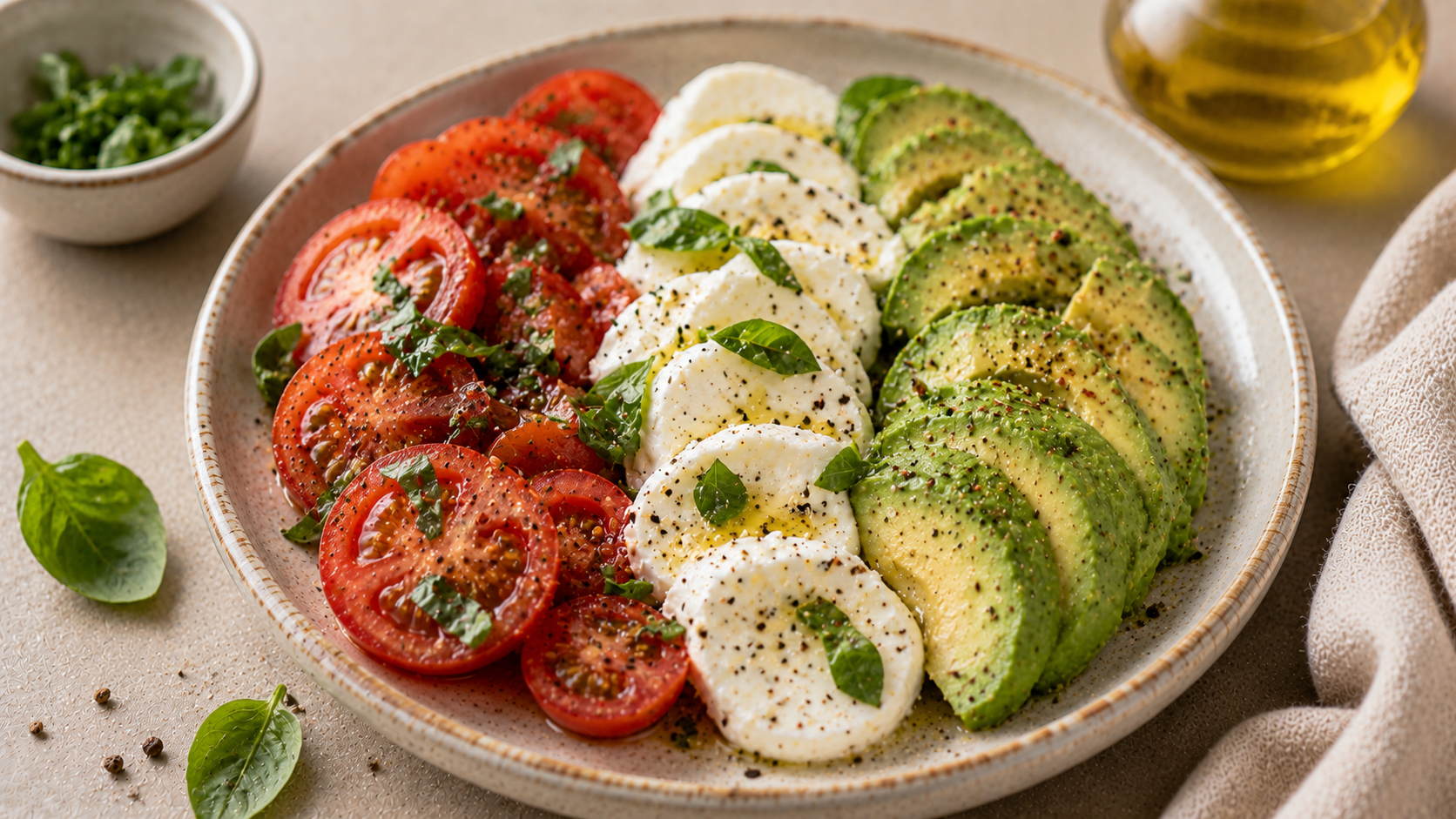
Some classics never need improving, just a little thought about the portions. The tricolour salad — the Italian caprese of tomato, mozzarella and avocado, in the green, white and red of the Italian flag — is simple, fresh and delicious, and it makes a lovely GLP-1 lunch at around 320 calories with 16g of protein. It feels like a proper little treat while being genuinely good for you.
A quick word first: I am not a doctor or a dietitian, just someone who lived this. None of these foods or supplements are medication, and if you are on a GLP-1, check anything new with your GP or pharmacist. Right, let us get to it.
For the full approach to eating on the jab, see my complete GLP-1 guide, and for protein, how much protein per day.
Why this Italian classic works
A good caprese is proof that a few great ingredients beat a long list of mediocre ones.
Mozzarella brings the protein. Fresh mozzarella gives a proper protein hit and a lovely creamy texture, making this more substantial than it looks.
Avocado adds the third colour and healthy fats. The classic caprese uses basil for the green; this version leans on avocado too, adding healthy fats and fibre.
Simple, fresh and low-carb. Just a handful of quality ingredients, no cooking, and very low in carbs — a fresh, satisfying plate for barely any effort.
Why a few good ingredients beat a long recipe
There is a lesson in the caprese salad that took me years to properly learn: the quality of your ingredients matters more than the length of your recipe. A tricolour salad is just tomato, mozzarella, avocado, basil and good olive oil — five things — and yet made with ripe, in-season tomatoes and decent mozzarella it is one of the most satisfying plates you can eat. Made with pale, watery winter tomatoes and rubbery cheese, it is disappointing. Same recipe, completely different result.
That taught me to spend a little more on the few ingredients that carry a simple dish, rather than always reaching for complicated recipes to compensate for mediocre components. On a GLP-1, where you are eating smaller portions anyway, it is a genuinely good trade to make each mouthful count with better-quality food. A ripe tomato in July needs almost nothing done to it. Learn to let good ingredients speak for themselves and you will eat better and cook less.
The macros that matter
Here is roughly what one serving gives you. Treat these as a guide rather than gospel, since it depends on your exact ingredients and portions:
| Approx per serving | Amount |
|---|---|
| Calories | ~320 kcal |
| Protein | 16g |
| Carbohydrate | 14g |
| Fat | 22g |
| Fibre | 5g |
The protein figure is the one I watch on a GLP-1. As a rough guide I aim for somewhere around 1.2 to 1.6g of protein per kilo of body weight across the day to protect muscle while losing fat, and I judge every meal by how much of that it contributes. I log meals like this in Cronometer (it is free) so I know I am actually hitting my targets rather than hoping. The first time I tracked properly I realised I was eating far less protein than I thought, so if you have never done it, give it two weeks.
What you need (serves 1)
- 1 large ripe tomato (or a few smaller ones), sliced
- ½ ball of fresh mozzarella (about 60g), sliced or torn
- ½ avocado, sliced
- A handful of fresh basil leaves
- 1 tbsp olive oil (a good one)
- 1 tsp balsamic vinegar or glaze
- Salt and black pepper
- Optional: a slice of rye or sourdough on the side
How to make it
- Arrange the sliced tomato, mozzarella and avocado on a plate, alternating them — it should look like the Italian flag.
- Tuck the fresh basil leaves in among the slices.
- Drizzle generously with the good olive oil.
- Add a little balsamic vinegar or a drizzle of balsamic glaze.
- Season well with salt and black pepper — a ripe tomato needs a bit of salt to sing.
- Serve as is for a low-carb lunch, or with a slice of rye on the side for something more substantial.
Making it a bigger meal
At 16g this is a solid light lunch, and easy to build up:
Add grilled chicken or Parma ham. Either takes it to a 30g-plus protein meal while staying true to the Italian theme.
Add more mozzarella. A simple way to bump the protein and make it more filling.
Serve with rye or sourdough. A slice on the side adds fibre and energy if you want more substance. See how much protein per day.
Choosing your mozzarella (and watching portions)
Two practical notes make this simple salad much better. First, use fresh mozzarella — the kind that comes in a ball in water, not the firm block meant for pizza. Fresh mozzarella is creamy, milky and delicate, and it is what makes a caprese special. Buffalo mozzarella is the luxury version if you can get it. Second, watch the portion, because mozzarella and avocado are both reasonably calorie-dense. Half a ball of mozzarella and half an avocado is a sensible, satisfying amount; use a whole ball and a whole avocado and the calories climb. As with so much of eating well, it is not about banning the rich, delicious ingredients, it is about enjoying a proper but sensible portion of them. A little good mozzarella beats a lot of mediocre cheese every time.
A fresh, no-prep lunch
This is a make-and-eat salad — it is at its best fresh, with ripe tomato and creamy mozzarella, and it takes about three minutes to assemble. There is not much to prep, which is part of its charm. If taking it out, keep it simple and dress it just before eating, and add the avocado fresh so it stays green. A quick, fresh addition to my meal prep ideas for Mounjaro.
How it fits a full day of eating
At 16g of protein this is a respectable light lunch, and I make sure the rest of the day carries the load — a protein-solid breakfast from my high-protein breakfasts and a proper high-protein dinner. Add chicken or Parma ham and it becomes a complete meal in its own right.
Being low-carb, it leaves room for carbs elsewhere if I want them, with a protein shake as a backstop after training. The healthy fats keep me full through the afternoon. As always, it is the day’s total protein that counts — my complete GLP-1 guide explains how I plan it.
No appetite today?
Soft, fresh and needing no cooking, this is manageable on a low-appetite day — even a few slices of tomato, mozzarella and avocado get protein and good fats in gently. When even assembling is too much, HelloFresh keeps ready meals coming. More in what to eat with no appetite.
Supplements that pair well
A fresh, whole-food plate like this is a sign your eating is on track. The avocado gives healthy fats but little omega-3, so I add Super Omega-3 EPA, and through winter Vitamin D3 + K2 for immune and bone support. The free Lily & Loaf lifestyle analysis can fine-tune the rest of your routine.
Frequently asked questions
What is a tricolour salad?
It is the Italian caprese — tomato, mozzarella and (in this version) avocado, arranged in the green, white and red of the Italian flag, hence tricolour. Simple, fresh and classic.
What mozzarella should I use?
Fresh mozzarella — the soft ball in water, not the firm block for pizza. It is creamy and delicate, which is what makes the salad special. Buffalo mozzarella is the luxury option.
Is it filling enough for lunch?
As a light, low-carb lunch, yes, thanks to the mozzarella and avocado. For a hungrier day, add grilled chicken, Parma ham or a slice of rye on the side.
How do I make it higher in protein?
Add grilled chicken or Parma ham for a 30g-plus meal, or simply use more mozzarella. All keep the Italian theme intact.
Can I make it in winter?
You can, but it is at its best in summer with ripe, in-season tomatoes. Out of season, use the sweetest cherry or vine tomatoes you can find, as the tomato really carries this dish.
The bottom line
The tricolour salad is a classic caprese done right — tomato, fresh mozzarella and avocado, simple, fresh and low-carb, at around 320 calories with 16g of protein. It is a lesson in letting a few good ingredients speak for themselves rather than reaching for complicated recipes. Add grilled chicken or Parma ham for a complete meal. To match your supplements to a fresh, whole-food diet, the free Lily & Loaf lifestyle analysis is a quick, no-pressure check.
The tools I lean on
If you are putting a GLP-1 routine together, this is the order I would do it in, free tools first:
- Track a fortnight of food in Cronometer so you can see your real protein and calories.
- Take the free Lily & Loaf lifestyle analysis to find the supplements actually worth buying.
- Start an Audible trial for something to listen to while you cook or walk.
- Keep HelloFresh on standby for the weeks cooking from scratch just is not happening.
A bit about me
I am Alan Spicer. I lost around seven stone on Mounjaro and filmed the whole thing, warts and all, on my YouTube channel. Simple, protein-first lunches like this were a real part of how I held onto muscle and kept the weight off.
This article shares my personal experience and general information only. It is not medical advice. Food and supplements support a balanced diet and healthy lifestyle and do not replace it or any treatment prescribed by your doctor. Speak to your GP or pharmacist before making changes, especially while on a GLP-1 medication. Nutrition figures are approximate and will vary with the exact ingredients and brands you use.
Inspired by the kind of fresh, wholefood lunches in the Lily & Loaf lunches collection. This is my own version, written from my own kitchen.
Discover more from Healthy Weight Loss GLP1
Subscribe to get the latest posts sent to your email.