
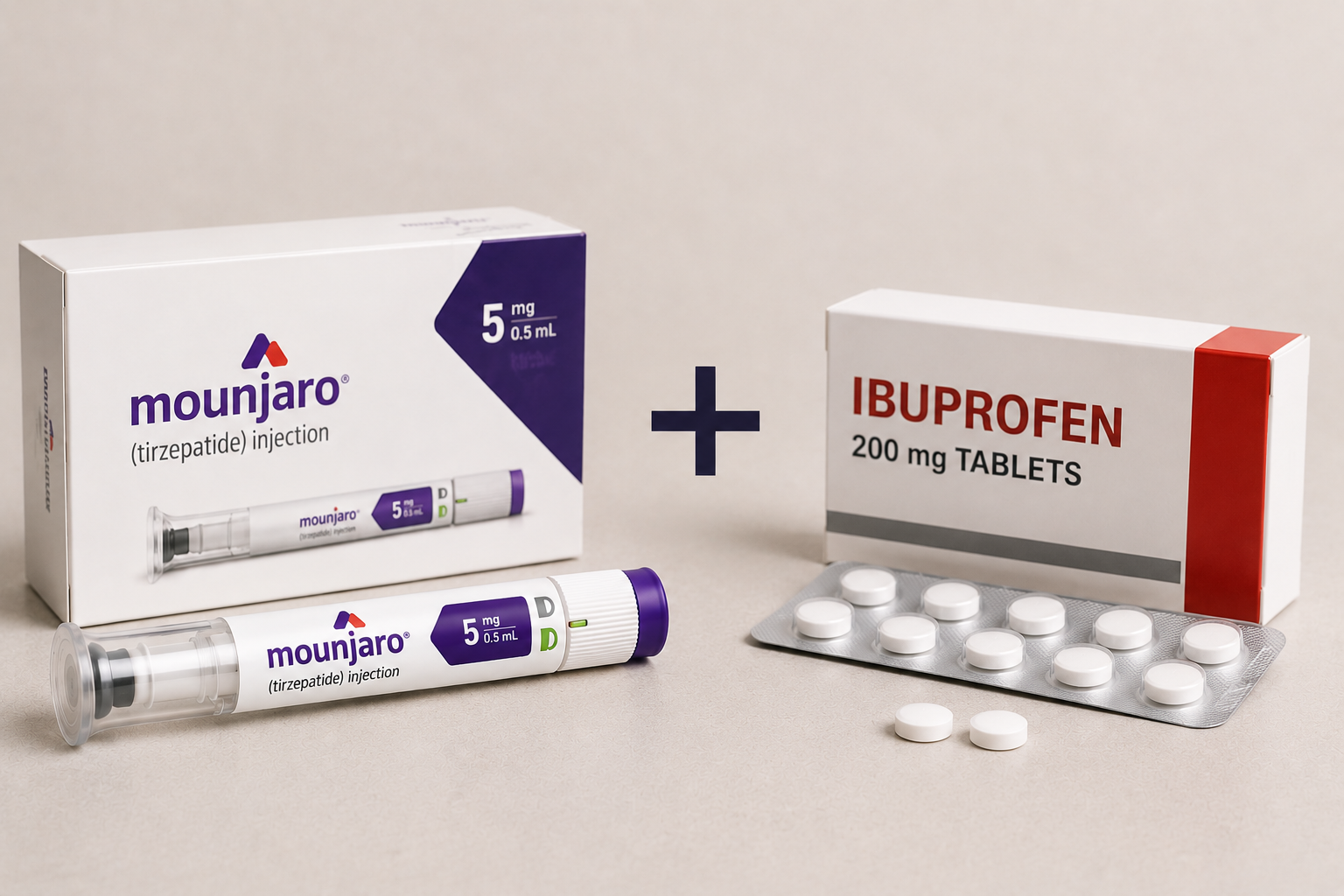
Ibuprofen and other NSAIDs (naproxen, diclofenac, aspirin at anti-inflammatory doses) are not contraindicated with Mounjaro — there’s no direct drug interaction between tirzepatide and NSAIDs. The practical considerations are indirect: Mounjaro’s slowed gastric emptying means NSAIDs sit in the stomach longer and increase gastric irritation risk, and chronic NSAID use alongside a GLP-1 carries a slightly elevated risk of gastric ulcers. For occasional use, ibuprofen with food is fine. For regular use, the picture is more nuanced.
For paracetamol (the first-choice alternative): Can I Take Paracetamol on Mounjaro UK. For general medication interactions: GLP-1 Medication Interactions UK.
The direct answer on safety
Mounjaro and ibuprofen do not interact at the pharmacological level — tirzepatide doesn’t affect ibuprofen metabolism, and ibuprofen doesn’t affect tirzepatide. This is confirmed in the Mounjaro prescribing information, which doesn’t list NSAIDs as a specific interaction concern.
Occasional ibuprofen (for headache, period pain, minor injury) taken with food is generally fine on Mounjaro.
Why the situation is more nuanced for regular NSAID use
Slowed gastric emptying amplifies NSAID gastric effects
NSAIDs work partly by inhibiting prostaglandins in the stomach lining that normally protect against acid damage. This protective inhibition is independent of whether you take ibuprofen with food — but taking NSAIDs without food concentrates the irritant effect in the stomach.
On Mounjaro, gastric emptying is slowed. An ibuprofen tablet taken with a small meal sits in the stomach significantly longer than it would pre-medication. This extended contact time increases gastric irritation risk — not dramatically for occasional use, but meaningfully for regular use (daily or near-daily).
The result in practice: users on regular NSAID therapy (for osteoarthritis, chronic pain, or conditions requiring regular anti-inflammatory treatment) have higher gastric ulcer and gastritis risk on a GLP-1 than they would have off it.
Kidney function consideration
Both NSAIDs and GLP-1 medications (in the context of dehydration) can affect kidney function. NSAIDs reduce renal blood flow; dehydration on a GLP-1 can temporarily impair kidney function. Using NSAIDs regularly while inadequately hydrated on Mounjaro creates a compound risk, particularly for users with any pre-existing kidney impairment.
This is a reason to maintain good hydration (see Electrolytes on GLP-1 UK) rather than a reason to avoid ibuprofen entirely — but it’s worth knowing.
Ibuprofen vs paracetamol on Mounjaro: which to choose
For most common pain scenarios — headache, mild injury, period pain, post-exercise soreness — paracetamol is the better first choice on Mounjaro because:
- No gastric irritation risk (doesn’t affect stomach lining)
- No prostaglandin inhibition and associated kidney effects
- Safe at standard doses (1g four times daily maximum) without food
- Equally effective as ibuprofen for most mild-to-moderate pain
Ibuprofen wins over paracetamol for:
- Inflammatory pain (joint swelling, inflammatory conditions) — NSAIDs address the inflammation; paracetamol doesn’t
- Period pain — prostaglandins drive menstrual cramping; NSAIDs specifically address this mechanism
- Dental pain — often has an inflammatory component that responds better to NSAIDs
- Headache with a strong inflammatory component
If ibuprofen is clinically the better choice for your pain type, use it with food and keep the course short. Don’t default to avoiding it entirely — just don’t use it as your first-choice painkiller for non-inflammatory pain.
How to take ibuprofen safely on Mounjaro
When ibuprofen is the right pain medication for your situation:
- Always take with food — even a small amount (plain crackers, yoghurt) significantly reduces gastric irritation risk
- Use the lowest effective dose for the shortest necessary time — standard OTC dose is 400mg three times daily; don’t exceed 1,200mg per day without prescriber guidance
- Stay well hydrated throughout — particularly relevant given Mounjaro’s own fluid considerations
- Avoid taking on injection day if you’re already nauseous — gastric irritation on top of medication-related nausea makes for a bad combination
- Don’t combine with aspirin at anti-inflammatory doses — both are NSAIDs and combining them increases GI risk without adding benefit
If you need NSAIDs regularly
Regular NSAID use (three or more times per week consistently) on a GLP-1 warrants a conversation with your GP. Options include:
Gastric protection: a proton pump inhibitor (omeprazole, lansoprazole) taken alongside regular NSAIDs significantly reduces ulcer risk. Available on NHS prescription for patients requiring regular NSAIDs. This is common practice for patients on NSAIDs regardless of GLP-1 use — the GLP-1 adds a reason to discuss it if you’re not already taking a PPI.
Alternative pain management: for conditions like osteoarthritis where NSAIDs are regularly needed, physiotherapy, topical anti-inflammatory creams (topical diclofenac gel — lower systemic absorption than oral NSAIDs), and physical activity may reduce the need for oral NSAIDs. Weight loss itself reduces joint load significantly — many Mounjaro users find NSAID requirements reduce as weight drops.
Alternative anti-inflammatory medications: for specific conditions, prescribers may recommend COX-2 selective NSAIDs (celecoxib, etoricoxib) which have lower GI ulcer risk than traditional NSAIDs. Prescription only and not suitable for everyone.
Specific scenarios
Post-workout soreness
Paracetamol first choice. NSAID use after resistance training may slightly blunt muscle protein synthesis — not a major effect, but a reason to prefer paracetamol for exercise-related soreness when both are equally effective.
Period pain
Ibuprofen is significantly more effective than paracetamol for menstrual cramping. Take with food. Standard course of 2–3 days per cycle at OTC doses is fine on Mounjaro.
Dental pain
Often benefits from anti-inflammatory action — ibuprofen typically works better than paracetamol alone. Ibuprofen plus paracetamol alternating is a common dental pain protocol (safe to combine at standard doses — they work through different mechanisms).
Headache
Paracetamol first choice. If ineffective, ibuprofen with food as a second option. Note: headaches on Mounjaro are often dehydration-related (common side effect) — try fluids and electrolytes before reaching for any painkiller.
Injury or acute inflammation
Ibuprofen is appropriate here — the anti-inflammatory benefit justifies the gastric risk. Short course, with food, adequate hydration. For significant injuries, discuss with your GP whether prescription NSAIDs with gastric protection are more appropriate than OTC ibuprofen.
Aspirin — special case
Low-dose aspirin (75mg daily) prescribed for cardiovascular protection is a different situation from anti-inflammatory aspirin use. Most patients on low-dose aspirin continue it on Mounjaro — it’s prescribed for a specific cardiovascular risk reason and stopping it requires a clinical decision, not a self-adjustment.
If you’re on low-dose aspirin and starting Mounjaro, mention it to your prescriber. They’ll typically advise continuing the aspirin unchanged and may recommend a PPI alongside it.
Frequently asked questions
Can I take ibuprofen while on Mounjaro?
Yes, with food, for short courses. There’s no direct pharmacological interaction. The main consideration is that slowed gastric emptying increases gastric irritation risk with NSAIDs, so taking with food and keeping courses short reduces this.
Is paracetamol or ibuprofen better on Mounjaro?
Paracetamol is the better default choice for most common pain on Mounjaro — no gastric effects, no kidney considerations. Ibuprofen is the better choice specifically for inflammatory pain, period pain, and dental pain where its anti-inflammatory mechanism provides a clinical advantage.
Can I take ibuprofen and Mounjaro on the same day?
Yes. Taking them at the same time isn’t required or contraindicated. Take ibuprofen with food; take Mounjaro as your normal injection regardless of ibuprofen timing.
Does ibuprofen interfere with Mounjaro weight loss?
Not directly. Ibuprofen doesn’t affect tirzepatide’s mechanism of action or absorption. Regular NSAID use may contribute to water retention at higher doses, which can temporarily affect scale readings, but doesn’t impair actual fat loss.
I’m on regular NSAIDs for arthritis — do I need to stop them on Mounjaro?
Don’t stop without speaking to your GP. Regular NSAID use on Mounjaro warrants a GP conversation about gastric protection (a PPI may be recommended). The good news is that weight loss on Mounjaro typically reduces arthritic joint pain significantly — you may find your NSAID requirements reduce naturally over the first six to twelve months of treatment.
Medical disclaimer: this is general information. Consult your GP or pharmacist before making changes to regular medications. If you experience significant stomach pain, black stools, or vomiting blood while taking NSAIDs, seek urgent medical attention.
Tracking pain patterns alongside medication use
One useful practice for GLP-1 users on regular NSAID therapy: log pain episodes and medication use alongside weight progress. This serves two purposes.
First, it documents the improvement in pain as weight drops — joint pain from osteoarthritis and mechanical musculoskeletal conditions typically reduces as load decreases. Users who needed ibuprofen twice weekly pre-treatment often find they need it once a week at six months, and rarely at twelve months. This pattern, documented, supports conversations with your GP about whether NSAID therapy can be reduced or stopped.
Second, it identifies whether certain foods or injection-day patterns correlate with pain flares. Some users notice inflammation-related pain is worse around injection days — this isn’t firmly established clinically but tracking the pattern helps identify it individually.
Log this in a simple notes field alongside your food diary in Cronometer, or in a separate journal. The data is most useful at GP review appointments where you’re discussing whether continued NSAID use is still appropriate as weight and mobility change.
The longer-term picture is encouraging: significant weight loss on Mounjaro (15%+) produces joint load reduction that often allows NSAID therapy to be stepped down or discontinued under GP supervision. Many users who started treatment partly because of pain-related mobility issues find this is one of the most life-changing non-scale benefits of treatment — and one that their GP can formally document and act on.
Discover more from Healthy Weight Loss GLP1
Subscribe to get the latest posts sent to your email.