
⚕️ Medical Disclaimer
This content is for informational purposes only and does not constitute medical advice. Always consult your GP or prescribing clinician before making changes to your medication, diet, or supplement regimen.
⚡ QUICK ANSWER
Does collagen help with loose skin during weight loss?
Collagen supplementation may support skin elasticity during weight loss, though evidence is moderate rather than conclusive. Hydrolysed collagen peptides (particularly Type I and III) have shown improvements in skin elasticity, hydration, and dermal density in multiple RCTs. The effect is likely greater in people who are collagen-deficient (older adults, those with poor diet, or rapid weight loss). Combined with adequate protein, vitamin C, and hydration, collagen supplementation provides a reasonable supporting role.
Loose skin and changes to hair and nail quality are among the most common concerns for people losing significant weight — particularly on GLP-1 medications where the rate of loss can be rapid. This guide covers what collagen actually does, what the evidence says, and which forms and products are worth buying in the UK in 2026. For the broader skin and hair picture: Loose Skin After Weight Loss on GLP-1 and Hair Loss on GLP-1.
What Is Collagen and Why Does Weight Loss Deplete It?
Collagen is the most abundant protein in the human body — it forms the structural matrix of skin, tendons, ligaments, cartilage, and bone. It is produced by fibroblast cells using amino acids (primarily glycine, proline, and hydroxyproline) with vitamin C as a required cofactor.
During significant weight loss, collagen loss occurs through two mechanisms:
- Reduced synthesis: Calorie restriction reduces the raw materials available for collagen production. On GLP-1 medication with suppressed appetite, this risk is elevated without deliberate protein and vitamin C intake.
- Stretched and damaged existing collagen: When fat cells shrink, the collagen scaffolding of the skin that previously surrounded them may be damaged or insufficient to contract — contributing to loose skin appearance
Types of Collagen — Which One Matters?
| Collagen Type | Found In | Supplement Relevance |
|---|---|---|
| Type I | Skin, hair, nails, tendons, bones, teeth | Most abundant; primary target for skin elasticity and hair supplements |
| Type II | Cartilage | Joint health supplements — specifically targeted for arthritis and joint pain |
| Type III | Skin, blood vessels, organs (found with Type I) | Often combined with Type I in skin supplements |
| Type V | Hair, placenta, neonatal tissue | Minor component of hair-targeted supplements |
| Marine collagen | Fish skin and scales — primarily Type I | Higher bioavailability than bovine; popular in UK skin supplements |
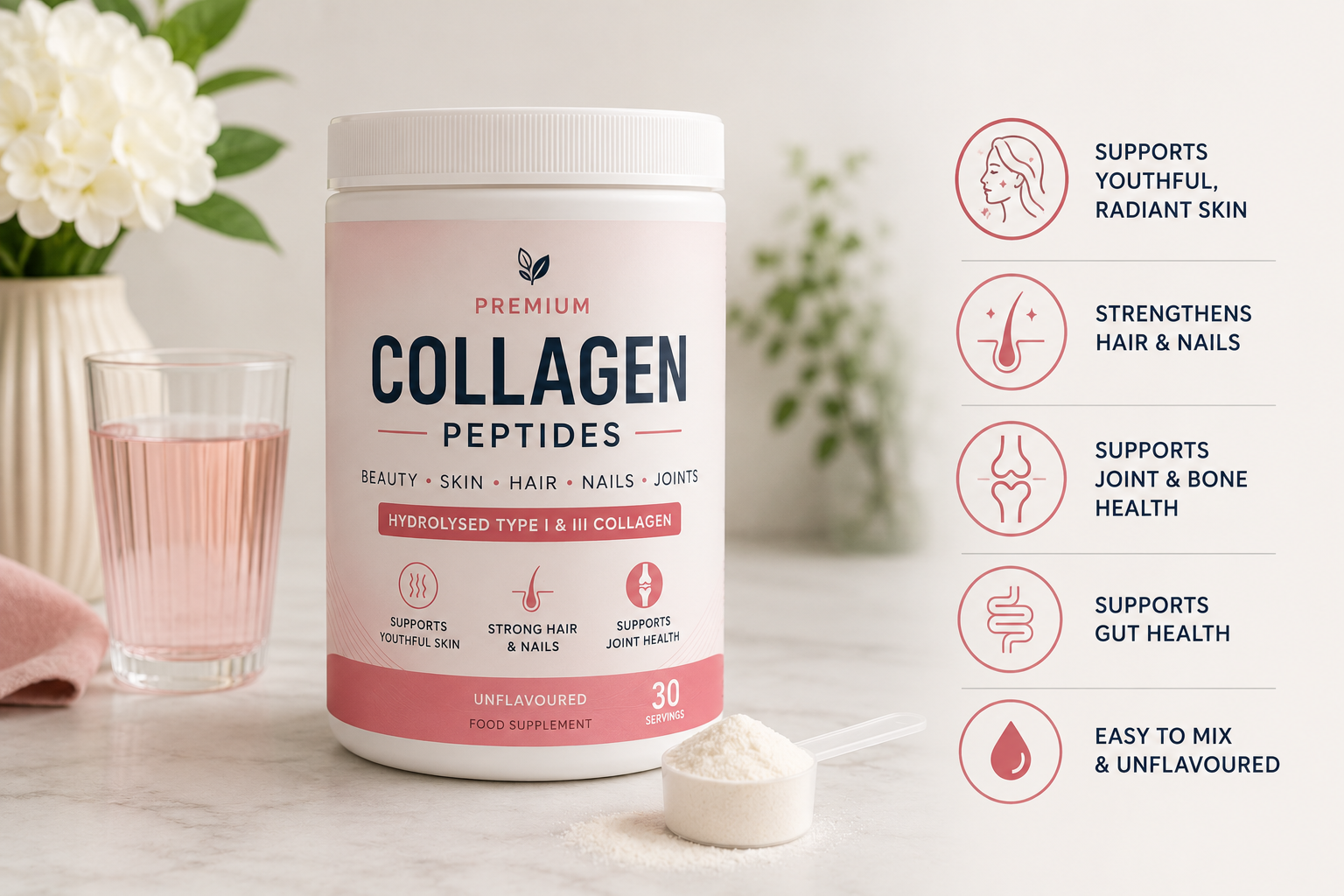
For weight loss and skin concerns: Type I and III collagen peptides are the relevant forms. For joint pain from weight: Type II collagen (found in specific joint health supplements).
Does Collagen Supplementation Actually Work? — The Evidence
The evidence base for collagen supplementation is more robust than many supplements — though not definitive:
- A 2019 systematic review of 11 RCTs found hydrolysed collagen improved skin hydration, elasticity, and reduced wrinkle depth over 4-24 weeks
- A 2021 meta-analysis of 19 trials found significant improvement in skin elasticity and dermal density with 2.5-10g daily collagen peptide supplementation
- Joint pain studies show benefit particularly for osteoarthritis — Type II collagen at 10-40mg/day or collagen peptides at 10g/day showed significant pain reduction in multiple trials
- Hair thickness and growth: evidence is limited but several small trials show improvements with collagen peptide supplementation, particularly in women with hair thinning
💡 Vitamin C Is Essential for Collagen Synthesis
Collagen cannot be synthesised without vitamin C — it is a required cofactor for the enzymes that cross-link collagen fibres. Supplementing collagen without adequate vitamin C intake is less effective. Lily & Loaf Vitamin C alongside collagen provides the cofactor needed for optimal synthesis.
Lily & Loaf Collagen Plus — The GLP-1 User Pick
Lily & Loaf Collagen Plus (use code ALAN10 for 10% off) combines marine collagen peptides with vitamin C, zinc, and biotin — the complete cofactor stack for collagen synthesis and skin health. The marine source provides Type I collagen in hydrolysed form for maximum absorption. It is specifically designed for women in weight management, making it particularly relevant for GLP-1 users concerned about skin changes during rapid fat loss.
Full review: Lily & Loaf Collagen Plus Review UK
Other UK Collagen Supplements Worth Considering
| Product | Type | Dose | Best For | Amazon |
|---|---|---|---|---|
| Vital Proteins Collagen Peptides | Bovine Type I+III | 20g per serving | High-dose bovine collagen — unflavoured, mixes well | Find on Amazon |
| Hunter & Gather Marine Collagen | Marine Type I | 10g per serving | Marine source; clean ingredients; joint and skin combined | Find on Amazon |
| Further Food Collagen | Bovine peptides | 10g per serving | Budget-friendly; unflavoured for adding to food or drinks | Find on Amazon |
| Solgar Full Spectrum Collagen | Multi-type blend | Each capsule varying | Capsule format for those who prefer not to add powder to drinks | Find on Amazon |
How to Take Collagen for Best Results During Weight Loss
- Dose: 2.5-10g daily of hydrolysed collagen peptides. 10g/day is the dose showing strongest skin results in clinical trials.
- Timing: No evidence that timing matters significantly. Consistent daily use matters more than specific timing.
- With vitamin C: Take with Vitamin C or a vitamin C-rich food. This is the most evidence-backed combination for collagen synthesis.
- With protein: Collagen is not a complete protein (low tryptophan) — do not rely on it as your sole protein source. Combine with complete protein sources or pea protein
- Duration: Studies typically show results after 8-12 weeks of consistent supplementation. This is not a rapid-action supplement.
Lifestyle Factors That Affect Collagen — Beyond Supplementation
- Hydration: Dehydrated skin loses elasticity rapidly. Hydration on GLP-1 covers the specific challenges on medication.
- UV protection: UV radiation directly degrades collagen. SPF30+ daily significantly protects skin collagen during outdoor activity.
- Smoking: Smoking is one of the most potent inhibitors of collagen synthesis — more impactful than any supplement.
- Sleep: Collagen synthesis occurs primarily during deep sleep. Sleep on GLP-1 is therefore directly relevant to skin health during weight loss.
RECOMMENDED SUPPLEMENTS
Lily & Loaf — Quality Supplements for GLP-1 Users
Lily & Loaf Collagen Plus, Vitamin C, and Biotin — the complete skin and hair support stack for GLP-1 weight loss.
📚 RELATED READING
Some links in this post are affiliate links. If you purchase through them, I may earn a small commission at no extra cost to you. I only recommend products I use myself. Use code ALAN10 for 10% off Lily & Loaf. This post is for informational purposes only — always consult your GP for medical advice.
Collagen and Joint Health — The GLP-1 Relevance
Weight loss relieves mechanical load on joints significantly — each kilogram lost reduces knee joint force by approximately 4kg per step. However, rapid weight loss can temporarily affect joint support structures as the soft tissue adapts. Collagen supplementation may support this transition:
- Type II collagen specifically targets cartilage — the cushioning between joints
- Vitamin C alongside collagen is essential for the enzymatic cross-linking that makes collagen mechanically useful
- Type II collagen supplement UK — specific cartilage support, different from skin-focused Type I/III products
- Dose for joint benefit: 10g/day hydrolysed collagen peptides or 10-40mg specific Type II collagen — these are different mechanisms at different doses
Sources: Shaw et al., 2017: Vitamin C-enriched collagen for joint support · Zdzieblik et al., 2021: Collagen peptides and knee osteoarthritis
Discover more from Healthy Weight Loss GLP1
Subscribe to get the latest posts sent to your email.