
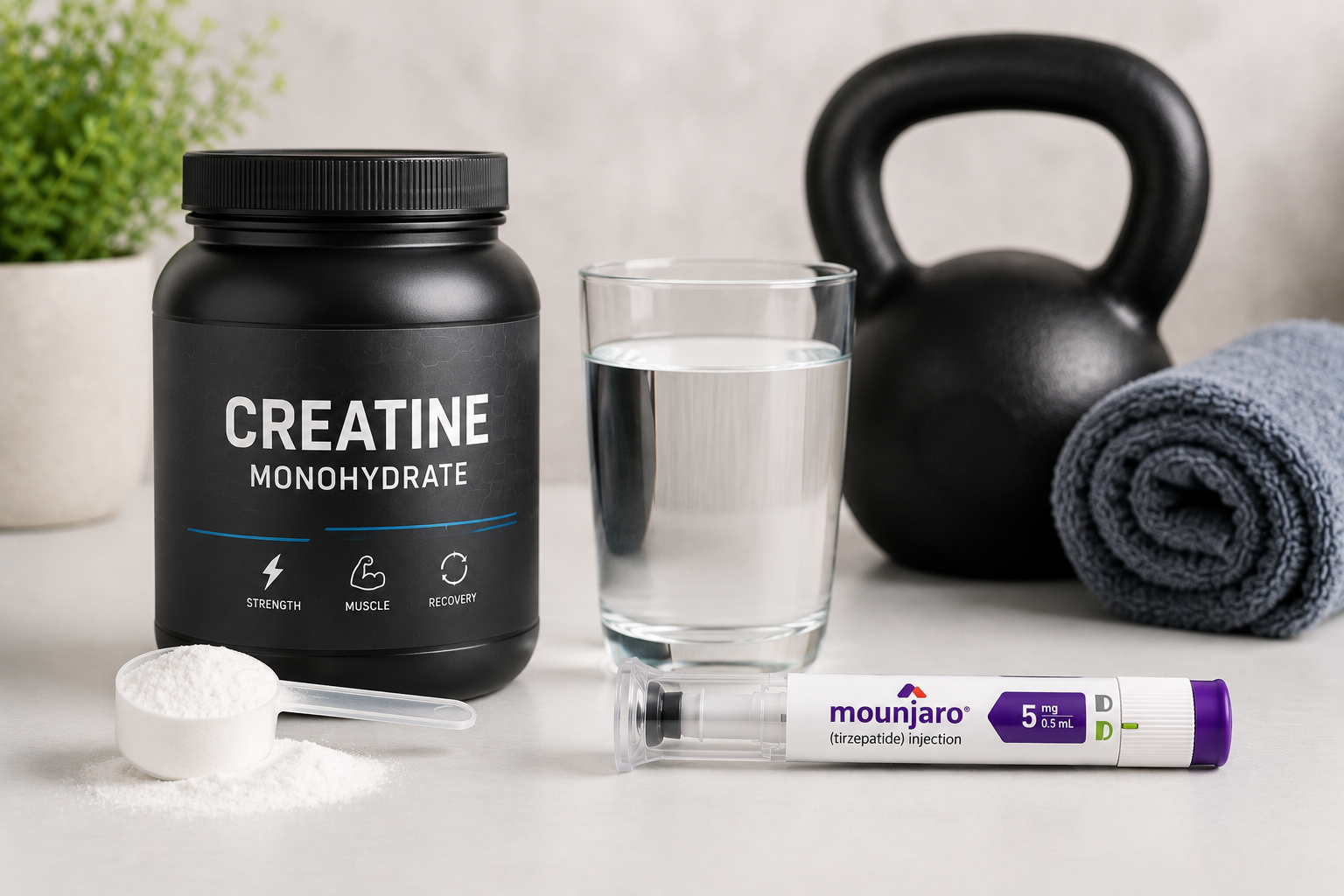
Creatine is one of the most well-researched supplements in sports science and one of the most underused by GLP-1 users. For anyone on Mounjaro trying to preserve muscle during rapid weight loss, creatine monohydrate offers a specific and meaningful benefit: it improves the quality of each resistance training session by supporting ATP regeneration, which means more work per set and better muscle retention signalling. It doesn’t cause water weight gain in the way gym myths suggest, it’s safe at standard doses, and it costs around £15–25 for a three-month supply. This is the evidence-based UK guide.
For the training context: Strength Training on GLP-1 UK and Progressive Overload Explained UK. For the broader supplement picture: Supplements on GLP-1 Starter Stack UK.
What creatine actually does
Creatine phosphate is stored in muscle cells and used to rapidly regenerate ATP (adenosine triphosphate) — the immediate energy currency of muscle contraction. When you do a heavy set of squats or kettlebell swings, ATP runs out quickly. Creatine phosphate replenishes it, allowing one or two more quality reps before fatigue forces you to stop.
Those extra reps, accumulated over weeks of training, produce a measurably higher training stimulus — which means better muscle retention and modest strength improvement compared to training without creatine supplementation.
Secondary effects with growing evidence:
- Cognitive function: creatine supports brain ATP regeneration as well as muscle. Research shows modest improvements in processing speed and memory under fatigue — relevant for GLP-1 users who experience brain fog in early treatment
- Bone density: some evidence for creatine supporting bone mineral density, relevant during rapid weight loss where bone density changes can occur
- Recovery: slightly faster recovery between training sessions, supporting three-sessions-per-week training structure
The water weight myth, clarified
The most common creatine misconception: “it makes you hold water weight.” This requires nuance for GLP-1 users.
Creatine is stored in muscle cells alongside water — approximately 0.3–0.5g of water is held per gram of creatine stored. During initial supplementation (loading or gradual approach), muscle creatine stores fill and total body water in muscle increases by approximately 0.5–1.5kg over 2–4 weeks.
Important distinctions:
- This water is intramuscular — inside muscle cells, not subcutaneous bloating
- The scale may not move or may slightly increase during loading, despite fat loss continuing
- This is not the same as the subcutaneous water retention that makes you look puffy
- Once stores are saturated, no further water is held — the effect is a one-time plateau in scale weight of 1–2 weeks, then normal fat loss continues
For GLP-1 users already experiencing frustrating scale stalls, understanding that creatine causes a brief, expected weight change prevents misinterpreting normal creatine pharmacology as a plateau.
Creatine for muscle preservation on GLP-1s: the specific case
The standard concern with rapid weight loss is the ratio of muscle to fat in total weight lost. Without intervention, GLP-1-mediated rapid weight loss includes approximately 15–25% lean mass loss (muscle, connective tissue, organ tissue). With adequate protein and resistance training, this drops to 5–10%.
Creatine adds a third layer of protection:
- Better training performance → stronger muscle contraction signal → stronger retention stimulus
- Improved cognitive function on lower calories → better adherence to training and nutrition protocols
- Potential direct anti-catabolic effect (limited but emerging evidence)
This makes creatine a sensible addition to the muscle preservation stack of protein + resistance training for GLP-1 users.
How to take creatine on a GLP-1
Loading vs gradual approach
Loading protocol: 20g per day (4 × 5g doses) for 5–7 days, then 3–5g daily maintenance. Fills muscle stores within a week. The higher initial dose can cause GI discomfort — particularly relevant for GLP-1 users with already-sensitised GI systems. Not recommended for most Mounjaro users.
Gradual approach (recommended for GLP-1 users): 3–5g daily from day one. Muscle stores fill to the same level within 3–4 weeks rather than one week. No GI side effects, no sudden scale fluctuation to misinterpret. This is the better choice for most people on Mounjaro.
Dose: 3g–5g daily. Research suggests 3g is effective for most adults; 5g is the standard recommendation. Larger doses (10g+) don’t produce proportionally better results.
Timing: doesn’t matter significantly. Post-workout is slightly better supported by evidence. Many users simply take it with their morning protein shake or a meal.
With food: taking with a meal or carbohydrate source marginally improves uptake. On a GLP-1 where meals are small, mixing into a protein shake or Greek yoghurt works fine.
Which form to buy
Creatine monohydrate: the form in virtually all research. Cheap, effective, widely available. Buy this. Nothing else is meaningfully better for the purpose of muscle preservation on a GLP-1.
Forms to ignore:
- Creatine HCl: marginally better solubility, not better efficacy. Higher cost, no benefit.
- Buffered creatine (Kre-Alkalyn): claimed to reduce breakdown in the stomach. Evidence doesn’t support superiority over monohydrate.
- Creatine ethyl ester: less effective than monohydrate in head-to-head trials. Avoid.
- Liquid creatine products: creatine is unstable in solution. Poor shelf life, poor efficacy.
Creatine monohydrate powder from a reputable UK supplier at 3–5g daily is the entirety of the evidence-based recommendation.
UK products worth considering
Verify your intake with Cronometer if you’re supplementing — log creatine as a food entry (creatine provides approximately 0 calories) to note the daily addition to your protocol without it inflating your calorie count.
Bulk Powders Pure Creatine Monohydrate: unflavoured, highly pure, cost-effective. Check pricing on Amazon UK. One of the most tested brands in the UK market.
Optimum Nutrition Micronised Creatine: slightly finer powder, mixes a little more easily. Slightly more expensive but widely trusted. Available in most UK supplement retailers.
MyProtein Creatine Monohydrate: UK brand, competitive pricing, HPLC-tested batches. Good quality for the price.
There is no meaningful difference between these products for muscle preservation purposes. Buy whichever is cheapest per gram of creatine monohydrate from a reputable supplier with batch testing.
Safety and side effects
Creatine monohydrate at 3–5g daily has an exceptional safety profile. Studies of up to five years of continuous supplementation show no adverse kidney or liver effects in healthy adults.
Specific note for GLP-1 users: creatine is sometimes associated with a slight increase in serum creatinine (a kidney function marker) — this is not kidney damage but reflects higher total creatine turnover. If you have kidney function tests while on creatine, mention supplementation to your GP so the result is interpreted correctly.
GI side effects are rare at 3–5g daily gradual approach. If you experience any, split the dose (1.5–2.5g twice daily) or take with food.
Creatine alongside other supplements
No interactions of concern with Mounjaro. Safe alongside protein powder, electrolytes, magnesium, B12, iron, and other supplements commonly used by GLP-1 users. Can be mixed with protein shakes directly.
Frequently asked questions
Should GLP-1 users take creatine?
If you’re doing resistance training, yes — it’s the most evidence-backed supplement specifically for improving training performance and muscle retention alongside a calorie deficit. If you’re not training, the benefit is minimal.
Will creatine cause weight gain on Mounjaro?
The scale may plateau or show a 0.5–1.5kg increase during the first 3–4 weeks as muscle creatine stores fill with associated intramuscular water. This reverses the scale benefits temporarily but does not represent fat gain. Fat loss continues during this period.
Is creatine safe with Mounjaro?
Yes. No interaction between tirzepatide and creatine. Standard safety considerations apply: maintain good hydration, and if you have pre-existing kidney issues, discuss with your GP before starting.
How long before creatine works?
With the gradual approach (3–5g daily from day one), training performance improvements are typically noticeable by weeks 3–4 as muscle stores fill. The cognitive benefits (reduced brain fog) may appear slightly earlier.
Do I need to cycle creatine?
No. Continuous daily use is supported by research up to five years. Cycling on and off is a gym myth with no evidence basis. Take it daily.
Creatine and the broader GLP-1 supplement stack
Creatine slots cleanly into a GLP-1 supplement routine without interaction concerns. For users building their full stack, here’s how creatine fits alongside the other most useful additions:
Priority 1 (most users need): protein powder — to hit protein targets on reduced appetite. Creatine can be mixed directly into a protein shake.
Priority 2 (most users benefit from): magnesium glycinate — sleep, constipation, muscle function. See Magnesium on GLP-1 UK.
Priority 3 (very common deficiency): vitamin D3 — particularly in UK adults where dietary and sun exposure is low. See Vitamin D3+K2 UK.
Priority 4 (if training): creatine monohydrate — specifically for users doing resistance training. Not useful without training.
Priority 5 (if low from diet): omega-3, B12, iron, zinc — check with Cronometer first; supplement specifically where gaps are identified rather than blanket supplementation.
Log your supplement doses in Cronometer alongside food. This isn’t for calorie tracking purposes (most supplements are negligible) — it’s for maintaining a consistent supplementation record and for conversations with your GP when they’re reviewing your overall health picture. A prescriber asking “are you taking any supplements?” benefits from an accurate answer, and Cronometer makes that easy to provide.
The complete stack costs approximately £40–60 per month for all five priorities at recommended doses from UK suppliers. Creatine monohydrate is the cheapest item — roughly £15 for a three-month supply from Bulk Powders or MyProtein. High value per pound spent relative to its training performance and muscle preservation benefits.
Discover more from Healthy Weight Loss GLP1
Subscribe to get the latest posts sent to your email.