
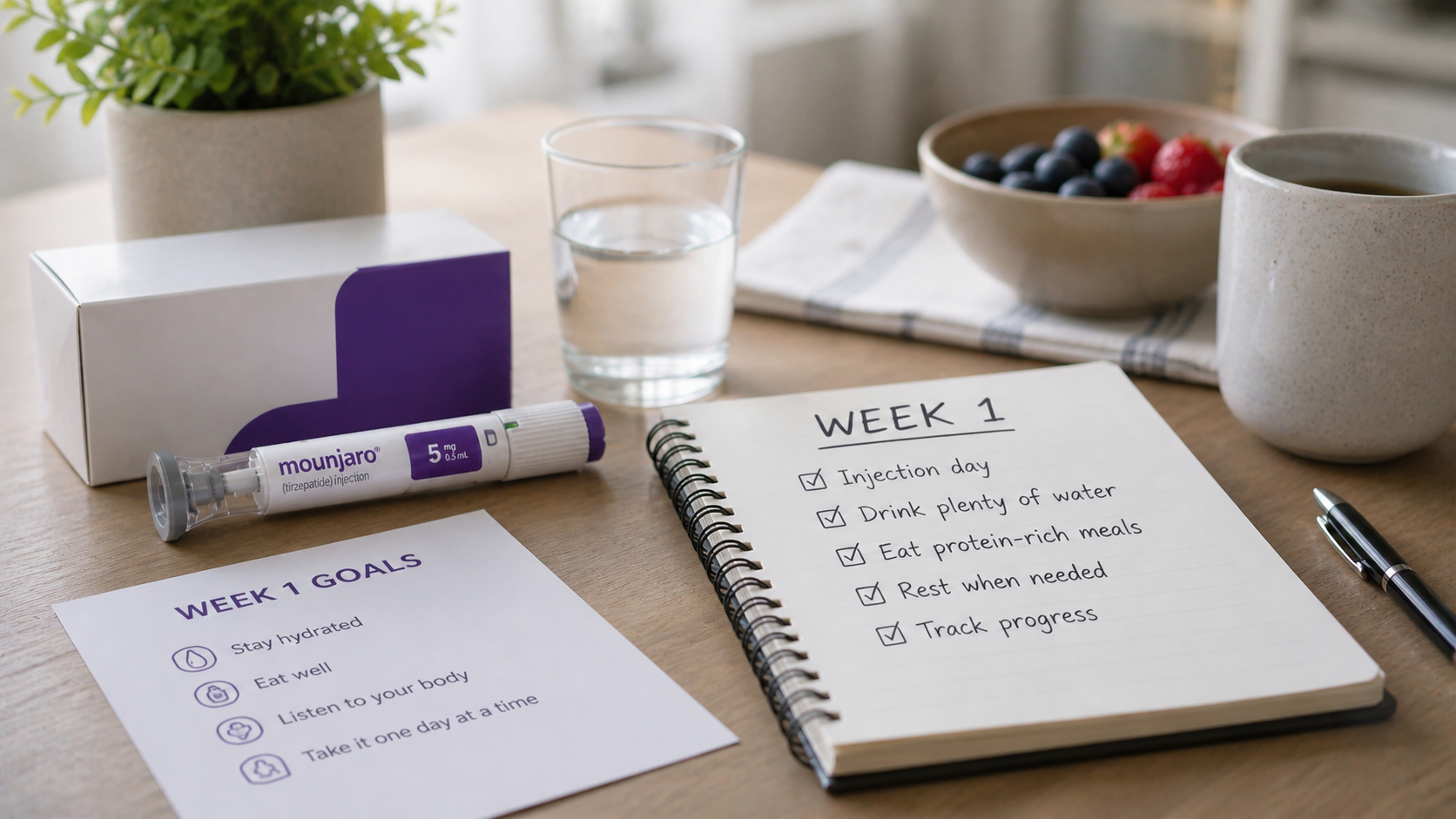
The first week on Mounjaro is the one everyone overthinks and underprepares for. Here’s what genuinely happens day by day, what’s normal vs what’s not, and how to set yourself up so the second week is easier than the first. Based on my own week-one notes from starting in early 2025 and what I’ve learned writing to thousands of people going through theirs.
For the broader first-month picture, see First Month on Mounjaro UK (in prep). For the full weeks 1–4 framework, Starting Out in the Complete Guide. This post is strictly week one.
Before your first injection: the 48-hour prep
The right prep matters more than most people realise. In the 48 hours before your first dose:
1. Read your pen’s patient information leaflet. Yes, all of it. It’s 30 minutes. You’ll learn which button does what, where to store the pen, expected side effects, and contraindications. Most anxiety about injection is solved by just knowing the mechanism.
2. Plan your injection day. Most people pick Sunday evening as their default. Rationale: peak side effects hit 24–72 hours later (Monday/Tuesday) when you’re at home or at a desk, rather than travelling, socialising, or doing heavy physical work. Pick a day that will repeat weekly and stick to it.
3. Stock practical items. Plain water and electrolyte drinks (SiS Go Hydro tablets or Lily & Loaf Electrolyte Drink work well). Ginger tea or fresh ginger. Peppermint tea. Plain crackers or dry toast. Paracetamol for headaches. Tissues. Light, bland food for the first 48 hours after injection.
4. Eat protein-first the day before. If your eating pattern pre-Mounjaro was carb-heavy, shift to a protein-forward meal the evening before your first injection. Your stomach will empty more slowly on medication, and the last big meal you have before your first dose can sit heavily if it’s carb-dense.
5. Hydrate. Start drinking properly a day ahead. 2 litres of fluid. Good hydration blunts the worst of early side effects.
6. Skip alcohol the day before and the day of. Alcohol plus early GLP-1 adaptation is a grim combination.
7. Don’t panic-buy the entire supplement stack yet. Starting five new things at once means you can’t tell which is helping or causing which. Start the medication first; add supplements in week 2 or 3.
Injection day (Day 0)
The injection itself is almost anticlimactic. The Mounjaro pen is a single-use auto-injector designed to be simple: remove cap, press against skin, push the button, hold for 10 seconds, done. The needle is very fine (32 gauge typically) and barely felt by most people.
Where to inject on day one: thigh or abdomen. Thighs are easier for first-timers because you can see the site clearly and have both hands free. Abdomen is fine, at least 2 inches from the navel.
What to feel on day one: practically nothing. Almost no one feels the first injection in their body hours later. Any nausea or GI effects on day 0 itself are usually psychological (anxiety, hyper-awareness of body) rather than pharmacological — the drug takes hours to start peaking.
What to eat day 0: normal-sized meals. Your last “normal appetite” meal. Enjoy it. Hydrate well. Go to bed at a decent hour.
Day 1 (the morning after first injection)
What to expect: very little, for most people. A small percentage feel mild nausea or tiredness first thing, but many people wake up on Day 1 wondering if the injection did anything at all.
Appetite on Day 1: slightly reduced but not dramatic. You’ll probably eat 70–80% of your usual breakfast and feel slightly fuller for longer. This is the very start of the effect building.
Energy: can dip slightly. Take it easy on exercise today — gentle walk only.
What to do: keep hydrating (2L+ water), eat protein-forward meals, avoid fatty heavy foods, walk gently after meals to aid digestion.
Day 2 (peak side-effect window begins)
Day 2 is when the medication level in your blood starts to peak. If you’re going to get side effects, this is when they’ll arrive.
Most common Day 2 experiences:
- Nausea — mild for most, moderate for some, rare to be severe on 2.5mg. Usually after meals, particularly fatty ones.
- Fatigue — noticeable, often the most surprising bit. Your body is adjusting to significantly reduced food intake on top of the medication. Usually worst late afternoon.
- Appetite suppression — now clearly noticeable. You’ll eat less at each meal without needing to consciously try. Some people describe forgetting to eat, which isn’t metaphor — the food noise is quiet.
- Reflux or sulphur burps — delayed gastric emptying means food sits longer. Some people experience a sulphur-egg burp sensation. Keep meals small and low-fat today.
- Mild headaches — usually dehydration. Drink more.
What to do on Day 2:
- Eat smaller portions (half to two-thirds of what you’d normally eat)
- Keep meals protein-forward and lower-fat
- Ginger tea or peppermint tea for mild nausea
- Go to bed an hour earlier — fatigue is real
- Skip anything strenuous; gentle walking is fine
- Stay off alcohol
- Avoid lying down within 2 hours of eating (helps reflux)
Day 3 (often the peak)
For most people, Day 3 is the hardest day of week one. Side effects that started on Day 2 are at their strongest here. Not everyone experiences this; some people sail through with barely any symptoms. But if you’ve got side effects, Day 3 is usually when they peak.
The mental thing to know: this is normal, it’s temporary, and it will ease substantially by Day 4 or 5. People quit medications in week one who shouldn’t because they don’t know this pattern. Ride it out unless symptoms are severe.
Severe = persistent vomiting for more than 24 hours, severe abdominal pain, inability to keep water down, signs of dehydration (very dark urine, dizziness on standing, confusion). If any of these, contact your prescriber or NHS 111.
Moderate Day 3 symptoms (which are normal): mild nausea on and off, full feeling after half a meal, a sulphur-egg burp, fatigue, mild headache, constipation starting to set in.
Management on Day 3:
- Very small meals — genuinely half-portions today
- Lean heavily on bland foods: plain toast, rice, plain chicken, banana
- Avoid fat-heavy foods entirely today
- Increase electrolytes
- Peppermint capsules or tea for reflux
- Early to bed again
- Don’t force exercise; gentle walk only
Days 4–5 (the downslope)
By Day 4 most people notice a meaningful easing of symptoms. Nausea reduces. Energy starts coming back. You’re still appetite-suppressed but starting to get used to it. Most people find their eating rhythm: smaller meals, protein-first, no snacking out of habit because the habit-hunger is quiet.
What’s still adjusting:
- Constipation may start to appear around here for some people (covered more below)
- Mild reflux can persist, particularly in the evenings
- You may feel cold — less food means less thermic effect of eating; it’s temporary
What to introduce now:
- Light resistance exercise if you were active before — bodyweight or bands, not heavy lifting
- Increasing your walking again toward your normal pattern
- Starting to pay attention to protein targets (you’ll find it’s harder to hit than before)
Days 6–7 (stabilising)
By the end of week one most people feel “new normal.” The medication level in your blood has plateaued at 2.5mg. Side effects are mostly settled. Your appetite is clearly, consistently reduced. Meals are smaller. Water intake needs conscious effort. You’re probably not losing dramatic weight yet — 2.5mg is a titration dose, not a therapeutic one, and real weight loss typically starts from month 2.
Common week-one finish line experiences:
- Waking up without food noise for the first time in years
- Forgetting to eat lunch, realising at 3pm
- Eating half a dinner, not being able to finish, and not feeling guilty about it
- A glass of wine hitting much harder than expected (tolerance drops)
- Feeling both lighter and flatter emotionally (food was doing more than feed you)
Specific issues that commonly surface in week one
Constipation (appears Day 3–7 typically)
Slowed gastric emptying plus reduced food and fibre intake equals slower bowel transit. Usually starts mid-week. Address it before it gets entrenched:
- 2–3 litres of fluid daily, not just water — rotate in herbal teas, broths, electrolytes
- Start a daily fibre habit: tablespoon of chia seeds in yogurt, psyllium husk capsules, or a high-fibre cereal
- Walk 20+ minutes after at least one meal per day
- Magnesium citrate (400mg at night) can help; Lily & Loaf Triple Magnesium is well-absorbed
- If nothing works by Day 7, over-the-counter Movicol from any UK pharmacy is safe and effective
Full guide: Constipation on GLP-1.
Hydration struggles
Many GLP-1 users find water hard to drink in week one — it sits heavily. Solutions: small sips rather than big glasses, drink at room temperature rather than ice cold, add electrolytes for taste, switch to warm herbal teas, count fluid from all sources (broths, yogurt, fruit).
Getting enough protein
Your appetite is suppressed. Hitting 100g+ protein feels harder than you expected. Options:
- Protein shakes — one a day at minimum, two if struggling (Super Protein with Fibre covers fibre too)
- Protein-first plating — eat the meat, fish, eggs, or tofu on your plate before anything else
- Small high-protein snacks between meals — Skyr yogurt, cottage cheese, tuna sachets, protein bars
See High-Protein Snacks UK for GLP-1 Users for a full snack list.
Sleep weirdness
Some people sleep beautifully on week one of Mounjaro (less reflux, less bloating at night). Others have vivid dreams or early waking. Usually settles by week 2. If it doesn’t: check magnesium intake, caffeine timing, and whether dehydration might be waking you.
Red flags to watch for (call NHS 111 or your prescriber)
- Persistent vomiting for more than 24 hours
- Severe abdominal pain, particularly upper-right (could indicate gallbladder — see Gallstones & Gallbladder Risk)
- Severe upper abdominal pain radiating to the back (possible pancreatitis — go to A&E)
- Signs of dehydration: very dark urine, no urination for 12+ hours, confusion, extreme dizziness
- Allergic reaction symptoms: widespread rash, facial swelling, breathing difficulty (999)
- New persistent neck lump or unusual hoarseness (rare, but on the label)
For the full side effect management guide: GLP-1 Side Effects UK.
What week one is not
Week one is not going to show you dramatic weight loss on the scale. 2.5mg tirzepatide is a titration dose designed to let your body adapt, not the therapeutic dose that drives the headline weight loss numbers you’ve read about. Expect a couple of pounds of water weight change at most. The real work happens from month 2 onwards as you titrate up.
Week one is also not going to tell you whether you’ll respond well long-term. Some people sail through week one and plateau at month 4. Some people have a rough week one and end up with textbook 20% results at month 12. Week one is just the adaptation period; it’s not a prediction.
The one thing I wish I’d known before week one
It’s easier than the internet horror stories suggest for most people. The content ecosystem skews toward dramatic experiences because they’re what gets clicks. The median week-one experience is a few days of mild symptoms, an easing toward the end of the week, and a significantly quieter relationship with food. You probably won’t have the “worst week of my life” some Reddit posts describe. Prepare sensibly, eat simply, hydrate well, and don’t over-worry.
For week 2 and beyond: First Month on Mounjaro UK. For the overall journey: Complete GLP-1 Weight Loss Guide.
Medical note: This is one person’s honest account of week one and what to expect based on clinical trial patterns. It’s not medical advice. Individual experiences vary substantially. Contact your prescriber for anything severe or persistent.
Discover more from Healthy Weight Loss GLP1
Subscribe to get the latest posts sent to your email.