
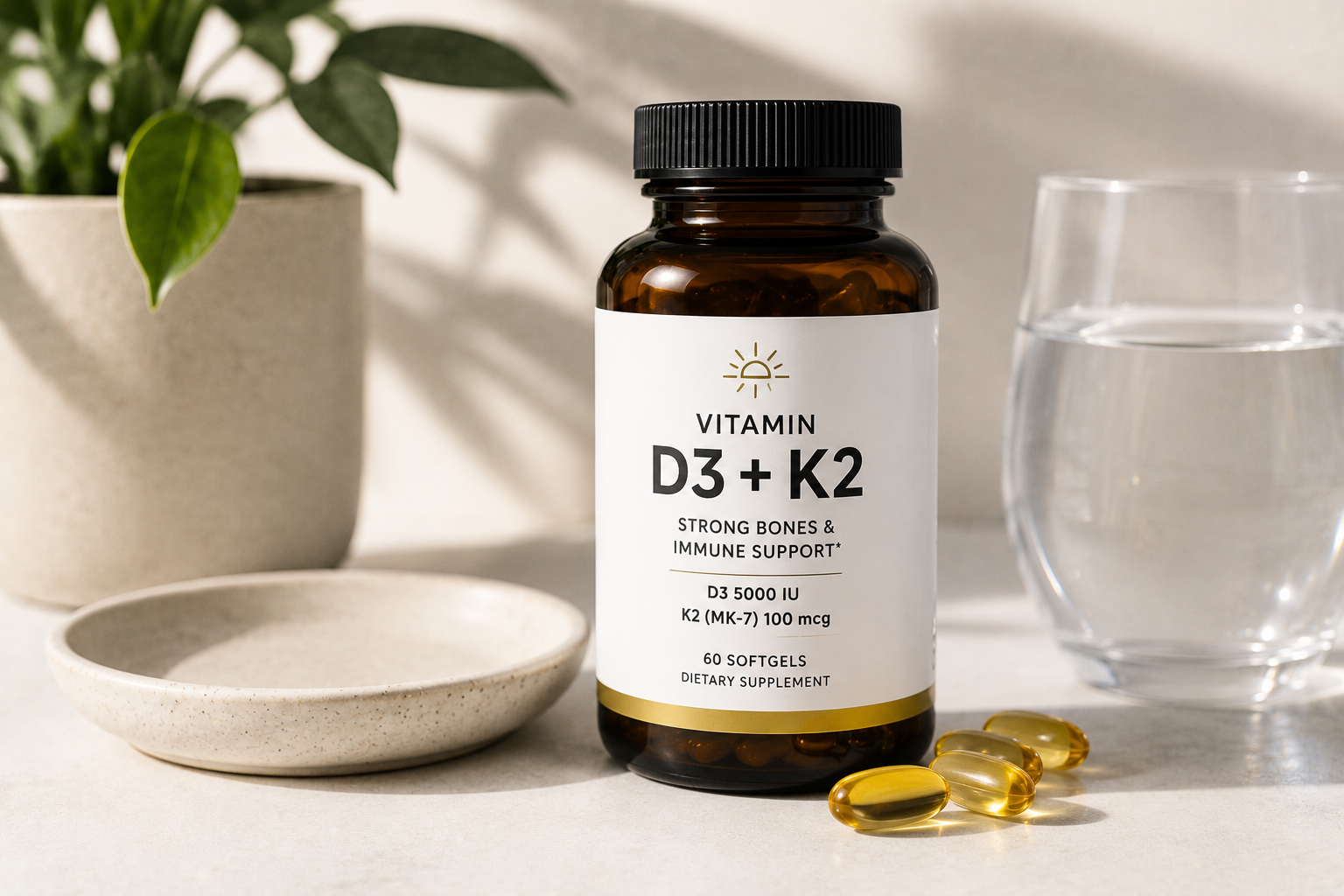
Vitamin D3 supplementation in the UK isn’t optional for most adults — it’s recommended by Public Health England from October through March, and for many of us year-round. On a GLP-1 where you’re eating less food and losing weight rapidly, adequate vitamin D matters more, not less. Pairing with K2 optimises the calcium pathway and protects bone health during fast weight loss. This is the honest guide to picking a D3/K2 supplement in the UK in 2026.
For the broader supplement stack see Supplements Worth Taking in the Complete Guide. This post is specifically on D3/K2.
Why vitamin D specifically matters for UK GLP-1 users
Three factors stack:
1. UK geography. Most of the UK sits above 50°N latitude. Between October and late March, the angle of the sun is too low to produce meaningful vitamin D in skin, regardless of how much time you spend outside. Public Health England’s official recommendation is that all adults should consider a 10µg (400 IU) daily D3 supplement through autumn and winter; many public health experts argue year-round supplementation is appropriate for most UK adults.
2. Obesity and low vitamin D status are strongly correlated. Adipose (fat) tissue sequesters fat-soluble vitamin D, reducing circulating levels. Most people starting a GLP-1 with a BMI of 30+ have suboptimal vitamin D status as a baseline.
3. Rapid weight loss challenges bone health. Bone mineral density can decline during significant weight loss. Adequate vitamin D and calcium are critical for maintaining bone mass as you lose fat tissue.
The upshot: if you’re a UK adult on a GLP-1, a D3 supplement is close to non-optional.
Why K2 matters alongside D3
Vitamin D3 increases calcium absorption from the gut. But calcium in the bloodstream needs to be deposited into bone rather than into soft tissue or arteries. Vitamin K2 (specifically the MK-7 form) activates proteins — osteocalcin in bone, matrix Gla protein in the vascular system — that direct calcium to bone and away from arteries.
The practical implication: supplementing high-dose D3 alone over time can, in theory, push calcium into the wrong places without adequate K2. K2 is protective. Most high-quality supplements now combine D3 and K2 for this reason.
Important caveat: the D3 + K2 combination is genuinely beneficial, but it’s oversold by supplement marketers. The real-world difference at standard doses (1,000–4,000 IU D3, 50–200mcg K2) is modest for most people. Don’t expect dramatic effects; do expect sensible baseline optimisation.
Dosing: what’s right for most UK adults
Public Health England recommends 10µg (400 IU) daily for autumn and winter. Many clinicians now consider this a minimum rather than a target, particularly for people with obesity, limited sun exposure, darker skin tones (reduced synthesis at UK latitude), and those on rapid weight loss.
Typical supplementation doses for UK adults:
- Maintenance for most adults: 1,000–2,000 IU (25–50µg) daily, year-round
- For people with obesity or previously documented deficiency: 2,000–4,000 IU daily, adjusted based on blood test result
- For documented severe deficiency (under medical supervision): higher short-term loading doses under GP oversight
For K2 MK-7: typical supplement doses are 50–200µg daily alongside the D3. More is not meaningfully better for most people.
The UK picks for 2026
Best all-rounder: Lily & Loaf Vitamin D3 & K2
2,000 IU D3, 100µg K2 MK-7 per capsule. Around £15 for 60 capsules (2-month supply).
Clean formulation: D3 from lanolin (the standard, well-studied form), K2 as MK-7 (the longer-half-life form of K2 compared to MK-4), suspended in olive oil for absorption (fat-soluble vitamins need fat for uptake, even at small doses). No magnesium stearate, no unnecessary fillers. UK-brand.
The 2,000 IU dose hits the “more than PHE’s 400 IU floor but comfortably safe” territory suitable for most UK adults year-round. The MK-7 form of K2 is what you want rather than MK-4 (shorter half-life, less efficient at standard doses).
Buy from: Lily & Loaf Vitamin D3 & K2.
Best higher dose: BetterYou D3 K2 4,000 IU Oral Spray
3,000 IU D3, 75µg K2 MK-7 per spray. Around £15 for 12ml bottle (100 sprays).
BetterYou make vitamin oral sprays designed for direct buccal absorption. The spray format appeals to people who struggle swallowing capsules, want slightly more absorption-robust delivery, or have gut issues that might affect capsule-based absorption. At 3,000 IU it’s a slightly higher daily dose than the Lily & Loaf option, suitable for people with documented sub-optimal levels or heavier frames.
The spray goes under the tongue; 30 seconds without swallowing before drinking/eating. Slight orange/lemon flavour. Taste is innocuous.
Buy from: BetterYou D3 K2 Oral Spray on Amazon UK.
Best budget: Nature’s Best Vitamin D3 & K2
1,000 IU D3, 100µg K2 MK-7. Around £10 for 120 tablets (4-month supply).
The budget pick that doesn’t cut formulation corners. Nature’s Best is a long-standing UK supplement brand with solid reputation. 1,000 IU is modest but adequate for most adults with some summer sun exposure; higher doses are available in the range.
Buy from: Nature’s Best D3 & K2 on Amazon UK.
Best vegan option: Together Health Vegan D3 & K2
1,000 IU D3 (from lichen), 75µg K2 MK-7. Around £12 for 60 capsules.
Standard D3 is animal-derived (lanolin from sheep wool). Vegan D3 is extracted from lichen and is biologically identical. Together Health’s vegan D3 capsule is one of the cleaner formulations in the vegan space, UK-brand, capsule shell is plant-based.
Buy from: Together Health Vegan D3 & K2 on Amazon UK.
Best liquid drops: Viridian D3 & K2 Drops
2,000 IU D3, 100µg K2 MK-7 per drop. Around £20 for 20ml.
Liquid drops for people who don’t get on with capsules and don’t want spray format. One drop on the tongue, swallow. Flavourless. 500-drop bottle lasts over a year.
Buy from: Viridian D3 & K2 Drops on Amazon UK.
What to look for when buying
Five things that matter in a D3/K2 supplement:
1. D3 (cholecalciferol), not D2 (ergocalciferol). D3 is substantially more effective at raising 25(OH)D blood levels. D2 is cheaper and sometimes sold as “vegan D” — note that proper vegan D3 from lichen is widely available now, so settling for D2 is rarely necessary.
2. K2 as MK-7, not MK-4. MK-7 has a half-life of around 3 days, meaning a daily dose maintains a steady level. MK-4 has a half-life of a few hours; daily doses produce brief peaks with troughs. MK-7 is the clearly preferable form.
3. Combined with an oil (olive, coconut, MCT) for absorption. Vitamins D and K are fat-soluble. Supplements delivered in an oil base or taken with a fat-containing meal absorb substantially better than dry-powder capsules taken on an empty stomach.
4. Third-party testing or reputable brand. Supplement quality varies wildly in the unregulated parts of the market. Stick with brands that have third-party testing or a long established reputation.
5. Dose you can consistently take. A 4,000 IU capsule you take daily is better than a 50,000 IU weekly capsule you keep forgetting. Consistency matters more than the specific dose within a reasonable range.
Should you get a blood test first?
Ideal: yes. Practical: most UK adults don’t.
If you want one, the test is 25-hydroxyvitamin D (25(OH)D). NHS GPs can request it; some will be happy to, others will be cautious about testing in asymptomatic patients. If NHS doesn’t come through easily, private options include:
- NHS Direct GP-ordered tests through paid private arrangements
- Nuffield Health, Bupa, Randox Health, Thriva, Medichecks (home finger-prick tests, ~£30–£60)
Target ranges most clinicians use:
- <25 nmol/L: deficient (needs medical management, not just supplementation)
- 25–50 nmol/L: insufficient (supplement to raise)
- 50–75 nmol/L: adequate but low end
- 75–125 nmol/L: optimal for most adults
- >125 nmol/L: no benefit beyond this, still safe
- >250 nmol/L: toxicity risk
If you’re supplementing 2,000 IU daily without testing, you’re likely safe but may not know if you’re still sub-optimal or whether you could reduce dose. A single test per year is reasonable.
Calcium: the often-overlooked third corner
D3 and K2 optimise calcium absorption and distribution, but you still need adequate calcium intake for the system to work. UK adult target: 700mg daily.
Dietary sources on a GLP-1 diet:
- Greek yogurt (200g): ~250mg calcium
- Cheese (30g): ~200mg
- Semi-skimmed milk (200ml): ~240mg
- Tinned sardines with bones (60g): ~200mg
- Fortified plant milks (200ml): ~240mg
- Spring greens or kale (80g): ~80mg
- Tofu set with calcium (100g): ~150mg
If you’re hitting 2–3 portions of calcium-rich foods daily (which most protein-focused GLP-1 eating plans naturally achieve via dairy), you don’t need a calcium supplement. If you’re dairy-free and not reliably hitting calcium foods, a 400–600mg calcium supplement pairs well with the D3/K2.
Timing and pairing with other supplements
D3/K2 is best taken with a meal containing some fat. Morning or evening, with breakfast or dinner, works equally well. Consistency matters more than timing.
Pairs well with:
- Omega-3 (similar fat-soluble pattern; take together with a meal)
- Magnesium (supports vitamin D metabolism)
- B-complex multivitamins
Take separately (at least 2 hours apart) from:
- Calcium supplements above 500mg (better absorbed in smaller separate doses)
- Iron supplements (unrelated but general practice)
Common mistakes to avoid
1. Taking D3 without K2 long-term. Unlikely to cause harm for most people at standard doses, but the combination is a modest improvement.
2. Using D2 instead of D3. Save the money unless you’re strictly avoiding any animal-derived products.
3. Taking a “mega dose” monthly rather than a standard daily dose. High single doses have shown modest safety concerns in some trials. Daily low-to-moderate dosing is simpler and equally effective.
4. Assuming you’re getting enough from your multivitamin. Most standard multivitamins have 400–800 IU D3. Fine as a minimum floor; often below what someone with obesity and limited sun exposure actually needs.
5. Stopping supplementation in summer. If you’re indoors most days, apply sunscreen, and live in the UK, your summer sun exposure may not actually produce much D3. Testing in autumn can surprise people. Year-round supplementation is often the simpler, safer bet.
6. Taking D3 without a fat-containing meal. Reduces absorption meaningfully. Always take with food.
My recommendation in one line
For most UK adult GLP-1 users: Lily & Loaf Vitamin D3 & K2 (2,000 IU + 100mcg MK-7) once daily with breakfast, year-round. For higher doses or spray format: the BetterYou oral spray. For vegan: Together Health. For budget: Nature’s Best. Get a 25(OH)D blood test once a year to adjust dose if needed.
For the broader supplement stack: Supplements Worth Taking in the Complete Guide. For omega-3, the pair that most people add at the same time: Best Omega-3 Fish Oil UK 2026.
Disclosure: some links above are affiliate links. Medical note: if you have any condition affecting calcium metabolism (hyperparathyroidism, sarcoidosis, kidney disease) or are on medications affecting vitamin D or calcium, consult your GP before supplementing.
Discover more from Healthy Weight Loss GLP1
Subscribe to get the latest posts sent to your email.