
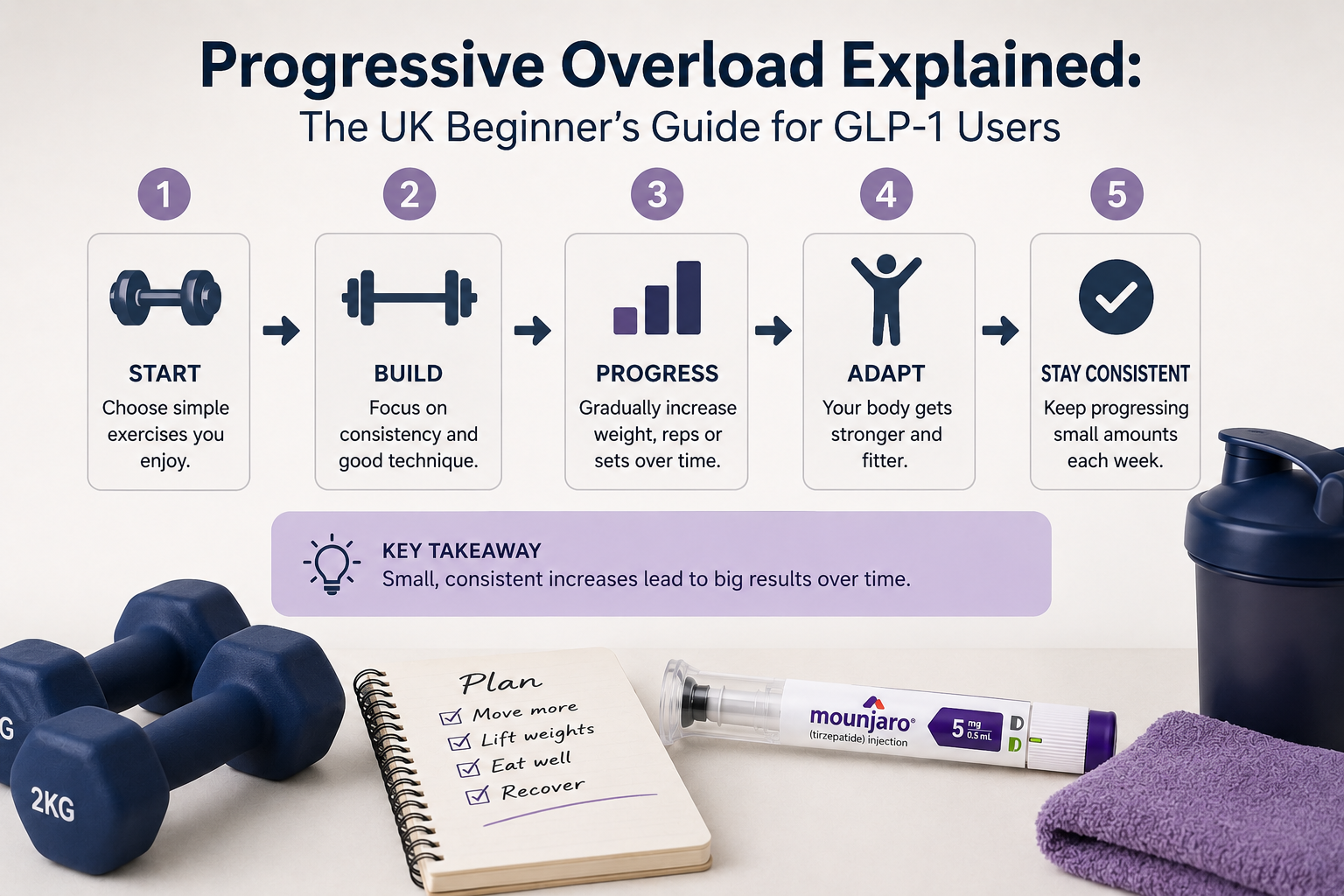
Progressive overload is the single most important principle in strength training for anyone trying to preserve or build muscle on a GLP-1. It simply means gradually asking your muscles to do more over time — more weight, more reps, more sets, or better form. Without progressive overload, you can lift the same weights for a year and see almost no muscle retention benefit. This is the honest UK explainer for GLP-1 users, including the simple tracking method that actually works.
For the broader fitness context see Exercise on GLP-1s in the Complete Guide. For routines: Dumbbell Workout for GLP-1 Beginners UK and Bodyweight Workout for GLP-1 Beginners UK.
Why progressive overload matters on a GLP-1
Rapid weight loss on a GLP-1 includes some lean tissue loss unless you specifically train to preserve muscle. Studies of semaglutide and tirzepatide users show:
- 15–25% of total weight lost can come from lean mass (muscle, organ tissue, connective tissue, water) without intervention
- With adequate protein AND resistance training, lean mass loss can drop to 5–10% of total weight lost
- The resistance training component needs to be progressive to matter — same-weight-every-week routines give limited benefit
The mechanism: muscle tissue responds to being asked to do hard work by adapting (maintaining or building). If the work never gets harder, adaptation signal fades, and the calorie deficit + medication effect strip lean mass.
This is why “just being active” isn’t the same as strength training, and strength training without progression isn’t the same as progressive overload.
The four ways to progress
Progressive overload doesn’t mean “add weight every workout.” It means your muscles experience more demand over time. Four main routes:
1. Add weight
Classic progression: last week you squatted 20kg; this week 22.5kg. Easiest to track, most visible progress. But you can’t add weight every session indefinitely; most intermediate lifters add small increments over months, not weeks.
2. Add reps
Same weight, more reps. Last week 3 sets of 8 reps at 20kg; this week 3 sets of 10 reps at 20kg. Useful when weight progression stalls. Eventually you move to higher weight with lower reps once reps get to 12–15.
3. Add sets
More total volume at the same weight and rep range. Last week 3 sets of 8; this week 4 sets of 8. Useful when time allows and you want more training volume without heavier loads.
4. Improve quality
Same weight, reps, sets — but slower eccentric (lowering) phase, fuller range of motion, better bracing, less momentum. Often overlooked but powerful. A 20kg squat done with 3-second descent and full depth is significantly harder than a 20kg squat done fast with partial range.
Most beginners should prioritise route 4 (quality) for the first 6–8 weeks before chasing weight/reps/sets.
The beginner trap: progression too aggressive
Common mistake: adding weight every session because you can. Early gains are often from nervous system adaptation (learning the movement) rather than muscle growth. Chasing weight too aggressively leads to:
- Form degradation (injury risk)
- Burnout from constantly feeling “heavy”
- Plateau at a weight that’s technically your max but not sustainable
- On a GLP-1 specifically: fatigue crash mid-session when blood sugar and energy are lower than pre-medication
Better pattern for GLP-1 beginners:
- Weeks 1–2: focus on form, lightweight, learn the movements
- Weeks 3–6: add reps within each existing weight (e.g. 3×8 → 3×10 → 3×12)
- Weeks 7–12: add weight in small increments (2.5–5kg for compound lifts) when you can do 3×12 cleanly
- Beyond: slower progression, one adjustment per exercise per 2–3 weeks
A simple tracking method
You don’t need an app. You don’t need a spreadsheet. You need a notebook or note in your phone.
For each exercise, record:
- Date
- Weight used
- Sets x reps completed
- A rating of how hard the last set felt (1–10)
Example:
Sunday 12 Jul
Goblet squat: 12kg, 3×10 (last set felt 7/10)
Dumbbell row: 10kg each, 3×10 (last set 6/10)
Press-up: bodyweight, 3×6 (last set 8/10)
Next session, target:
- If last set was 6/10 or easier: add reps or weight
- If last set was 7–8/10: repeat same
- If last set was 9–10/10: consider reducing one variable (maybe rushed through it with poor form, or just had a bad day)
This “subjective difficulty” rating prevents you from progressing too fast because you can, and holds you accountable when you’re undershooting.
The RPE concept
RPE = Rate of Perceived Exertion, on a scale of 1–10. Useful definitions:
- RPE 6: Could do 4 more reps
- RPE 7: Could do 3 more reps
- RPE 8: Could do 2 more reps
- RPE 9: Could do 1 more rep
- RPE 10: Couldn’t do another rep at all (muscular failure)
For most progressive overload on GLP-1s, train most sets at RPE 7–8. Occasional RPE 9. Avoid RPE 10 (failure) as routine because recovery becomes a problem, especially with reduced calories.
Why RPE beats “going to failure” on a GLP-1
Traditional gym culture often emphasises training to muscular failure. On a GLP-1:
- Recovery capacity is reduced (fewer calories, possibly less sleep)
- Energy mid-workout can crash suddenly
- Form degrades faster under fatigue
- Muscular and joint repair takes longer on a deficit
Leaving 1–2 reps in reserve each set (RPE 8–9) produces about 90% of the muscle-building signal with significantly better recovery. For a 12-week programme, this is clearly the better trade.
You can train to genuine failure occasionally (last set of last exercise in a session, once every 2–3 weeks) to check where your limits are. Not as a routine.
Deload weeks
Every 6–8 weeks, take a deload week:
- Reduce weights to 70–80% of current working weight
- Keep the same exercises and schedule
- Everything should feel easy
- Next week, resume at previous weights
Reasons this helps:
- Connective tissue (tendons, ligaments) recovers slower than muscle
- Nervous system fatigue accumulates beyond what you feel subjectively
- Mental refresh often unlocks a breakthrough the following week
Not negotiating this with yourself: plan the deload, take it, resume fresh.
What progressive overload looks like over 3 months
Realistic numbers for an adult beginner on a GLP-1:
Goblet squat:
- Month 1: start 8kg 3×10 → end 10kg 3×10
- Month 2: progress to 12kg 3×10, then 3×12
- Month 3: 14–15kg 3×10 (or move to dumbbell/barbell back squat)
Bench press (or dumbbell press):
- Month 1: start 15kg 3×8 → end 17.5kg 3×8
- Month 2: 20kg 3×8 then 3×10
- Month 3: 22.5–25kg 3×8
Dumbbell row:
- Month 1: start 8kg each 3×10 → end 10kg 3×10
- Month 2: 12kg 3×10 then 3×12
- Month 3: 14–16kg 3×10
Individual progress varies significantly (starting fitness, age, sex, training history, recovery). These are rough targets, not guarantees.
What progression stalls mean
Plateaus are normal. When they happen, check:
- Protein intake: 1.2–1.6g per kg bodyweight per day. Below this, muscle repair capacity drops.
- Sleep: 7+ hours. Major factor in recovery.
- Rest days: 1–2 per week. Not optional.
- Deload: have you taken a deload week in the past 8 weeks?
- Session frequency: 2–3 resistance sessions per week is a sweet spot. Less is too little; more can be too much on a deficit.
- Form creep: video yourself. Are you actually performing the movement as well as you think?
- Life stress: chronic stress tanks recovery. Training through a high-stress period is sometimes a wash.
If all of these are solid and progression has stalled for 2–3 weeks, it may simply be that you’ve reached a local ceiling for your current level. Change one exercise, add a new variation, or accept maintenance for a few weeks and push again.
Progressive overload with bodyweight training
If you’re training with bodyweight (no equipment or minimal equipment), progression still applies — just uses different variables:
- Harder variations: wall push-up → incline push-up → flat push-up → decline push-up → diamond push-up
- More reps: bodyweight squats, push-ups, sit-ups can progress well into 20–30 rep sets
- Slower tempo: 3-second descent, 1-second pause, controlled ascent
- Less rest: 60-second rest → 45-second → 30-second, increases total metabolic demand
- Unilateral variations: bodyweight squat → Bulgarian split squat → pistol squat. Each unilateral variation is roughly twice as hard per leg.
See Bodyweight Workout for GLP-1 Beginners UK for specific progressions.
Compound vs isolation exercises
For progressive overload on a GLP-1 with limited time:
Compound exercises (squat, deadlift, bench press, row, pull-up, overhead press) should make up 70–80% of your training. They allow heavier loads and train more muscle per exercise.
Isolation exercises (bicep curl, tricep extension, calf raise, lateral raise) round out the programme for specific muscle groups but shouldn’t dominate. Progressive overload still matters here; just use lighter weights.
A weekly session split like 4–5 compound exercises + 2–3 isolation exercises + 10 minutes core gives you a complete session in 40–50 minutes.
Common progression mistakes
Six patterns that derail progression on a GLP-1:
1. Progressing weight without earning the reps. Adding weight before you can do all prescribed reps cleanly at current weight. Result: form breaks down at the top of the rep range, injury risk climbs, next session feels like a step back. Fix: complete the full rep target (e.g., 3 sets of 10) at current weight for two consecutive sessions before adding weight.
2. Skipping warm-up sets. Jumping to working weight without 1–2 light warm-up sets. The first work set feels harder than it should, you underperform, you think you’ve regressed. Fix: warm up with 50% and 75% of working weight for 5–6 reps each before first heavy set.
3. Tracking inconsistently. Remembering “roughly” what you did last week means overshooting or undershooting random variables. Fix: write every session down. Takes 30 seconds, prevents weeks of drift.
4. Ignoring eccentric tempo. Dropping the weight under gravity wastes the most productive part of the rep. Fix: count “one-two-three” on the lowering phase of every rep for 2–3 weeks; it will transform how your lifts feel.
5. Training too often. On a GLP-1, recovery capacity is reduced. Four or five hard sessions per week often produces worse results than three well-recovered sessions. Fix: start with 2–3 sessions, add frequency only if recovery allows.
6. Chasing soreness as a marker of progress. Soreness mostly reflects novel movement or eccentric loading, not productive training. A session that left you sore once can be repeated without soreness and still produce adaptation. Fix: use performance (reps, weight, RPE) as the marker, not muscle soreness.
The mental side
Progressive overload is psychologically demanding because it means pushing slightly beyond what’s comfortable most sessions. On a GLP-1 where energy can fluctuate:
- Some sessions you’ll feel genuinely unable to add anything — just match last week and call it success
- Some sessions you’ll find weights that felt hard 2 weeks ago feel easy — progress happens in unexpected jumps
- Over 3–6 months, trajectory matters more than session-to-session variation
Don’t evaluate your training week by week. Evaluate monthly. If your numbers have moved up over 4 weeks, the system is working; if they’ve stalled, investigate the factors above.
The summary
Progressive overload — gradually increasing weight, reps, sets, or movement quality over time — is how strength training protects muscle on a GLP-1. Track sessions simply, use RPE to guide intensity, leave 1–2 reps in reserve most sets, deload every 6–8 weeks, and evaluate progress monthly not weekly. Without progression, resistance training becomes cardio with dumbbells; with it, you keep the muscle that GLP-1s would otherwise cost you.
For routines to apply this to: Dumbbell Workout for GLP-1 Beginners UK, Bodyweight Workout for GLP-1 Beginners UK. For gear: Best Adjustable Dumbbells UK 2026.
Medical note: if you have joint issues, cardiovascular conditions, or other medical considerations, speak to a GP before starting a resistance programme. Muscle mass preservation is a real benefit of training on a GLP-1; safety comes first.
Discover more from Healthy Weight Loss GLP1
Subscribe to get the latest posts sent to your email.