
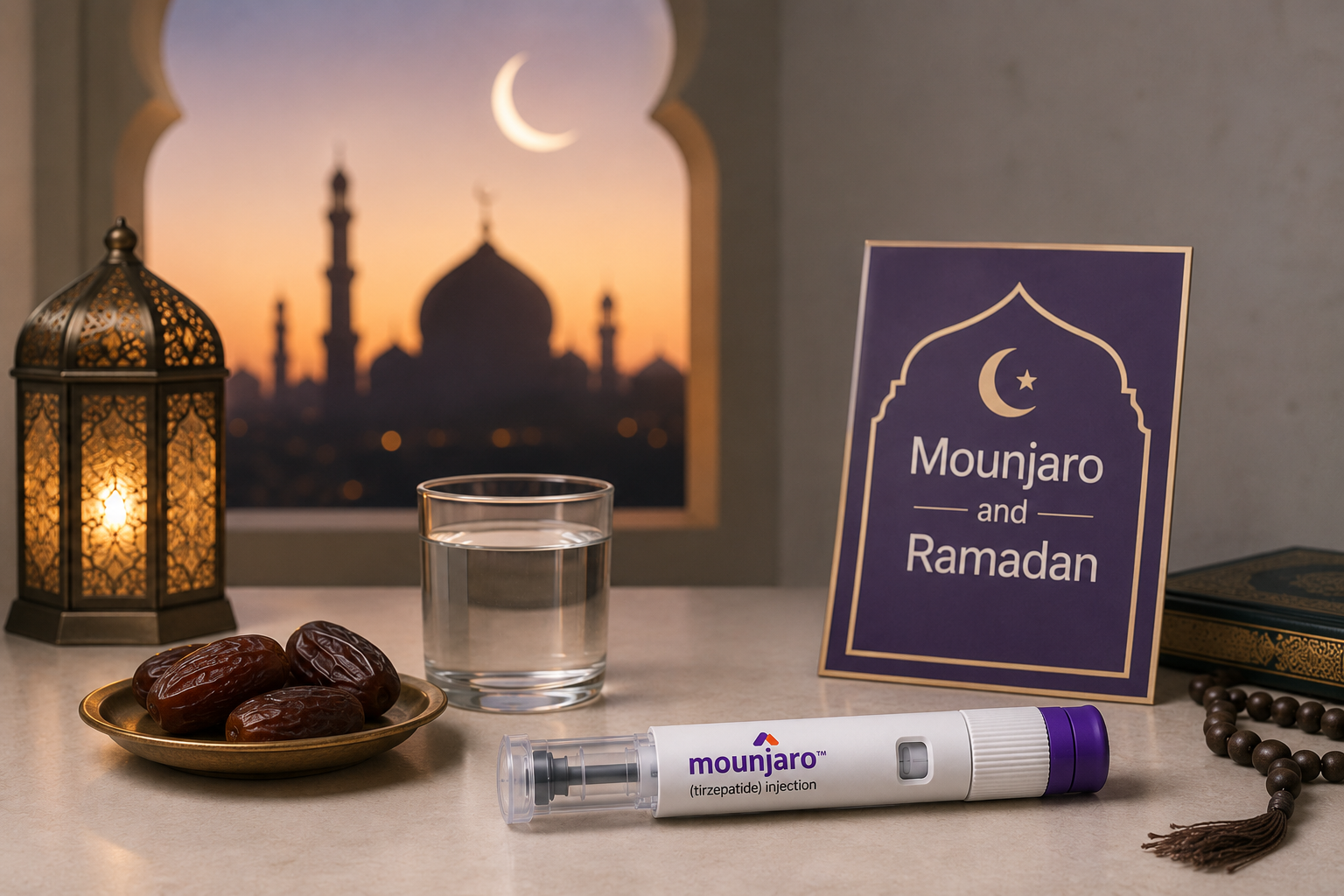
Fasting during Ramadan while on Mounjaro is possible for many users but requires planning. The main considerations: dehydration risk during long daylight fasts, reduced suhoor/iftar intake compounding calorie restriction, potential for amplified nausea at iftar, and whether to continue, adjust, or pause the medication during the month. This is the practical UK guide for Muslim Mounjaro users, developed from community experience and general GLP-1 clinical principles.
For broader illness/fasting context see Mounjaro and Flu/Illness UK. For the complete treatment overview: Complete GLP-1 Weight Loss Guide.
The opening caveat
This is general information, not religious or medical guidance. Decisions about fasting with medication are individual and should involve:
- Your prescriber (for clinical assessment of fasting suitability)
- Your religious leader (for guidance on religious obligations, including whether medication use affects fast validity)
- Your own sense of how your body is responding
Islamic jurisprudence generally permits people with medical conditions to not fast; many scholars hold that injectable medications that don’t enter the digestive system don’t break the fast. But interpretations vary, and this is a conversation for a religious authority you trust.
Clinical considerations for fasting on Mounjaro
1. Hydration risk
The most significant clinical concern. A typical Ramadan day involves 12–16 hours without fluids (longer in summer; shorter in winter). On a GLP-1, baseline fluid intake is often already reduced, so:
- Dehydration risk is higher than for non-Mounjaro fasters
- Symptoms of dehydration (headache, dizziness, fatigue) can mimic or worsen medication side effects
- Severe dehydration risks acute kidney injury — particularly relevant given tirzepatide’s known (rare) kidney effects
- Elderly users or those with kidney issues face higher risk
2. Nausea at iftar
Breaking a long fast with a large meal on a stomach with slowed gastric emptying can produce pronounced nausea, fullness, and reflux. Users who’ve fasted 14+ hours then eat a substantial iftar often experience:
- Immediate overwhelming fullness after just a small amount of food
- Nausea that lasts several hours into the evening
- Reflux if lying down shortly after
- Sleep disruption
3. Nutritional adequacy
Between reduced appetite (Mounjaro) and limited eating window (Ramadan), maintaining adequate nutrition is harder than either factor alone. Risks:
- Insufficient protein (compromising lean mass preservation)
- Insufficient calories (beyond what’s needed for weight loss; risk of excessive muscle loss)
- Insufficient electrolytes (especially if water intake is low)
- Insufficient micronutrients
4. Blood glucose management
For Muslim users with type 2 diabetes on Mounjaro: fasting changes glucose patterns significantly. Close monitoring required. Risk of hypoglycaemia usually low with Mounjaro alone but can be significant if combined with sulphonylureas, insulin, or other glucose-lowering medications.
Options for handling Mounjaro during Ramadan
Option 1: Continue normal Mounjaro schedule
For users who:
- Are young and healthy
- Have stable dose and mild side effects
- Have no comorbidities
- Have adequate hydration and nutrition planning
Continuing weekly injections through Ramadan is often fine. The injection itself doesn’t break the fast (consensus among most Islamic scholars for subcutaneous medication). Schedule the injection after iftar rather than during fasting hours.
Option 2: Pause Mounjaro for Ramadan
Some users choose to pause for the month. Reasons:
- Avoids compounding medication side effects with fasting challenges
- Allows normal eating patterns at iftar and suhoor without amplified nausea
- Reduces dehydration risk
- Simplifies overall health management during the month
Trade-offs:
- Appetite returns during the month; potential weight regain
- Food noise comes back
- Restart after Ramadan may require re-titration (particularly if missed 4+ weeks)
Pausing is a legitimate clinical choice; discuss with your prescriber in advance.
Option 3: Reduce dose for Ramadan
Some users drop down one dose level during the fasting month (e.g., from 10mg to 7.5mg) to reduce side effect intensity while maintaining some appetite suppression. Trade-offs include slight weight progress pause in exchange for easier daily management.
This requires prescriber agreement; not a self-initiated adjustment.
Option 4: Time injection carefully within the week
Peak side effects usually hit 24–72 hours after injection. If your injection day falls during Ramadan, try to schedule it so peak side effects hit on a day that’s easier to manage — e.g., a weekend where you can rest if needed, or after iftar on a night you don’t have evening commitments.
Daily practical strategies if fasting on Mounjaro
Suhoor (pre-dawn meal)
- Protein is the priority. 25–40g at suhoor. Sources: eggs, Greek yoghurt, chicken, fish, cottage cheese, protein powder.
- Complex carbs for sustained energy. Oats, brown rice, whole grain bread. Avoids blood sugar crash mid-afternoon.
- Healthy fats. Nuts, avocado, olive oil. Slower-digesting; helps with satiety through the day.
- Significant water intake. 500–750ml as part of suhoor.
- Avoid heavy, greasy foods. Worse reflux and nausea later.
- Avoid excessive sugar. Crashes blood glucose mid-fast.
Break of fast (iftar)
- Start small. Traditional dates (1–2) with water is a good opening. On Mounjaro, even this may feel substantial. Pause before eating more.
- Hydrate first. 2–3 glasses of water over 20–30 minutes before the main meal.
- Eat slowly. Pause between bites; assess fullness. Mounjaro-suppressed fullness signals come fast; rushing means overshooting.
- Prioritise protein at iftar. 30–40g at iftar. Lean meat, fish, pulses.
- Moderate portions of traditional foods. You can eat what your family eats, just smaller amounts.
- Leave space in your stomach. Gastric emptying is slowed; overfilling causes reflux.
Between iftar and suhoor
- Water continuously. 2–3 litres total across the eating window is a reasonable target.
- Second meal or large snack a few hours after iftar, before suhoor. Spreads calories and nutrients.
- Avoid heavy late-night meals that cause reflux or sleep disruption.
- Electrolyte drink once a day can help, especially in hot weather.
Warning signs that fasting isn’t working
Break your fast immediately (and consult a medical professional) if you experience:
- Severe dizziness, especially when standing
- Confusion or disorientation
- Very dark urine or no urination for 8+ hours
- Severe headache that doesn’t respond to hydration at iftar
- Rapid or irregular heartbeat
- Fainting or near-fainting episodes
- Persistent vomiting at iftar preventing fluid retention
- Signs of low blood sugar (shakiness, sweating, confusion) if diabetic
- Severe abdominal pain
Islamic law explicitly permits breaking the fast for medical necessity. Continuing to fast while unwell is not required and not healthy.
Injection timing within Ramadan
Options for injection timing during Ramadan:
1. Same day, after iftar: most sensible. Pen warms to room temperature while you eat; inject after your evening meal when you’re alert and not fasting.
2. Same day, near suhoor: some users inject at the last eating time before dawn. Less ideal as peak side effects may hit mid-day during the next fast.
3. Shift injection day: if your normal injection day falls on a particularly demanding day (travel, guests, family obligation), shift injection to a more manageable day within 1–2 days of your normal schedule.
Avoid: injecting during fasting hours (no clinical benefit, slightly awkward; some users worry about whether it “breaks” the fast, though most scholars say it doesn’t for subcutaneous medication).
Weight loss during Ramadan on Mounjaro
Expectations to set:
- Weight loss during Ramadan is often slower than usual, even with medication
- Dehydration causes weight fluctuations that aren’t real fat loss
- Night-time eating patterns can lead to unexpected calorie intake
- Some users experience slight weight gain during Ramadan from changed eating patterns
- Typical expectation: maintain weight loss pace at 50–80% of normal rate, or maintenance
Post-Ramadan, normal progress usually resumes within 2–3 weeks.
Ramadan-specific nutritional priorities
Protein targets during Ramadan may be harder to hit with reduced eating windows and reduced appetite. Strategies:
- Protein powder/shakes are particularly useful at iftar and suhoor when appetite is low
- Greek yoghurt (higher protein than regular) for both meals
- Eggs for suhoor
- Lean meats, fish, chicken, pulses at iftar
- Aim for at least 25g protein at suhoor and 30–40g at iftar
See High-Protein Breakfast on GLP-1 UK for suhoor-friendly ideas and High-Protein Dinner on GLP-1 UK for iftar options.
Community and family considerations
Ramadan is communal. Some practical notes:
- You don’t need to explain medication choices to everyone. Your prescription is private. If eating less at iftar draws questions, “I’ve been working with a doctor on my health” is usually sufficient.
- Attending iftar gatherings is fine. You can eat what’s served; just smaller portions and paced.
- Saying “I’ve had enough” is okay. Polite decline isn’t rude.
- Preparing food for others while you’re fasting and on reduced appetite can be harder than pre-Mounjaro. Taste-testing is more unpleasant than you remember.
- Travel for Eid may overlap with injection day; see Mounjaro Travel Guide UK.
Pregnancy, nursing, elderly, chronic conditions
Specific scenarios where fasting with Mounjaro requires more caution:
- Pregnant or breastfeeding: Mounjaro isn’t recommended during pregnancy/breastfeeding anyway; should have been paused. Fasting may be permitted or excused under Islamic law given the medical situation.
- Elderly: dehydration risk is higher; consider carefully whether fasting is safe. Many elderly users are exempt from fasting under Islamic guidance.
- Type 2 diabetes: requires active glucose monitoring; insulin-requiring diabetics usually shouldn’t fast.
- Kidney issues: dehydration risk is significant. Discuss with prescriber and nephrology if applicable.
- Chronic conditions requiring regular medication: oral medication timing becomes complex; may need regimen adjustment.
These scenarios particularly benefit from both medical and religious consultation.
After Ramadan: re-establishing routine
First week post-Ramadan:
- Resume normal eating pattern gradually; don’t dive into large meals immediately
- Hydration remains a focus
- Weight may have shifted (up or down or steady); wait a week or two before assessing
- If you paused Mounjaro: resume at prescriber-agreed dose. If over 4 weeks of pausing, re-titration from lower dose may be needed.
- Return to normal training and activity
- Review with prescriber at your next scheduled appointment
Most users find post-Ramadan is a good moment to reset habits and refocus goals for the rest of the year.
Six nights of Shawwal and other voluntary fasts
After obligatory Ramadan fasting, some Muslims complete six days of Shawwal, Monday/Thursday voluntary fasts, or Ashura. Same principles apply:
- Continue hydration and protein focus
- Maintain injection schedule
- Voluntary fasts are easier to skip if you’re having a difficult medication week
- No religious obligation to push through medical difficulty
The summary
Fasting during Ramadan while on Mounjaro is manageable for many users with planning. Key priorities: adequate hydration during the eating window, protein-forward suhoor and iftar, careful pacing when breaking the fast, attention to warning signs of dehydration or hypoglycaemia. Consider injection timing carefully. Pausing or reducing dose for the month is a legitimate choice. Always discuss with both your prescriber and a trusted religious authority.
For related topics: Mounjaro and Flu/Illness UK, Electrolytes on GLP-1 UK, and the Complete GLP-1 Weight Loss Guide.
Medical note: this is general information. Decisions about fasting with medication should involve your prescriber. Decisions about religious obligation should involve your religious authority. Report any adverse events during Ramadan to your prescriber or the MHRA Yellow Card Scheme.
Discover more from Healthy Weight Loss GLP1
Subscribe to get the latest posts sent to your email.