

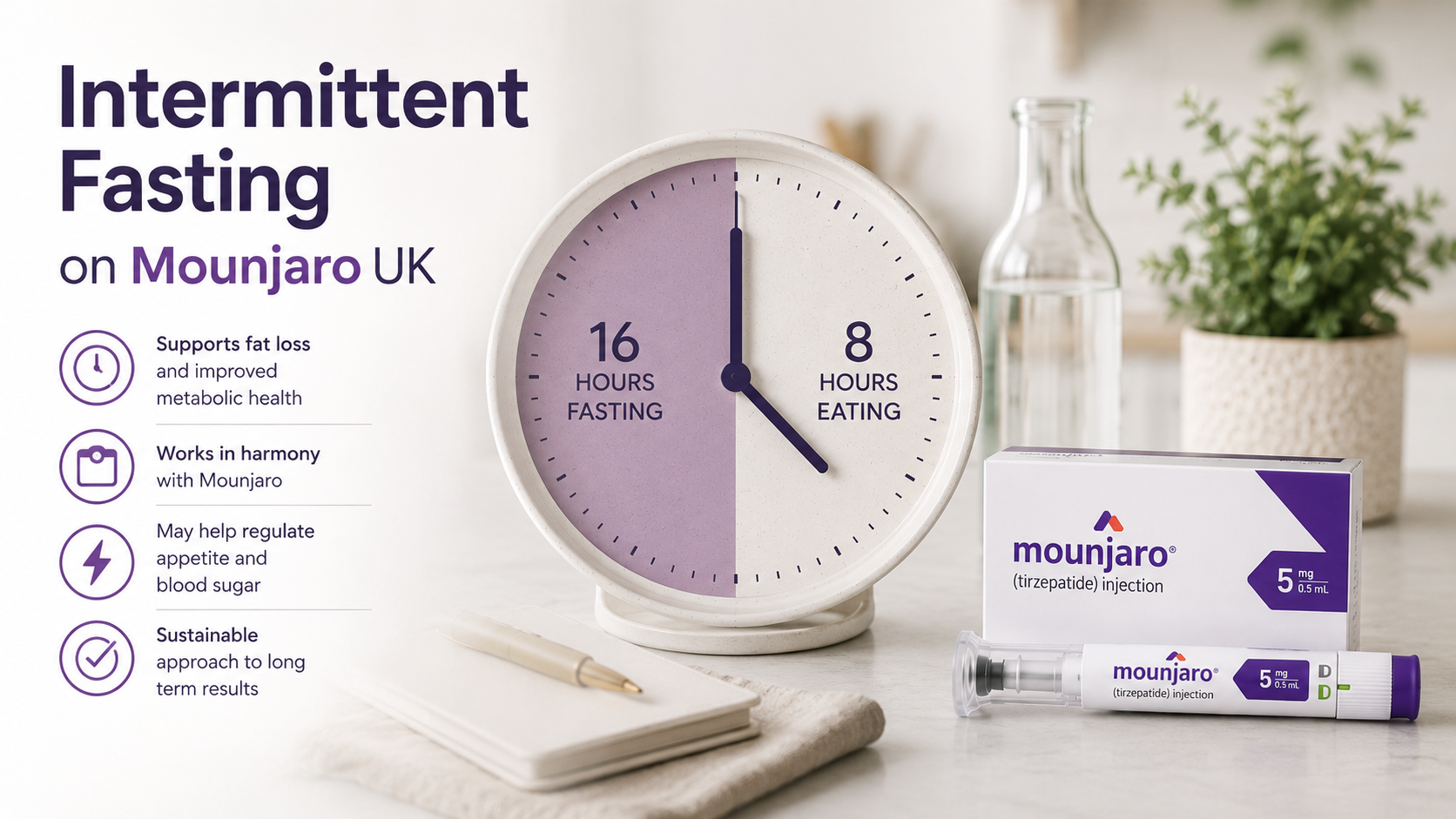
Intermittent fasting (IF) and Mounjaro are compatible — but combining them isn’t straightforwardly better than Mounjaro alone. The medication already creates a substantial calorie deficit through appetite suppression; adding an eating window restriction on top can help some users hit protein targets more consistently, but can also lead to insufficient intake and muscle loss for others. Whether IF helps or hinders your Mounjaro results depends on which specific protocol you’re using and how well you can hit protein targets within a restricted window. This is the evidence-based UK guide.
For the calorie deficit context: Calorie Deficit Explained UK GLP-1. For nutrition tracking in an eating window: How to Track Macros on Mounjaro UK.
The IF protocols and how they interact with Mounjaro
16:8 (16 hours fasting, 8-hour eating window)
The most common IF protocol. For a GLP-1 user, this typically means eating between noon and 8pm, or 10am and 6pm. The 16-hour fast overlaps with sleep, making it less demanding than it sounds.
On Mounjaro, where appetite is already suppressed, 16:8 often happens naturally — many users find they’re not hungry until 10am or noon anyway. If that’s your experience, 16:8 is essentially free: it matches your natural eating pattern.
The risk: compressing protein intake into 8 hours requires deliberate high-protein meal choices at every meal. If your eating window meals are low-protein (which happens when reduced appetite means you reach for easy options), 16:8 with insufficient protein causes faster muscle loss than Mounjaro without IF.
18:6 and 20:4
Shorter eating windows. Practical only if your eating is already structured and protein targets are consistently met in 16:8. Not recommended as a starting point for GLP-1 users still building nutrition habits.
5:2 (5 days eating, 2 days severe restriction)
500–600 kcal on fast days. On Mounjaro, where appetite is already reduced, fast days can easily drop calorie intake to levels that cause significant fatigue and risk muscle catabolism. Generally not recommended alongside GLP-1 treatment without prescriber guidance.
OMAD (one meal a day)
Not compatible with adequate protein intake on a GLP-1. Hitting 120–140g protein in a single sitting on a medication-reduced appetite is extremely difficult. OMAD on Mounjaro risks significant muscle loss. Avoid.
The core tension: deficit on top of deficit
This is the fundamental consideration. Mounjaro creates a calorie deficit through appetite suppression — typically producing intake reductions of 30–50% from baseline. Adding IF adds another layer of restriction on top of this.
For users whose main problem is grazing between meals or eating larger evening meals that undermine the deficit, IF imposes structure that helps.
For users who are already eating adequately-but-not-excessively on Mounjaro and hitting protein targets, IF adds restriction that serves no additional benefit and risks pushing intake too low.
The question to ask: Am I currently eating more than I need to lose weight? If yes, IF helps create structure. If no — if you’re already in a meaningful deficit — IF adds risk without corresponding benefit.
What IF does that Mounjaro doesn’t already do
Mounjaro suppresses appetite throughout the day. IF restricts the window in which eating occurs. These are different mechanisms with some overlap:
IF adds:
- A clear boundary for eating vs non-eating time — useful for people who graze habitually
- Extended overnight fast, which improves insulin sensitivity modestly
- Potential autophagy (cellular cleaning) effects during the fasting period — evidence still emerging
- Simplified meal planning (fewer meals to plan and prepare)
Mounjaro already covers:
- Appetite suppression throughout the day
- Significant improvement in insulin sensitivity
- Reduction in food noise and cravings
- Direct metabolic effects on weight loss
The honest assessment: for most Mounjaro users, IF adds modest incremental benefit at best and muscle loss risk at worst. But for users who struggle with evening grazing or late-night eating despite the medication, a structured eating window helps.
Protein in a restricted window: what’s realistic
This is the deciding factor. On a 16:8 window (noon–8pm), hitting 130g protein means eating approximately 40–45g protein per meal across three meals in eight hours. With a GLP-1-reduced appetite:
- Noon: 40g protein (a substantial lunch — chicken breast, eggs, Greek yoghurt)
- 4pm: 15–20g protein (a protein-dense snack — cottage cheese, protein shake)
- 7pm: 40–50g protein (a high-protein dinner)
This is achievable but requires specific food choices at every eating occasion. Log it in Cronometer and check the protein total before concluding IF is working for you. Many users think they’re hitting targets in a compressed window but fall 30–40g short daily.
Using HelloFresh High Protein recipes (50% off first box) for two of the three meals in an IF eating window ensures at least two meals are hitting 35–40g protein — reducing the planning burden significantly.
Injection timing and IF
No clinical requirement to inject during your eating window. Mounjaro is absorbed subcutaneously — it doesn’t interact with the eating vs fasting state. Inject at your normal day and time regardless of whether it falls in the fasting window.
Practical consideration: some users prefer to inject near the start of their eating window so peak medication effect (and associated nausea) aligns with hours when eating support is nearby. But this is personal preference, not a medical requirement.
Common mistakes combining IF and Mounjaro
Starting both simultaneously. Week one of Mounjaro plus starting 16:8 is too many variables changing at once. If you want to try IF, wait until you’re on a stable dose (minimum 4–6 weeks) and established in your eating pattern before adding the eating window restriction.
Relying on thirst and hunger signals during the fast. Mounjaro suppresses these signals. Not feeling hungry during a 16-hour fast doesn’t confirm the fast is going well — it confirms the medication is working. Break the fast at your planned time regardless of hunger.
Treating IF as a calorie restriction tool rather than a structure tool. If you’re eating fewer than 1,200 kcal daily on the combination, you’re under-eating — particularly if training is part of your protocol. Track in Cronometer to check.
Using IF to avoid difficult meals. Prolonged fasting can become disordered eating behaviours in a different format. If an eating window feels like relief from having to deal with food rather than a practical structure, it’s worth discussing with a healthcare professional.
For whom does IF work best alongside Mounjaro
Most likely to benefit:
- Users who habitually graze in the evenings despite the medication’s appetite suppression
- Users with insulin resistance who respond well to extended overnight fasting
- Users who find a structured eating window simplifies meal planning
- Users who already naturally eat in a compressed window and want to formalise it
Less likely to benefit or potentially harmed:
- Users who are already struggling to hit protein targets
- Users with a history of disordered eating (IF can reactivate restriction patterns)
- Users who have significant energy drops mid-morning or experience injection-day fatigue — the fasting period can exacerbate this
- Perimenopausal women — hormonal disruption may be worsened by extended fasting; discuss with GP
Frequently asked questions
Can I do intermittent fasting on Mounjaro?
Yes — they’re compatible. Whether you should depends on whether IF adds value to your specific situation or just layers restriction on top of already adequate restriction.
Does IF speed up weight loss on Mounjaro?
Not reliably. The evidence for IF providing metabolic benefits beyond calorie restriction is limited. For users whose IF eating window produces genuinely higher protein intake and better meal structure, results may improve. For users where IF mainly reduces total intake, the risk of muscle loss increases without a corresponding fat loss benefit.
What IF protocol works best with Mounjaro?
16:8 if you try it. This is the gentlest restriction and aligns best with GLP-1-naturally reduced morning appetite. More aggressive protocols (5:2, 20:4, OMAD) carry higher muscle loss risk on a medication that’s already creating a substantial deficit.
Should I break my fast with protein?
Yes. Breaking the fast with a high-protein meal (eggs, Greek yoghurt, protein shake, chicken) supports muscle protein synthesis and reduces the muscle catabolism risk of the fasting period. A carbohydrate-only break (fruit, toast, juice) doesn’t provide this protection.
Can intermittent fasting help with Mounjaro nausea?
Possibly — not eating for extended periods means the stomach has time to empty fully, which can reduce the backed-up-stomach nausea pattern. However, an empty stomach can also produce its own nausea on a GLP-1. Neither always helps; experiment carefully.
Medical disclaimer: if you have type 2 diabetes and take insulin or sulphonylureas, intermittent fasting carries hypoglycaemia risk. Discuss with your diabetes team before combining IF with Mounjaro.
The meal timing evidence for GLP-1 users
Beyond structured IF protocols, there’s a simpler version of meal timing worth understanding: front-loading calories and protein earlier in the day produces better outcomes on GLP-1s than back-loading them into evenings.
The mechanism: cortisol peaks in the morning and insulin sensitivity is highest. Eating more calories and protein earlier in the day aligns with these hormonal rhythms. Late-evening eating (after 8pm) occurs when insulin sensitivity is lowest and cortisol is suppressed — less optimal metabolic timing for the same calories.
For GLP-1 users, this translates practically:
- Break the fast with a substantial protein-rich meal (eggs, Greek yoghurt, protein shake) rather than coffee alone
- Front-load protein at breakfast and lunch — these are the meals most users underserve on GLP-1-reduced appetite
- Keep dinner moderate rather than making it the largest meal of the day
- Avoid eating after 8pm where possible
This isn’t strict IF — it doesn’t require a formal fasting window. But it applies the evidence-based meal timing principles that make IF beneficial (earlier eating, hormonal rhythm alignment) without the protein restriction risk of a formal compressed window.
Log your meal timing alongside food content in Cronometer for two weeks and review the pattern. Most GLP-1 users discover they’re eating 40–50% of their daily protein at dinner and very little at breakfast — a pattern that front-loading corrects simply and produces measurable body composition benefits over months.
Structuring meals with HelloFresh (50% off first box) as your dinner anchor — pre-planned, high-protein, specific cook time — encourages eating at a consistent hour rather than whenever the evening unfolds, which naturally supports better meal timing even without a formal IF protocol.
Discover more from Healthy Weight Loss GLP1
Subscribe to get the latest posts sent to your email.