

⚕️ Medical Disclaimer
This content is for informational purposes only and does not constitute medical advice. Always consult your GP or prescribing clinician before making changes to your medication, diet, or supplement regimen.
⚡ QUICK ANSWER
How big should your calorie deficit be on GLP-1 medication?
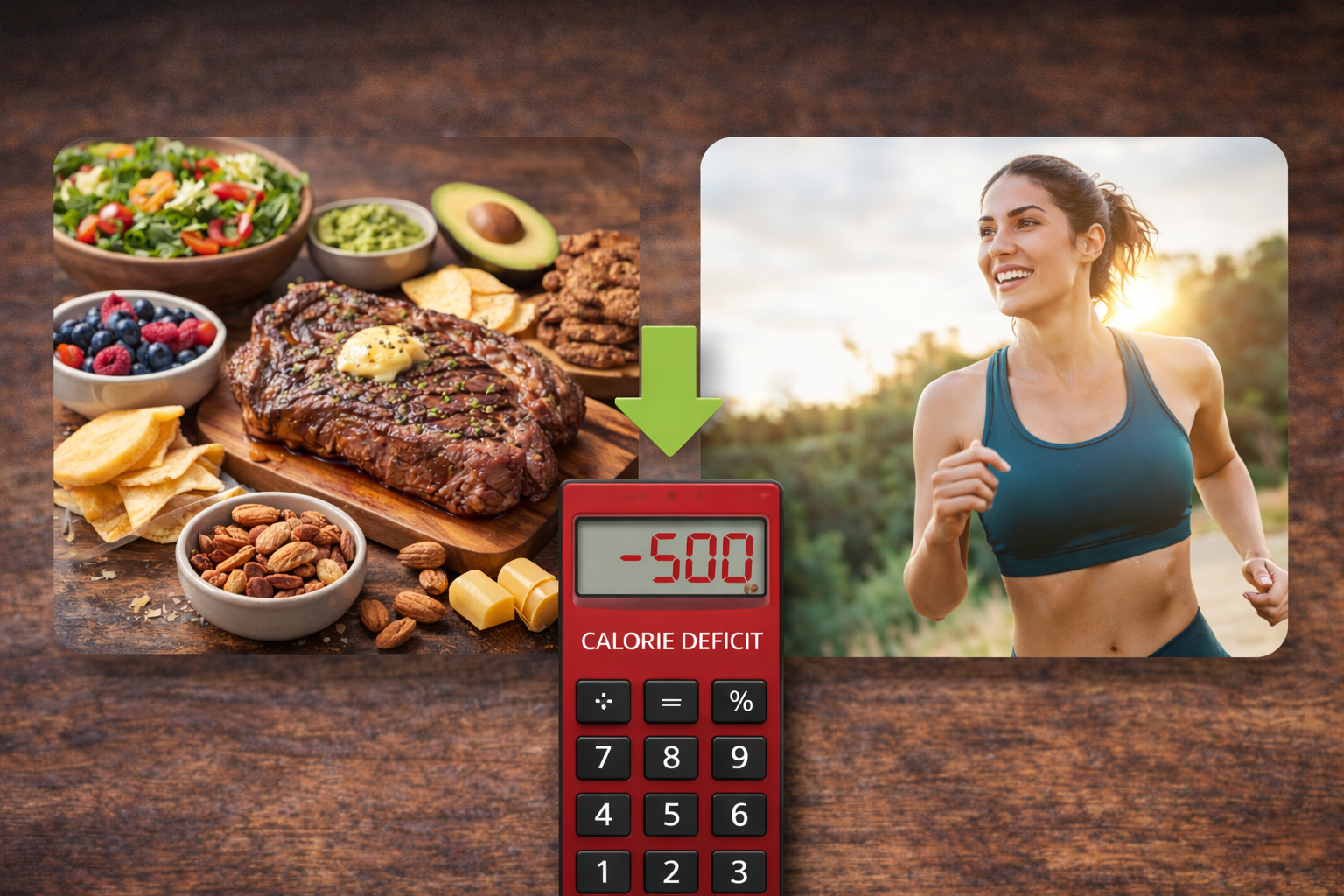
A deficit of 500-750 kcal per day below your Total Daily Energy Expenditure (TDEE) is the recommended safe range for GLP-1 users. Many people on Mounjaro and Wegovy inadvertently create much larger deficits (1,000+ kcal/day) because appetite suppression is so significant. Too large a deficit accelerates muscle loss, causes nutrient deficiencies, and can slow long-term weight loss by reducing metabolic rate.
One of the most common mistakes on GLP-1 medication is under-eating. The appetite suppression is so effective that many people eat 600-800 kcal per day without difficulty — and assume this is fine because they are losing weight fast. The problem: the body adapts to extreme restriction in ways that slow long-term results and cause muscle loss. This guide covers the numbers and the strategy. For the full picture on why weight loss sometimes stalls: Why Am I Not Losing Weight Even Though I’m Eating Less?.
What a Calorie Deficit Actually Is
A calorie deficit means consuming fewer calories than your body uses. Your Total Daily Energy Expenditure (TDEE) is the total calories you burn daily — including your Basal Metabolic Rate (BMR, the calories you burn just existing), activity, and the thermic effect of food.
When you eat less than your TDEE, your body must source the difference from stored energy — primarily fat, but also muscle if protein intake and resistance training do not signal the body to preserve lean mass.
| Term | Definition | Why It Matters for GLP-1 Users |
|---|---|---|
| BMR (Basal Metabolic Rate) | Calories burned at complete rest — the minimum energy to sustain life | Must not eat below BMR consistently — this causes metabolic adaptation |
| TDEE (Total Daily Energy Expenditure) | Total daily calorie burn including activity | Your target deficit should be calculated against TDEE, not BMR |
| Calorie deficit | TDEE minus calories consumed | 500-750 kcal/day deficit is the safe target range |
| Metabolic adaptation | The body reducing BMR in response to prolonged under-eating | Eating too little causes this; slows weight loss paradoxically |
Calculating Your TDEE — The Simple Method
Step 1: Calculate your BMR using the Mifflin-St Jeor equation (the most validated for people with obesity):
- For women: (10 × weight in kg) + (6.25 × height in cm) − (5 × age) − 161
- For men: (10 × weight in kg) + (6.25 × height in cm) − (5 × age) + 5
Step 2: Multiply by your activity multiplier: Sedentary (desk job, little exercise) = ×1.2 / Lightly active (light exercise 1-3 days/week) = ×1.375 / Moderately active (exercise 3-5 days/week) = ×1.55
Step 3: Subtract 500-750 kcal to create your deficit. This is your daily calorie target.
Alternatively, the NHS calorie calculator provides a simplified estimate. Use whichever method you find easier to start.
Why 500-750 kcal Deficit — Not More
The 500-750 kcal daily deficit is the range that produces sustainable fat loss (approximately 0.5-1kg/week) without triggering significant metabolic adaptation or muscle loss. Here is what happens outside this range:
| Deficit Size | Short-Term Result | Long-Term Consequence |
|---|---|---|
| Under 300 kcal/day | Very slow weight loss | Safe but may require more patience than GLP-1 users expect |
| 300-500 kcal/day | 0.3-0.5 kg/week fat loss | Conservative — appropriate if already lean or very active |
| 500-750 kcal/day (recommended) | 0.5-1 kg/week fat loss | Optimal — preserves muscle, maintains metabolic rate, sustainable |
| 750-1,000 kcal/day | 1-1.2 kg/week initially | Risk of muscle loss increases; fatigue likely; sustainable short-term only |
| Over 1,000 kcal/day (very common on GLP-1) | Fast initial loss, then plateau | Metabolic adaptation, significant muscle loss, nutrient deficiency likely |
Why GLP-1 Users Accidentally Under-Eat
Mounjaro and Wegovy are so effective at reducing appetite that many users eat 600-900 kcal daily without feeling restricted. This feels like success — and in the short term, weight loss is fast. The problems that emerge after 2-4 months:
- Muscle loss accelerates. Without adequate protein and calories, muscle tissue is broken down for energy. See muscle preservation on GLP-1.
- Energy levels crash. Chronic under-fuelling causes fatigue that makes exercise — already important for muscle preservation — feel impossible.
- Hair loss worsens. Hair loss on GLP-1 is partly driven by nutrient deficiency. Eating too little accelerates this significantly.
- The plateau arrives earlier. Metabolic adaptation in response to very low intake reduces BMR. When you eventually eat more, weight regain is faster.
The Minimum: What You Must Eat Every Day on GLP-1
- Minimum 800-1,000 kcal/day — eating below this regularly is medically inappropriate outside specialist supervision
- Minimum 1.2g protein per kg of body weight — see protein guide for targets
- Minimum 25g of fibre — critical for gut health and bowel regularity on GLP-1
- Electrolytes daily — Lily & Loaf Electrolytes or equivalent when eating below 1,200 kcal
RECOMMENDED SUPPLEMENTS
Lily & Loaf — Quality Supplements for GLP-1 Users
When eating at a deficit, quality nutrition matters even more. The Daily Essentials Bundle fills the gaps.
📚 RELATED READING
Some links in this post are affiliate links. If you purchase through them, I may earn a small commission at no extra cost to you. I only recommend products I use myself. Use code ALAN10 for 10% off Lily & Loaf. This post is for informational purposes only — always consult your GP for medical advice.
Practical Calorie Tracking Tools for GLP-1 Users
The most effective tools for tracking calorie intake on GLP-1 medication in the UK:
- Nutracheck Premium — the largest UK food database with the most accurate barcode scanning for UK-specific products. Most GLP-1 users find this the most practical option.
- MyFitnessPal — largest global database; free tier is adequate for calorie tracking; the Pro version adds micronutrient tracking which is useful on a restricted intake
- Cronometer — the best for micronutrient tracking; useful if you want to check protein, vitamin D, and B12 intake specifically
For the full tracking guide including measurements and progress photos: How to Track GLP-1 Weight Loss Progress UK.
Sources: NHS: calorie counting apps · BDA: portion sizes and calorie awareness
The most important message: on GLP-1 medication, the medication does most of the work of appetite reduction. Your job is to ensure that when you do eat, what you eat is nutritionally dense enough to support muscle preservation, gut health, and energy. A 1,000-1,200 kcal day built around protein, vegetables, and healthy fats is dramatically better than a 600-800 kcal day built around whatever you can tolerate. See How to Create a GLP-1 Meal Plan UK for the practical eating framework.
Discover more from Healthy Weight Loss GLP1
Subscribe to get the latest posts sent to your email.