
The right daily protein intake for weight loss in the UK is not the government’s 45–56g minimum RNI — that figure prevents deficiency, it doesn’t support weight loss, muscle preservation, or the elevated demands of GLP-1 treatment. The practical target for most adults trying to lose weight is 1.2–1.6g of protein per kilogram of body weight daily. For a 90kg person, that’s 108–144g — roughly double what most UK adults actually eat. This guide gives you the exact calculation for your weight and age, explains why GLP-1 users need even more, and shows you how to verify you’re hitting it.
Your protein target: calculate it now
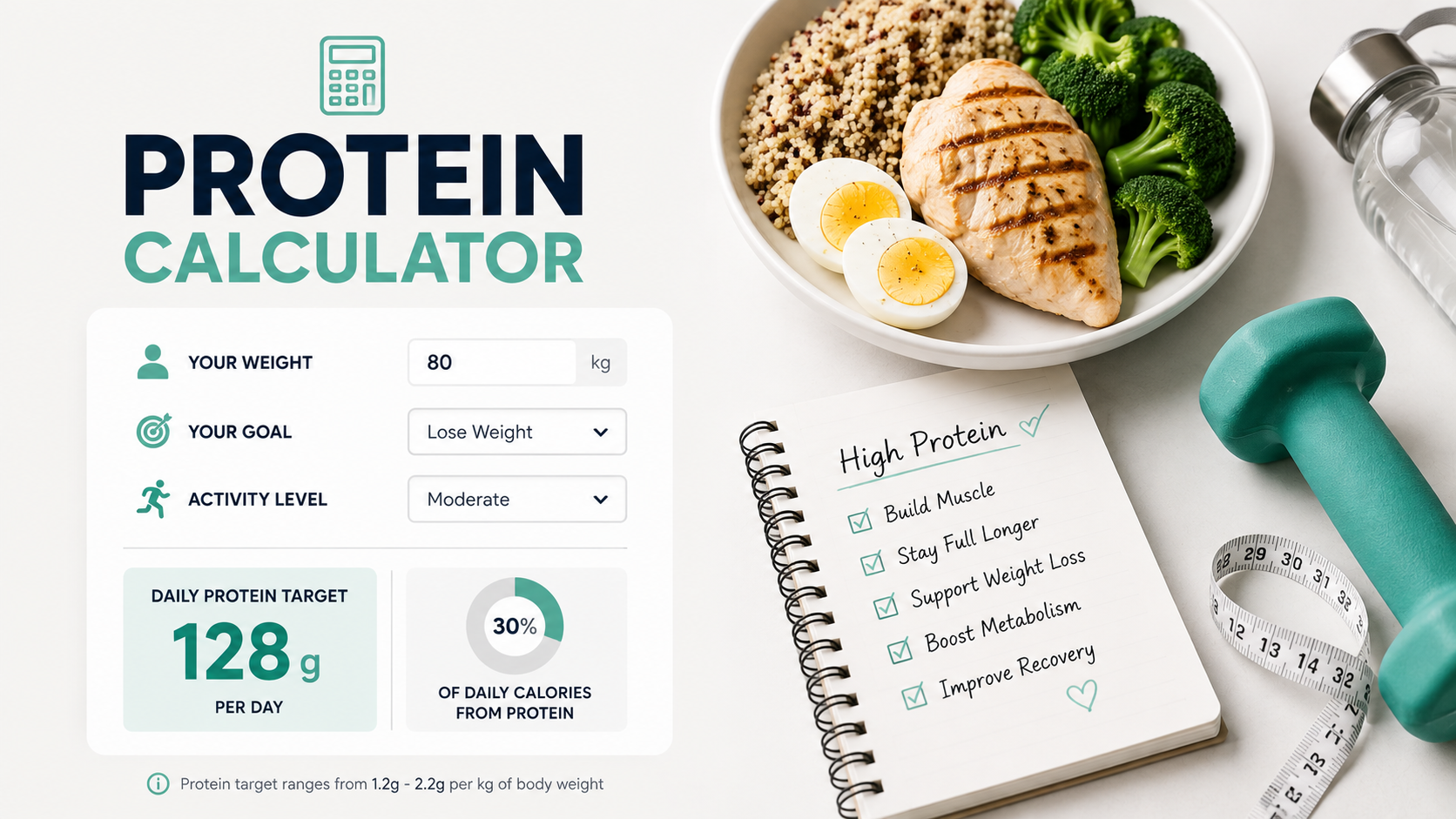
The formula is simple. Find your current body weight in the table below:
| Body weight | Minimum (1.2g/kg) | Optimal (1.4g/kg) | Maximum benefit (1.6g/kg) |
|---|---|---|---|
| 60kg | 72g/day | 84g/day | 96g/day |
| 70kg | 84g/day | 98g/day | 112g/day |
| 80kg | 96g/day | 112g/day | 128g/day |
| 90kg | 108g/day | 126g/day | 144g/day |
| 100kg | 120g/day | 140g/day | 160g/day |
| 110kg | 132g/day | 154g/day | 176g/day |
| 120kg | 144g/day | 168g/day | 192g/day |
| 130kg | 156g/day | 182g/day | 208g/day |
| 140kg+ | 168g/day | 196g/day | 224g/day |
Use your current body weight, not your goal weight. Update your target monthly as you lose weight.
For users over 65, add 10% to all figures — muscle protein synthesis efficiency decreases with age, requiring higher intake for the same muscle preservation effect.
Why GLP-1 users need more protein than average
The standard protein recommendation for weight loss (around 1.2g/kg) is based on sedentary adults with modest calorie restriction. GLP-1 users face a specific challenge:
- Rapid weight loss (1–2kg per week in early treatment) means lean tissue loss risk is elevated
- Reduced total food volume makes hitting protein targets harder than before medication
- Every gram of muscle preserved during treatment keeps resting metabolic rate higher, which matters enormously for long-term maintenance
Studies of semaglutide and tirzepatide users show that lean mass loss represents 15–25% of total weight lost without intervention, dropping to 5–10% with adequate protein plus resistance training. For a 30kg total loss, that’s the difference between losing 4.5–7.5kg of muscle versus 1.5–3kg of muscle. The difference shows up in body composition, strength, metabolic rate, and long-term weight maintenance.
How much protein is in common UK foods
| Food | Serving | Protein | Notes |
|---|---|---|---|
| Chicken breast (cooked) | 150g | ~44g | Best single-serving protein source |
| Salmon fillet | 150g | ~33g | Plus omega-3 |
| Greek yoghurt (full fat) | 200g | ~20g | Easy on GLP-1 appetite |
| Eggs | 3 large | ~19g | Complete amino acid profile |
| Cottage cheese | 200g | ~25g | High protein, low calorie |
| Beef mince (lean, 100g cooked) | 100g | ~26g | Plus zinc and B12 |
| Tinned tuna | 1 tin (130g) | ~31g | Convenient, no cooking |
| Whey protein powder | 1 scoop (30g) | ~22–25g | Useful when appetite is low |
| Edamame | 150g | ~17g | Good plant source |
| Black beans (cooked) | 150g | ~11g | Plus fibre |
A sample day hitting 140g protein
For a 100kg person targeting the optimal range:
| Meal | Food | Protein |
|---|---|---|
| Breakfast | 3 eggs + 200g Greek yoghurt + berries | ~38g |
| Mid-morning | 1 scoop whey protein shake | ~24g |
| Lunch | Tinned tuna + salad + 100g cottage cheese | ~45g |
| Dinner | 150g salmon + vegetables + small portion rice | ~35g |
| Total | ~142g |
This is achievable on a GLP-1-reduced appetite. The key is protein-first at every meal — eat the protein component before anything else. By the time satiety kicks in (faster than pre-medication), the protein target has been addressed even if total volume is low.
How to track your protein accurately
The gap between perceived protein intake and actual protein intake is consistently 30–50g daily for GLP-1 users. Most people who think they’re eating 100g are eating 65g.
Cronometer solves this because it uses a verified food database rather than user-submitted entries. The difference matters: MyFitnessPal has five different entries for “chicken breast” with protein ranging from 21–32g per 100g. Cronometer has one verified entry: 31g per 100g raw. When you’re targeting a specific number, accuracy matters.
Set up:
- Create free account at Cronometer
- Go to Profile → Targets → Macronutrients
- Set protein as a gram target (not percentage): enter your figure from the table above
- Log every meal for two weeks — this is the diagnostic phase
- Review weekly average protein, not daily (some variation is normal)
Age adjustments
| Age group | Adjustment to base target | Reason |
|---|---|---|
| 18–40 | None — use table as above | Standard muscle protein synthesis |
| 40–60 | +5–10% | Beginning of age-related muscle loss (sarcopenia) |
| 60–70 | +10–15% | Accelerating sarcopenia, reduced absorption efficiency |
| 70+ | +15–20% | Significant sarcopenia risk; higher threshold for muscle protein synthesis |
What happens when protein is too low
Consistently below your minimum target:
- Muscle loss accelerates — lean mass makes up a higher proportion of total weight lost
- Resting metabolic rate falls as muscle is lost, making future weight maintenance harder
- Hair loss on GLP-1 worsens — keratin is protein-dependent
- Satiety between meals is lower (protein is the most satiating macronutrient)
- Recovery from training is impaired
For hair-specific protein concerns alongside GLP-1 treatment: Mounjaro Hair Loss Prevention Plan UK.
The supplement bridge
When appetite reliably limits food-sourced protein below target, protein powder is the most evidence-backed supplement addition for GLP-1 users. 25g of whey adds to what food provides without significant volume or preparation.
Beyond protein, inadequate total food volume depletes micronutrients that interact with protein metabolism — zinc for tissue repair, magnesium for muscle function, B12 for cellular energy. The free Lily & Loaf lifestyle analysis identifies which micronutrient gaps are most relevant to your current symptoms and recommends specifically.
And for understanding the science behind why protein matters so much during GLP-1 treatment — the muscle physiology, the metabolic rate story, the amino acid mechanics — Audible has several excellent titles covering sports nutrition and muscle science that explain it in accessible audio form.
Frequently asked questions
Should I use my current weight or goal weight to calculate protein?
Current body weight. Your protein needs are based on the muscle mass you currently carry, not the muscle mass you’ll have when you reach goal weight. Recalculate monthly as you lose weight.
Is it possible to eat too much protein on Mounjaro?
At the levels recommended here (up to 1.6g/kg), no. The upper safe limit for protein is considerably higher than these targets. The main cost of higher protein is caloric — ensure your total intake remains adequate, not that protein specifically is a concern.
Does protein powder count toward the target?
Yes. Whey, casein, pea, and soy protein all count toward daily protein intake. For GLP-1 users specifically, whey protein powder is a useful tool for hitting targets on low-appetite days.
The walking-protein connection
One of the most underappreciated aspects of the protein-activity relationship: resistance training without adequate protein is significantly less effective at preserving muscle than resistance training with adequate protein. And adequate protein without resistance training still allows more muscle loss than the combination.
The practical implication: hitting your protein target and building your daily walking habit are not independent goals. They compound. A 90kg user hitting 126g protein daily and walking 8,000 steps preserves substantially more muscle than either intervention alone. Track both in Cronometer — the app’s exercise diary records your walking alongside your protein intake so you can see both on the same daily view.
For the walking component: a WalkingPad under a standing desk makes the 8,000 steps happen during working hours rather than requiring a dedicated walk. The combination of desk walking, accurate protein tracking, and two resistance sessions per week is the minimum viable training-nutrition package for GLP-1 muscle preservation.
The nutritional science behind why protein matters at the cellular level — the mechanistic target of rapamycin pathway, muscle protein synthesis, leucine as the key trigger amino acid — is covered accessibly in sports nutrition audiobooks. Start your free Audible trial and the science becomes clear in a way that makes the practical recommendation feel logical rather than arbitrary.
And beyond protein specifically, micronutrient adequacy determines whether the protein you’re eating is being used effectively. Zinc, magnesium, and B vitamins are all involved in protein metabolism. The free Lily & Loaf lifestyle analysis identifies which of these are most likely low based on your current symptoms.
Frequently asked questions
What happens if I consistently eat below my protein minimum on Mounjaro?
Muscle loss makes up a higher proportion of total weight lost — potentially 25–30% of total loss rather than 10–15% with adequate protein. This reduces resting metabolic rate, makes weight maintenance harder post-treatment, and produces visible muscle loss rather than the toned appearance most users are aiming for. The scale may move faster but body composition suffers significantly.
Can I get enough protein from plant-based sources on a GLP-1?
Yes, but it requires more planning. Plant proteins are generally less bioavailable and lower in leucine (the key muscle-protein-synthesis trigger) than animal proteins. Targets should be set 10–15% higher for predominantly plant-based eaters. Tofu, tempeh, edamame, hemp seeds, and lentils are the highest-quality plant protein sources.
Is protein powder safe on Mounjaro?
Yes. Whey, casein, pea, and soy protein powders are safe alongside GLP-1 medication. They’re a practical tool for hitting targets on low-appetite days. GI-sensitive users may prefer pea or rice protein over whey in early titration.
Does protein intake matter more at some doses of Mounjaro than others?
Protein adequacy is important at every dose but the risk is highest during rapid active loss (typically months 2–6 at therapeutic doses). This is when the deficit is largest and muscle catabolism risk is greatest. Maintaining protein through this phase is the most impactful thing you can do for long-term body composition.
Discover more from Healthy Weight Loss GLP1
Subscribe to get the latest posts sent to your email.