
BMI is a blunt instrument that misses a lot — it doesn’t account for muscle mass, age, or where fat is stored — but it remains the primary gating criterion for GLP-1 eligibility in the UK, both on the NHS and through most private providers. This guide gives you the UK BMI table, explains the thresholds that determine Mounjaro and Wegovy access, covers the ethnic group adjustments that change eligibility for many South Asian, Chinese, and Black adults, and explains what to do if your BMI sits just below the threshold.
BMI reference table: UK adults
| BMI range | Category | NHS classification |
|---|---|---|
| Below 18.5 | Underweight | — |
| 18.5–24.9 | Healthy weight | — |
| 25.0–29.9 | Overweight | — |
| 30.0–34.9 | Obesity class I | GLP-1 may be available privately |
| 35.0–39.9 | Obesity class II | GLP-1 eligible + comorbidity (private/NHS) |
| 40.0+ | Obesity class III | NHS GLP-1 Cohort 1 eligible |
How to calculate your BMI
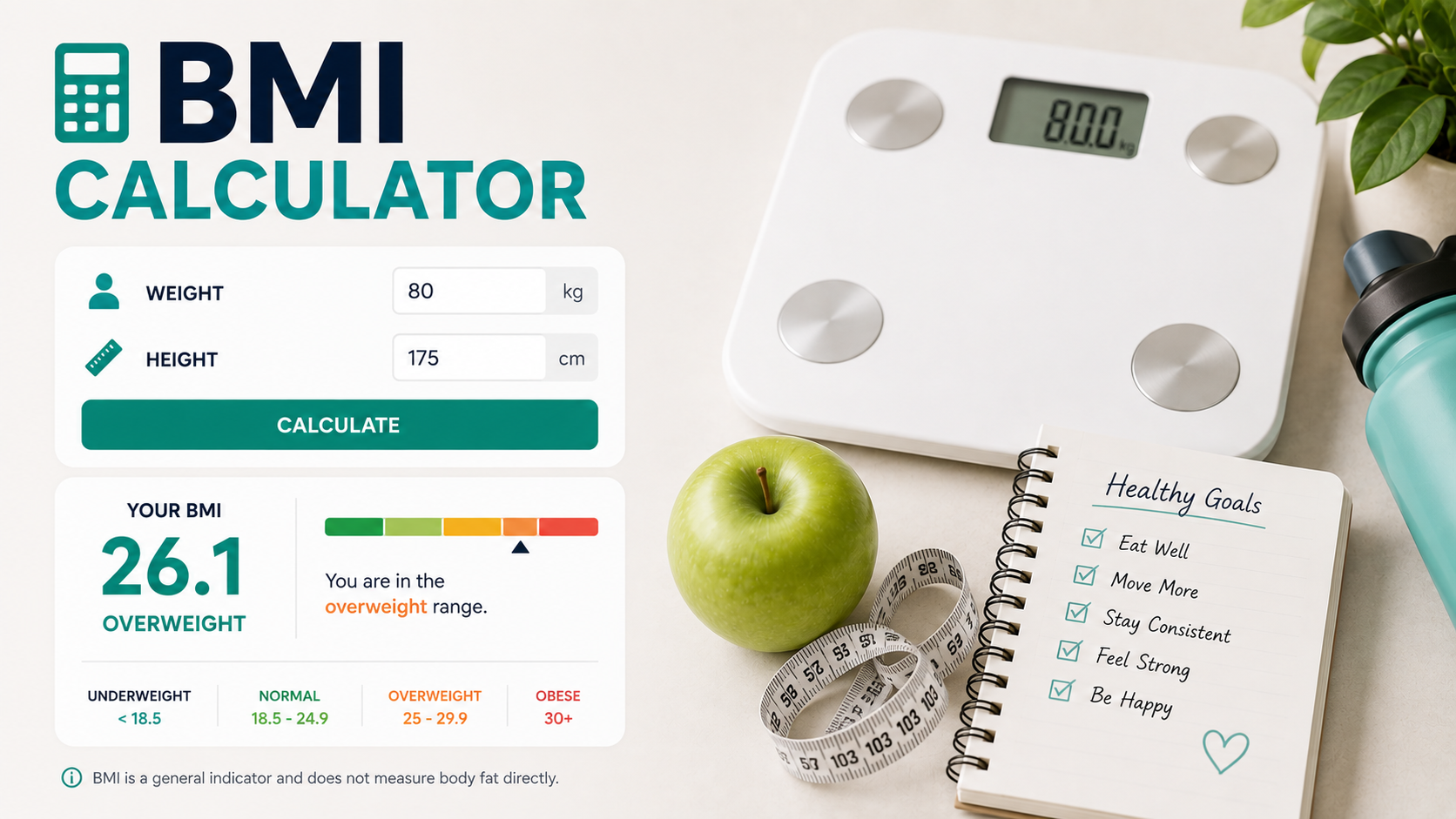
BMI = weight (kg) ÷ height (m) ÷ height (m)
Example: 95kg, 1.70m tall → 95 ÷ 1.70 ÷ 1.70 = 32.9 (Obesity class I)
Quick reference by height and weight:
| Height | BMI 30 (starts obesity) | BMI 35 | BMI 40 |
|---|---|---|---|
| 1.55m (5’1″) | 72kg | 84kg | 96kg |
| 1.60m (5’3″) | 77kg | 90kg | 102kg |
| 1.65m (5’5″) | 82kg | 95kg | 109kg |
| 1.70m (5’7″) | 87kg | 101kg | 116kg |
| 1.75m (5’9″) | 92kg | 107kg | 122kg |
| 1.80m (5’11”) | 97kg | 113kg | 130kg |
| 1.85m (6’1″) | 103kg | 120kg | 137kg |
| 1.90m (6’3″) | 108kg | 126kg | 144kg |
GLP-1 eligibility by BMI: the UK picture in 2026
NHS Mounjaro (tirzepatide)
NICE approved Mounjaro for NHS prescribing in December 2024. The staged rollout means eligibility is currently restricted:
- Cohort 1 (currently open): BMI 40+ with at least one significant weight-related comorbidity (type 2 diabetes, hypertension, cardiovascular disease, sleep apnea, joint disease)
- Cohort 2 (upcoming): BMI 37.5+ with comorbidities — rollout timeline TBC
- Future cohorts: BMI 35+ with comorbidities, eventually expanding further
Full NHS eligibility guide: Can I Get Mounjaro on the NHS UK.
Private Mounjaro prescribing
Private providers generally follow NICE criteria but with more flexibility:
- Most providers: BMI 30+ with at least one comorbidity, OR BMI 35+ without comorbidity
- Some providers: BMI 27+ with comorbidities
- Ethnic group adjustments apply (see below)
Full provider comparison: Mounjaro Cost UK.
NHS Wegovy (semaglutide)
Available through specialist weight management services since 2023. Criteria similar to Mounjaro cohort approach but slightly different NICE guidance (TA875). Generally BMI 35+ with comorbidities, or BMI 30+ with high cardiovascular risk.
Ethnic group adjustments: lower BMI thresholds
BMI thresholds used in standard tables are based on White European populations. For several ethnic groups, health risk occurs at lower BMI values — NICE and NHS guidance adjusts thresholds accordingly:
| Ethnic group | Standard BMI threshold | Adjusted threshold |
|---|---|---|
| South Asian (Indian, Pakistani, Bangladeshi, Sri Lankan) | 30 (obesity) | 27.5 (equivalent health risk) |
| Chinese | 30 (obesity) | 27.5 |
| Black African and Black Caribbean | 30 (obesity) | ~28 (varies by specific guidance) |
| Arab/Middle Eastern | 30 (obesity) | ~27.5 |
| White European | 30 (standard) | No adjustment |
If you are from one of these groups, your actual GLP-1 eligibility threshold is lower than the standard tables suggest. A South Asian adult with BMI 28 and hypertension may qualify for NHS Mounjaro under cohort criteria where a White European adult with the same BMI would not.
BMI’s limitations: what it misses
BMI is useful for population-level statistics and as a prescribing gating criterion. It is a poor measure of individual health or body composition:
| BMI limitation | Real-world example |
|---|---|
| Doesn’t distinguish muscle from fat | A muscular 85kg person at 1.75m has BMI 27.8 — “overweight” despite excellent health |
| Doesn’t measure fat distribution | Abdominal fat is significantly more dangerous than subcutaneous fat at the same total weight |
| Doesn’t account for age | Older adults with BMI 27 may have significant sarcopenic obesity (high fat, low muscle) |
| Doesn’t reflect metabolic health | Someone with BMI 28 may be insulin-resistant; someone with BMI 32 may be metabolically healthy |
Waist circumference is a more clinically meaningful measure of metabolic risk. UK targets: men below 94cm; women below 80cm. South Asian men below 90cm; South Asian women below 80cm.
What to do if you’re just below the threshold
If your BMI sits just below the private prescribing threshold (typically 30):
Check for comorbidities. Type 2 diabetes, prediabetes, hypertension, sleep apnea, and polycystic ovary syndrome all lower the BMI threshold required for private prescribing. A GP blood test (HbA1c, fasting glucose, blood pressure check) may identify a comorbidity that opens access.
Use ethnic group adjustment. If you’re from a group listed above, ask your GP or private prescriber about adjusted thresholds.
Consider the private prescribing variation. Some UK providers use BMI 27+ as their threshold with appropriate clinical context. Compare providers here.
Address the metabolic picture in parallel. Regardless of medication access, nutrition tracking in Cronometer and daily movement via a walking pad produce meaningful metabolic improvement at any BMI.
Tracking the number that matters more than BMI
During GLP-1 treatment, waist circumference and body composition change faster than BMI suggests. A body composition scale (see Best Body Composition Scale UK) tracks fat percentage and muscle mass separately — a far more clinically meaningful picture than BMI alone.
And while the numbers are useful context, the science behind why body fat distribution matters more than total weight is explained in detail in several audiobooks covering metabolic health. Start your free Audible trial and try The Obesity Code or The Glucose Revolution — both cover the BMI limitations discussion in accessible detail.
For a personalised picture of what your nutritional status looks like and which supplements would best support your metabolic health, take the free Lily & Loaf lifestyle analysis.
Frequently asked questions
What BMI do I need for Mounjaro in the UK?
For NHS prescribing (Cohort 1): BMI 40+ with comorbidities. For private prescribing: most providers require BMI 30+ with at least one comorbidity, or BMI 35+ without. Ethnic group adjustments apply — see table above.
Is BMI 30 enough to get Mounjaro?
For private prescribing with a qualifying comorbidity (type 2 diabetes, hypertension, sleep apnea, PCOS, cardiovascular disease), BMI 30 is sufficient at most UK private providers. Without a comorbidity, most providers require BMI 35+.
Does losing weight change my BMI threshold for treatment?
If you lose weight before starting treatment and drop below the threshold, you may need to demonstrate medical need through comorbidities or metabolic markers rather than BMI alone. Discuss timing with your GP or private prescriber before attempting to lose weight in advance of starting GLP-1 medication.
Beyond BMI: measurements that matter more during treatment
Once you’ve started GLP-1 treatment, BMI becomes a less useful tracking metric than body composition. For monitoring progress:
Waist circumference: measure around the navel, relaxed, weekly or monthly. This tracks visceral fat reduction — the metabolically active abdominal fat that GLP-1 medications reduce disproportionately. A waist reduction of 2–3cm often precedes any BMI change and reflects meaningful metabolic improvement.
Body fat percentage: a body composition scale gives a weekly snapshot of fat versus muscle. The goal during GLP-1 treatment is reducing fat percentage without reducing muscle mass. BMI cannot distinguish between these; a composition scale can.
Energy and symptom tracking: blood pressure, resting heart rate, sleep quality, and joint pain often improve before BMI moves significantly. These functional improvements are clinically meaningful and motivationally important.
Track all of these in Cronometer‘s diary section alongside your nutrition data — the correlation between nutritional adequacy and symptom improvement often becomes visible at 4–8 weeks of consistent logging.
For a personalised read on which supplements would best support your current symptoms and BMI context, the free Lily & Loaf lifestyle analysis takes five minutes and produces recommendations based on what you’re actually experiencing.
The science behind why BMI is a poor measure — and what metabolic health markers actually predict disease risk better — is covered in depth in The Obesity Code and The Glucose Revolution. Start your free Audible trial and either of these titles will change how you think about the numbers.
Frequently asked questions
Can I start Mounjaro with a BMI under 30?
Not on standard NHS or private prescribing routes. BMI under 30 requires either specific ethnic group adjustment (see table above) or a clinical situation that overrides standard criteria. Discuss with a GP if you believe your metabolic risk warrants treatment below standard thresholds.
How quickly does BMI change on Mounjaro?
Approximately 0.5–1 BMI point per month in active weight loss phase at typical doses. A person starting at BMI 42 who loses 20kg over 12 months reduces BMI by approximately 6.5 points to 35.5.
Does BMI affect Mounjaro effectiveness?
Higher starting BMI is associated with greater absolute weight loss but similar percentage loss. A person starting at BMI 45 and a person starting at BMI 35 both tend to lose approximately 15–22% of starting body weight on tirzepatide — the higher BMI person loses more total kilograms.
Does BMI affect Mounjaro side effects?
No consistent relationship between starting BMI and side effect severity has been established. Nausea, constipation, and fatigue in early treatment appear across the BMI spectrum. The main BMI-related clinical consideration is gallstone risk — higher starting BMI is a risk factor for gallstone formation during rapid weight loss. See GLP-1 Gallbladder Guide UK.
Discover more from Healthy Weight Loss GLP1
Subscribe to get the latest posts sent to your email.